Get More Management Leads: The Content Playbook Rivals Skip

Getting more management leads means building a system that puts your company in front of property owners at the exact moment they search for help, then converting that attention into signed management agreements. The fastest-growing short-term rental management companies in 2026 aren't winning with cold calls alone. They're winning because their content answers owner questions before a phone even rings, while a fast follow-up process closes what the content starts.
Table of Contents
- What Is the 5 Minute Rule for Leads?
- What Is the Fastest Way to Generate Management Leads?
- What Is the 10-3-1 Rule in Sales, and Does It Apply to Property Management?
- How Much Does It Cost to Get Management Leads?
- Why Do Generic Owner Pages Fail to Convert?
- What Does a Real Content Cluster for Owner Leads Look Like?
- How Do Referral Partnerships Fit Into a Lead Strategy?
- How Do You Prove Content Is Actually Generating Leads?
- What Mistakes Cost Management Companies the Most Leads?
- How Do You Build a 90-Day Lead Generation Plan?
- Frequently Asked Questions
Key Takeaways
- Responding to a new owner lead within five minutes makes a company roughly 8 times more likely to convert it, according to DoorLoop.
- Real estate Google Ads in 2026 averaged about $2.53 per click and $100.48 per lead, per DoorLoop, making paid search an expensive standalone channel for owner acquisition.
- Organic search leads convert at an average close rate of 14.6%, according to SharkPlatform, and cost roughly 84% less than paid search leads.
- A durable content channel (SEO) paired with one fast channel (referrals or paid ads) is the combination competitors consistently recommend, but almost none show how to build the content side at scale.
- Across inkSTR customer sites, we've published more than 4,000 articles as of September 2026, generating over 2.6 million Google Search impressions in the trailing 90 days.
- inkSTR's AI Content Writer and Keyword Research tools automate the owner-facing content pipeline that most management companies never get around to building.
If you run a short-term rental management company, you already know the referral network and the cold outreach spreadsheet. What you probably don't have is a content engine that captures owners who are actively typing "should I hire a property manager" or "vacation rental management fees" into Google right now. That gap is where most companies leave leads on the table, and it's the gap this guide closes.
We wrote this for management companies at every stage: the two-person operation still doing outreach by hand, and the 50-plus door portfolio trying to scale acquisition without scaling headcount. In 2026, owner-intent search volume keeps climbing as more accidental landlords and out-of-area investors search for management help online before they ever call an agent. The companies capturing that traffic aren't necessarily the biggest, they're the ones publishing consistently.
What follows draws on real search behavior data, published industry benchmarks, and our own experience helping management companies build content systems that turn into signed doors, not just page views.
What Is the 5 Minute Rule for Leads?
The 5 minute rule for leads states that contacting a new lead within five minutes of submission dramatically increases the odds of converting them, compared to waiting even 30 minutes. DoorLoop's research puts the multiplier at roughly 8 times more likely to convert when speed-to-lead stays under five minutes.
For property management specifically, this matters because owner leads are comparison shopping. An owner who just submitted a form on your site is likely filling out two or three competitor forms in the same session. Whoever calls first often wins the conversation, regardless of who has the better fee structure.
The problem is that most management companies generate leads inconsistently, so there's no dedicated system watching for that five-minute window. A lead comes in from a blog post at 9 p.m. on a Tuesday and sits in an inbox until Wednesday morning. By then, the owner has already scheduled a call with someone else.
This is exactly why the leads themselves need to come from content built around real owner search intent, not generic traffic. inkSTR's Content Calendar keeps publishing on a fixed schedule so your CRM notification setup and speed-to-lead process have something consistent to respond to, instead of sporadic form fills you're not prepared for.
What Is the Fastest Way to Generate Management Leads?
The fastest way to generate management leads is combining one immediate-response channel, such as paid search or pay-per-lead services, with one compounding channel, such as SEO content, run at the same time. DoorLoop recommends this exact pairing: a fast channel for leads today, a durable channel for leads next year.
Paid search delivers speed. Real estate Google Ads averaged about $2.53 per click and $100.48 per lead in 2026, per DoorLoop's data. That's a real number you can budget against this week. But paid leads stop the moment you stop paying.
Referral partnerships with agents, investors, and accountants also move quickly, especially when you formalize the arrangement. Leads for PMs recommends targeting 10 to 15 agents who regularly work with investors, and structuring referral fees around each acquired door, sometimes $500 to $1,000 per success.
The problem most companies hit isn't finding a fast channel, it's that they never build the slow channel alongside it. Content marketing takes months to compound, so it gets deprioritized every quarter in favor of whatever generates a lead this week. Two years later, competitors who started publishing consistently now dominate search for every owner-intent keyword in the space.

We built inkSTR specifically to remove the excuse of "we don't have time to write." The AI Content Writer generates SEO-optimized articles automatically, and Auto-Publishing pushes them live on schedule, so your durable channel runs in the background while your team handles the fast channel manually.
What Is the 10-3-1 Rule in Sales, and Does It Apply to Property Management?
There is no verified "10-3-1 rule" as an established, sourced sales framework for property management lead generation. Rather than force an invented ratio onto your acquisition math, it's more useful to look at what the research actually supports: a documented allocation of activity across channels.
ClearLead Digital's published guidance recommends roughly 1 to 2 hours weekly on outreach and referral conversations, 1 to 2 hours on content or social marketing, and about 30 minutes reviewing lead volume, cost per lead, and conversion rate. That's a real, sourced weekly structure you can actually implement.
Applied to property management, this means your week should include direct conversations with referral partners, consistent content or social output, and a short weekly review of what's actually converting. Skipping the review step is the most common mistake we see. Companies publish content or run ads for months without checking which keywords or channels are producing signed agreements.
The content half of that weekly allocation is where most management companies fall behind, because writing takes real time away from operations. inkSTR's Content Calendar and Keyword Research tool handle the planning and drafting automatically, so the 1 to 2 hours you'd spend writing gets redirected to referral calls and lead review instead.
How Much Does It Cost to Get Management Leads?
The cost to get management leads varies significantly by channel: paid search real estate leads averaged $100.48 per lead in 2026 according to DoorLoop, while organic search leads cost roughly 84% less than paid search leads, per SeoProfy data. Referral leads carry a different cost structure entirely, often a flat fee per acquired door rather than a per-lead charge.
Here's how the primary channels compare on cost and durability:
| Channel | Typical Cost Structure | Speed | Durability |
|---|---|---|---|
| Paid search (Google Ads) | About $2.53 CPC, $100.48 CPL (DoorLoop, 2026) | Immediate | Stops when spend stops |
| Organic search / content | Roughly 84% less per lead than paid search (SeoProfy) | Weeks to months to build | Compounds for years once ranking |
| Referral partnerships | Often $500 to $1,000 per acquired door (Leads for PMs) | Moderate, depends on partner activity | Requires ongoing relationship maintenance |
| Pay-per-lead services | Varies by provider and market | Immediate | Ongoing cost per lead, no compounding |
The math favors organic content once you look past month one. Paid channels never get cheaper. Organic content, once published, keeps generating impressions without an additional dollar spent per click. A ranking blog article can drive organic search traffic for years, which is the entire argument for treating content as an asset rather than an expense.
inkSTR is priced at $99 per month, a fraction of the $100.48 many companies already pay per single paid-search lead. That's the comparison worth sitting with before deciding content isn't worth the investment.
Why Do Generic Owner Pages Fail to Convert?
Generic owner pages fail to convert because they answer no specific question an owner actually searched. A single "Why Hire Us" page with a stock photo and a contact form doesn't rank for anything, and it doesn't address the objections a specific owner type actually has.
Most competitor content in this space, including guides from DoorLoop, ClearLead Digital, and Leads for PMs, recommends "owner-focused content" without specifying what that content should say for different owner situations. An accidental landlord who inherited a cabin has completely different objections than a portfolio investor evaluating five markets, or an owner currently unhappy with their existing manager.
We regularly see management companies publish one generic "our services" page and wonder why it never ranks or converts. Compare that to content built around distinct owner scenarios:
- Accidental landlords: content addressing "what does a property manager actually do" and "is self-managing worth the time"
- Portfolio investors: content comparing management fee structures across markets and property types
- Owners switching managers: content addressing common reasons owners leave a manager and what a transition looks like
- Out-of-area owners: content on remote management logistics, communication cadence, and local compliance handling
Building four distinct content tracks by hand is realistically a full-time job on top of running your portfolio. This is where inkSTR's Keyword Research tool earns its place, it surfaces the actual search terms different owner segments use, then the AI Content Writer builds content matched to each intent instead of one flat page trying to speak to everyone.
What Does a Real Content Cluster for Owner Leads Look Like?
A content cluster for owner leads is a group of articles built around one pillar topic (such as "property management costs") surrounded by supporting articles answering related owner questions, all linking back to a conversion page. This structure signals topical authority to Google and gives owners multiple entry points into your site depending on where they are in their research.
A working cluster might include a pillar page on management fee structures, supported by articles on "when to hire a property manager," local compliance requirements, and property-type-specific operational guides. Leads for PMs specifically recommends content around "property management cost," "when to hire property manager," and local-market topics, but stops short of showing how those pieces connect.
The connection is the part that actually drives leads. Each supporting article should link to the pillar page, and the pillar page should link to a conversion asset, whether that's a fee calculator, a consultation request, or a case study page. Without that internal linking structure, you have a pile of disconnected blog posts instead of a system.

This is precisely the architecture our content strategy wizard builds automatically. Instead of guessing which supporting articles to write around your pillar topic, inkSTR maps the cluster, schedules the publishing order through the Content Calendar, and handles the internal linking so each piece reinforces the others.
Ready to automate your content marketing?
inkSTR handles keyword research, content strategy, article writing, and publishing, all on autopilot.
How Do Referral Partnerships Fit Into a Lead Strategy?
Referral partnerships fit into a lead strategy as the relationship-driven complement to content, converting warm introductions from agents, investors, and accountants into signed management agreements. ClearLead Digital recommends contacting five agents or investors per week to build this pipeline consistently.
Leads for PMs suggests formalizing these relationships with referral fees of $500 to $1,000 per acquired door, which gives partners a concrete incentive rather than a vague promise of reciprocity. LeadSync goes further, recommending a reciprocal structure where a referring agent gets first access to an owner's future listing when they eventually sell.
The mistake many companies make is treating referrals as purely a networking activity, disconnected from content. In reality, the two reinforce each other. A referral partner who sends you an owner lead is far more confident doing so when your website has substantial, specific content proving you understand local compliance, fee structures, and owner concerns. Thin websites make referral partners hesitant to stake their reputation on a recommendation.
Content also gives referral partners something concrete to share. An agent forwarding your article on local short-term rental compliance to a client looks more credible than forwarding a generic "contact us" link. Building that content library is exactly what inkSTR automates through the AI Content Writer, so your referral partners always have something recent and specific to point owners toward.
How Do You Prove Content Is Actually Generating Leads?
Proving content generates leads requires tracing a path from article view to form submission to signed management agreement, then calculating cost per acquired door. Most published guides recommend publishing owner content but rarely explain how to measure whether it worked, which is one of the biggest gaps in this entire topic.
Start with GA4 conversion events for form submissions, phone clicks, and chat starts, tied to the specific article or landing page that drove them. From there, connect your CRM so each lead record carries its source article. Follow Up Boss, named in LeadSync's guidance as an example CRM, supports this kind of source tagging for real estate pipelines.
Once you can see which articles produced leads, track those leads through your sales pipeline to a signed agreement, then divide total content cost by doors acquired. This is the number that actually matters, not raw traffic or impressions.
For context on scale: across inkSTR customer sites, we've generated more than 2.6 million Google Search impressions and nearly 19,800 clicks in the trailing 90 days as of September 2026, with over 1,180 verified AI-search citations secured for customer content all-time. One of our management-company customers, a 50-plus property portfolio operator in the Charlotte and Lake Norman region, generated four property-owner leads directly from AI search within the first month of publishing owner-facing content on inkSTR, with Google impressions running 4.6 times higher than the year prior within three months. That's the kind of attribution chain worth building for your own site.
What Mistakes Cost Management Companies the Most Leads?
The costliest mistakes in management lead generation are slow follow-up, generic content that ignores owner segments, and abandoning content efforts before they compound. Each mistake compounds the others, since slow follow-up wastes leads that expensive content or referrals worked hard to generate.
- Waiting hours or days to respond to a new lead. Given the roughly 8x conversion difference DoorLoop documents for five-minute response times, this single fix often outperforms adding a new acquisition channel entirely.
- Publishing one generic services page instead of segmented content. Different owner types search differently and object differently; one page can't answer all of it.
- Quitting content marketing after two or three months. SEO content compounds over months, not weeks. Companies that stop publishing right before results appear hand that traffic to competitors who kept going.
- Not tracking cost per acquired door. Without this number, you can't tell if your $100+ paid leads are actually cheaper or more expensive than the content you dismissed as "not working."
- Ignoring referral partners as a distribution channel for content. A referral partner sharing your article multiplies its reach at zero additional cost.
We see the second and third mistakes most often among management companies scaling past their first ten doors. They start a blog, publish six posts, see no leads yet, and stop. inkSTR's Content Calendar exists specifically to prevent that drop-off, keeping publication cadence steady on autopilot through the months where compounding hasn't kicked in yet.
How Do You Build a 90-Day Lead Generation Plan?
A 90-day lead generation plan for property management sequences quick wins in the first month, channel launches in the second, and refinement in the third. ClearLead Digital's published framework structures it this way, and it's the clearest phased approach among the competitor guides we reviewed.
Month One: Repair the Foundation
Audit your online reputation, update your Google Business Profile with current service descriptions and photos, and add a clear owner-facing section to your website with specific calls to action. This is unglamorous work, but skipping it undermines every channel you launch afterward.
Month Two: Launch Your Channels
ClearLead Digital recommends launching one or two key channels here, alongside four blog posts monthly. This is also when a $500 to $1,000 monthly Google Ads budget targeting owner-intent keywords in your service area starts making sense, with call tracking in place from day one.
Month Three: Refine and Expand
Review what's converting using the weekly cadence described earlier, roughly 30 minutes reviewing volume, cost per lead, and conversion rate. Expand whichever channel is outperforming, and consider adding location or service pages plus a formal review-generation system.
Manually hitting "four blog posts monthly" for three straight months, on top of running a portfolio, is where most 90-day plans quietly die. That's the exact workload inkSTR's Auto-Publishing and Content Calendar remove, publishing directly to WordPress or Wix on the schedule you set at the start of month one.
Frequently Asked Questions
How to find property management leads?
Finding property management leads combines owner-intent content on topics like fees and hiring decisions, referral relationships with agents and investors, and paid channels like Google Ads for immediate volume. The most reliable long-term source is content that ranks for the specific questions owners search, since that traffic keeps arriving without ongoing ad spend.
How to get property management leads without a large marketing team?
Getting property management leads without a large team means automating the parts of lead generation that don't require your personal judgment, specifically content research, writing, and publishing. Tools like inkSTR's AI Content Writer let a solo operator or small team maintain a publishing cadence that would otherwise require a dedicated content hire.
What is the 5 minute rule for leads?
The 5 minute rule for leads is the practice of responding to a new lead within five minutes of submission, which DoorLoop reports makes a business roughly 8 times more likely to convert that lead compared to slower response times.
What is the fastest way to generate leads for a management company?
The fastest way combines an immediate channel like paid search or referral outreach with a durable channel like SEO content running simultaneously, so you get leads this week while building a channel that compounds over the next several years.
How much does it cost to get management leads?
Costs vary by channel. Paid search real estate leads averaged $100.48 per lead in 2026 per DoorLoop, organic search leads cost roughly 84% less per SeoProfy's data, and referral leads typically run $500 to $1,000 per acquired door according to Leads for PMs.
Is content marketing worth it for a small property management company?
Content marketing is worth it for small management companies specifically because organic leads carry a lower per-lead cost than paid channels and keep producing traffic for years after publishing, unlike ads that stop the moment spend stops. The tradeoff is that content takes months to build momentum, so it works best paired with a faster channel in the meantime.
How often should a management company publish new content?
ClearLead Digital's published framework recommends four blog posts monthly during the channel-launch phase of a 90-day plan, with a steady cadence maintained afterward rather than publishing in bursts. Consistent publishing on a fixed schedule, which inkSTR's Content Calendar automates, matters more than any single post's length.
Conclusion
Getting more management leads in 2026 isn't a single-channel problem. It's a five-minute response habit, a referral network you actually maintain, and a content system built around the real questions different owner types search, all running at the same time. The companies pulling ahead right now aren't necessarily spending more, they're just not letting any one of those three pieces lapse.
Content is the piece most management companies let slip, not because it doesn't work, but because writing and publishing consistently competes with the actual job of managing properties. That's the specific gap inkSTR was built to close for STR and property management operators who don't have a content team on staff.
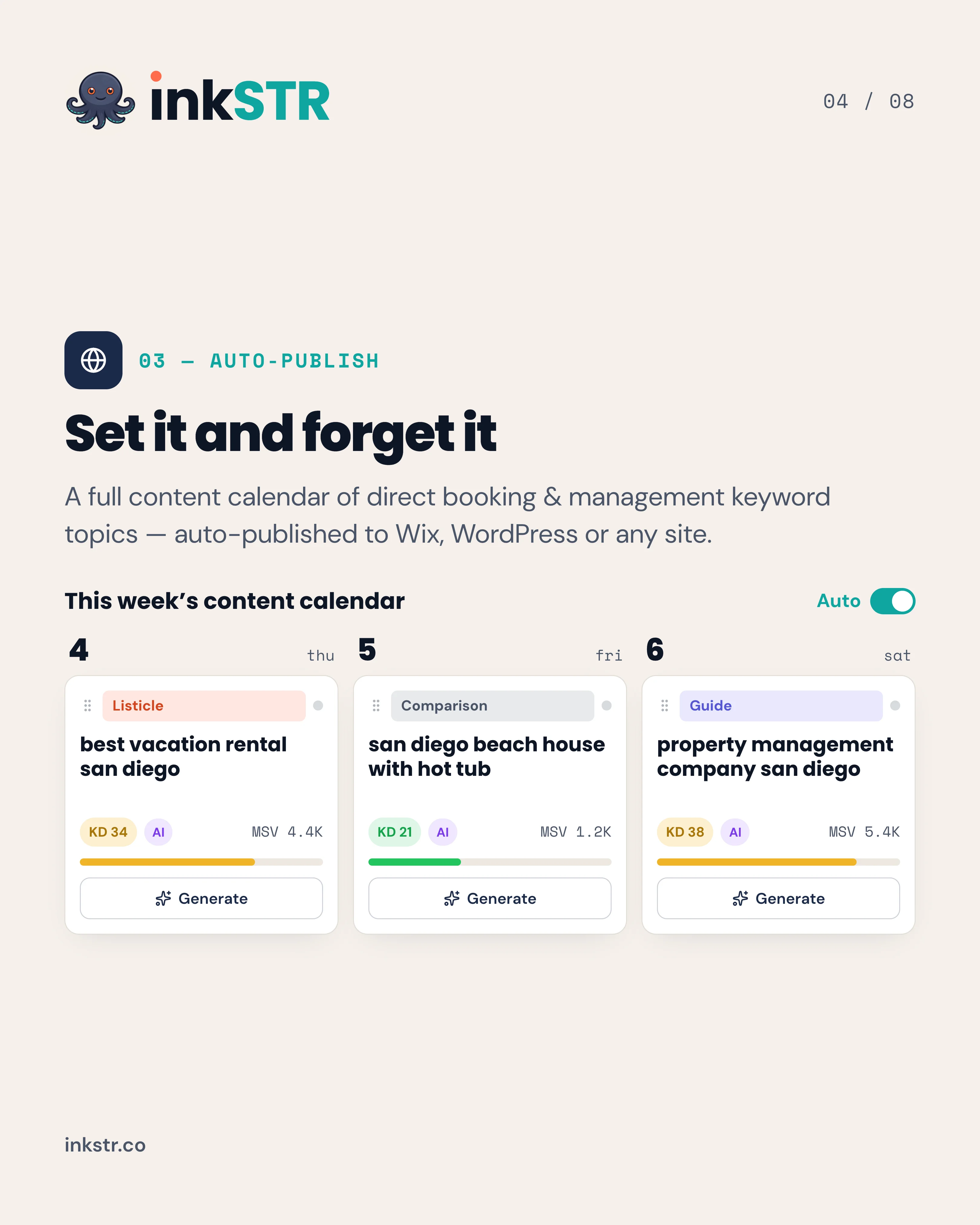
If keeping a publishing cadence going for the next 90 days feels unrealistic on top of running your portfolio, that's exactly what inkSTR automates from keyword research through scheduled publishing. Start a free trial with inkSTR and see your first owner-focused content plan today.
Content powered by inkSTR.co
Enjoyed this article? Share it:
Get more of inkSTR in Google Search
Add inkstr.co as a preferred source and our articles show up more in Top Stories, AI Overviews, and AI Mode — with a “Preferred” badge.
Get more guides like this
New SEO and AI-search guides, straight to your inbox. No spam, unsubscribe anytime.