Property Management Leads: The Complete 2026 Guide

Property management leads are prospective property owners, whether individual landlords, absentee owners, or vacation rental investors, who are actively looking to hire a management company to handle bookings, guest communication, and day-to-day operations. Most companies get them through a mix of referrals, search engine visibility, and direct outbound prospecting, with cost per acquisition ranging from free (organic referrals) to several hundred dollars per pay-per-lead contact.
Key Takeaways
- The 80/20 rule in property management typically means 80% of your new management contracts come from 20% of your lead sources, usually referrals and repeat owner relationships.
- Pay-per-lead services for property management leads can cost anywhere from under $20 to well over $100 per contact, depending on market and asset type, and conversion rates vary widely by follow-up speed.
- Organic search leads convert at an average 14.6% close rate, according to SharkPlatform data from 2026, making SEO one of the highest-converting channels available to property managers.
- A single direct booking a managed property secures is typically worth $1,000 to $4,000 in revenue, which is the downstream value your lead generation efforts protect once an owner signs.
- The 5 P's framework (People, Property, Process, Promotion, Profit) gives multi-property managers a structure for evaluating where their lead pipeline is actually weak.
- inkSTR automates the content and SEO side of lead generation, publishing keyword-targeted articles on a schedule so your website keeps attracting owner inquiries without you writing a single post.
If you manage vacation rental properties, you already know that finding new owners to sign is a completely different problem than filling calendars for the units you already manage. Property management leads, meaning owners who want someone else to run their short-term rental, don't show up the way guest bookings do. They come from a patchwork of referrals, cold outreach, paid ads, and content that ranks well enough to get found.
In 2026, the pressure on this pipeline has only increased. The global vacation rental market is projected to reach somewhere between roughly $101 billion and $109 billion this year depending on the research firm, according to figures from Grand View Research and Mordor Intelligence, and professional management companies already control an estimated 42% of the more than 7 million active short-term rental listings worldwide, per Data IntelO. That growth means more owners entering the market, but also more management companies competing for the same signatures.
At inkSTR, we work with property management companies every day who tell us the same thing: they know how to run a rental portfolio well, but they don't know how to consistently get new owners into their pipeline without relying entirely on word of mouth. This guide breaks down where property management leads actually come from, what they cost, the frameworks that help you prioritize your effort, and where content and SEO fit into a modern lead generation strategy.
How Do You Find Leads for Property Management?
Property management leads come from five main channels: referral and partnership networks, paid pay-per-lead services, outbound prospecting to absentee owners, organic search and content marketing, and community or investor networking. Most established companies run three or four of these simultaneously, tracking cost per acquisition separately for each.
Referral and Partnership Programs
Referral partnerships with real estate agents, closing attorneys, and other local professionals remain the single highest-converting source most companies report. A real estate agent who just sold an investment property to an out-of-state buyer is exactly the kind of contact who produces a warm, pre-qualified lead. The trade-off is that referral volume is inconsistent. You can't scale it on demand the way you can scale outbound calls or ad spend.
Outbound Prospecting to Absentee Owners
Cold calling, direct mail, and door-knocking absentee owners is a proven, if labor-intensive, channel. Tools that identify absentee owner records by parcel and tax data let you build target lists, but the manual follow-up cadence is where most companies fall apart. If you're not calling a lead within minutes of receiving contact information, your conversion rate drops fast, and few guides address exactly how many calls per week actually turn into a signed contract, which is one of the biggest blind spots in this channel.
Organic Search and Content Marketing
This is the channel most property management companies underinvest in, and it's also the one with the best long-term economics. Organic search leads have an average 14.6% close rate, according to SharkPlatform's 2026 data, higher than most paid channels once you strip out the ongoing ad spend. But it requires a website that actually ranks, and that means consistent, keyword-targeted content, something most portfolio managers simply don't have time to produce alongside their operational responsibilities.
That's exactly the gap inkSTR's AI Content Writer was built to close. Instead of you blocking out hours to draft blog posts about your management services, inkSTR generates SEO-optimized articles targeted at the exact searches owners run when they're shopping for a management company, then publishes them on a schedule through the Content Calendar.

What Does the 80/20 Rule Mean in Property Management?
The 80/20 rule in property management, borrowed from the broader Pareto principle, means roughly 80% of your new management contracts and revenue typically come from 20% of your lead sources or client relationships. In practice, that 20% is usually your referral network and your best-converting content pages, not your widest-reaching paid campaigns.
Applying this rule changes how you allocate time and budget. Instead of spreading yourself across ten different lead channels at a mediocre level, you identify the two or three that produce the highest close rates and double down. For most multi-property managers, that means: first, nurture the referral relationships already producing signed contracts. Second, invest in the organic search assets, like landing pages and blog content, that keep converting month after month without ongoing spend. Third, treat everything else as supplementary volume, not your core strategy.
The problem is that identifying which 20% is actually working requires tracking lead source all the way through to signed contract, and most companies never build that reporting. As a result, they keep spending on channels that feel productive but aren't. We see this constantly: a management company doubles down on a pay-per-lead subscription because it produces a high volume of contacts, without realizing their close rate on that channel is a fraction of what their organic search traffic delivers.
This is precisely where inkSTR's Keyword Research tool earns its keep. It identifies exactly which owner-intent searches, like "vacation rental property management near me" or "how to hire a vacation rental manager", are worth targeting, so the content you publish sits inside that high-converting 20% instead of adding noise to your marketing mix.
How Much Do Property Management Leads Cost?
Property management leads cost anywhere from effectively $0 for organic referrals to over $100 per contact through pay-per-lead services, with the exact price depending on your market, asset type, and lead exclusivity. Cost per acquisition, not the sticker price of the lead itself, is the number that actually matters for evaluating whether a channel is worth continuing.
| Lead Channel | Typical Cost Range | Conversion Characteristics |
|---|---|---|
| Referral partnerships | $0 to occasional finder's fee | Highest close rate, low volume, hard to scale on demand |
| Pay-per-lead services | Roughly $20 to $100+ per contact | High volume, lower average close rate, requires fast follow-up |
| Direct mail to absentee owners | Printing and postage costs per piece, plus list acquisition | Low response rate, but produces qualified, motivated contacts |
| Cold calling | Primarily labor cost (staff time) | Requires volume; response depends heavily on call cadence |
| Organic search and content | Content production and SEO investment (one-time or ongoing) | 14.6% average close rate for organic leads (SharkPlatform, 2026); compounds over time |
A freelance travel or hospitality writer typically charges $300 to $700 per quality blog post, and writing one manually takes 3 to 5 hours of research and drafting if you do it yourself. If you're publishing weekly to build the organic pipeline that produces that 14.6% close rate, the math adds up fast, either in freelancer invoices or your own unbilled hours.
inkSTR runs at a flat $99 per month through our Pricing plans, generating, scheduling, and publishing articles automatically on a set cadence. Compared to per-post freelance rates, that's a materially lower cost per piece of content once you're publishing more than a couple of articles a month, and it removes the labor cost entirely if you were planning to write it yourself. A single signed management contract, or even a single direct booking at $1,000 to $4,000 in revenue for one of your owners, justifies that investment many times over.
What Are the 5 P's of Property Management?
The 5 P's of property management, People, Property, Process, Promotion, and Profit, is a framework for evaluating whether your management operation is structured to both retain existing owners and attract new ones. Applied to lead generation specifically, "Promotion" is the pillar most companies neglect, and it's the one most directly tied to your ability to generate new property management leads.
People
Your staff, contractors, and the relationships you maintain with real estate agents and local professionals. Referral-driven leads live here, and they depend entirely on the strength of these relationships being actively maintained, not left dormant after the initial introduction.
Property
The specific asset types and markets you manage, whether that's mountain cabins, beach condos, or urban apartments. Owners searching for a manager typically look for someone with proven expertise in their exact property type, which is why generic marketing rarely converts as well as content specific to a niche.
Process
Your intake, qualification, and follow-up workflow once a lead comes in. This is where most companies leak conversions. Without a defined process, a lead generated through a pay-per-lead service gets a different (and usually slower) response than one that came through referral, and response speed is one of the biggest predictors of whether a lead converts.
Promotion
Your visibility, on Google, on AI search tools, and across your own website. This is the pillar content marketing and SEO live inside. Without consistent promotion, even a great referral network eventually plateaus because you're not adding new inbound demand.
Profit
The lifetime value of a signed management contract relative to what it cost you to acquire. Almost no lead-generation guide connects cost per lead directly to contract value or lifetime value by source, but it's the calculation that tells you which channels to keep funding.
We built inkSTR around the Promotion pillar specifically, because it's the one most portfolio managers have neither the time nor in-house expertise to execute consistently. Our How inkSTR Works page walks through the full pipeline, from keyword research to a published article, that keeps this pillar running without adding to your workload.
How Do You Build a Lead Follow-Up Cadence by Source?
A lead follow-up cadence by source means running a different contact schedule depending on where a lead originated, because a pay-per-lead contact, a referral introduction, and an organic website inquiry all have different expectations for how quickly and how often you should reach out. Treating every lead with the same generic follow-up sequence is one of the most common reasons qualified leads go cold.
For pay-per-lead contacts, speed is everything. These owners often submitted the same request to multiple companies simultaneously, so a same-day, ideally within-the-hour, phone call dramatically outperforms a next-day email. For referral leads, the cadence can be slower and more personal, since the referring contact has already done some of the trust-building work for you. For organic website leads, meaning someone who read your content and filled out a contact form, a prompt but conversational follow-up that references what they read tends to convert better than a generic sales pitch.
Few resources actually lay out this distinction by channel, which is a gap worth closing internally even if you never publish it. As a starting framework: pay-per-lead contacts get a call within one hour and a follow-up within 24 hours if unanswered; referral leads get a call within one business day; organic leads get a response within a few hours referencing the specific page or article that brought them in.
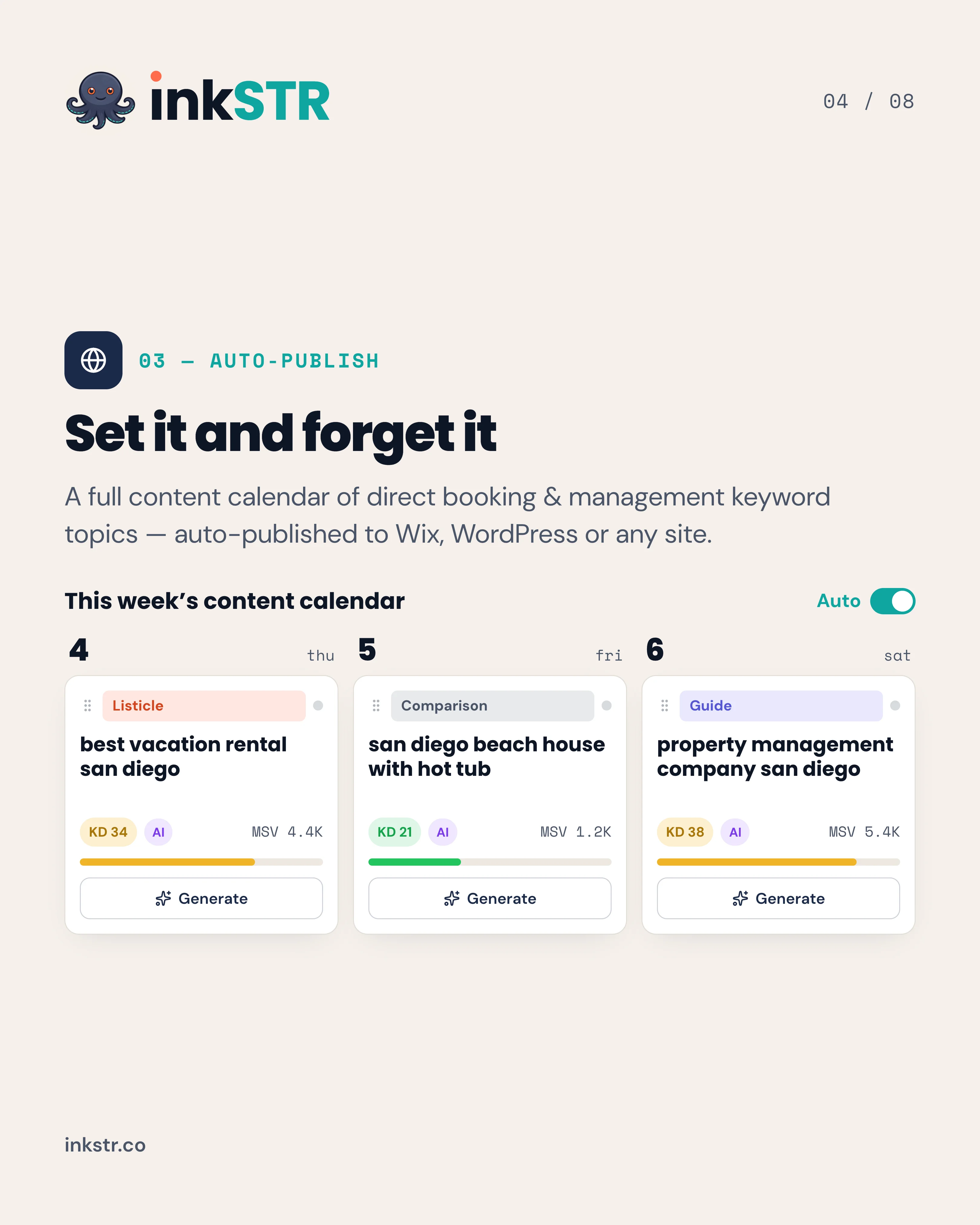
That last point matters more than it sounds. If your blog content is actually converting visitors into leads, your sales team needs visibility into which article a lead came from so the follow-up feels personal rather than generic. inkSTR's Auto-Publishing feature keeps that content flowing to your site on schedule, so this part of your funnel never runs dry while you're focused on the calls that actually close deals.
How Do You Qualify a Property Management Lead?
Qualifying a property management lead means confirming the contact is a decision-maker who owns or controls the property, matches your target asset type and location, and has a realistic timeline for signing a management agreement. Most guides stop at "location and asset type," but a standardized qualification checklist needs more structure than that to be useful across a growing team.
A workable qualification framework asks four questions before a lead moves to your sales pipeline. First, is this person the owner or an authorized decision-maker, not a tenant or unrelated inquiry? Second, does the property match your service area and asset type, whether that's a beach town condo, a mountain retreat cabin, or an urban apartment? Third, what is their timeline, meaning are they looking to list within 30 days, or just gathering information for a decision six months out? Fourth, do their expectations on management fees and service scope roughly align with what you actually offer?
Disqualifying leads quickly matters just as much as qualifying good ones. An unqualified lead that lingers in your pipeline wastes follow-up time you could spend on someone ready to sign. Building this discipline into your process is part of the "Process" pillar from the 5 P's framework above, and it's worth documenting even if it's just a shared spreadsheet or simple CRM tagging system to start.
How Does Content Marketing Fit Into a Property Management Lead Funnel?
Content marketing fits into a property management lead funnel as the top-of-funnel channel that captures owners actively researching whether to hire a manager, before they've decided who to call. Unlike outbound channels where you're interrupting someone's day, content marketing meets an owner at the exact moment they're typing "should I hire a property manager for my vacation rental" into Google.
The funnel typically works like this: an owner searches a question, lands on a blog article that answers it thoroughly, then follows an internal link to a service page or contact form. This is why internal linking structure matters as much as the content itself, an article with no clear path to a conversion point is a dead end, no matter how well it ranks.
Almost no lead-generation guide connects this content funnel to actual contract value, but the math is straightforward. A single ranking blog article can drive organic search traffic for 2 to 5 years with minimal maintenance, producing a steady trickle of qualified inquiries long after the original writing investment. Compare that to a pay-per-lead subscription, where the moment you stop paying, the leads stop arriving entirely.
We designed inkSTR's internal link management specifically to route readers from educational blog content toward your booking or contact page automatically, so a self-reinforcing funnel builds itself as your content library grows. If you want a deeper look at why generic content underperforms here, our piece on why generic travel content kills conversions covers the specificity problem in more detail, and our guide to ranking on Google for STR-specific factors explains the technical side of what makes this content actually surface in search.

Ready to automate your content marketing?
inkSTR handles keyword research, content strategy, article writing, and publishing, all on autopilot.
What Metrics Should You Track to Improve Your Lead Pipeline?
The metrics that matter most for a property management lead pipeline are cost per lead, cost per acquisition (meaning cost per signed contract, not just per contact), close rate by source, and average contract value by channel. Tracking raw lead volume alone tells you almost nothing about whether a channel is actually profitable.
- Cost per lead: Total spend on a channel divided by number of contacts generated. Useful for comparing channels, but misleading on its own.
- Close rate by source: The percentage of leads from each channel that actually sign a management agreement. This is where organic search's 14.6% average close rate (SharkPlatform, 2026) becomes a meaningful benchmark to compare your own channels against.
- Cost per acquisition: Total spend divided by signed contracts, not contacts. This is the number that should drive budget decisions.
- Average contract value by source: Some channels attract higher-value properties than others. A referral from a luxury real estate agent may produce a materially higher-value contract than a generic pay-per-lead contact.
- Time to close: How long from first contact to signed agreement, broken out by channel, so you can forecast pipeline realistically.
Most companies never connect these metrics back to lifetime value, which is one of the clearest content gaps in this space. If you can show that organic search leads, though slower to convert individually, produce a lower cost per acquisition and higher lifetime value over a multi-year horizon, that reframes your entire marketing budget conversation.
Practical Guidance: Building Your Property Management Lead Strategy
Start with two or three channels, not ten. Trying to run referral partnerships, pay-per-lead subscriptions, cold calling, direct mail, and content marketing simultaneously from day one spreads your attention too thin to measure any of them properly. Most experienced operators recommend starting with your strongest referral relationships and one scalable channel, usually organic content, then adding outbound prospecting once you have bandwidth.
- Audit your current lead sources. Where did your last ten signed contracts actually come from? Most companies are surprised by the answer.
- Pick your core two or three channels. Apply the 80/20 rule: double down on what's already converting rather than diversifying for its own sake.
- Build a qualification checklist. Decision-maker status, asset type match, timeline, and fee expectations, documented so every team member applies the same standard.
- Set a follow-up cadence by source. Fast response for pay-per-lead, personal cadence for referrals, content-aware follow-up for organic inquiries.
- Invest in your organic pipeline early. A ranking article compounds for years; a paid lead disappears the moment you stop paying for it.
- Track cost per acquisition monthly, not just cost per lead. This is the metric that actually tells you where to invest next quarter.
Common mistakes to avoid: treating all leads with an identical follow-up script regardless of source, chasing lead volume instead of close rate, and neglecting content marketing because it feels slower than paid channels, when in fact it's often the highest-converting and lowest-cost option once it's established. If you're managing multiple properties or markets, our guide on must-have tools for short-term rental managers scaling up covers the broader operational stack worth pairing with your lead strategy.
Data and Evidence: The Real Cost of Manual Lead Generation Content
Building the organic search channel that produces a 14.6% average close rate requires consistent content, and that consistency is exactly where most management companies stall out. Writing one quality blog post manually takes 3 to 5 hours of research and drafting. Hiring it out costs $300 to $700 per post through a freelance writer. Multiply that across a monthly publishing schedule and the annual cost, in either time or invoices, adds up quickly.
| Approach | Time Cost | Dollar Cost | Consistency Risk |
|---|---|---|---|
| Writing it yourself | 3 to 5 hours per post | $0 direct cost, high opportunity cost | High: first thing dropped when busy |
| Freelance writer | Minimal your time, editing only | $300 to $700 per post | Medium: depends on freelancer reliability |
| inkSTR automated pipeline | Minutes for setup and review | $99 per month flat | Low: scheduled and published automatically |
This is the exact comparison we built inkSTR to win. Instead of choosing between your own unpaid hours or a recurring freelance invoice, inkSTR's AI Content Writer generates the article, our Content Calendar schedules it, and Auto-Publishing puts it live on your Wix or WordPress site without you touching a single step. If you're currently relying on referrals alone, this is the fastest way to add a second high-converting channel without hiring a marketing person.
Deep Dive: Why Multi-Property Managers Need a Different Lead Strategy Than Single-Property Owners
A property management company juggling 15, 30, or 100 units faces a fundamentally different lead generation problem than a single owner marketing one cabin. Volume alone doesn't solve it. Every additional unit adds operational complexity, but new owner acquisition still runs through the same handful of channels, referrals, search visibility, and outbound prospecting, just at a scale where manual content production becomes completely unworkable.
Consider a company managing properties across three distinct markets: a beach town, a mountain retreat area, and an urban apartment cluster. Each market has different owner search intent, different local competition, and different seasonal patterns in when owners decide to switch management companies. Writing content that speaks specifically to each market, rather than one generic "our services" page, is what separates companies that rank locally from ones that don't show up at all for market-specific searches.
This is precisely the challenge inkSTR's multi-project support was built to solve. Each property, brand, or market gets its own independent content pipeline, so a company running fifteen properties across three regions can run parallel content calendars without duplicating effort or diluting keyword targeting for any single market. Instead of one generic company blog trying to serve every market at once, you get content that's actually specific enough to rank for "vacation rental property management" searches in each individual location.
We've also seen companies use this same infrastructure defensively. If your competitors dominate search results for "[your city] vacation rental management," which is a common complaint we hear from newer entrants, a targeted content strategy focused on the specific gaps their content misses is often the fastest way to compete, without matching their ad spend dollar for dollar. Our guide to ranking your vacation rental website on Google goes deeper into the technical mechanics behind this.
Frequently Asked Questions
What is the fastest way to get more property management leads?
The fastest short-term results usually come from activating your existing referral network, real estate agents, closing attorneys, and current clients you already manage for. For sustainable long-term growth, organic search content is the channel worth building in parallel, since it compounds instead of requiring ongoing spend to keep producing leads.
How many blog articles do I need before I start seeing property management leads from search?
Most companies need a consistent publishing cadence over several months before organic content produces a meaningful lead flow, since search engines reward consistency and topical depth over a single post. A steady schedule of keyword-targeted articles, which is what inkSTR's Content Calendar maintains automatically, tends to outperform sporadic bursts of content.
Is paying for pay-per-lead services worth it for property management companies?
Pay-per-lead services can work well if you have a fast follow-up process, since these leads often go to multiple companies simultaneously and reward whoever responds first. However, cost per acquisition on these services can run higher than organic search, where the average close rate reaches 14.6% according to SharkPlatform's 2026 data, so it's worth tracking both channels side by side rather than committing to one exclusively.
What's the difference between a qualified and unqualified property management lead?
A qualified lead is a decision-maker who owns or controls a property matching your service area and asset type, with a realistic timeline to sign a management agreement. An unqualified lead might be a tenant, someone outside your service area, or a contact with no real intention of switching management companies in the near future.
Can I use content marketing to compete with larger property management companies?
Yes, and it's often the most cost-effective way for smaller or newer companies to compete, since content specific to a niche market or property type frequently outranks generic, broad-market content from larger competitors. Publishing consistently around the exact questions local owners are searching is the differentiator, not overall marketing budget.
How does inkSTR help with property management lead generation specifically?
inkSTR automates the content and SEO side of your lead pipeline by generating keyword-targeted blog articles, scheduling them through an automated content calendar, and publishing them directly to your website, all for a flat $99 per month. It doesn't replace referral relationships or outbound prospecting, but it keeps the organic search channel running consistently without requiring you to write, research, or manually publish anything yourself.
Do I need existing SEO knowledge to start generating property management leads through content?
No. inkSTR's Keyword Research tool identifies the exact searches owners run when looking for a management company, removing the guesswork typically required to know what to write about. You don't need prior SEO expertise to benefit from a content pipeline built specifically around owner search intent.
Quick-Reference Summary
- Audit where your last ten signed contracts actually originated.
- Apply the 80/20 rule and focus budget on your two or three highest-converting channels.
- Build a standardized lead qualification checklist covering decision-maker status, asset type, location, and timeline.
- Set a different follow-up cadence for pay-per-lead, referral, and organic leads.
- Invest in organic search content, which averages a 14.6% close rate and compounds for years.
- Track cost per acquisition and lifetime value by channel, not just cost per lead.
Conclusion
Property management leads come from a mix of channels, but the 80/20 rule holds true across most portfolios: a small number of sources, usually referrals and organic search, produce the majority of your signed contracts. Pay-per-lead services and outbound prospecting still have a place, but they require fast follow-up and clear tracking to justify their cost. As of 2026, with the vacation rental market continuing to expand and management companies now controlling a growing share of global listings, the operators who invest in consistent, search-optimized content are building a channel that keeps producing leads long after a single campaign ends.
Getting found by owners searching for a management company isn't about publishing more content for its own sake, it's about publishing the right content, consistently, structured the way both readers and search engines expect. inkSTR handles that process end to end, from keyword research to scheduled publishing, so your organic pipeline keeps building whether or not you have time to sit down and write.
If building this kind of content pipeline manually feels like a full-time job stacked on top of running your portfolio, Get started with inkSTR and see your first scheduled article draft this week.
Content powered by inkSTR.co
Enjoyed this article? Share it:
Get more of inkSTR in Google Search
Add inkstr.co as a preferred source and our articles show up more in Top Stories, AI Overviews, and AI Mode — with a “Preferred” badge.
Get more guides like this
New SEO and AI-search guides, straight to your inbox. No spam, unsubscribe anytime.