How to Rank Your Vacation Rental Website on Google

To rank your vacation rental website on Google, you need three things working together: a technically sound site that Google can crawl and index, keyword-targeted content that matches what travelers actually search, and enough authority signals (reviews, backlinks, consistent publishing) to earn a spot above the competition. Most operators have one of these. Few have all three.
- Google organic search drives 38% of vacation rental website traffic, according to CUFinder's 2026 data, making it the single largest traffic channel for direct booking sites.
- 42% of U.S. leisure travelers say Google Search influenced their last travel provider decision, per ShortTermRentalz, meaning ranking on Google is not optional if you want direct bookings.
- Technical SEO (site speed, mobile optimization, HTTPS, schema markup) is the foundation. Without it, content and backlinks cannot do their job.
- Keyword-targeted blog content is the primary lever for long-term ranking. A single well-optimized article can drive organic search traffic for 2 to 5 years.
- Google's own vacation rental listing system (accessed via Google Travel) gives your property additional search visibility beyond your website alone.
- inkSTR automates the keyword research, article writing, and publishing schedule that make consistent content ranking possible without manual effort from the operator.
Why Is Your Vacation Rental Website Not Showing Up on Google?
A vacation rental website fails to rank on Google for one of three reasons: Google cannot properly crawl and index the site, the site lacks content that matches what travelers are searching for, or the site has not earned enough authority to outrank established OTA platforms and competitors. In 2026, all three of these problems are solvable, but you have to address them in the right order.
Here is the painful reality most operators face. You built a beautiful direct booking site, wrote a property description, added a gallery, and then waited for Google to send you guests. Nothing happened. Meanwhile, your Airbnb listing ranks fine, Airbnb keeps 17 to 19 percent of every booking, and your own website collects dust.
The reason the Airbnb listing ranks and your website does not comes down to one thing: content volume and authority. Airbnb publishes millions of pages of keyword-rich content. Your site has five pages and a blog with two posts from 2023.
The fix is not complicated, but it requires consistent execution. Your site needs technical health, targeted keywords on every page, and a regular publishing cadence that tells Google your site is active, relevant, and authoritative. That is where most operators get stuck, because writing three to four blog posts per month while managing properties is simply not realistic.
At inkSTR, we built the platform specifically because operators kept telling us the same thing: "I know I need to blog, I just have no time to do it." The answer to ranking on Google is not a secret. It is execution, and execution requires a system.
How Do I List My Short-Term Rental on Google?
Listing your short-term rental on Google refers to getting your property visible in Google Search and Google Maps through Google's vacation rental integration, which pulls property data from booking platforms and direct booking websites. As of 2026, the most reliable way to appear in Google's vacation rental results is to list on a platform that feeds Google's Hotel Center, or to connect your direct booking website directly through a channel manager that has a Google integration.
Most operators do not realize that Google surfaces vacation rental listings in search results the same way it surfaces hotel rooms: through a structured data feed. Platforms like VRBO and Airbnb already have Google integrations, which is one reason their listings dominate organic search results.
If you want your direct booking website to appear in those same Google vacation rental carousels, you have two options. First, use a property management system or channel manager that has a direct Google Hotel Center integration and submit your property data through that feed. Second, implement VacationRental schema markup on your website so Google can understand your property details from the page itself.
Here is what the manual version of this looks like: you research Google Hotel Center requirements, connect to a certified integration partner, map your property attributes to Google's data schema, and then monitor the feed for errors. That process easily takes a full day, and it breaks every time you update your listing.
The more sustainable strategy is pairing a Google listing with a content-rich direct booking site that ranks organically for destination keywords. The Google listing gets you into the booking carousel. The blog content gets you into organic results for "best cabin rental in the Smoky Mountains" or "beachfront house rental Gulf Shores with pool." Both matter. Together, they make your site visible across multiple search surfaces.
Is Google Vacation Rentals Worth It?
Google Vacation Rentals is worth pursuing for most operators because it places your property inside Google's search results directly, without requiring travelers to visit a separate OTA. The listing appears in the vacation rental carousel on Google Search, giving your property exposure to travelers who are actively comparing options. The catch is that Google's vacation rental feature primarily shows properties from platforms that have active Google integrations, not every independent website automatically.
For operators running a direct booking site, the ROI calculation is straightforward. A single direct booking is typically worth $1,000 to $4,000 in revenue, and you keep 100 percent of it rather than surrendering 17 to 19 percent to OTA platform fees. If a Google listing contributes even two or three direct bookings per year, it pays for itself many times over.
But here is the part most articles skip: the Google vacation rental listing is a distribution channel, not a marketing strategy. Getting listed on Google Travel puts your property in front of people who are already searching. It does not help you compete for the organic search queries travelers use before they enter a specific listing comparison: queries like "family-friendly beach house rental with private pool Florida" or "pet-friendly mountain cabin Asheville North Carolina." Those queries are won through ranking on Google with keyword-targeted content, not just through the booking carousel.
Operators who rely solely on the Google vacation rentals carousel are still competing on price and photos against every other property in that carousel. Operators who also rank organically for destination content queries get inbound traffic from travelers who have already decided on the area and are now looking for the right property. That traffic converts at a significantly higher rate.
Our recommendation: pursue the Google listing, and simultaneously build the content strategy that earns organic rankings. One without the other leaves meaningful direct booking revenue on the table.

How Do Google Vacation Rentals Compare to Other Sites?
Google Vacation Rentals differs from OTA platforms like Airbnb and VRBO in one critical way: Google is a discovery and comparison surface, not a booking platform with its own fee structure tied to every transaction. When a traveler finds your property through Google Vacation Rentals and clicks through to your direct booking site, you pay no per-booking commission. That is the fundamental financial argument for prioritizing Google visibility over OTA visibility.
Here is a side-by-side view of how the major channels compare for vacation rental operators:
| Channel | Commission / Fee | Your Brand Visibility | Direct Traffic to Your Site | Content Strategy Required |
|---|---|---|---|---|
| Airbnb | 17-19% combined host + guest fee | Low (Airbnb brand dominates) | None | No |
| VRBO | Variable (subscription or per-booking) | Low (VRBO brand dominates) | None | No |
| Google Vacation Rentals | None (click goes to your site) | Medium (property photo and name show) | Yes (direct to your booking page) | Requires integration setup |
| Google Organic Search | None | High (your site, your brand) | Yes (direct) | Yes (blog content required) |
The data tells the story plainly. According to research cited by ShortTermRentalz, VRBO ranks on the first page of Google for 94% of vacation rental markets analyzed, and holds a top-3 position 64% of the time. That dominance exists because VRBO and Airbnb invest heavily in SEO content. Your direct booking site can compete, but only if you match that content investment.
Google organic search is where the real leverage lives for independent operators. According to CUFinder's 2026 data, 38% of all vacation rental website traffic comes from organic search. That is the largest single traffic channel, and it costs nothing per click.
For operators evaluating their marketing channels, our view at inkSTR is direct: OTAs are a short-term income floor, not a long-term strategy. Every dollar Airbnb takes in commission is a dollar you could keep if that booking came through Google to your own site. Building the content strategy that makes that shift possible is exactly what inkSTR's Keyword Research and AI Content Writer tools are built to do.
How to Get Listed on Google Travel?
Getting listed on Google Travel for vacation rentals requires connecting your property data to Google's vacation rental system through a certified integration. As of 2026, direct independent website submissions to Google Travel are not available without going through an approved connectivity partner or a property management system that maintains a live Google Hotel Center feed. The practical path for most operators runs through their existing booking software or channel manager.
Here are the steps most operators need to follow:
- Verify your Google Business Profile. Claim and verify your property or management company on Google Business Profile. This is a separate step from the vacation rental listing, but it establishes your presence in Google Maps and local search, which reinforces the vacation rental listing's authority.
- Check if your property management system has a Google integration. Many PMS platforms maintain active Google Hotel Center connections. If your PMS has this feature enabled, your property may already be eligible for inclusion in Google Travel results once the feed is live.
- Use a channel manager with Google connectivity. If your PMS does not have a native Google integration, a channel manager with certified Google connectivity can bridge the gap and submit your property data in the required format.
- Implement VacationRental schema markup on your website. Schema markup using structured data helps Google understand your property's details directly from your website pages, improving your chances of appearing in rich results even without a direct feed connection.
- Ensure your rates and availability are current. Google surfaces real-time pricing in the vacation rental carousel. Stale or inaccurate rates cause your listing to be suppressed or removed from results.
The manual version of maintaining a Google Travel listing is genuinely tedious. Rate synchronization errors, schema validation failures, and feed outages are common and require technical troubleshooting every few months. Most solo operators spend more time on the technical maintenance than they expect.
The smarter long-term investment is building content that earns Google organic rankings independently of the booking carousel. A well-optimized local area guide or destination blog post can rank on page one for years, driving direct booking traffic without requiring a live data feed or technical integration. That is the part of Google visibility that inkSTR's Auto-Publishing and content calendar system handles automatically.
Ready to automate your content marketing?
inkSTR handles keyword research, content strategy, article writing, and publishing, all on autopilot.
What Does a Strong Vacation Rental SEO Strategy Actually Look Like?
A strong vacation rental SEO strategy in 2026 combines three layers: technical site health, on-page keyword optimization for property and destination pages, and a consistent blog content pipeline targeting long-tail search queries. Operators who execute all three layers tend to compound their organic traffic over time, while those who address only one layer plateau quickly.
Technical SEO: The Foundation
Technical SEO refers to the infrastructure that allows Google to crawl, index, and understand your site. Without it, even the best content will not rank. The most impactful technical factors for vacation rental sites include:
- Mobile performance: Mobile traffic accounts for 68.5% of all vacation rental website visits, according to CUFinder's 2026 data. A site that loads slowly on mobile or displays poorly on small screens will rank lower and convert fewer visitors regardless of content quality.
- HTTPS security: All modern vacation rental sites should run on HTTPS. It is a ranking signal and a trust signal for guests entering payment information.
- Crawlability and indexing: Submit an XML sitemap to Google Search Console and monitor for crawl errors. Fix any 404 errors promptly with proper redirects. Tools like Screaming Frog can crawl your entire site and surface indexing issues in minutes.
- Schema markup: VacationRental and LodgingBusiness schema markup helps Google understand your property type, location, pricing, and amenities. This structured data improves your chances of appearing in rich results and AI search extractions.
On-Page Optimization: Every Page Earns Its Place
Every page on your direct booking site should target a specific keyword. Your homepage targets your primary market ("beach house rental [city]"). Each property page targets a long-tail variation ("3-bedroom beachfront house rental [city] with private pool"). Your blog targets destination and activity queries that travelers search before they start comparing specific properties.
Page titles should stay under 65 characters and include the primary keyword. Meta descriptions should sit between 75 and 155 characters and include a regional keyword. URLs should be short and descriptive. Image alt text should be unique for each image and keyword-relevant. These are not optional details; they are the on-page signals Google reads to understand what each page is about.
Blog Content: The Long-Term Ranking Engine
This is where most operators underinvest and where the largest gap exists between operators who rank and operators who do not. A single well-optimized blog post targeting a long-tail destination query can drive organic search traffic for 2 to 5 years. Freelance travel writers charge $300 to $700 per quality post. Writing one manually takes 3 to 5 hours of research and writing. At two to four posts per month, that is a significant time or budget commitment that most operators cannot sustain.
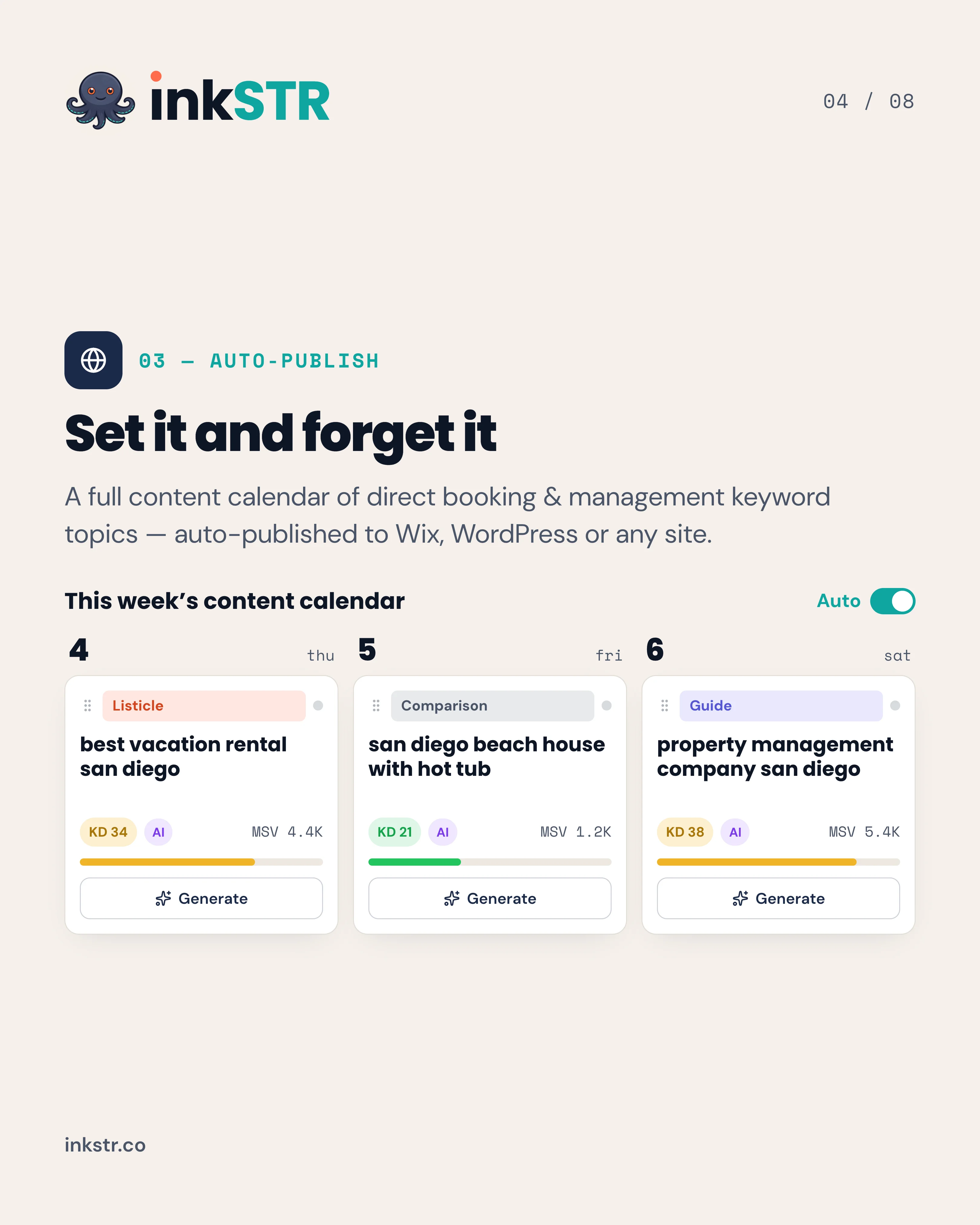
This is exactly the problem inkSTR was designed to solve. The Content Calendar automates the scheduling and publishing pipeline, so your site publishes consistently without you touching it. The AI Content Writer generates posts optimized for the specific destination keywords your guests actually search. The result is a compounding content library that grows your organic footprint month over month.

Which Keywords Should Your Vacation Rental Website Target?
Vacation rental websites should target three categories of keywords: location-based property queries (what travelers search when ready to book), destination content queries (what travelers search when planning a trip), and long-tail niche queries that match specific property features or traveler types. Most operators only pursue the first category, which is the most competitive and the hardest to rank for without significant domain authority.
Here is a practical framework for building your keyword map:
- Primary property keywords: "[property type] rental [city/region]": example: "cabin rental Blue Ridge Georgia." These are high intent, high competition. They should appear on your homepage and property pages.
- Long-tail property keywords: "[feature] [property type] rental [city]": example: "pet-friendly cabin rental Blue Ridge Georgia with fenced yard." Lower competition, higher conversion rate because the searcher is describing exactly what they want.
- Destination content keywords: "things to do in [city]", "best hikes near [city]", "restaurants in [city] worth the drive." These are what travelers search two to four weeks before they decide where to book. Ranking for them puts your site in front of guests before they've chosen a property.
- Niche traveler queries: "family-friendly vacation rental [region] with pool," "Airbnb for groups of 10 near [city]," "romantic cabin getaway [state] for couples." These convert extremely well because the searcher has pre-qualified themselves.
Free keyword research tools like Ubersuggest and professional platforms like SEMRush or Moz can help you identify search volume and competition levels for any of these query types. The challenge is not finding keywords: it is building a content strategy around them and executing it consistently.
inkSTR's keyword research tool handles this automatically. You enter your market and property type, and the platform surfaces a ranked keyword list with monthly search volume and competitor gap data. Instead of spending hours in a spreadsheet, you get a prioritized content plan ready for execution.
How Do You Build Authority to Compete With Big Booking Platforms?
Competing with OTA platforms like Airbnb and VRBO in Google search rankings is genuinely difficult because those sites have decades of domain authority, millions of backlinks, and full-time SEO teams. But independent operators do not need to outrank Airbnb for head-term keywords to win meaningful organic traffic. The strategy is to dominate the long-tail and local content searches that OTAs do not prioritize.
Authority for a vacation rental website grows through three signals: backlinks from credible external sites, consistent content publishing that signals topical relevance, and user engagement metrics that confirm visitors find the site useful.
Backlinks matter. A link from a local tourism board, a regional travel blog, or a destination guide carries significant weight for location-specific rankings. Earning those links typically requires publishing content worth linking to, which circles back to the content strategy. Operators who publish detailed local area guides, seasonal activity roundups, and destination-specific travel tips earn natural backlinks from travel writers and local business sites over time.
Consistent publishing signals topical authority. A site that publishes two destination-relevant blog posts per month for six months tells Google it is an active, authoritative resource for that market. A site that publishes sporadically or not at all tells Google nothing. Most operators intend to blog consistently and fail because the production burden is too high. The reason generic travel content kills conversions is not just quality: it is that operators who produce generic content run out of ideas and stop publishing altogether.
The SEO timeline is honest: most vacation rental websites see meaningful organic ranking movement after 90 to 180 days of consistent publishing. If you need bookings in the next 30 days, paid ads are the faster path. But if you want a direct booking engine that compounds without ad spend over the next 12 to 24 months, content-driven SEO is the better long-term investment. inkSTR makes the 180-day publishing commitment manageable by removing the production bottleneck entirely.
Frequently Asked Questions
How long does it take to rank a vacation rental website on Google?
Most vacation rental websites begin seeing meaningful organic ranking improvement after 3 to 6 months of consistent, keyword-targeted content publishing. The exact timeline depends on your market's competitiveness, how frequently you publish, and the technical health of your site. Head-term keywords like "beach house rental Miami" may take 12 to 18 months to compete for, while long-tail keywords like "pet-friendly beachfront rental Miami with fenced yard" can rank significantly faster with well-optimized content.
Do I need a blog to rank my vacation rental website on Google?
Yes, in most markets a blog is the primary mechanism for growing organic search rankings beyond your core property pages. Your property and homepage pages can rank for branded and direct-match queries, but destination content queries, activity guides, and niche traveler searches require dedicated blog content. A ranking blog article can drive organic search traffic for 2 to 5 years, making each published post a long-term asset. inkSTR's AI Content Writer generates these posts automatically, including keyword targeting and internal link structure.
What is Google Vacation Rentals and how do I get my property listed?
Google Vacation Rentals is a feature within Google Search that surfaces rental properties in a booking carousel alongside hotel results. Getting listed requires connecting your property data through a platform or channel manager that has an active Google Hotel Center integration. Most major property management systems offer this connectivity. Implementing VacationRental schema markup on your direct booking site also helps Google understand and surface your property in relevant searches.
How do I do keyword research for my vacation rental website?
Start with three keyword categories: primary location keywords ("cabin rental Asheville NC"), long-tail feature keywords ("dog-friendly cabin Asheville with fenced yard"), and destination content keywords ("things to do in Asheville with kids"). Free tools like Ubersuggest and professional platforms like SEMRush can show you search volume and competition levels. inkSTR's built-in Keyword Research tool surfaces the specific queries your target guests are searching in your market, so you skip the manual spreadsheet work.
Is it worth having a direct booking website if I already list on Airbnb and VRBO?
Yes, and the financial case is clear. Airbnb and VRBO combined fees run 17 to 19 percent of every booking. A single direct booking worth $2,000 saves you $340 to $380 in platform fees. Over a full season of bookings, the cumulative savings easily justify the investment in building and marketing a direct booking site. The key is giving that site enough content to rank on Google, which is what most operators skip. Pairing direct booking SEO strategy with Google visibility creates a booking channel you own outright and that compounds in value over time.
How many blog posts do I need before I start getting organic traffic to my vacation rental site?
Most vacation rental websites begin showing measurable organic traffic gains after 12 to 20 published articles targeting a mix of destination keywords and long-tail booking intent queries. That volume establishes topical authority in your market and gives Google enough content to understand what your site covers. inkSTR's Content Calendar automates the publishing schedule so you can reach that content threshold without manually tracking every post date.
What is schema markup and does my vacation rental website need it?
Schema markup is structured data code added to your website's HTML that helps search engines understand the content on each page. For vacation rental websites, VacationRental and LodgingBusiness schema communicates your property type, location, amenities, pricing, and availability to Google in a format it can reliably interpret. Schema markup improves your chances of appearing in rich results and Google AI Overviews, and it is one of the technical signals that separates well-ranked direct booking sites from invisible ones. Most website builders support schema through plugins or code injection, and Google Search Console will flag schema errors if they exist.
Can AI-generated blog content actually rank on Google for vacation rental keywords?
Yes, when the content is specific, well-structured, and genuinely useful to travelers. Google's quality guidelines focus on helpfulness and expertise, not on whether a human or AI produced the text. AI-generated content that is generic, thin, or inaccurate will not rank, but AI content built on solid keyword research, real destination details, and STR-specific language performs the same as human-written content. inkSTR generates articles in the 2,500 to 3,500 word range with STR-specific terminology, location detail, and internal link structure built in, which is why the content ranks rather than just existing on the page. For a deeper look at this topic, see our guide on ranking in AI search as an STR operator.
Start Building the Google Presence Your Direct Booking Site Deserves
Ranking your vacation rental website on Google is not a single task. It is a system: technical site health, keyword-optimized property pages, a Google vacation rental listing, and a consistent blog content pipeline that grows your organic authority month after month. Operators who treat it as a system build a booking channel they own. Operators who treat it as a checklist item get stuck after the first few posts and fall back to paying OTA commissions indefinitely.
The good news is that you do not need to be a full-time SEO strategist to execute this. You need the right foundation and a publishing system that runs without you micromanaging it. The operators who are generating reliable direct bookings from organic search in 2026 are not better writers than you. They just have a content engine that keeps publishing while they focus on running their properties.
If you are ready to build that engine, start with the How inkSTR Works overview to see the full content pipeline from keyword to published post. Starting at $99/month, a single additional direct booking covers the platform cost and then some. The compounding value of a growing content library is what makes it worth building now rather than next year.

If writing, scheduling, and publishing keyword-targeted blog content is the part of your SEO strategy you keep putting off, inkSTR handles the entire content pipeline automatically. Try it free and see how fast your content library can grow when the production bottleneck is gone.
Content powered by inkSTR.co
Enjoyed this article? Share it:
Get more of inkSTR in Google Search
Add inkstr.co as a preferred source and our articles show up more in Top Stories, AI Overviews, and AI Mode — with a “Preferred” badge.
Get more guides like this
New SEO and AI-search guides, straight to your inbox. No spam, unsubscribe anytime.