Why Your Blog Content Isn't Converting Visitors Into Guests

Blog content is the written, published material on a website that answers audience questions, builds search visibility, and guides readers toward a decision. For short-term rental operators, that decision is a booking. But most STR blogs stop at attracting readers and never close the gap between a curious visitor and a confirmed guest. The content exists. The traffic sometimes shows up. The bookings do not follow. That disconnect is not a traffic problem. It is a content strategy problem.
TL;DR
- Blog content for STR operators should do one job above all others: convert readers into guests. Most STR blogs fail this test because they produce informational content without conversion architecture.
- Writing one quality blog post manually takes 3-5 hours. A freelance travel writer charges $300-$700 per post. At that rate, building a content library is either exhausting or expensive.
- According to the HubSpot State of Marketing Report 2026, blog posts rank among the top 5 highest-ROI content formats, with small businesses 23% more likely than average to see ROI from blogging.
- The four types of content (educational, entertaining, inspirational, and conversational) serve different funnel stages. Most STR blogs publish only educational content and miss the transactional content that actually drives reservations.
- A ranking blog article can drive organic search traffic for 2-5 years. That makes each post a long-term asset, not a one-time expense.
- inkSTR automates blog content creation, keyword research, and publishing for STR operators, generating SEO-optimized posts built specifically to convert vacation rental browsers into direct booking guests.
Table of Contents
- What Is Blog Content and Why Does It Matter for STR Operators?
- What Are the 4 Types of Content and Which One Actually Drives Bookings?
- Why Your Blog Traffic Isn't Converting Into Reservations
- How to Write Blog Content That Moves Readers Toward a Booking
- Can You Make $1,000 a Month From Your Vacation Rental Blog?
- How Did Mark Manson Start His Blog, and What STR Operators Can Learn From It?
- What Makes Blog Content Rank on Google in 2026?
- How to Build a Blog Content Strategy That Works Without Consuming Your Week
- Frequently Asked Questions About Blog Content for STR Operators
- Conclusion: Turn Your Blog Into a Direct Booking Engine
What Is Blog Content and Why Does It Matter for STR Operators?
Blog content refers to the structured, published articles on a website that answer audience questions, improve organic search rankings, and guide readers through a decision-making process. For vacation rental operators specifically, blog content is the primary tool for attracting guests who are not already on Airbnb or VRBO. These are the guests who search Google for "best cabin near Asheville for a family reunion" or "dog-friendly beach house Gulf Coast" and land directly on your website.
Here is why this matters in 2026. According to the HubSpot State of Marketing Report 2026, blog posts rank among the top five highest-ROI content formats. Small businesses are 23% more likely than the average marketer to see positive ROI from blogging. Website, blog, and SEO combined remain the single highest ROI-generating marketing channel overall. For an STR operator paying 17-19% combined platform fees on every booking through Airbnb or VRBO, a blog that generates direct traffic is not just a marketing tactic. It is a profit center.
The problem is that most STR operators either skip blog content entirely or publish generic travel posts that attract casual browsers with no intent to book. We built inkSTR specifically because we saw this gap constantly: operators with beautiful properties and empty contact forms, hosts with website traffic and zero direct bookings. The content existed. The conversion strategy did not.
Blog content works when it is built for a specific reader at a specific moment in their booking decision. A guest comparing your cabin to three others does not need another listicle about "top things to do in the Smokies." They need content that answers their specific objection, speaks to their travel style, and points them toward a booking page. That is the difference between blog content that fills a website and blog content that fills a calendar.

What Are the 4 Types of Content and Which One Actually Drives Bookings?
The four types of content are educational, entertaining, inspirational, and conversational. Each type serves a different stage of the guest's decision-making process, and the most common mistake STR bloggers make is publishing only educational content while ignoring the three types that actually move someone toward a reservation.
Educational content teaches something: how to plan a mountain trip, what to pack for a beach vacation, what neighborhoods have the best restaurants. This content earns search traffic and builds credibility. But it rarely converts on its own. A reader who learns something from your post does not automatically know they should book your property.
Entertaining content creates emotional connection. Property-specific stories, behind-the-scenes looks at how you manage the guest experience, the reason you chose to furnish the living room a specific way. This content builds the kind of trust that makes a first-time visitor feel comfortable enough to book directly rather than retreat to a platform they already know.
Inspirational content paints a picture. "What your four days at our lakehouse will actually feel like" beats a bulleted amenity list every time. Inspiration-driven posts work exceptionally well as the final nudge before a booking decision because they help the reader see themselves in your property.
Conversational content answers objections directly. What is the cancellation policy? Is the property suitable for toddlers? How far is the nearest grocery store? Most STR operators bury this content in a FAQ page nobody reads. Publishing it as standalone blog posts puts it in front of guests who are actively searching those exact questions on Google.
At inkSTR, we see operators publish almost exclusively educational content and then wonder why their blogs generate traffic but not inquiries. The fix is not more content. It is the right mix of content types, mapped to the guest journey. Our AI Content Writer generates posts across all four content types, calibrated specifically to drive STR bookings rather than just page views.
| Content Type | Primary Goal | Where It Fits in the Funnel | Example for STR Operators |
|---|---|---|---|
| Educational | Build awareness and organic traffic | Top of funnel | "Best hiking trails near [location]" |
| Entertaining | Build emotional trust and connection | Middle of funnel | "How we designed our cabin for real family trips" |
| Inspirational | Trigger booking intent | Middle to bottom of funnel | "Your perfect long weekend at [property name]" |
| Conversational | Resolve objections and close bookings | Bottom of funnel | "Is [property] right for a group trip with kids?" |
Why Your Blog Traffic Isn't Converting Into Reservations
The conversion gap in STR blog content is the space between a reader finishing your article and that reader making a booking inquiry. Most STR blogs never close this gap because they treat blog content as a publishing exercise rather than a conversion funnel. Traffic without conversion architecture is just an audience with nowhere to go.
Think about what most STR blog posts look like. A 600-word travel guide to local restaurants. A seasonal packing list. A generic "top five reasons to visit" post with stock photography. These posts may rank for informational searches. But they attract readers who are in research mode, not booking mode. And when those readers finish the article, there is no next step. No call to action. No booking link. No reason to stay on the site at all.
This is the failure mode we see most often when operators come to inkSTR. They have published dozens of posts. They have some traffic. But their inquiry rate is close to zero because every post ends with a blank space where a conversion opportunity should be. Consider the math: a single direct vacation rental booking is typically worth $1,000 to $4,000 in revenue. One conversion from a blog post that cost you nothing beyond the writing time covers months of content investment.
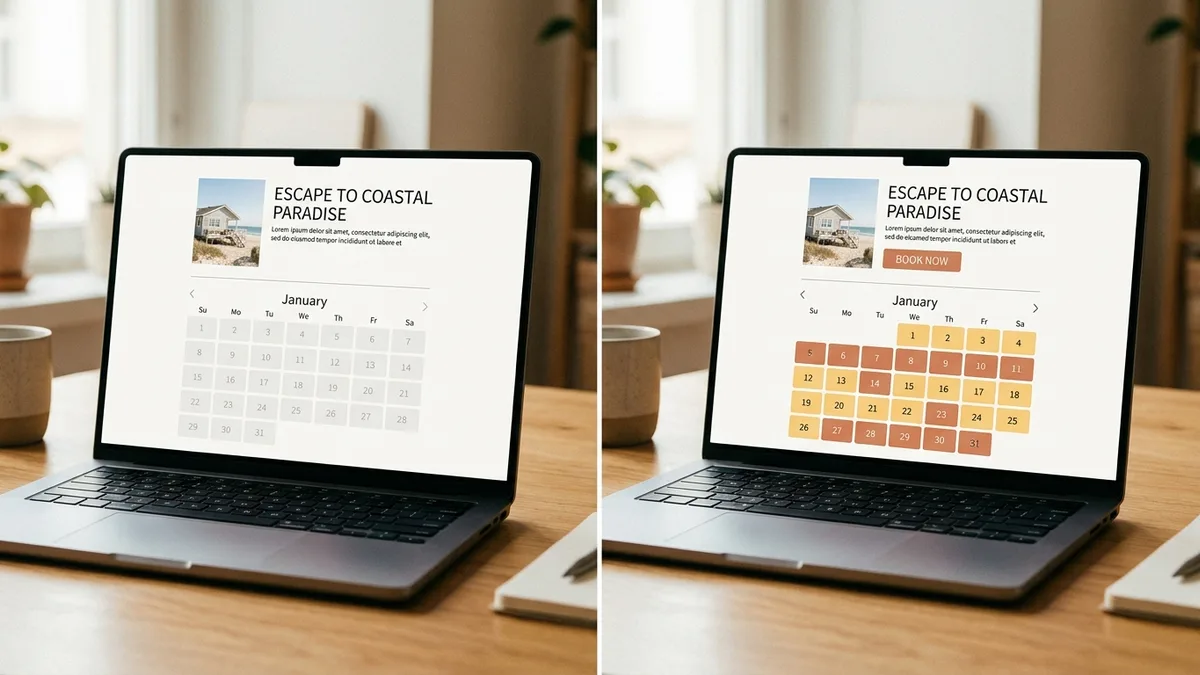
The fix requires three things working together. First, intent alignment: your content should match the search intent of guests who are close to booking, not just browsing. Second, trust signals embedded within the content itself: specific details, photos of real results, and social proof that makes a first-time visitor confident enough to book directly. Third, a clear call to action that appears within the post, not only in a sidebar or footer that most readers ignore.
Our post on why generic travel content kills conversions covers the specifics of content-to-funnel alignment in more detail. The short version: publishing content that does not point to a booking outcome is the most common and most expensive mistake in STR content marketing.
How to Write Blog Content That Moves Readers Toward a Booking
Writing blog content that converts visitors into guests requires a specific structure: match the reader's intent, build trust within the article body, and include a clear, natural path to a booking. Each of these elements fails independently. Together, they produce direct bookings from organic traffic.
Step 1: Match the Reader's Search Intent Before You Write a Word
Search intent is the underlying goal behind a search query. A guest searching "things to do in Gatlinburg in October" is in research mode. A guest searching "pet-friendly cabin Gatlinburg sleeps six" is in booking mode. Writing the same type of post for both searches is a strategic mistake. The first needs local expertise and broad information. The second needs your property's specific details, your booking link, and a reason to trust you over a listing platform.
Before writing any blog post, classify the intent: informational, navigational, or transactional. Transactional posts should be shorter, more direct, and end with an explicit booking call to action. Informational posts should establish your local authority and then connect that authority to a soft recommendation for your property at the end.
Step 2: Build Trust Inside the Article, Not Just On Your About Page
Trust signals within blog content convert passive readers into active inquirers. These are not just testimonials in a sidebar. They are the specific details that make a stranger feel safe booking directly with an individual host rather than through a platform with buyer protections. Include a real photo of your property interior alongside the text. Name the specific beach access point your property uses. Mention that you have hosted 200-plus groups in this space without a single complaint about the Wi-Fi speed. Concrete specifics signal authenticity in a way that generic descriptions never can.
This is also where local area guides that convert outperform generic travel content. A guide written by someone who actually manages the property, knows which trailhead has the most reliable parking, and can name the best breakfast spot three blocks from the front door earns a different level of trust than anything a visitor could find on a travel review site.
Step 3: Place the Call to Action Where the Decision Happens
Most STR blogs bury calls to action in the footer or leave them off entirely. The decision to book happens while the reader is engaged with your content, not after they have scrolled to the bottom of the page. Place your booking link or inquiry CTA within the body of the post, at the natural peak of the reader's interest. For a post about "the best winter cabin experience in [region]," that peak is right after the vivid description of what a snow weekend in your property actually feels like. That is where you include the link. Not in a closing paragraph where attention has already faded.
inkSTR's AI Content Writer generates posts with built-in conversion architecture, including strategically placed internal links and booking CTAs matched to the post's intent. We do not write generic travel content and expect operators to retrofit it. Every post is built from the guest's decision point backward.
Can You Make $1,000 a Month From Your Vacation Rental Blog?
A vacation rental blog can generate far more than $1,000 a month in revenue when it is treated as a direct booking channel rather than a content hobby. A single direct booking is typically worth $1,000 to $4,000 in revenue. One booking per month from blog-driven organic traffic covers that threshold entirely. The more accurate question is how long it takes to build that pipeline.
Here is the honest picture. A ranking blog article can drive organic search traffic for 2-5 years. That is the compounding advantage of content investment: a post you write today can continue generating bookings in 2028 without any additional spend. Compare that to paid advertising, where revenue stops the moment the budget does. Organic blog content is the only marketing channel that appreciates over time.
The barrier for most operators is the production cost. Writing one quality blog post manually takes 3-5 hours of research and writing. At that pace, building a library of 20-30 posts that covers enough keyword territory to generate consistent organic traffic takes months of sustained effort. Hiring a freelance travel writer runs $300-$700 per post. Twenty posts at $400 each is $8,000 before a single booking arrives from organic search.
This is exactly the math that drove us to build inkSTR. Starting at $99 per month, inkSTR generates, schedules, and publishes articles automatically on a set schedule. The cost of building a 20-post content library through inkSTR is a fraction of the freelancer route, and the posts are built with STR-specific keyword research baked in rather than general travel content that happens to mention your market.
The operators who see the strongest ROI from blog content share one trait: consistency. Publishing one post a month for 18 months builds a different kind of search presence than publishing 18 posts in a single week. Google rewards editorial consistency. Guests trust websites that appear active and maintained. Our Content Calendar manages that consistency automatically, so the schedule runs even when your week is full of guest management and property maintenance.
For a deeper look at the revenue math behind direct bookings, our article on revenue maximization strategies for STR hosts breaks down how content-driven direct traffic compounds over a 12-month window.

Ready to automate your content marketing?
inkSTR handles keyword research, content strategy, article writing, and publishing, all on autopilot.
How Did Mark Manson Start His Blog, and What STR Operators Can Learn From It?
Mark Manson started his blog in 2009 by writing consistently about a specific niche he understood from personal experience: personal development and self-improvement, filtered through a direct and unconventional voice. He did not try to cover everything. He did not write for an abstract general audience. He wrote with a specific perspective for a specific kind of reader, and he published that perspective consistently over years before the blog became a business.
The lesson for STR operators is not about personal development. It is about niche authority and voice consistency. Manson's blog succeeded because it had a clear point of view that made it different from every other personal development site. Your STR blog needs the same thing: a clear perspective that makes it the obvious resource for guests interested in your specific market, property type, or travel experience.
Generic vacation rental blogs fail for the same reason generic personal development blogs fail. There is nothing to remember. Nothing to recommend. No reason to return. A blog that covers every beach destination in the country with thin, templated content earns no loyalty and generates no search authority. A blog that covers your specific coastal market with deep local knowledge, specific property recommendations, and genuine hospitality expertise builds the kind of topical authority that ranks and converts.
In our experience working with STR operators across the country, the hosts whose blogs perform best are the ones who commit to a niche before they commit to a publishing schedule. Define your ideal guest, the specific travel experience your property delivers, and the local knowledge that sets you apart from every other listing in your market. Then write specifically for that reader. The audience will be smaller. The conversions will be dramatically higher.
inkSTR's content strategy wizard helps operators define that niche before generating a single post. We call it pillar-cluster architecture: a core topic your property owns, supported by a structured library of related articles that build search authority around that topic over time. You can explore the full workflow at how inkSTR works.
What Makes Blog Content Rank on Google in 2026?
Blog content ranks on Google in 2026 when it demonstrates topical authority, answers search intent completely, and earns trust signals from both readers and the search algorithm. The ranking factors that mattered in 2020 still apply, but the bar for content quality has shifted significantly as AI-generated content has flooded every category including vacation rentals.
Google's helpful content system specifically rewards "information gain," the presence of unique, experience-based insights that go beyond what already ranks. For STR operators, this means blog content that includes local details only someone who manages properties in that market would know: specific seasonal demand patterns, the correct distance from your property to the nearest major attraction, the actual parking situation at the trailhead your guests use most. These details are invisible to AI writers generating generic travel content. They are exactly what Google's algorithm surfaces.
In 2026, the percentage of marketers not using AI for blog creation has dropped from 65% to 5% in just two years, according to Typeface research. That means nearly every blog in your competitive category now publishes AI content. The operators who rank are the ones whose AI content includes specific local knowledge, genuine brand voice, and conversion architecture that generic tools do not produce.
There is also the AI search layer to consider. ChatGPT, Perplexity, and Google AI Overviews now answer vacation planning questions directly, often citing specific websites as sources. Content that earns AI citations follows a specific structure: definition-first paragraphs, named local entities (specific trailheads, neighborhoods, attractions), and self-contained sections that answer a single question completely. Our article on ranking in AI search for STR operators covers this in full.
The technical baseline matters too. According to the Airbnb ranking factors documentation, platform search and Google search share similar signals: completeness, recency, and relevance to the specific query. A blog that publishes new content regularly signals to Google that the website is active and maintained. Our Auto-Publishing feature handles that consistency automatically, posting directly to Wix or WordPress on a set schedule without requiring manual intervention.
For the SEO fundamentals specific to STR businesses, our guide on ranking on Google for STR operators covers the signals that matter most for property-specific content.
How to Build a Blog Content Strategy That Works Without Consuming Your Week
A functional blog content strategy for STR operators requires four components: keyword research that targets actual booking intent, a content calendar that enforces consistent publishing, posts that cover all four content types across the guest journey, and automation that keeps the system running when your attention is on operations.
Start With Keywords That Match Booking Intent, Not Just Search Volume
Keyword research for STR blog content starts with questions your potential guests actually type when they are close to booking, not when they are casually browsing. High-volume informational queries like "things to do in Denver" attract millions of readers who will never book your specific property. Long-tail transactional queries like "family-friendly cabin near Rocky Mountain National Park with hot tub" attract far fewer readers, but those readers are actively comparing properties and ready to book.
The best keyword research for STR blogs also surfaces competitor content gaps: topics your market competitors are not covering that your target guests are actively searching. This is where organic search advantage is built, not in competing for the same high-volume keywords that travel giants already dominate. Our Keyword Research tool identifies exactly these long-tail opportunities, filtered specifically for vacation rental search intent rather than generic travel queries.
Map Content to the Guest Journey, Not to Your Publishing Convenience
Most STR operators publish whatever content is easiest to produce: local restaurant roundups, seasonal packing lists, general area guides. These posts serve the top of the funnel and stop there. A complete content strategy maps posts to every stage of the guest's decision process.
Top-of-funnel posts attract guests who are choosing a destination. They answer broad questions about your market: what is the area known for, what time of year is best, what types of travelers it suits. Middle-funnel posts help guests choose a property type: cabin versus hotel, STR versus resort, your specific neighborhood versus alternatives. Bottom-funnel posts close the decision: your specific property's features, your cancellation policy, what past guests say about the experience.
Running all three content types simultaneously is what fills a booking calendar from organic traffic. Most STR blogs publish only top-of-funnel content and generate awareness without bookings. For practical guidance on local content that converts, our guide on local area guides that sell shows exactly how to structure location content for booking conversion rather than casual readership.
Automate Everything the Algorithm Does Not Care Who Writes
The guest does not care whether you personally wrote the blog post or whether a well-trained content system generated it. They care whether the content answered their question, made them trust your property, and made booking easy. The algorithm cares about quality, relevance, and freshness. Neither audience cares about your effort.
This is the operational case for content automation. According to Typeface research, 98% of marketers are planning higher spend on AI SEO tools in 2026. The competitive landscape has shifted: operators who automate content production are publishing more frequently, covering more keyword territory, and building topical authority faster than those writing manually.
inkSTR generates 2,500-3,500 word SEO-optimized blog posts in minutes rather than hours. Our Content Calendar schedules and manages publishing on autopilot, so your blog stays active and consistent even when property management takes every available hour. Starting at $99 per month, the platform costs less than a single freelance blog post while producing a complete monthly content pipeline.
Frequently Asked Questions About Blog Content for STR Operators
What is blog content and how is it different from social media content?
Blog content refers to long-form, search-optimized articles published on a website that answer specific audience questions and build organic search rankings over time. Unlike social media posts that disappear from feeds within hours, blog content continues attracting search traffic for months or years after publication. According to research cited in the HubSpot State of Marketing Report 2026, blog posts rank among the top five highest-ROI content formats and remain a core owned-media channel that compounds in value over time.
How often should I publish new blog content for my vacation rental website?
Publishing consistency matters more than publishing frequency. One high-quality, well-researched post per month that genuinely answers a guest's booking question outperforms four generic posts per month with thin content. That said, operators who publish more frequently build topical authority faster. inkSTR's Content Calendar automates scheduling so you can maintain a consistent rhythm without dedicating time to manual publishing each week.
Can I use the same blog content across multiple vacation rental properties?
Republishing identical content across multiple property websites creates duplicate content issues that can suppress Google rankings for all versions. Each property website needs original content tailored to its specific location, guest profile, and nearby attractions. inkSTR's multi-project architecture creates independent content pipelines for each property, generating unique, property-specific posts without duplicating content across your portfolio.
What types of local content work best for STR blog SEO?
Local content that answers specific guest questions about your immediate area consistently outperforms generic destination guides. Posts covering hyper-local topics such as the best breakfast spot within walking distance, parking logistics at nearby attractions, and seasonal access conditions for local trails attract guests who are already comparing properties in your specific market and are close to booking. These readers convert at significantly higher rates than broad destination searchers.
How long does it take to see results from vacation rental blog content?
Organic search results from blog content typically appear within 3-6 months for lower-competition long-tail keywords and 6-12 months for more competitive terms. A ranking blog article can drive organic search traffic for 2-5 years, making early content investment the highest-leverage marketing activity available to STR operators. The earlier you start building your blog library, the longer your content compounds.
Should I write my own STR blog content or use a professional service?
The honest answer depends on your time and expertise. Writing one quality blog post manually takes 3-5 hours, and a freelance travel writer charges $300-$700 per post. For most operators managing properties full-time, neither option is sustainable at scale. inkSTR generates publication-ready, STR-specific blog content in minutes rather than hours, at a fraction of freelance costs, and publishes directly to Wix or WordPress without manual steps.
What is the ROI of blog content marketing for STR businesses?
A single direct vacation rental booking is typically worth $1,000 to $4,000 in revenue. A blog article that generates even one direct booking per year from organic traffic delivers a return on investment that far exceeds its production cost. Because ranking articles continue attracting traffic for 2-5 years, the ROI compounds: the same article that generates one booking in year one can generate five bookings in year three as its search rankings solidify and its indexed content gains authority.
Conclusion: Turn Your Blog Into a Direct Booking Engine
Blog content is either a booking engine or a publishing exercise. The difference is not the quality of the writing. It is the presence of a conversion strategy: content matched to guest intent, trust signals embedded within the articles, and clear paths from reading to booking. According to the HubSpot State of Marketing Report 2026, blog content remains among the top five highest-ROI marketing formats, with small businesses 23% more likely than the average marketer to see positive returns. The opportunity is real. Most STR operators simply are not capturing it.
The production barrier is the most common reason operators leave this channel underexploited. Writing 3-5 hours per post, paying $300-$700 per freelancer post, managing a publishing schedule while running properties: these are real costs that make consistent blog content feel out of reach. They should not be. In 2026, the gap between operators who automate their content and those who do not is widening every month, and the operators on the wrong side of that gap are leaving direct booking revenue on the table while paying 17-19% platform fees on every reservation.
Implementing a consistent, conversion-focused blog content strategy positions your vacation rental business for compounding organic growth. A post published this month can generate bookings in 2028. The calendar fills differently when your marketing works while you manage properties instead of competing with it for your attention.
Ready to build a blog content library that converts visitors into guests? Start your free inkSTR trial and publish your first SEO-optimized, conversion-ready blog post this week.

The inkSTR platform was built for exactly this outcome: STR operators who understand the value of organic traffic but cannot afford to spend five hours per post building it manually. Our system handles keyword research, content generation, scheduling, and direct publishing to your Wix or WordPress site. The content it produces is built for STR conversion, not generic travel readership. See how it works and publish your first post today.
Enjoyed this article? Share it:
Get more of inkSTR in Google Search
Add inkstr.co as a preferred source and our articles show up more in Top Stories, AI Overviews, and AI Mode — with a “Preferred” badge.
Get more guides like this
New SEO and AI-search guides, straight to your inbox. No spam, unsubscribe anytime.