AI Content Generator for Hosts: What Actually Works in 2026
An AI content generator for hosts is software that researches keywords, writes SEO-optimized blog articles, and publishes them to a vacation rental website automatically, replacing the manual work of researching, drafting, and formatting content by hand. For short-term rental operators, that means a system built specifically around vacation rental terminology and traveler search intent, not a general-purpose writing tool applied to a niche it was never designed for.
Key Takeaways
- Writing one quality blog post manually takes 3-5 hours of research and drafting, and a freelance travel writer typically charges $300-$700 per post.
- A single direct booking is often worth $1,000 to $4,000 in revenue, while Airbnb host and guest fees combined run 17-19% of every booking.
- A ranking blog article can drive organic traffic for 2-5 years, unlike a paid ad that stops the day you stop paying.
- A five-market vacation rental brand grew from 26 to 1,924 monthly Google search visits in four months using an automated content pipeline built for short-term rentals.
- General-purpose AI tools like ChatGPT can draft text, but they cannot schedule publishing, run keyword research, or update your site without manual copy-paste work.
- inkSTR generates, schedules, and publishes vacation-rental-specific blog articles automatically, starting at $99/month, so operators get a working content pipeline instead of a blank page.
If you run a vacation rental business in 2026, you've probably typed some version of "AI content generator for hosts" into Google at 11pm, exhausted after a day of guest messages, turnover coordination, and pricing adjustments, wondering if there's a faster way to get your website ranking. There is. But not every AI tool marketed at hosts understands what a host needs.
Most general AI writing tools were built for e-commerce brands, agencies, or generic bloggers. They can string sentences together about "cozy getaways" and "unforgettable memories," but they don't know the difference between a cleaning fee disclosure and a house rule, or why "pet-friendly cabin near the Smokies with a hot tub" converts better than "beautiful mountain retreat." That gap is what this guide covers: how AI content tools work for short-term rental operators, where general-purpose tools fall short, and what a purpose-built system looks like in practice.
We'll walk through the real cost of manual content creation, what separates a niche AI content generator from a generic one, and how to evaluate the category honestly.
Why Isn't Your Vacation Rental Getting Bookings From Search?
Your vacation rental isn't getting bookings from search because your website has little to no content targeting the specific phrases guests actually type into Google. A single homepage and a few listing pages rarely rank for anything competitive, no matter how nice your photos are.
Here's what that looks like in practice. You've got a direct booking site. It has a homepage, an about page, maybe a gallery. Google has almost nothing to index beyond your five listing pages. Meanwhile, guests are searching "pet-friendly lake house rental with dock access" or "3 bedroom cabin near hiking trails for large groups," and your site never shows up because you've never published a single page answering those exact questions. This is the single biggest reason independent hosts stay invisible on Google while bigger property management companies dominate page one. It's not that they have better properties. It's that they publish consistently, and consistency compounds.
Fixing this manually means writing dozens of blog posts covering local attractions, property comparisons, and booking FAQs, at 3-5 hours per post. That's weeks of writing time most hosts running one to five properties simply don't have. Hiring it out costs $300-$700 per post from a freelance travel writer, and most hosts need 20-40 posts to build real topical coverage.
This is the exact gap an inkSTR content pipeline is built to close. Instead of staring at a blank page once a month, inkSTR's Keyword Research tool identifies the specific phrases your guests search, then the AI Content Writer drafts full articles against that plan automatically. We built it this way because the problem was never a lack of writing talent among hosts, it was a lack of hours in the day.
How Do Independent Hosts Compete With Big Property Management Companies in Search?
Independent hosts compete with large property management companies in search by publishing more specific, locally grounded content than the bigger players bother writing. Large management companies often have hundreds of listings but thin content, because writing custom copy for every market doesn't scale on a manual workflow. That's your opening. A management company with 200 units across ten states typically publishes generic, templated pages because a content team of two or three writers can't personalize hundreds of markets. You, running three cabins in one valley, can out-write them on specificity every time, if you have the time.
The problem is you don't. You're doing guest communication, turnover scheduling, and pricing adjustments before you even get to content. Most independent hosts we talk to spend less than five hours a week on marketing of any kind. Meanwhile, the property management company down the road, even with thin content, publishes something every week because they've automated it.
This is where scale-matching matters. inkSTR's Content Calendar schedules articles automatically so a solo host publishes at the same cadence as a company with a content team, without hiring one. In one case, a five-market mountain rental brand running 114 inkSTR articles in four months went from 26 to 1,924 monthly Google search visits, with distinct ranking search queries climbing to 5,939. That's the specificity advantage independent operators have, executed at a pace they couldn't manage manually.

What Should You Actually Blog About as a Vacation Rental Host?
A vacation rental blog should cover four content types: local area guides tied to your property's actual location, property comparison posts, seasonal booking guides, and pre-arrival or FAQ content that answers real guest questions before they ask. Generic "10 things to do in [city]" posts that could describe any town rank poorly and convert worse. The mistake most hosts make is publishing destination content that reads like it was written for a tourism board, not a guest deciding between your property and three others. A guide that says "enjoy scenic views and outdoor adventure" tells a reader nothing. A guide that names specific trailheads, drive times from your actual door, and which rooms face the mountain does the conversion work generic content can't. Content built around real search intent has a measurably higher chance of ranking well, since it matches what people are actually trying to find. That's the difference between a blog post that ranks and one that just exists.
Writing this kind of specific content takes longer than generic filler. Research alone for a properly detailed local guide can eat two hours before you write a word. Multiply that across the 15-20 posts most vacation rental sites need for real topical coverage, and you're looking at a part-time job. That's why we designed inkSTR's content strategy wizard to pull real property details, amenities, and location data into a pillar-and-cluster plan before a single article gets drafted. The system doesn't guess at generic "beach getaway" angles. It builds content around your specific property and its actual market, then the AI Content Writer executes the plan on a schedule you set. Our guide to writing local area guides that sell breaks down the exact structure that converts browsers into bookings.
Can AI Actually Write Vacation Rental Content That Ranks?
AI can write vacation rental content that ranks, but only when the underlying system is trained on hospitality-specific search intent and structured for both traditional SEO and AI search citation. A general-purpose AI chatbot can draft a paragraph about your property, but it has no built-in understanding of what makes vacation rental content different from a restaurant review or a product description. General-purpose large language models handle one-off drafting tasks like rewriting a paragraph or brainstorming a title. But they cannot update your prices, block calendar dates, send guest messages, or publish directly to your website without manual integration work. You still copy, paste, format, and publish everything by hand.
That's the gap between a general AI assistant and a purpose-built content system. A tool built specifically for short-term rentals understands terms like "self check-in" and "minimum night stay" without you explaining them every time. It also understands that a guest searching "cabin rental near Gatlinburg with hot tub for 8 people" is deep in the decision funnel and needs specific, factual content, not generic inspiration copy. In one case, a Smoky Mountains cabin rental brand's monthly Google Search clicks grew from 788 to 5,195 over 11 months on a continuous, hospitality-specific content pipeline, with monthly search impressions climbing from 130,000 to 450,000 over the same period. That kind of sustained growth comes from consistent, correctly targeted publishing, not a single well-written post.
This is exactly what inkSTR was built to solve. Every article generated through our AI Content Writer is written with short-term rental terminology and traveler search intent baked in, then automatically checked against quality scoring before it ever gets scheduled. Across inkSTR customer sites, we've secured more than 1,191 verified AI-search citations as of September 2026, meaning our content gets pulled into AI Overviews and chatbot answers, not just ranked on Google. Our guide on ranking in AI search covers exactly how that citation process works.
What Does It Actually Cost to Skip Content Marketing and Rely on OTAs Instead?
Skipping content marketing and relying entirely on OTAs costs you the difference between full booking revenue and revenue after platform fees, indefinitely, on every single reservation. Airbnb host and guest fees combined typically run 17-19% of every booking, a percentage that never goes away no matter how long you've hosted. Run the math on your own numbers. If a direct booking is worth $1,000 to $4,000 in revenue, and you're losing 17-19% of that to platform fees on every OTA-sourced reservation, the gap widens fast across a full season of bookings. A property doing forty bookings a year at OTA rates versus the same forty bookings direct represents a revenue difference that compounds every year you don't have a direct booking channel.
The counterargument hosts make is that OTAs bring guests you'd never find otherwise, and that's true, especially for new listings. But once you have reviews and a track record, relying exclusively on OTA traffic means you're permanently paying a toll on revenue you could be capturing directly. A blog post that ranks for "pet-friendly cabin rental [your area]" keeps working two to five years after you publish it, with zero per-booking fee attached. That's a different economic model than paid OTA placement or paid ads, which stop producing the moment you stop paying.
This is the core reason we built inkSTR around direct booking capture specifically, not generic traffic. The AI Content Writer and Content Calendar work together to build content that funnels readers toward your booking page instead of just generating page views. Our piece on booking page conversion optimization covers what happens after the traffic arrives, since ranking content that doesn't convert is only half the job.

How Is a Niche AI Content Generator Different From a General-Purpose AI Tool?
A niche AI content generator for hosts differs from a general-purpose AI tool by understanding vacation rental terminology and traveler search intent without manual prompting, and by handling the full pipeline from keyword research to publishing rather than producing isolated text. General AI assistants require you to prompt, copy, paste, format, and publish every single article by hand. AI tools generally split into three buckets: general-purpose language models for one-off drafting, niche tools built for repeated hospitality workflows, and property-management-system-embedded tools for centralized operations. Each solves a different problem, and conflating them leads to disappointment.
A general-purpose model is fine if you need to rewrite one paragraph today. It's the wrong tool if you need 20 articles published on a schedule over the next six months, because you'll be doing all the research, formatting, scheduling, and publishing manually anyway. The AI only saved you the typing, not the workflow.
| Capability | General-Purpose AI Chatbot | Niche STR Content Platform (inkSTR) |
|---|---|---|
| Understands STR terminology and traveler intent | Requires manual prompting and correction | Built in, trained on hospitality search patterns |
| Keyword research | Not included, done separately | Automated via built-in keyword research |
| Scheduling and publishing | Manual copy-paste to your CMS | Automated via content calendar and one-click publishing to Wix or WordPress |
| Cost structure | Free or low monthly fee, but requires your time for every step | $99/month starting price, full pipeline included |
| AI search citation optimization | Not addressed | Built into content structure from the draft stage |
The distinction matters most for operators managing more than one property. inkSTR's multi-project support runs an independent content pipeline for every property or brand from a single dashboard, something no general-purpose chatbot offers out of the box. That's the difference between a tool that helps you write and a system that runs your content operation. See how inkSTR works for the full workflow from keyword to published post.
Ready to automate your content marketing?
inkSTR handles keyword research, content strategy, article writing, and publishing, all on autopilot.
What Are the Real Risks of AI-Generated Content for a Vacation Rental Site?
The real risks of AI-generated content for a vacation rental site are factual inaccuracy about amenities, misleading distance or location claims, and generic content that fails to differentiate your property from competitors. AI models can confidently state something false, like an amenity you don't have or a landmark distance that's wrong, if the underlying data isn't grounded in your actual property details. Vague phrases like "close to everything" are a common failure mode. Distances to the nearest trailhead, restaurant, or transit stop should be stated in actual minutes, not marketing fluff, because guests need accurate information and misleading claims create real risk if a guest arrives and finds the property doesn't match the description.
The second risk is sameness. If every AI-written post about "top things to do near [your town]" reads the same regardless of which host published it, none of them differentiate or convert well. Generic content that could describe any cabin in any mountain town does nothing for your brand positioning against a competing luxury property or a bigger management company. A third, less discussed risk: local regulations change. Occupancy tax rules, permit requirements, and short-term rental zoning restrictions vary by jurisdiction and shift periodically. AI-generated content referencing outdated regulatory specifics can actively mislead readers if it isn't checked against current, verifiable sources.
This is why inkSTR's content generation pulls from your actual property data, amenities, and location details rather than generating generic destination copy, and includes quality scoring and pre-publish validation before anything goes live. We also recommend hosts verify any regulation-specific claim against their local tourism authority or business licensing office directly, since AI content should never be your sole source for compliance-sensitive statements. Our guide to backlinks in SEO covers another area where accuracy matters for long-term ranking credibility.
How Do You Build a Repeatable Content System Across the Guest Journey?
A repeatable content system across the guest journey covers five stages: pre-search discovery content (local guides), comparison content (why this property versus alternatives), pre-booking FAQ content, pre-arrival messaging, and post-stay rebooking content. Most hosts only ever produce content for the first stage, then wonder why direct bookings stay flat. Discovery content gets someone to your site. Comparison content convinces them to book yours instead of the listing next door. FAQ content removes the friction that causes cart abandonment on your booking page. Pre-arrival content improves the guest experience enough to drive a review. Post-stay content turns a one-time guest into a repeat direct booker, skipping the OTA entirely on their next visit.
Building all five stages manually means juggling blog software, email tools, and a messaging platform separately, which is exactly the kind of fragmentation that eats a host's week. Handling this piecemeal is where hosts lose momentum. You'll write discovery content for a month, then get busy with turnovers and let the comparison and FAQ stages sit unfinished for months.
inkSTR's content strategy wizard builds pillar, cluster, and conversion content across these stages as one connected architecture rather than a list of disconnected blog ideas, so the FAQ and comparison content that closes bookings gets built alongside the discovery content that brings traffic in. Our article on the psychology behind vacation rental booking decisions digs deeper into why comparison and FAQ content close more bookings than discovery content alone.
Content Refresh or Full Rewrite: How Do You Decide?
A content refresh is the right call when an existing article's core topic and structure still match search intent but the details, statistics, or examples have gone stale. A full rewrite is necessary when the article's structure, angle, or targeted keyword no longer matches what searchers or AI systems are actually looking for. Deciding between the two starts with checking whether the page still gets impressions in Google Search Console without converting to clicks. If impressions are healthy but clicks are low, update the title and meta description first, not the whole article. If both impressions and clicks have declined steadily, the content likely needs a structural rewrite because the ranking signal itself has weakened.
A useful guideline: refresh content when you're adding or correcting information within the existing framework, for example updating a seasonal rate range or adding a newly opened trail. Rewrite when the original article was built around an outdated content format, like a listicle that needs to become an answer-first guide to compete for AI Overview citations in 2026. Expanding content differs from both. Expansion means the topic was correct but the coverage was too thin, so you add sections rather than replace them.
inkSTR's quality scoring flags underperforming articles so you know which ones need attention instead of guessing, and the platform can regenerate sections against updated keyword research without starting from a blank page. As of September 2026, articles published across all customer sites have generated over 2,753,726 Google Search impressions in the trailing 90 days alone, and knowing which of those pages need a refresh versus a rewrite is a data problem, not a guessing game.

Practical Guidance: How Do You Choose and Implement an AI Content Generator for Hosts?
Choosing an AI content generator for hosts starts with confirming it understands hospitality search intent natively, then verifying it handles the full pipeline from keyword research to publishing, not just drafting. A tool that only writes paragraphs still leaves you doing the research, scheduling, and publishing manually. Here's the evaluation checklist we'd use if we were starting from scratch:
- Confirm keyword research is built in. If you have to run keyword research separately in another tool, you've only automated half the workflow.
- Check for a content calendar and auto-publishing. Drafts sitting in a folder don't rank. Confirm the tool publishes directly to Wix, WordPress, or your CMS, not just exports a document.
- Ask if it understands your property management system data. Tools that pull real amenity and property details produce more specific, accurate content than tools working from a blank prompt.
- Verify multi-property support if you manage more than one listing. Running five separate content workflows manually defeats the purpose of automation.
- Look for quality scoring or pre-publish review. AI-generated content needs a validation step before it goes live, not just a generate button.
- Confirm AI search citation optimization is part of the content structure. In 2026, ranking on Google alone isn't enough; your content needs structure built for citation in AI Overviews and chatbot answers too.
Common mistakes we see: hosts adopting a general AI chatbot expecting it to replace a full content operation, then abandoning content marketing altogether when it doesn't scale. Others publish a burst of ten posts in one month, then nothing for six months, which tanks the consistency signal that search engines and AI systems reward. Automation removes writing and publishing friction, but it doesn't remove strategy. You still need to know your market and your competitive positioning. What a good platform does is execute that strategy consistently, which is the part most hosts fail at when doing it manually.
This is the checklist inkSTR was built against directly: Keyword Research, Content Calendar, Auto-Publishing to Wix or WordPress, and quality scoring before publish, all from one dashboard. Property management companies running larger portfolios can see how the multi-property side works on our property management page, and independent hosts can review pricing starting at $99 a month before committing.
Frequently Asked Questions
What's the difference between a content refresh and a rewrite?
A content refresh updates facts, statistics, or examples within an article's existing structure, while a rewrite changes the article's angle, format, or targeted keyword because it no longer matches search intent. Use a refresh when impressions stay healthy but clicks decline; use a rewrite when both metrics have fallen steadily.
When should I refresh vs rewrite content?
Refresh when the core topic still matches what searchers want but the details are outdated, like a seasonal rate or a newly closed attraction. Rewrite when the content format itself is outdated, for example a generic listicle that needs to become an answer-first guide structured for AI Overview citation in 2026.
How do I decide whether to rewrite or expand content during a refresh?
Expand content when the topic and keyword are correct but coverage is too thin to compete with top-ranking pages. Rewrite when the structure or angle itself is wrong, regardless of how much you add to it. Checking Google Search Console impressions versus clicks for the specific page is the fastest way to tell which situation you're in.
What tools automate an AI content pipeline from keyword research to WordPress publishing and reporting?
A full content pipeline needs four connected pieces: keyword research, AI drafting matched to your niche's search intent, a scheduling calendar, and direct publishing to your CMS. inkSTR combines all four in one platform, using Keyword Research to find target terms, the AI Content Writer to draft against them, and Auto-Publishing to push finished articles to Wix or WordPress automatically.
Can AI-generated content actually rank on Google and get cited in AI search results like ChatGPT or AI Overviews?
Yes, when the content is structured with answer-first paragraphs, specific factual detail, and hospitality-specific search intent baked in. Across inkSTR customer sites, we've secured more than 1,191 verified AI-search citations as of September 2026, which confirms that well-structured AI-generated content gets pulled into AI answer engines, not just traditional search results.
How do I get more direct bookings without relying on Airbnb or VRBO traffic?
Direct bookings without OTA reliance come from ranking your own website for the specific terms your guests search, then converting that traffic with clear comparison and FAQ content on your booking page. Since Airbnb host and guest fees combined run 17-19% of every booking, every direct booking you capture through organic search keeps that entire margin instead of handing it to a platform.
Is content marketing worth it for a small, independent vacation rental host?
Yes, particularly because independent hosts can write more specific, locally grounded content than large property management companies that can't personalize hundreds of listings. A ranking blog article typically drives organic traffic for two to five years, making it a better long-term investment than paid ads that stop producing the moment you stop paying for them.
Where This Leaves You in 2026
An AI content generator for hosts closes the gap between the content your vacation rental website needs and the hours you actually have to produce it. The operators winning search in 2026 aren't the ones with the biggest portfolios, they're the ones publishing consistently, with content specific enough to convert, on a schedule that doesn't depend on finding a free Sunday afternoon. The math is straightforward: manual content creation costs 3-5 hours per post or $300-$700 per freelance article, while a ranking post keeps producing traffic for years without a recurring per-post bill. Whether you manage one cabin or a fifty-property portfolio, the fundamentals don't change, only the scale of the pipeline does.
inkSTR was built for exactly this gap: a content system that understands short-term rental terminology natively, researches keywords automatically, and publishes on schedule without you touching a formatting menu. Get started with inkSTR and see what a working content pipeline looks like for your properties.
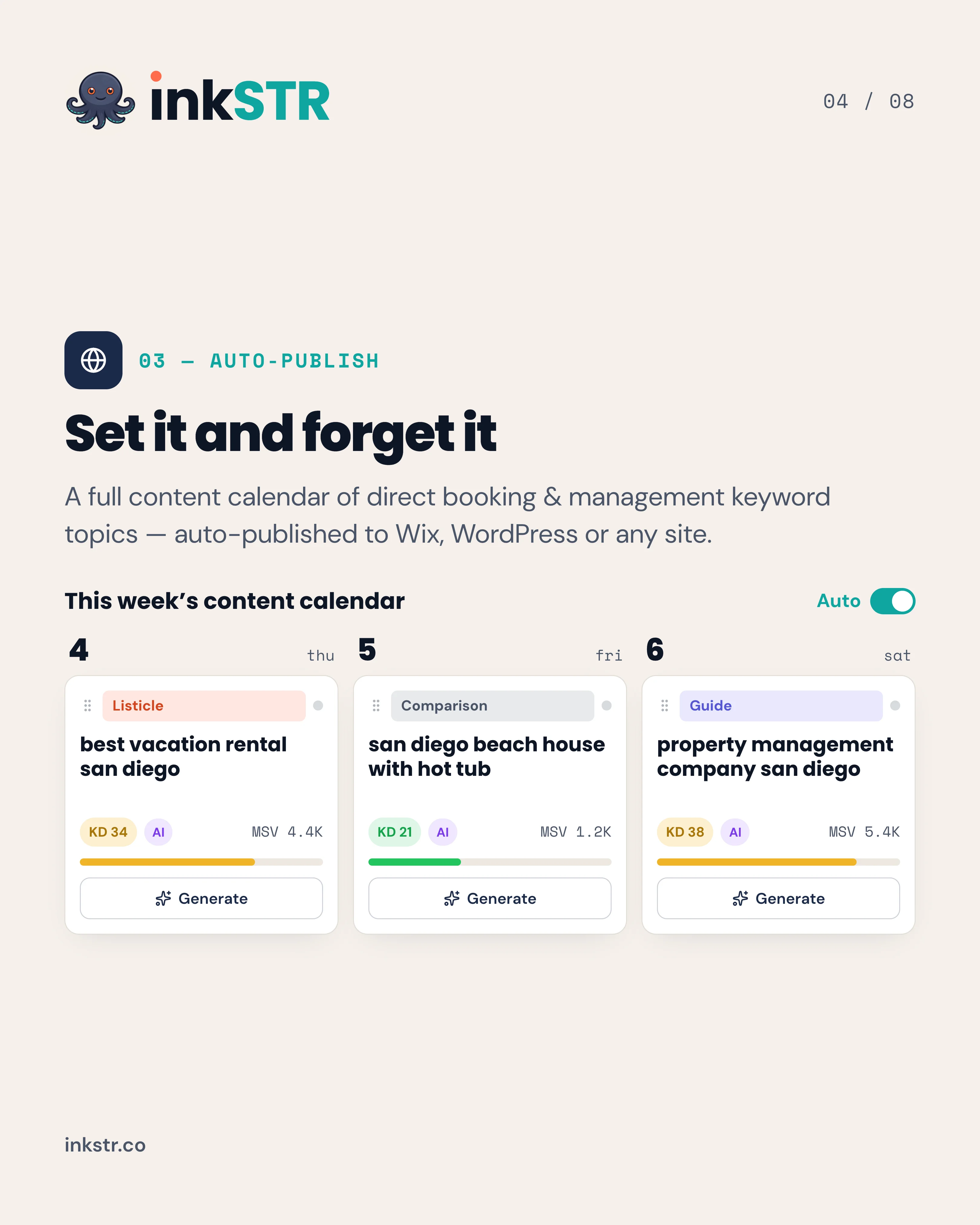
If you're ready to stop guessing what to publish next, inkSTR's content calendar lays out your entire pipeline, from keyword to draft to published post, in one view. Start a free trial and see your first content plan today.
Content powered by inkSTR.co
Enjoyed this article? Share it:
Get more of inkSTR in Google Search
Add inkstr.co as a preferred source and our articles show up more in Top Stories, AI Overviews, and AI Mode — with a “Preferred” badge.
Get more guides like this
New SEO and AI-search guides, straight to your inbox. No spam, unsubscribe anytime.