Property Management Marketing Automation That Actually Works
Property management marketing automation means using software to handle the repetitive work of attracting new owner clients and filling vacancies, so tasks like lead follow-up, listing syndication, and content publishing happen on a schedule instead of a manual to-do list. For short-term rental managers, this typically covers keyword research, blog publishing, email nurture sequences, and review collection running without someone manually triggering each step.
Key Takeaways
- Property management marketing automation covers lead capture, content publishing, owner-acquisition nurture sequences, and guest retention, replacing manual, one-off marketing tasks with scheduled systems.
- Content marketing generates roughly three times more leads per dollar spent than paid advertising for B2B SaaS companies, according to industry benchmarks, making organic content one of the highest-ROI channels for owner acquisition.
- Automated guest communication workflows can cut staff time on routine messaging by 40 to 60 percent, based on research cited by the Institute of Real Estate Management, though the exact figure varies by portfolio size and tooling.
- A five-market vacation rental brand using inkSTR grew from 26 to 1,924 monthly Google search visits in four months after publishing 114 articles across its portfolio, tracked through Google Search Console.
- STR operators typically juggle three to five separate software tools to run their operations, creating integration gaps that manual marketing workflows rarely account for.
- inkSTR automates the content side of property management marketing automation, generating, scheduling, and publishing SEO-optimized articles across every property in a portfolio from one dashboard.
If you manage more than a handful of short-term rental units, you already know marketing eats time you don't have. Every new listing needs a description. Every prospective owner asking about your management fees needs a response before they call a competitor instead. In 2026, most of that work still happens manually inside small and mid-size STR management companies, which means it happens late, inconsistently, or not at all.
Property management marketing automation exists to close that gap. It's the umbrella term for software and workflows that handle lead capture, nurture sequences, listing marketing, and retention campaigns without someone manually sending each message or writing each post. For property managers running a growing portfolio, this is core infrastructure: it separates a company that scales from one that stalls out managing 15 to 20 properties because the owner is stuck writing marketing copy at midnight.
This guide walks through what property management marketing automation includes, how to build it out step by step, and where most STR-specific companies get it wrong. We'll also cover the content side of the equation, the part most generic marketing automation guides skip, and where inkSTR fits specifically for short-term rental operators.
What Is Property Management Marketing Automation?
Property management marketing automation is the use of software to run marketing tasks on triggers and schedules instead of manual action, covering lead response, content publishing, email nurture, and review collection for rental businesses. For short-term rental managers specifically, it typically spans two goals: filling vacancies with guest bookings and winning new owner clients for the management side of the business.
Most general property management automation content, written for long-term residential landlords, focuses on tenant applications and lease renewals. That framework doesn't map cleanly onto STR operations. Short-term rental managers have a dual audience: guests booking a stay, and property owners deciding whether to hire a manager at all. A workflow built only around lease signing misses half the job.
In practice, STR-specific marketing automation covers instant response to new inquiries, follow-up sequences for prospects who go quiet, seasonal listing promotion, owner-acquisition content that ranks in search, and review requests after a stay. Each of these can run on autopilot once the triggers and content are built. The trouble, as we'll get into, is that most companies build half the system and leave the content half completely manual.
This is exactly the gap inkSTR was built to close. Generic marketing automation platforms handle email sequences and CRM triggers well. None of them understand short-term rental terminology or how to write content that captures owner-acquisition intent. That's a specialized problem, and it's the one we focus on.
How Do You Market Your Property Management Company Step by Step?
Marketing a property management company effectively requires a sequence: define your ideal owner client, build lead capture into every channel, automate follow-up, publish content that targets owner-acquisition search terms, and layer in retention campaigns for existing clients. Skipping the content step is the most common mistake we see across STR management companies of every size.
Step 1: Define Your Owner-Acquisition Profile
Before automating anything, identify what kind of owner client you actually want. A boutique operator managing five luxury cabins needs different marketing than a company scaling toward 50 units across multiple markets. Your content, your ad targeting, and your follow-up messaging should reflect that distinction, not a generic "we manage rentals" pitch.
Step 2: Build Instant Lead Response Into Every Channel
When a prospective owner fills out a contact form or a potential guest messages about a listing, the response window matters. Manually checking email a few times a day means losing prospects to whichever competitor responded first. Automated instant-response workflows, triggered the moment a form submits, keep you in the conversation without someone sitting at a keyboard all day.
Step 3: Automate Follow-Up Sequences for Unresponsive Prospects
Most owner leads don't convert on the first message. A follow-up sequence, spaced over days rather than sent all at once, keeps your company top of mind without manual tracking in a spreadsheet. This is standard CRM territory, and a connected email platform can handle it well.
Step 4: Publish Owner-Acquisition and Guest-Facing Content on a Schedule
Here's where most STR management companies fall apart. Writing one quality blog post manually takes three to five hours of research and writing, and a freelance travel writer charges $300 to $700 per post. At that pace and cost, most operators publish sporadically, if at all, while competitors who publish consistently capture the search traffic instead.
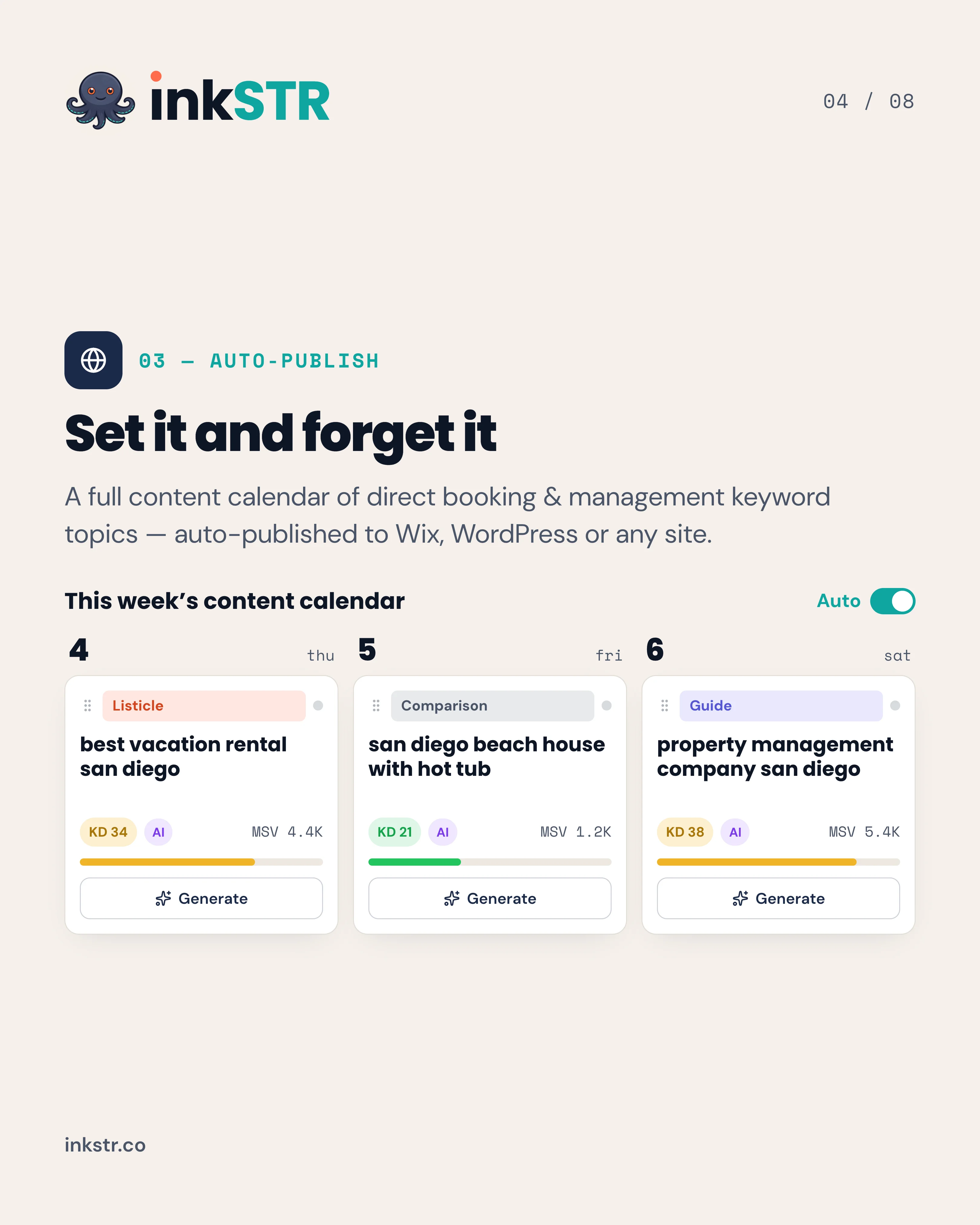
We built inkSTR's Content Calendar specifically because this step is the one that gets skipped. It schedules and manages blog publishing on autopilot, so content keeps going out whether or not anyone on your team has three free hours that week. Combined with the AI Content Writer, which generates the SEO-optimized draft, the entire publishing step runs without a human bottleneck.
Step 5: Layer in Retention and Review Automation
Once a guest checks out or an owner renews their contract, automated review requests and satisfaction surveys keep the relationship active without manual outreach. Renewal reminders that start the conversation early, rather than waiting until a contract is close to expiring, consistently perform better than last-minute outreach.

What Are the Core Categories of Marketing Automation Tools?
Marketing automation tools for property managers generally fall into a few functional categories: CRM and lead-nurture platforms, email and SMS marketing systems, social media scheduling tools, local SEO and review management platforms, and content publishing systems. Most STR companies end up running two or three of these simultaneously rather than one all-in-one platform.
CRM and lead-nurture platforms handle the lead capture and follow-up sequence side, tracking prospects from first inquiry through signed management agreement. Email and SMS marketing systems manage segmented campaigns and automated drip sequences to owners and past guests. Social scheduling tools queue posts across channels so social presence doesn't depend on someone remembering to post that day.
Local SEO and review platforms center on Google Business Profile optimization and local search visibility, which matters heavily for property managers competing on "[market] vacation rental management" searches. Content publishing systems, the category we focus on, handle the blog and website content that captures both guest search intent and owner-acquisition search intent over the long term.
STR operators typically run three to five separate tools across these categories, which creates real integration friction. inkSTR doesn't try to replace your CRM or your email platform. It specifically owns the content publishing category, generating and scheduling SEO content through the Auto-Publishing feature so it fits alongside whatever CRM or email tools you already run, rather than asking you to rebuild your entire stack.
| Automation Category | What It Handles | Typical Staffing Impact |
|---|---|---|
| CRM / Lead Nurture | Inquiry tracking, follow-up sequences, applicant status | Reduces manual lead tracking and missed follow-ups |
| Email / SMS Marketing | Segmented campaigns, renewal reminders, drip sequences | Cuts manual send time; standard in most CRMs |
| Social Scheduling | Queued posts across channels | Removes daily manual posting task |
| Local SEO / Reviews | Google Business Profile, review requests | Improves local visibility without daily upkeep |
| Content Publishing (inkSTR) | Keyword research, blog drafting, scheduling, publishing | Removes the 3-5 hour manual writing bottleneck per post |
What Is the Highest Value Marketing Role in a Growing Property Management Company?
The highest value marketing function inside a growing short-term rental management company is content and SEO strategy, because it drives owner-acquisition leads and guest bookings without the recurring cost of paid advertising. Organic leads cost roughly 84 percent less than paid search leads, which makes content the marketing function with the best long-term return for companies trying to scale a portfolio.
This isn't the flashiest role. Social media management gets more attention because it's visible day to day, but a ranking blog article can drive organic search traffic for two to five years after publication, compounding in value while a paid ad stops working the moment you stop paying for it. For a management company trying to grow from 15 units to 50, that compounding traffic eventually replaces cold outreach as the primary lead source.
The problem is that most companies can't justify hiring a dedicated content strategist or SEO specialist until they're already large enough to afford one. That's the gap between knowing content matters and having the resources to execute it consistently, week after week, across every property in the portfolio.
We built inkSTR because we watched this exact bottleneck play out across dozens of STR management companies. The Keyword Research feature finds the terms prospective owners and guests actually search, so you don't need to hire a strategist to figure out what to write about. It's the highest-leverage marketing function in the business, made accessible without the headcount.
What Are the Core Functions Every Property Management Marketing Strategy Needs?
Every effective property management marketing strategy needs five core functions working together: lead capture and instant response, prospect nurture and follow-up, content that ranks in search, retention and renewal outreach, and performance tracking. Skipping any one of these creates a visible gap in results, usually showing up as traffic without conversions or leads without follow-through.
Lead capture and instant response means every inquiry, whether from a website form, a phone call, or a listing platform message, gets acknowledged within minutes, not hours. Prospect nurture and follow-up covers the sequence of messages that keep unresponsive leads warm without manual tracking in a spreadsheet or a sticky note on someone's monitor.
Content that ranks in search is the function most companies underinvest in, mainly because it requires sustained weekly output rather than a one-time project. Retention and renewal outreach keeps existing owner clients and repeat guests engaged, since acquiring a new owner client costs significantly more effort than retaining one who's already satisfied with your management. Performance tracking closes the loop, showing which channels and content produce signed contracts and completed bookings.
Most STR companies build the first two functions reasonably well, since CRM tools handle lead capture and nurture out of the box. Content consistently falls last, not because it matters less, but because it demands the most ongoing labor. That's the specific function inkSTR automates: the How inkSTR Works page walks through the full pipeline from keyword to published post, covering the one function most marketing stacks leave incomplete.
Why Isn't Your Vacation Rental Getting Enough Direct Bookings or Owner Leads?
Vacation rental properties and management companies often struggle with bookings and leads because their marketing automation stops at email and social media, leaving organic search content running on an inconsistent or nonexistent schedule. Traffic without conversions almost always traces back to a content gap, not a pricing or photography problem.
Think about what happens without a content system. Someone on your team writes a blog post when they find a spare afternoon, maybe once a month if you're lucky. Meanwhile, a competitor publishing weekly captures the search terms your prospective guests and owners are typing into Google. Airbnb and guest fees combined already take 17 to 19 percent of every booking, so every dollar you can redirect toward direct, commission-free bookings compounds over a full season.
We saw this exact pattern with a Smoky Mountains cabin rental brand running on inkSTR. Their organic search presence had plateaued at 788 monthly Google Search clicks, leaving growth entirely dependent on OTAs and paid channels. After building out a continuous content pipeline of pillar and cluster articles, grounded in real property data and auto-published to WordPress on a steady cadence, monthly clicks grew to 5,195 within eleven months, with search impressions climbing from 130,000 to 450,000 over the same period. That pipeline generated $309,775 in direct booking revenue in its first fourteen months, measured directly in Google Search Console and Google Analytics.
That's the specific outcome inkSTR's content pipeline is built to produce: consistent, scheduled publishing that compounds instead of a single blog post that gets forgotten. If you want to dig deeper into why traffic and bookings often diverge, our piece on why your vacation rental website is not ranking on Google covers the technical side of this same problem.
How Do You Set Up a Marketing Automation Workflow From Scratch?
Setting up a property management marketing automation workflow starts with defining your triggers, mapping your content calendar, connecting your publishing platform, and establishing a review cadence before scaling to additional properties. This section walks through the sequence in order, since skipping steps creates gaps that show up months later as missed leads or stalled traffic.
- Define your triggers. Identify the exact moments that should kick off automation: a new inquiry form submission, a guest checkout, an owner contract renewal date approaching. Each trigger needs a specific, timed response, not a vague "we'll get to it" plan.
- Map your content calendar around search intent. Before writing anything, identify the keywords prospective owners and guests actually search. inkSTR's Keyword Research tool surfaces these terms directly, removing the guesswork of picking blog topics that nobody searches for.
- Connect your publishing platform. Whether you run Wix, WordPress, or a custom site, your content system needs a direct publishing connection. inkSTR's Auto-Publishing feature pushes finished articles straight to your site without manual copy-paste steps.
- Build your follow-up sequences. Set up timed messages for unresponsive leads, spaced over several days rather than sent all at once. This applies to both prospective owners and guests who inquired but didn't book.
- Establish a review and referral cadence. Automate review requests after checkout and renewal reminders that start well before a contract's expiration date, not the week before.
- Track performance and adjust. Monitor which content, which sequences, and which channels produce signed contracts and completed bookings, then double down on what's working.
A five-market vacation rental brand followed roughly this sequence with inkSTR, publishing 114 articles across five markets in four months, building pillar and cluster content grounding real property details into buying-intent searches. Monthly Google search visits grew from 26 to 1,924, with Google Search Console clicks climbing from 290 to 1,706 between May and July 2026 alone. Their first commission-free direct bookings, totaling more than $2,500, closed within that same four-month window.
Ready to automate your content marketing?
inkSTR handles keyword research, content strategy, article writing, and publishing, all on autopilot.
What Compliance and Risk Controls Should Your Automation Include?
Property management marketing automation must include consent management for SMS and email, fair-housing safeguards in any personalized messaging, clear unsubscribe handling, and human review of AI-generated content before publication. This is the section most marketing automation guides skip, and it's where companies expose themselves to real liability.
Consent matters because most jurisdictions require opt-in before you send marketing texts or emails, not just after someone books a stay. Exact rules vary by state and platform, so check your obligations with counsel rather than assuming a blanket policy covers you. Fair-housing considerations apply even in short-term rental marketing when personalization touches protected characteristics, so review any dynamic content rules before deploying broad segmentation. Unsubscribe handling needs to be immediate and automatic, not a manual process someone handles when they remember.
Human review of AI-generated content deserves particular attention as more companies adopt content automation in 2026. Automated systems can draft accurate, well-researched articles, but a human should confirm property details, pricing figures, and location-specific claims before anything publishes. This is standard practice inside inkSTR's workflow: content generates automatically, but the publishing schedule gives your team visibility to review before it goes live, rather than publishing blind.
Data retention policies for guest and owner information also matter, particularly around how long you keep contact records and how that data moves between your CRM, your email platform, and your content system. Building these controls in from the start avoids a painful retrofit later.
What Does the Unit Economics of Content-Driven Marketing Automation Look Like?
The unit economics of content marketing automation come down to cost per article, time saved versus manual writing, and revenue attributed per published piece. A ranking blog article can drive organic search traffic for two to five years, which means the cost of producing it gets spread across a multi-year revenue window rather than a single campaign.
Compare the manual path to the automated one directly. A freelance travel writer charges $300 to $700 per quality blog post, and writing one manually takes three to five hours even if you do it yourself. A management company trying to publish weekly across three or four properties needs either a serious freelance budget or a dedicated staff hour block that most small operators don't have.
inkSTR costs $99 per month and generates, schedules, and publishes articles automatically on a set schedule, which changes the math. Instead of paying per article or burning staff hours, the entire monthly output runs on a flat cost that doesn't scale with volume the way freelance writing does. A single direct booking is typically worth $1,000 to $4,000 in revenue, so one converted lead from a ranking article covers months of the platform cost.
| Approach | Cost Structure | Time Required |
|---|---|---|
| Freelance writer per post | $300-$700 per article | Writer's time plus your review and publishing |
| In-house manual writing | Staff salary time (opportunity cost) | 3-5 hours per article |
| inkSTR automated pipeline | $99/month flat, per Pricing | Scheduled generation and publishing on autopilot |
The Charlotte and Lake Norman-area STR management company we work with illustrates this on the owner-acquisition side specifically. After building an owner-facing content pipeline structured for AI-search citability from day one, they generated four property-owner leads directly from AI search within their first month on inkSTR, alongside a 4.6x increase in Google impressions compared to the year prior. That's owner-acquisition ROI from a content system running on autopilot.
How Do You Prioritize Automation Across a Growing Portfolio?
Prioritizing marketing automation across a growing property portfolio means automating the highest-frequency, highest-friction tasks first, then layering in content and retention systems as the portfolio scales past what one person can manually manage. For most STR companies, lead response and follow-up come first, content publishing comes second, and advanced segmentation comes last.
Common mistakes we see include automating social media posting before fixing lead response times, which optimizes the least impactful channel first. Another frequent misstep is building content for guest-facing search terms while ignoring owner-acquisition keywords, which caps growth at your existing unit count instead of attracting new management contracts.
A practical trade-off worth understanding: full automation of every function sounds appealing, but companies that try to automate everything at once, without dedicated bandwidth to build it correctly, tend to end up with broken workflows nobody trusts. Start with lead response and content, since those two functions compound fastest, then expand outward.
inkSTR's multi-project support handles the scaling challenge directly for companies managing content across many properties or brands. Each property gets its own independent content pipeline, run from a single dashboard, so managing content across 15 properties doesn't mean duplicating your workflow 15 times. That's the specific operational pain point inkSTR was designed to remove as portfolios grow.
Data & Evidence: What Do Verified Market Numbers Say About This Space?
The vacation rental software and property management software markets are both expanding rapidly heading into 2026, which explains why marketing automation adoption is accelerating alongside them. The global vacation rental property management software market was valued at $4,900 million in 2026 and is projected to reach $12,500 million by 2035, an 8.9 percent compound annual growth rate. The broader global property management software market sits at $3.61 billion in 2026, projected to reach $5.89 billion by 2033.
On the content marketing side specifically, content marketing generates roughly three times more leads per dollar spent than paid advertising for B2B SaaS companies, according to industry benchmarks, which explains why organic content consistently outperforms paid channels for owner acquisition over time. Meanwhile, 56 percent of companies already use AI in digital marketing as of 2026, signaling that AI-assisted content production is quickly becoming standard practice rather than a novelty.
As of September 2026, across inkSTR customer sites specifically, we've published more than 4,000 articles, generating over 2.6 million Google Search impressions in the trailing 90 days across connected customer properties. That scale reflects what happens when content publishing runs on a consistent schedule instead of whenever someone finds spare time.

Practical Guidance: How Should You Choose and Roll Out Automation Tools?
Choosing marketing automation tools for a property management company means matching each tool to a specific bottleneck, checking integration with your existing CRM or PMS, and rolling out one function at a time rather than switching everything simultaneously. Buildium and similar platforms recommend testing workflows, monitoring performance, and adjusting based on real results rather than assumptions, a principle that applies broadly across any automation rollout.
Before adopting a new tool, walk through this checklist:
- Does it solve a function you're currently doing manually, or does it duplicate something your CRM already handles?
- Does it integrate with your property management software (Hospitable, OwnerRez, or similar) without manual data re-entry?
- Does the tool understand short-term rental terminology specifically, or is it a general real estate tool applied to a niche it wasn't built for?
- Can you measure its output in real terms: leads generated, traffic gained, bookings attributed?
- Does the pricing scale reasonably as your portfolio grows, or does cost jump sharply at each tier?
The most common rollout mistake is trying to automate every function in the same month. Start with the highest-friction, highest-frequency task, usually lead response or content publishing, prove it out, then expand. For guidance on aligning your content with what converts, our guide on vacation rental blog topics that actually drive bookings is a useful companion resource once your publishing system is running.
For companies weighing whether AI-generated content can hold up under real SEO and citation standards, our piece on ranking in AI search for STR operators covers what changed in how Google and AI assistants surface hospitality content in 2026.
Frequently Asked Questions
How do I find property management leads without paying for expensive advertising?
The most reliable low-cost method is ranking organically for owner-acquisition search terms like "short-term rental management company near me" or "how to hire a vacation rental manager," since organic leads cost roughly 84 percent less than paid search leads. Building a consistent content pipeline targeting these terms, rather than relying solely on referrals or paid ads, typically produces compounding results over months rather than a one-time spike.
How do I get property management leads to convert into signed contracts?
Convert leads by responding instantly to inquiries, then following up with a timed sequence over several days rather than a single message. Content that speaks directly to a prospective owner's specific concerns, like fee structure or portfolio management capacity, tends to convert better than generic "we manage rentals" messaging.
What are the core categories of marketing automation tools for property managers?
The core categories are CRM and lead-nurture platforms, email and SMS marketing systems, social scheduling tools, local SEO and review management platforms, and content publishing systems. Most STR companies run several of these simultaneously, since no single platform covers every function well, and STR operators typically use three to five tools total to manage operations.
How to market your property management company effectively in 2026?
Effective marketing in 2026 requires instant lead response, automated follow-up sequences, and a consistent content publishing schedule targeting both owner-acquisition and guest-facing search terms. Companies that skip the content function tend to plateau, since paid channels alone don't build the compounding organic traffic that reduces long-term acquisition costs.
What are the five core functions every property management marketing strategy needs?
The five functions are lead capture and instant response, prospect nurture and follow-up, content that ranks in search, retention and renewal outreach, and performance tracking. Each function needs to run consistently; skipping content is the most common gap we see across growing STR management companies.
Can AI-generated content actually rank on Google and get cited in AI search tools like ChatGPT?
Yes, when the content is built around real search intent, grounded in accurate property and market data, and structured for direct extraction. inkSTR's customer articles have secured over 1,184 verified AI-search citations as of September 2026, confirming that well-structured automated content performs in both traditional search and AI answer engines.
How long does property management marketing automation take to show results?
Lead response and follow-up automation show immediate results, often within days of activation, since they close gaps in response time. Content-driven results, like organic traffic and owner-acquisition leads, typically build over three to six months of consistent publishing, with the Peak Properties case showing visible traffic gains within four months of a sustained pipeline.
Conclusion
Property management marketing automation only works when every function runs consistently, not just the easy ones. Lead response and email sequences are table stakes at this point. The function that separates growing management companies from stalled ones is content, published on a schedule targeting both owner-acquisition and guest search terms, something most companies can't sustain manually at $300 to $700 per post and three to five hours of writing time each.
That's the specific gap inkSTR closes for short-term rental operators and property managers in 2026. We built inkSTR to own the content function: keyword research, drafting, scheduling, and publishing, running automatically across every property in your portfolio from a single dashboard.
If keeping up with keyword research and blog publishing across your properties feels impossible right now, that's exactly what we built inkSTR to automate. Get started with inkSTR and see your first content plan mapped out today.
Content powered by inkSTR.co
Enjoyed this article? Share it:
Get more of inkSTR in Google Search
Add inkstr.co as a preferred source and our articles show up more in Top Stories, AI Overviews, and AI Mode — with a “Preferred” badge.
Get more guides like this
New SEO and AI-search guides, straight to your inbox. No spam, unsubscribe anytime.