STR Content Automation Tools: The Real 2026 Comparison
STR content automation tools are software platforms that generate, schedule, and publish blog content for vacation rental websites without a writer manually drafting each post. The best ones for short-term rental operators combine keyword research and SEO-optimized drafting with direct publishing to Wix or WordPress, replacing the 3 to 5 hours a manual blog post typically takes with a workflow that runs on autopilot.
Key Takeaways
- STR content automation tools handle keyword research, drafting, scheduling, and publishing in one pipeline, cutting the manual time investment that typically runs 3 to 5 hours per post.
- General-purpose AI writing tools do not understand vacation rental terminology or location-based hospitality SEO, which shows up as generic output that needs heavy editing.
- A freelance travel writer typically charges $300 to $700 per quality blog post, a cost that scales painfully across a multi-property portfolio.
- A single ranking blog article can drive organic search traffic for 2 to 5 years, making content one of the few marketing investments with long-term compounding return.
- Airbnb host and guest fees combined run 17 to 19% of every booking, a cost direct-booking content is specifically designed to reduce.
- inkSTR automates the full pipeline, from keyword research to scheduled publishing, built specifically for short-term rental terminology and traveler search intent rather than adapted from a generic content tool.
If you run a vacation rental business in 2026, you already know content marketing works. What you probably don't know is which tool actually fits the job. Search "content automation" and you get a flood of generic marketing software built for e-commerce brands and social media agencies, none of which understand what a guest searching "pet-friendly cabin near the Smokies with a hot tub" is actually looking for.
This article compares the categories of content automation tools available to STR operators in 2026: general marketing automation platforms, AI writing assistants, social media schedulers, and purpose-built STR content platforms. We will look at what each category does well, where it falls short for vacation rental marketing specifically, and how to think about the tradeoff between generic flexibility and hospitality-specific precision.
At inkSTR, we built our platform after watching operators try to force generic tools into a niche they were never designed for. The pattern repeats: a host signs up for a broad AI writer, gets content that reads like it could describe any rental anywhere, and sees no ranking movement after months of publishing. This comparison is meant to help you avoid that detour.
What Are the Top Marketing Automation Tools for Short-Term Rentals?
Marketing automation tools for short-term rentals are software platforms that handle repetitive marketing tasks, primarily content creation, scheduling, and publishing, without daily manual input. The strongest options for STR operators fall into two groups: general-purpose marketing suites adapted for hospitality, and platforms built specifically around vacation rental search intent.
General marketing automation platforms typically excel at email sequences and CRM workflows. They were built for B2B sales funnels or e-commerce cart recovery, not for ranking a beach house rental against dozens of nearby competitors on Google. When an operator tries to bend one of these tools toward blog content, the keyword research module usually has no concept of "walkable to the boardwalk" or "3-night minimum stay" as search-relevant phrases.
Without a platform built for this niche, you are left doing the translation work yourself: taking generic content suggestions and rewriting them with property specifics and local landmarks. That manual layer erases most of the time savings the automation was supposed to provide.
This is exactly the gap inkSTR was built to close. Our Keyword Research feature is trained specifically on vacation rental and traveler search patterns, not generic retail or B2B queries, so the keyword suggestions already reflect how guests actually search for a stay in a beach town, mountain retreat, or urban market. As of September 2026, inkSTR has published more than 4,300 articles across active customer projects, all built around this niche-specific keyword logic rather than adapted from a general marketing template.

Can AI Write Blog Posts and Social Content for a Vacation Rental Business?
Yes, AI can generate blog posts, listing descriptions, and social content for vacation rentals, but the quality depends entirely on whether the tool understands hospitality-specific detail. A general AI assistant can produce grammatically correct paragraphs about "cozy accommodations" and "stunning views," but it cannot know your property's actual bedroom count, distance to the trailhead, or house rules unless you feed it that information every session.
This is where most hosts get burned. They ask a general-purpose chatbot to write ten blog posts, and the first draft looks fine on the surface. But read closely and every post could describe any rental in any location. There are no named local landmarks, no specific amenity call-outs, no answer to the question a guest is actually typing into Google. Publishing that content wastes the publishing slot without moving rankings.
Manually fixing this means rewriting every AI draft from scratch and feeding property facts into the prompt each time, hoping the AI does not invent a detail you then have to catch before it goes live. For an operator managing even five properties, that is hours of correction work per week, the same time drain the automation was supposed to eliminate.
Our AI Content Writer solves this differently. It generates SEO-optimized blog posts against the keyword research inkSTR already ran, and because the platform is built specifically for STR content, drafts start from hospitality context rather than a blank generic prompt. We still recommend reviewing the first several drafts for brand voice and property-specific accuracy before switching to fully automated publication.
What Is the Best SEO Software for Vacation Rentals?
The best SEO software for vacation rentals combines keyword research built around traveler search intent with automated publishing to the CMS you already use, typically Wix or WordPress. Generic SEO tools built for broad industries can identify search volume, but they rarely understand which keywords convert browsers into direct bookings versus which keywords just attract OTA-bound traffic.
Consider what a generic SEO tool sees when it analyzes "cabin rental Gatlinburg": search volume, difficulty score, related terms. What it misses is the difference between someone searching that phrase to browse Airbnb listings versus someone specifically looking for a direct-booking site, a distinction that matters for where you should be spending content effort.
Doing this analysis manually means cross-referencing generic keyword tools with your own booking data and guessing at intent, often getting it wrong. Most independent hosts do not have the bandwidth for that kind of research on top of running the property itself.
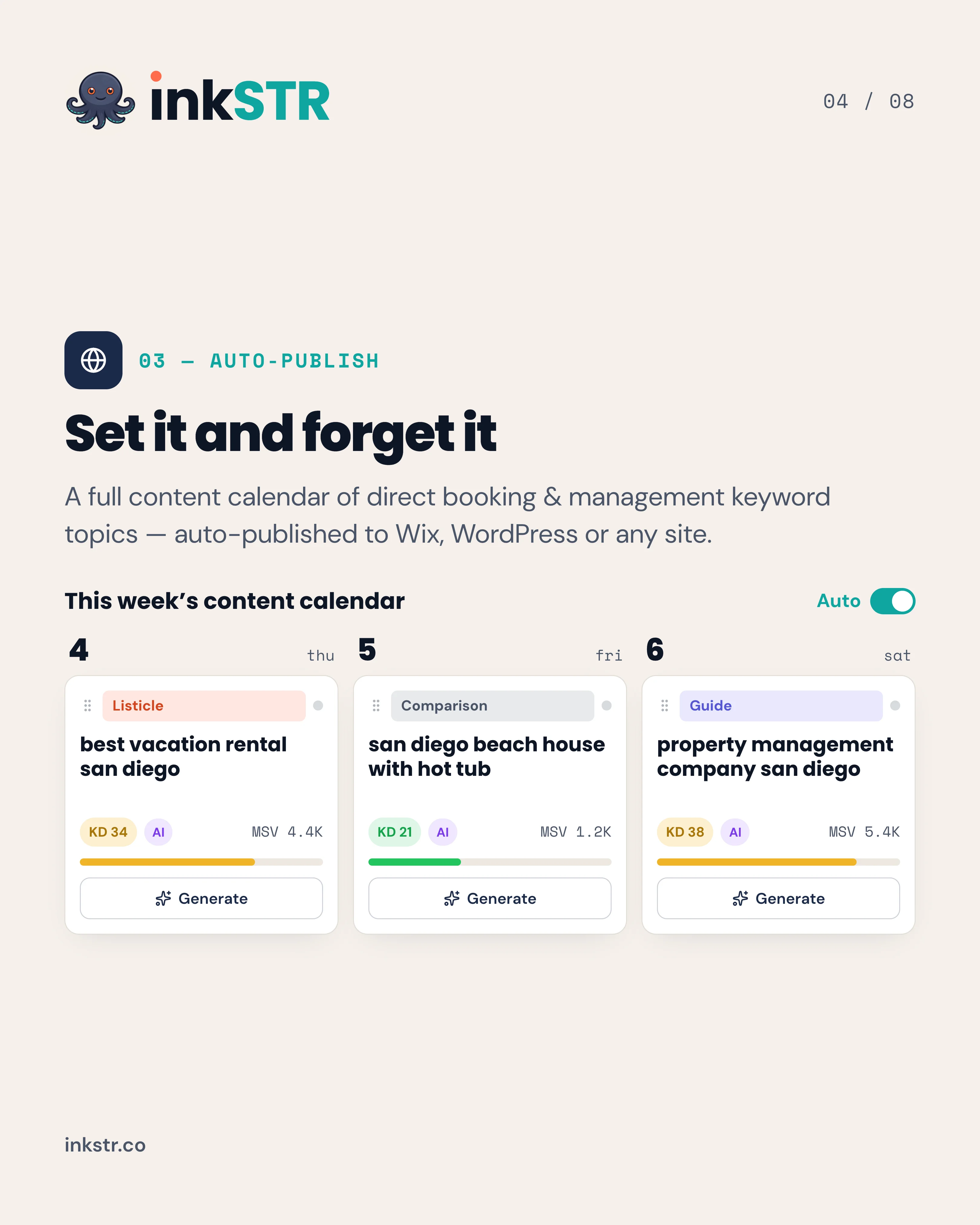
inkSTR's Keyword Research tool builds around this exact distinction, surfacing terms that reflect actual traveler search patterns rather than generic commercial intent. Paired with our Auto-Publishing feature, which pushes finished articles directly to Wix or WordPress without a manual copy-paste step, the entire research-to-live-page pipeline runs without you touching a keyword spreadsheet. In one case, a five-market vacation rental brand went from averaging 26 monthly Google search visits to 1,924 in four months after running inkSTR's pillar-and-cluster content structure across all five markets, published directly to Wix.
What Are the Best AI Content Tools for Short-Term Rental Marketing?
The best AI content tools for short-term rental marketing are platforms that treat keyword research, drafting, and publishing as one connected pipeline rather than three separate tasks. Standalone AI writers can produce a draft. Standalone schedulers can post it. But without the connective tissue between research and publishing, an operator ends up manually stitching multiple tools together every week.
Here is how the two categories actually compare in practice for an STR operator:
| Capability | General-purpose AI writing tools | Purpose-built STR content platforms |
|---|---|---|
| Understands vacation rental terminology and traveler search intent | No, requires manual prompting each time | Yes, built into the keyword and drafting logic |
| Publishes directly to Wix or WordPress | Rarely, usually requires manual copy-paste | Yes, via automated publishing integration |
| Runs on a recurring content calendar without daily input | Limited, mostly single-draft generation | Yes, drag-and-drop scheduling on autopilot |
| Handles multi-property content pipelines separately | Not designed for this use case | Yes, via multi-project support |
| Typical monthly cost for STR-specific use | Varies widely by general subscription tier | Starts at $99/month |
| Manual writer cost per post it typically replaces | N/A | $300 to $700 per post from a freelance travel writer |
The gap is not that general tools write badly. It is that they were not built to understand what makes a mountain retreat listing different from a lake house listing, or why a guest searching for a beach rental cares about parking and walkability in a way a hotel guest rarely does. That is a specialization problem, and it is exactly why inkSTR exists as a niche-specific alternative rather than a general tool retrofitted for hospitality.
What Content Can AI Automate for Short-Term Rentals?
AI can automate several distinct categories of short-term rental content: blog articles targeting traveler search queries, listing descriptions, local area guides, and metadata like titles and meta descriptions. Each category has a different level of risk if the AI invents details rather than working from verified property facts.
Blog content carries the lowest risk when built on a source-of-truth system, meaning the AI drafts from actual property specifics (bedroom count, distance to landmarks, named amenities) rather than generic filler. Naming the exact bedroom and bathroom count within the first two sentences of listing copy, and naming specific amenities like a coffee maker or dishwasher rather than vague phrases like "fully equipped kitchen," applies equally well to blog content.
Local area guide content is where automation adds the most compounding value, since it targets long-tail searches ("hiking trails near [property]," "best breakfast spot walking distance from downtown") that a generic listing page never captures. We cover this approach in more depth in our guide to local area guides that sell, which walks through how to turn neighborhood knowledge into searchable content.
Without a content pipeline that pulls from verified property data, you risk publishing AI content that invents a "five-minute walk to the beach" claim that is actually a fifteen-minute drive, a factual error that erodes guest trust and can trigger review complaints. inkSTR's workflow builds content against your actual keyword research and property context rather than generating from a blank prompt, reducing that invention risk at the drafting stage.
How Does AI Generate Short-Term Rental Listing and Blog Content?
AI generates short-term rental content by combining a keyword or topic input with a language model trained to produce SEO-structured text, then applying formatting rules like heading hierarchy and meta descriptions. The output quality depends heavily on what data the model has access to before it starts writing.
A generic AI writer works from whatever you type into the prompt box that session, which means quality is inconsistent from post to post and entirely dependent on how much detail you remember to include. First it needs the topic, then the property facts, then formatting instructions, and if you skip a step the draft comes back generic.
A dedicated pipeline works differently. inkSTR's recommended workflow runs five connected stages: keyword research, outline and draft generation, human review and fact-checking, publishing with proper metadata, and performance tracking. Because each stage feeds the next automatically, the draft stage already has keyword context loaded in, and the publishing stage already has metadata formatting applied, removing the manual handoff points where quality typically breaks down.
As a result, you spend your review time checking facts and voice rather than rebuilding structure from scratch. That is the specific problem our How inkSTR Works page walks through in full, covering the exact path from keyword to published post.
Is It Worth Paying a Content Writer for Your Vacation Rental, or Should You Automate?
Paying a freelance content writer for vacation rental blog posts typically costs $300 to $700 per article, and writing one quality post yourself takes 3 to 5 hours of research and drafting. For an operator who needs a steady publishing cadence, either option becomes expensive fast, whether the cost is paid in dollars or in hours pulled away from guest communication.
Run the math on a modest schedule of four posts a month. At freelancer rates, that is $1,200 to $2,800 monthly, recurring indefinitely as long as you want fresh content. At the DIY rate, that is 12 to 20 hours a month of writing time, time that competes directly with cleaning coordination and guest messaging.
Compare that to a $1,000 to $4,000 direct booking, which is the typical revenue range for a single reservation booked outside Airbnb or VRBO. A ranking blog article can drive that kind of booking repeatedly for 2 to 5 years after publication, meaning the content investment compounds while a one-time freelance invoice does not scale with your growing library of pages.
This tradeoff is exactly why we priced inkSTR at $99/month rather than per-article. Our Pricing page reflects a flat cost for unlimited pipeline output rather than a per-post fee, so the math improves the more consistently you publish instead of degrading like freelance costs do. We built the platform for operators who want the compounding return of content without the recurring per-post bill.
Ready to automate your content marketing?
inkSTR handles keyword research, content strategy, article writing, and publishing, all on autopilot.
How Do You Avoid Losing Brand Voice When Automating Content at Scale?
Losing brand voice during content automation happens when AI drafts publish without human review, allowing generic phrasing or invented details to slip onto a live site unchecked. The fix is building a review checkpoint into the pipeline rather than removing it entirely.
If you skip review because "the AI is good enough," you typically discover the problem only after a guest or a competitor notices an inaccurate claim, or a tone that does not match how you actually talk to guests. By then the content has already been indexed by Google, and fixing it means a rewrite plus a re-crawl wait.
We recommend reviewing the first several AI drafts closely for brand voice and property-specific accuracy before switching a project to fully automated publication, a practice we cover in detail in Article Automation Without Losing Your Brand Voice. This is not a one-time setup step. Voice drift can creep back in as you add new properties or markets, so periodic spot checks matter even after the pipeline is running smoothly.
inkSTR's Content Calendar is built around this exact checkpoint: drafts land in a scheduled queue where you can review before publish, rather than firing straight to your live site. If you manage content across ten or more listings, this matters especially, since our multi-project support keeps each property's voice and content pipeline independent instead of blending everything into one generic template.

What Should You Measure to Know Content Automation Is Actually Working?
Measuring content automation success means tracking organic search clicks, ranking keyword count, and direct booking revenue attributable to published content, not just how many articles you have published. Publishing volume alone tells you nothing about whether the content is reaching the right searchers or converting them into bookings.
Google Search Console is the baseline tool for this, showing impressions, clicks, and average position for every ranking keyword tied to your site. Pair that with your booking platform's referral data to see which published articles are actually driving direct reservations rather than just traffic.
In our own case data, a Smoky Mountains cabin rental brand grew monthly Google Search clicks from 788 to 5,195 over 11 months while running a continuous inkSTR content pipeline, with monthly search impressions climbing from 130,000 to 450,000 over the same period. That growth translated to $309,775 in attributed direct booking revenue across the first 14 months, measured directly in Google Search Console and Google Analytics rather than estimated.
A separate case saw four property-owner leads arrive from AI search results in a single month for an STR management company, alongside a 4.6x jump in Google impressions compared to the year prior. Track impressions, clicks, ranking keyword breadth, and revenue or lead attribution over a 3 to 6 month horizon, the typical window for consistent publishing to show meaningful movement.
How Do You Decide Between Refreshing and Rewriting Existing Content?
A content refresh means updating specific outdated details, statistics, or seasonal information within an existing article while keeping its structure and ranking history intact. A rewrite means restructuring the article's headings and core argument, essentially treating it as a new piece that happens to share a URL.
Refresh when the article's core topic and structure still match what searchers want, but details have gone stale: a mentioned local business closed, or a price range shifted. Refreshing preserves the ranking equity the page has already built, since Google generally does not penalize incremental updates the way it treats a full structural overhaul.
Rewrite when the article is ranking poorly despite reasonable age, when search intent for that keyword has shifted, or when the original draft was thin or built without proper keyword research to begin with. If an older post reads like it could describe any rental anywhere rather than your specific property and market, a rewrite is usually faster than trying to patch specificity into a generic skeleton.
Refresh first, and only escalate to a rewrite if performance tracking over 60 to 90 days shows no improvement after the refresh. inkSTR's performance tracking stage exists for exactly this decision point, flagging which published articles are underperforming so you know where to focus rewrite effort instead of guessing across your entire content library.
Practical Guidance: How to Choose the Right Content Automation Approach
Choosing the right STR content automation approach starts with matching the tool to your actual publishing volume and property count, not the tool with the most features. An independent host running one property has different needs than a property management company juggling 30 listings across five markets.
- Start with keyword research specificity. Confirm the tool understands vacation rental and traveler search terms before evaluating anything else, since generic keyword data leads every downstream step astray.
- Check for direct CMS publishing. A tool that generates drafts but requires manual copy-paste into Wix or WordPress erases most of the time savings automation promises.
- Build a source-of-truth document. List your property's bedroom count, named amenities, and distances to landmarks before turning on any automated drafting, so the AI has verified facts to work from instead of inventing them.
- Set a human review checkpoint. Review at minimum the first several drafts for voice and accuracy before allowing fully automated publication.
- Track performance at 30, 60, and 90 days. Use that window to decide which topics to expand and which need a refresh or rewrite.
- Avoid the common mistake of publishing volume over specificity. Ten generic posts rarely outperform three highly specific ones targeting real traveler search intent.
If you manage multiple properties, weigh how a tool handles separate brand voices per listing. Our multi-project support keeps each property's content pipeline independent, which matters more as your portfolio grows, a principle we cover further in Must-Have Tools for Short-Term Rental Managers Scaling Up.
Frequently Asked Questions
What tools automate an AI content pipeline from keyword research to WordPress publishing and reporting?
A full content pipeline needs four connected stages: keyword research built for your niche, AI drafting against that research, direct publishing to WordPress or Wix without manual copy-paste, and performance reporting through Google Search Console integration. inkSTR connects all four stages in one platform specifically for short-term rental content, rather than requiring you to stitch together separate keyword, writing, and publishing tools yourself.
What's the difference between a content refresh and a rewrite?
A refresh updates outdated details, prices, or seasonal information while keeping an article's existing structure and ranking history intact. A rewrite restructures the headings and core angle entirely, functioning as a new article on the same URL. Refresh first when the topic and structure still serve the search intent; rewrite when performance stays flat after 60 to 90 days or the original content was too generic to begin with.
When should I refresh vs rewrite content?
Refresh when core facts have gone stale but the article still ranks reasonably and matches current search intent. Rewrite when an article underperforms despite being live for several months, or when it reads generically without property-specific or market-specific detail. Performance tracking over a 60 to 90 day window is the clearest signal for which path to take.
How do I decide whether to rewrite or expand content during a refresh?
Expand a refresh when the existing article covers its topic well but is missing subtopics searchers also want answered, since adding sections can lift rankings without disrupting what already works. Rewrite instead when the entire foundation, from keyword targeting to structure, no longer matches what is actually ranking well in your market today.
Can AI-generated content actually rank on Google and get cited in AI search results like ChatGPT or AI Overviews?
Yes, when the content is built on real keyword research, verified property facts, and proper SEO structure, AI-generated content ranks the same way human-written content does. As of September 2026, inkSTR has secured more than 1,200 verified AI-search citations for customer content across its platform, showing that automated content can be cited by AI systems when it is structured for direct, quotable answers.
How long does it take for a vacation rental website to rank on Google?
Most vacation rental sites see meaningful traffic gains within 3 to 6 months of consistent publishing, though timelines vary by market competitiveness and existing domain authority. Some operators see faster movement: our case data shows one five-market brand jumped from 26 to 1,924 monthly Google search visits within four months of consistent publishing.
Do I need a blog if I already have a direct booking website?
Yes. A direct booking website without a blog has no mechanism for ranking against long-tail traveler searches, since your booking pages alone rarely target the informational queries guests type before they are ready to book. A blog captures that earlier-stage search traffic and funnels it toward your booking page, which is the core mechanism behind reducing dependence on Airbnb and VRBO referral traffic.
Conclusion
STR content automation tools exist on a spectrum from generic marketing platforms retrofitted for hospitality to purpose-built systems trained on vacation rental search intent from the start. The generic option costs less upfront in obvious dollars but costs more in correction time, since every draft needs manual rework to sound like it describes an actual property in an actual market. The specialized option starts with hospitality context already built in, which shows up in ranking speed and content quality over time.
The core decision comes down to this: do you want to spend your limited hours writing and correcting content, or reviewing and approving it? inkSTR was built for operators who choose the second option, running keyword research, drafting, scheduling, and publishing as one connected pipeline rather than a stack of disconnected tools. As 2026 continues to push more travelers toward AI-assisted search and away from pure keyword typing, content built from real property facts and proper SEO structure matters more, not less.
If keeping up with keyword research and blog publishing across your properties feels impossible right now, inkSTR was built to automate exactly this, from the first keyword to the published page. Get started with inkSTR and see your first content plan today.
Content powered by inkSTR.co
Enjoyed this article? Share it:
Get more of inkSTR in Google Search
Add inkstr.co as a preferred source and our articles show up more in Top Stories, AI Overviews, and AI Mode — with a “Preferred” badge.
Get more guides like this
New SEO and AI-search guides, straight to your inbox. No spam, unsubscribe anytime.