Must-Have Tools for Short-Term Rental Managers Scaling Up

The must-have tools for short-term rental managers are the ones that prevent revenue leakage, eliminate manual repetition, and create systems that scale without adding proportional headcount. Specifically, you need a property management system, a dynamic pricing engine, automated guest communication, smart access hardware, a cleaning coordinator, accounting software, a direct booking website, and a content marketing platform that drives organic traffic. Get those eight categories right, and your operation scales. Miss even two of them, and growth creates chaos instead of revenue.
- The must-have tools for short-term rental managers fall into eight core categories: property management software, dynamic pricing, guest communication, smart access, cleaning coordination, accounting, direct booking, and content marketing.
- Scaling past five properties without a PMS creates compounding failures: double bookings, missed messages, and pricing errors that cost you real nightly revenue.
- A single direct vacation rental booking is typically worth $1,000 to $4,000 in revenue. Every booking routed through Airbnb or VRBO surrenders 17-19% of that in combined platform fees.
- Freelance travel writers charge $300-$700 per quality blog post and writing one manually takes 3-5 hours. A ranking article can drive organic search traffic for 2-5 years.
- The global vacation rental management software market is projected to grow from $0.92 billion in 2026 to $2.38 billion by 2034, according to DataIntelo, reflecting just how fast operators are investing in tech infrastructure.
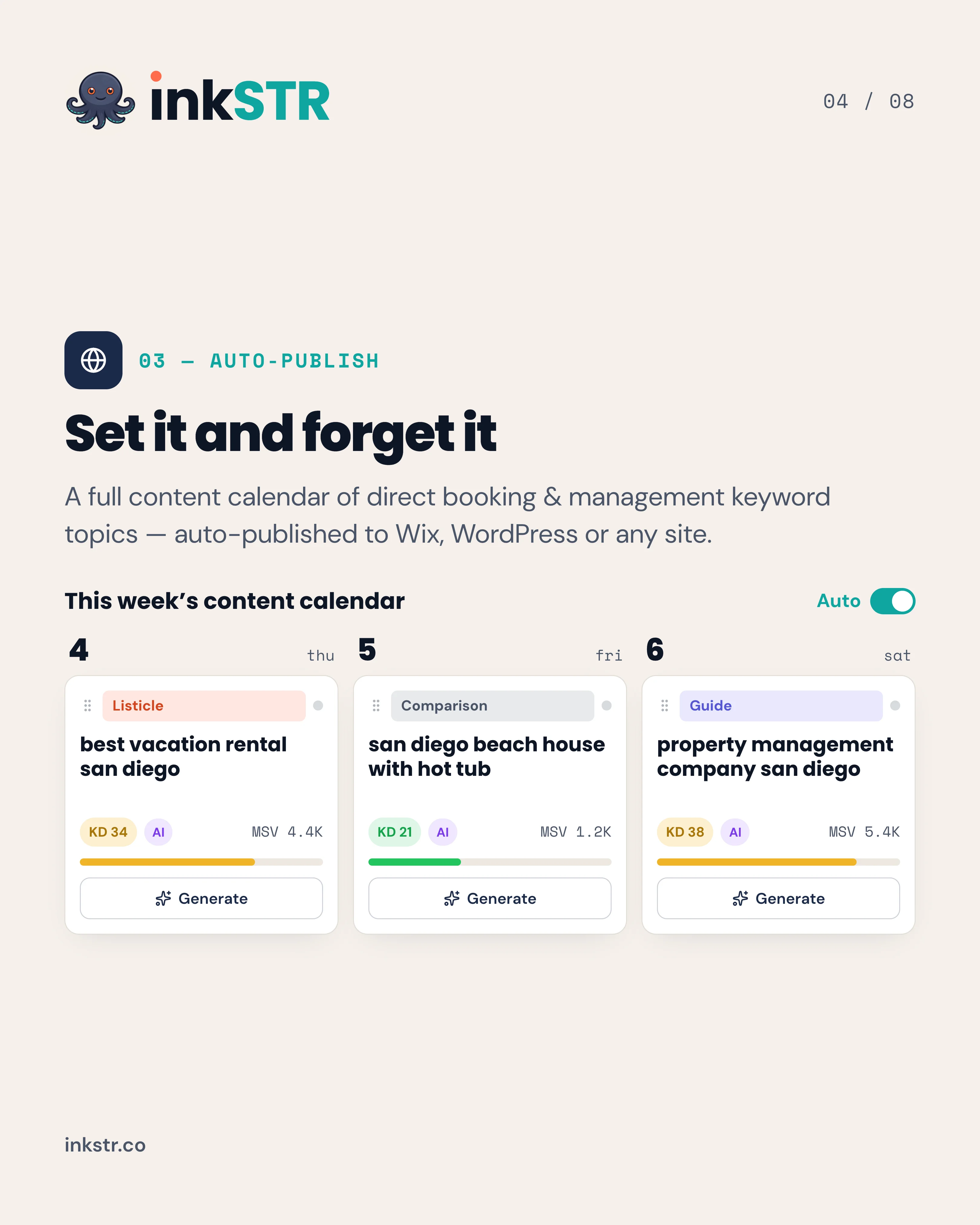
- inkSTR automates the full content pipeline, from STR-specific keyword research to scheduled publishing, so managers scaling their portfolio can build a direct booking traffic engine without writing a single post manually.
What Are the Most Important Tools for Short-Term Rental Managers?
The most important tools for short-term rental managers are the ones that remove single points of failure from your operation. At five properties managed manually, you are near your ceiling. At ten, the manual approach collapses. The right stack is not about having the most software; it is about covering every critical workflow so nothing falls through the gap between your calendar, your cleaner, your guests, and your bank account.
In 2026, professional management companies control an estimated 42% of all active short-term rental listings globally across major OTA platforms, according to industry tracking data. That concentration reflects a real competitive reality: operators who scale successfully do it with systems, not spreadsheets. The tools covered in this guide are what those systems look like in practice.
We have organized this as a ranked list, but the ranking reflects operational dependency, not preference. Tools at the top are load-bearing. Removing them breaks everything downstream. Tools toward the end are high-leverage growth investments that separate operators who grow revenue from those who simply grow headcount.
1. What Is a Property Management System and Do You Really Need One?
A property management system (PMS) for short-term rentals is a centralized software platform that manages reservations, syncs availability calendars across multiple booking channels, automates guest messaging, and consolidates owner reporting in one interface. For any operator managing more than two or three properties, a PMS is not optional. It is the operational spine that every other tool in your stack connects to.
Without one, you are manually updating calendars on Airbnb, VRBO, and your direct booking site every time a reservation moves. That process takes minutes per update, and one mistake creates a double booking, which costs you the reservation plus a penalty fee plus a damaged review. At five properties across two platforms, you are updating calendars dozens of times per week. That is hours of work per month that produces zero revenue.
A proper PMS eliminates that. It syncs all channels through a unified calendar so a booking on Airbnb instantly blocks the dates on VRBO and your direct site. Most platforms also include automated guest messaging sequences, so your check-in instructions, door code, and checkout reminders send themselves. That alone recovers significant weekly hours for operators managing ten or more units.
Look for a PMS that offers genuine two-way sync with Airbnb and VRBO, not just iCal exports. iCal sync has a delay window that still creates double booking risk. Two-way API integration eliminates it. Multi-owner reporting is also non-negotiable if you manage properties on behalf of other owners, because generating accurate monthly statements manually at scale is one of the fastest ways to burn out.
2. What Should Short-Term Rental Managers Use for Dynamic Pricing?
Dynamic pricing tools for short-term rentals automatically adjust your nightly rates based on real-time demand signals including local events, competitor pricing, booking lead time, day of week, and seasonal patterns. Setting a flat rate on a vacation rental is one of the most common and costly mistakes operators make when scaling, because it guarantees you are either leaving money on the table during peak demand or pricing yourself out of occupancy during slow periods.
The alternative to a dynamic pricing tool is manually reviewing market rates and adjusting your listing prices by hand, typically once a week or less. That cadence misses short-burst demand events like a concert announcement or a regional sports tournament that spikes booking demand for a three-day window. A dynamic pricing engine catches those signals within hours and adjusts automatically.
Most dedicated dynamic pricing platforms for STRs allow you to set minimum floors, base prices, and maximum caps, so you stay in control of the strategy while the tool handles the execution. Last-minute booking discount logic is particularly valuable: a 15-20% reduction on an unsold night three days out almost always outperforms leaving that night empty at full price.
When evaluating options, look specifically for tools with STR-specific market data rather than hotel revenue management tools adapted for rentals. The data sets are different, and the pricing behavior of vacation rental guests differs from hotel guests in ways that matter to your revenue model.
3. How Do STR Managers Handle Guest Communication at Scale?
Guest communication at scale requires an automated messaging platform that triggers pre-written messages based on booking events: a booking confirmation, a pre-arrival message with directions and access instructions, a mid-stay check-in, and a post-checkout review request. Without automation, guest messaging at ten or more properties is a part-time job in itself, and delayed responses at any stage risk a negative review.
The painful reality without a messaging tool is constant inbox monitoring. Guests message at unpredictable hours, often asking questions your listing already answers. Responding manually to every inquiry at three properties is manageable. At fifteen, it consumes your mornings and evenings without generating an additional dollar of revenue.
A well-configured messaging automation setup handles 80-90% of guest questions without human intervention. The remaining cases, genuine issues or unusual requests, are flagged for your attention with enough context to respond quickly. Most PMS platforms include a basic messaging layer, but standalone unified inbox tools designed specifically for STR operators offer more robust templates, sentiment detection, and multi-channel support.
Digital guest guide platforms are a related tool worth adding once your messaging automation is stable. These platforms host property-specific information, local recommendations, and house rules in a mobile-friendly format guests access via a link rather than a printed booklet. They reduce inbound questions significantly and create a more polished guest experience that supports better reviews.
4. What Smart Access Tools Do Property Managers Actually Need?
Smart locks and keyless entry systems are must-have tools for short-term rental managers because they eliminate the physical key handoff entirely, enable remote access management, and allow you to generate unique door codes per booking that expire automatically at checkout. For a manager overseeing multiple properties, coordinating physical key exchanges is operationally impractical and creates both security and liability exposure.
The operational case for smart locks is straightforward: you generate a unique code when a reservation is confirmed, send it automatically as part of your pre-arrival message sequence, and the code deactivates the moment checkout ends. No locksmith calls, no lockouts requiring emergency response, no keys left inside by departing guests. For properties in different cities or managed remotely, smart locks are not a convenience; they are a functional requirement.
Look for lock brands that integrate directly with your PMS through an API connection, not manual code entry. With API integration, access codes generate and revoke automatically as bookings flow through your calendar. Manual code management across twenty properties creates exactly the kind of human error that leads to a guest arriving to find their code does not work.
Beyond locks, noise monitoring devices and occupancy sensors serve a different but equally important function: protecting your properties from unauthorized parties and lease violations without requiring on-site presence. These devices alert you to threshold noise levels or unusual occupancy counts without recording audio, which preserves guest privacy while giving you an early warning system before neighbors call the city.

5. How Do You Coordinate Cleaning and Maintenance Across Multiple Properties?
Cleaning and maintenance coordination for short-term rental managers at scale requires a dedicated turnover management platform that automatically dispatches tasks to cleaning teams the moment a booking is confirmed or modified, attaches property-specific checklists, tracks completion with timestamped photo documentation, and flags maintenance issues for follow-up without requiring a phone call from your cleaner. At fewer than five properties, a group text thread may hold together. At ten or more, it fails consistently.
The most expensive cleaning coordination mistake we see managers make is relying on manual confirmation before each turnover. At high occupancy, your cleaner gets a booking notification the same way you do: late. When a same-day checkout and check-in are back to back, a two-hour window with unclear expectations is how you get a negative review for a dirty property. Automation closes that gap by triggering task assignments the moment the booking system updates.
Checklist-based inspection tools that require photo uploads per checklist item create accountability without micromanagement. Your cleaner cannot mark an item complete without uploading a photo, and that photo is timestamped. For managers overseeing remote properties or running teams of multiple cleaners across different units, this audit trail is invaluable when a guest reports a missed item at check-in.
Maintenance tracking deserves its own layer. Issues flagged during turnover should route directly into a maintenance log, not a text message that gets buried. Look for platforms that let cleaners flag issues with photos and severity ratings so you can triage them by urgency rather than by when you happen to check your phone.
6. What Accounting and Tax Tools Do STR Managers Need When Scaling?
Accounting and tax compliance tools for short-term rental managers address two distinct but related problems: tracking revenue and expenses accurately across multiple properties and owners, and ensuring that occupancy tax, lodging tax, and local short-term rental taxes are calculated and remitted correctly for every market you operate in. Get either of these wrong at scale and the financial exposure is significant.
The manual alternative is pulling data from multiple OTAs and your direct booking platform, reconciling them in a spreadsheet, generating owner statements by hand, and manually calculating tax obligations for each jurisdiction. At three properties in one market, a capable operator can manage this. At ten properties across three markets with different tax rates, the error rate climbs and the time investment becomes a part-time job in itself.
Tax compliance is particularly complex for STR operators because local tax obligations vary significantly by city and county. Some jurisdictions require separate registration and monthly remittance. Others collect automatically through Airbnb. When you operate across multiple markets, you cannot assume platform tax collection covers every obligation. A dedicated tax compliance tool or a tax professional who specializes in short-term rentals is not optional at scale; it is a financial and legal necessity.
For owner reporting, look for accounting software that integrates directly with your PMS so revenue and expense data flow automatically rather than requiring manual export and import. Generating accurate monthly owner statements from a connected system takes minutes. Doing it from spreadsheets across multiple data sources takes hours and introduces reconciliation errors that damage owner relationships.
Ready to automate your content marketing?
inkSTR handles keyword research, content strategy, article writing, and publishing, all on autopilot.
7. How Do Direct Booking and Branded Website Tools Reduce OTA Dependence?
Direct booking tools and branded property websites reduce OTA dependence by giving guests a path to reserve directly with you, bypassing Airbnb and VRBO entirely and eliminating the 17-19% combined fee both platforms charge per booking. A direct booking site is both a revenue protection strategy and a long-term asset that appreciates in value as it builds organic search visibility over time.
The math on direct bookings is compelling. A vacation rental booking worth $2,000 in total revenue routes $340-$380 of that to platform fees when booked through a major OTA. Over 50 bookings per year across a portfolio, that represents $17,000-$19,000 in fees paid to platforms that also control your guest relationship, your reviews, and your listing visibility. A direct booking website recaptures that margin and puts the guest relationship back in your hands.
The challenge most operators face is traffic. A beautiful direct booking website with zero organic visibility is invisible to the guests searching Google for rentals in your market. That is the gap between operators who successfully reduce OTA dependence and those who build a direct site that never gets a booking. Direct booking SEO is what closes that gap, specifically the local and destination-based content signals that tell Google your site is the authoritative source for your market.
Booking engine software that integrates with your PMS and accepts payment without redirecting to an OTA is the technical foundation. But technology alone does not drive traffic. You need content: destination guides, local area articles, and property-specific pages that answer the questions guests search for before they decide where to book. Without that content layer, your direct site is a landing page, not a marketing channel.
8. What Content and SEO Tools Help STR Managers Win on Google?
Content and SEO tools for short-term rental managers are the category most operators underinvest in, and it is the one with the highest long-term return. A single ranking blog article can drive organic search traffic for 2-5 years. A library of twenty well-targeted articles creates a compounding traffic engine that pulls guests directly to your booking site without any ongoing ad spend. The challenge is producing that content consistently without it consuming your entire week.
Writing one quality blog post manually takes 3-5 hours of research, writing, and formatting. Hiring a freelance travel writer costs $300-$700 per post. At a publishing cadence of two posts per month, that is $600-$1,400 in monthly freelancer fees, plus the time spent briefing, reviewing, and editing, and no guarantee the writer understands vacation rental SEO or traveler search intent in your specific market.
For ranking on Google, the type of content matters as much as the volume. Generic travel articles do not rank for the queries that convert. Destination guides, local area recommendations, and comparison articles targeting specific long-tail queries like "best cabin rental with hot tub near Asheville" are the content types that pull guests with genuine booking intent. Producing that content at scale requires a system, not a one-off writing effort.
This is exactly the problem inkSTR was designed to solve. Our platform generates, schedules, and publishes keyword-targeted blog articles on autopilot, built specifically for the STR and hospitality niche. The AI understands vacation rental terminology, traveler search intent, and destination-based SEO strategies relevant to beach towns, mountain retreats, urban apartments, and lake house markets. You get local area guides that sell, destination content that ranks, and a publishing schedule that runs without your manual involvement.
Starting at $99/month, inkSTR costs less than a single quality freelance blog post, and it publishes consistently without you needing to write a word. For operators who already know they need content but cannot sustain the production burden, the AI Content Writer and Content Calendar are the two features that transform a stalled content strategy into an automated publishing engine. If you want to understand why generic travel content kills conversions while niche-specific STR content compounds, that article is worth reading before you invest in any content strategy.

How Do These Tools Compare for Managers Scaling Past 5 Properties?
The tools you need at three properties differ meaningfully from the ones you need at fifteen. Below is a comparison framework organized by portfolio size and operational complexity, so you can prioritize the right investments at each stage rather than overbuild your stack before you need it.
| Tool Category | 1-3 Properties | 4-10 Properties | 11+ Properties |
|---|---|---|---|
| Property Management System | Optional but recommended | Required | Required, with multi-owner reporting |
| Dynamic Pricing | Helpful | High-priority investment | Essential |
| Guest Communication Automation | Basic templates sufficient | Dedicated tool needed | Unified inbox with team access required |
| Smart Locks | Recommended | Required | Required with PMS API integration |
| Cleaning Coordination Platform | Manual manageable | Dedicated tool needed | Required with photo verification |
| Accounting and Tax Tools | Spreadsheet manageable | Integrated accounting recommended | Required, multi-market tax compliance critical |
| Direct Booking Website | Worth building early | High priority | Essential revenue protection |
| Content and SEO Platform | Start early for compounding returns | High ROI investment | Core growth infrastructure |
The pattern is consistent: tools in the operational categories become requirements as portfolio size grows, while content and SEO tools reward early adopters most. A manager who starts publishing SEO content at five properties has a meaningful Google presence by the time they reach fifteen. A manager who waits until fifteen to start is twelve to eighteen months behind, competing against operators who already own the search results.
What Should You Prioritize When Building Your STR Tech Stack?
When building your short-term rental tech stack, prioritize tools that prevent revenue loss before tools that generate new revenue. A double booking caused by poor calendar sync, a negative review from a missed cleaning, or a tax penalty from incorrect remittance all produce immediate, measurable damage. An underperforming content strategy costs you slowly and invisibly. Solve the operational risks first, then invest in growth.
Here is a practical sequencing framework based on what we see from operators who build stacks that actually scale:
- Start with your PMS and channel manager. This is your operational foundation. Everything else connects to it. Do not add a dynamic pricing tool until your calendars sync reliably, because a pricing tool running on top of a calendar sync problem will fill the wrong dates at the wrong price.
- Add dynamic pricing as your second investment. This is the tool with the fastest, most measurable ROI. Most operators see revenue improvement within the first month of enabling real-time rate adjustments.
- Build your direct booking website alongside your guest communication automation. These two work together: your website captures guests who find you organically, and your communication automation handles them consistently once they book.
- Implement smart locks and cleaning coordination before scaling past five properties. Both tools become impossible to manage manually at scale and create significant liability if neglected.
- Add accounting and tax compliance tools before entering a second market. Multi-market tax obligations are where operators face the steepest learning curve and the highest financial exposure.
- Invest in content and SEO infrastructure early and sustain it consistently. This is the one tool category where time in market matters more than any other variable. An article published today may not rank for three to six months, but it will still be generating traffic three years from now.
The operators we see driving real direct booking revenue in 2026 are not the ones with the most tools. They are the ones who built their stack in the right order, integrated each layer properly, and then invested in the content engine that makes their direct booking site a real traffic destination instead of a vanity URL.
If keyword research is the piece of your content strategy you keep deferring because you do not know where to start, inkSTR's Keyword Research tool identifies exactly which queries your target guests are searching in your specific market. You do not have to guess. The platform maps the content your competitors are ranking for and surfaces the gaps where your articles can win. Pair that with the Auto-Publishing feature and you go from keyword to published post without a single manual step. You can review the full workflow at How inkSTR Works.
Frequently Asked Questions
What is the most important tool for a short-term rental manager who is scaling?
A property management system with built-in channel management is the single most critical tool when scaling past a handful of properties. It centralizes reservations, automates guest messaging, and syncs calendars across Airbnb, VRBO, and your direct booking site simultaneously. This eliminates the double-booking risk that plagues operators managing multiple listings manually and frees up hours of weekly calendar maintenance work.
How do dynamic pricing tools work for vacation rentals?
Dynamic pricing tools for vacation rentals pull real-time market data including local events, competitor rates, seasonal demand, and booking lead times to automatically adjust your nightly rate. Instead of setting a flat price and hoping for the best, the tool raises rates during high-demand periods and lowers them during slow stretches to capture last-minute bookings rather than leaving nights empty. Most platforms let you set minimum and maximum price floors so you retain full strategic control.
Is it worth building a direct booking website when I already list on Airbnb and VRBO?
Yes, and the math is clear. Airbnb and VRBO combined charge 17-19% of every booking in host and guest fees. A direct booking is typically worth $1,000 to $4,000 in revenue, meaning you keep hundreds of dollars more per stay by routing guests off-platform. The challenge is driving traffic to that direct site, which is where a content and SEO strategy becomes essential. Without organic visibility on Google, a direct booking website generates few reservations regardless of how well it is designed.
Can AI-generated content actually rank on Google for vacation rental keywords?
AI-generated content can rank on Google when it is built around genuine keyword research, structured for search intent, and tailored to the specific niche. Generic AI content fails because it lacks the specificity that distinguishes one market or property type from another. inkSTR is designed so the AI understands vacation rental terminology, traveler search intent, and destination-based keyword strategies, which is why the output performs differently from general-purpose writing tools.
How many blog posts does a vacation rental website need before seeing organic traffic?
Most vacation rental websites begin seeing meaningful ranking movement after publishing 12 to 20 well-targeted articles covering a mix of destination guides, local area content, and direct booking intent queries. inkSTR's content calendar automates the scheduling of that volume so you reach that milestone without manually tracking every publish date or spending 3-5 hours writing each post from scratch.
What tools do STR managers use to coordinate cleaning across multiple properties?
Dedicated cleaning coordination platforms for STRs send automatic turnover tasks to cleaners the moment a booking is confirmed, attach property-specific checklists, track completion with timestamped photo verification, and flag maintenance issues for follow-up. This is a must-have tool for short-term rental managers handling more than five properties, where manual coordination via text message breaks down quickly and creates the exact gaps in service quality that generate negative reviews.
How do I reduce OTA dependence without losing bookings?
The most sustainable path away from OTA dependence is building organic search visibility so guests find your property directly on Google before they open Airbnb. This requires a direct booking website paired with a consistent content strategy targeting the keywords your ideal guests actually search. Over time, a library of ranking articles compounds into a traffic engine that reduces your reliance on platform algorithms you do not control. Our guide on how to rank your vacation rental website on Google walks through the exact content structure that makes this work.
Conclusion
Building a short-term rental operation that scales past the first few properties requires tools that eliminate single points of failure, automate repeatable tasks, and create systems that run without your constant supervision. The must-have tools for short-term rental managers cover eight non-negotiable categories: property management software, dynamic pricing, guest communication, smart access, cleaning coordination, accounting and tax compliance, direct booking infrastructure, and content marketing.
Of those eight, content and SEO is the one category where starting early compounds into a sustainable competitive advantage. A direct booking website with no organic traffic is just an expense. A direct booking website backed by a library of ranking articles is a revenue engine that gets stronger every month. The operators winning on Google in 2026 are not the ones with the biggest ad budgets; they are the ones who started publishing consistently eighteen months ago and never stopped.
You do not need to write every one of those articles yourself. That is exactly what we built inkSTR to handle: the keyword research, the article generation, the scheduling, and the publishing, all automated and tailored to the STR niche. One direct booking from organic traffic covers months of the platform cost, and a ranking article keeps generating traffic for years.

If managing content across your portfolio is the task you keep deprioritizing because it never feels urgent enough, it is costing you bookings you will never see. Get started with inkSTR and let the content engine run while you focus on the properties that generate the revenue.
Content powered by inkSTR.co
Enjoyed this article? Share it:
Get more of inkSTR in Google Search
Add inkstr.co as a preferred source and our articles show up more in Top Stories, AI Overviews, and AI Mode — with a “Preferred” badge.
Get more guides like this
New SEO and AI-search guides, straight to your inbox. No spam, unsubscribe anytime.