Book Direct Strategy: How to Win Bookings Without Ad Spend
A book direct strategy is a repeatable system for moving guests off Airbnb and VRBO and onto your own website. It works without a big ad budget when you fix your booking page, give past guests a margin-safe reason to return, and publish search-optimized content that ranks on Google. Most owner-operators can start for the cost of one content tool and a few focused weekends.
Key Takeaways
- Airbnb host and guest fees combined take 17-19% of every booking, so each shifted reservation protects real margin.
- A single direct vacation rental booking is typically worth $1,000 to $4,000 in revenue, which means a handful of wins per year can pay for an entire low-budget program.
- The industry average for direct vacation rental bookings is 34% (Lodgify, 2026), so most operators have room to grow beyond the typical share.
- The cheapest sequence runs in this order: fix the booking page, capture guest emails, add non-discount perks, then publish content that ranks.
- You can measure incremental direct bookings with free tools: Google Analytics, Search Console, a "how did you find us" field, and a simple guest log.
- At inkSTR, we automate the slowest step, generating, scheduling, and publishing SEO blog articles for $99/month, so organic search traffic builds while you run your rentals.
You list on Airbnb, the reservations come in, and then the payout arrives 17-19% lighter than the rate you advertised. Meanwhile your own website sits quiet. Paid ads feel like the only way to change that, and for an operator with one to ten properties, ad spend is rarely the right first move.
This guide gives you a book direct strategy sequenced by cost, time, and effort, written for owner-operators with little staff capacity. In 2026 the work splits into five steps: conversion basics, perks, guest email, organic search, and measurement. We have watched hundreds of operators attempt this out of order, and the order matters more than the budget.
What Is a Book Direct Strategy and How Does It Compare With Airbnb Reservations?
A book direct strategy is the set of tactics that lead a traveler to reserve on your own site instead of a listing platform. Direct bookings work like this: the guest finds your website through search or email, checks availability in a booking engine, pays you, and you keep the guest relationship and the data.
The pain shows up in your payout. Imagine a hypothetical $2,000 stay on Airbnb; combined fees of 17-19% would take roughly $340 to $380 of it. Repeat that across dozens of stays a year and the leak is larger than most ad budgets. You also never see the guest's email, so you pay to acquire the same traveler again next season.
| Factor | OTA reservation (Airbnb, VRBO) | Direct booking |
|---|---|---|
| Fees to you and the guest | 17-19% combined on Airbnb | Payment processing only |
| Guest contact data | Limited by the platform | You own it |
| Cancellation and pricing terms | Largely set by the platform | You decide |
| Repeat marketing | Restricted | Email, referrals, loyalty perks |
| Traffic source | Platform search ranking | Google, email, word of mouth |
OTAs still earn their place for exposure. Our position is to use them as a discovery channel and treat your website as the destination. We built inkSTR around that idea: our direct bookings approach maps your site content to the searches travelers make before they ever open an app.
Step 1: What Should Your Booking Page Fix Before You Send Any Traffic?
Your booking page is the page where a visitor sees dates, total price, and a reserve button. It must load in under three seconds, show a visible "Book Direct" or "Check Availability" button above the fold, and finish checkout in two to three steps. Fix this before you chase traffic, or you pay twice for the same lost visitor.
Think about the visitor who finds you after an hour of research. The price jumps at checkout because cleaning fees and taxes appear late. The form asks for twelve fields. The page crawls on a phone. That guest hits back and books the same cabin on Airbnb, and you pay the fee you were trying to avoid. A cabin in Gatlinburg that hides a $175 cleaning fee until the last screen loses that guest every time.
The five-point booking page audit
- Test load time on mobile data, not office wifi.
- Put a reserve or availability button above the fold on every property page.
- Show the total price, including taxes and mandatory charges, before the payment step.
- Cut form fields down to what you need to confirm a reservation.
- Connect the booking engine to your channel manager or PMS so calendars stay accurate and double bookings disappear.
On the question of the best direct booking software: choose a booking engine that syncs with your PMS and embeds in your existing Wix or WordPress site. Price and features vary by plan, so compare on sync reliability first, because one double booking costs more than any monthly fee difference. Our booking page conversion guide covers the common mistakes in detail.
inkSTR does not process reservations. We handle the traffic side, so that when your booking page is ready, search visitors arrive with intent. That pairing turns a book direct strategy from a plan into revenue.
Step 2: How Do You Pick Direct-Only Perks That Protect Your Margin?
Direct-only perks are benefits a guest receives only when booking on your site, such as flexible check-in, a welcome gift, or a lower deposit schedule. The best ones cost you little or nothing. Blanket discounts defeat the purpose, because they give back the margin you saved by skipping the 17-19% platform fee.
Many operators default to a 10% direct discount because every guide says so. It is easy to announce and expensive to sustain. On a $2,000 stay, it hands the guest $200 you may not need to give, and it trains repeat guests to wait for coupons.
| Perk | Cost to you | Effort | Margin impact |
|---|---|---|---|
| Early check-in or late checkout when the calendar allows | Near zero | Low, a calendar check | Protects margin |
| Installment payments on higher-value stays | Small processing overhead | Low, set once | Protects margin |
| Best-rate guarantee message on your site | Zero unless you match | Low | Builds trust |
| Welcome basket or local gift | Moderate per stay | Medium | Review-friendly |
| Percentage discount | High | Low | Erodes margin |
Start with the first three. Price each perk against the fee you saved, then keep the cheapest ones that matter to your guest type. A cabin family cares about flexible payment, while an urban business traveler cares about early check-in. If a 3 p.m. check-in gap sits empty before a Friday arrival, offering a noon arrival costs you nothing and feels generous.
The perks only work if guests see them. That is a content job: a clear "why book direct" page and short mentions inside every blog article. inkSTR's AI Content Writer builds that messaging into articles so you write it once instead of on every page.
Step 3: How Do You Turn Past OTA Guests Into Direct Bookers?
Converting past guests into direct bookers means capturing an email address, then sending a short, well-timed sequence that points to your site. It costs only your time. Repeat guests already trust you, which makes them the cheapest direct bookings you will ever win.
The painful alternative is familiar. A guest leaves a five-star review on Airbnb, checks out, and vanishes. You have their first name and nothing else. Next summer they search again, find a competitor, and you never knew they were in the market.
Where to capture the email
Use a digital guidebook, the property wifi login page, and a handwritten card with a short link. Use the same business name on your OTA listing and your website so a returning guest can find you with one search.
The post-stay workflow, with timing
- Within 24 hours of checkout: send a thank-you message with a direct link and a small perk, such as a flexible check-in on the next stay.
- Around 10 months later: send a seasonal note to guests from the last 12 months, since they are the most likely to rebook.
- At 18 to 36 months: send a re-introduction to lapsed guests with one new reason to return.
- 48 to 72 hours before arrival: offer an upgrade or add-on to guests who booked direct.
Sample copy for step 1: "Thanks for staying with us. If you'd like the same dates next year, book through our site and we'll hold early check-in for you." Short, specific, no coupon.
Test your send times for a season and keep the winner. For a portfolio, inkSTR's property management workflow keeps each property's content pipeline separate, so guest-facing articles match the right property.
Step 4: How Do You Get Found on Google Without Paying for Ads?
Organic search visibility means ranking on Google for the searches travelers make before booking, using blog articles that match their intent. A ranking article can drive search traffic for 2-5 years, so a single post keeps working long after you publish it. That makes content the best low-budget channel, if you can sustain it.
Sustaining it is where operators fail. Writing one quality post manually takes 3-5 hours of research and writing. A freelance travel writer charges $300-$700 per quality post. At one post a week, that is a part-time job or a recurring invoice most solo owners cannot justify.
What inkSTR handles for you
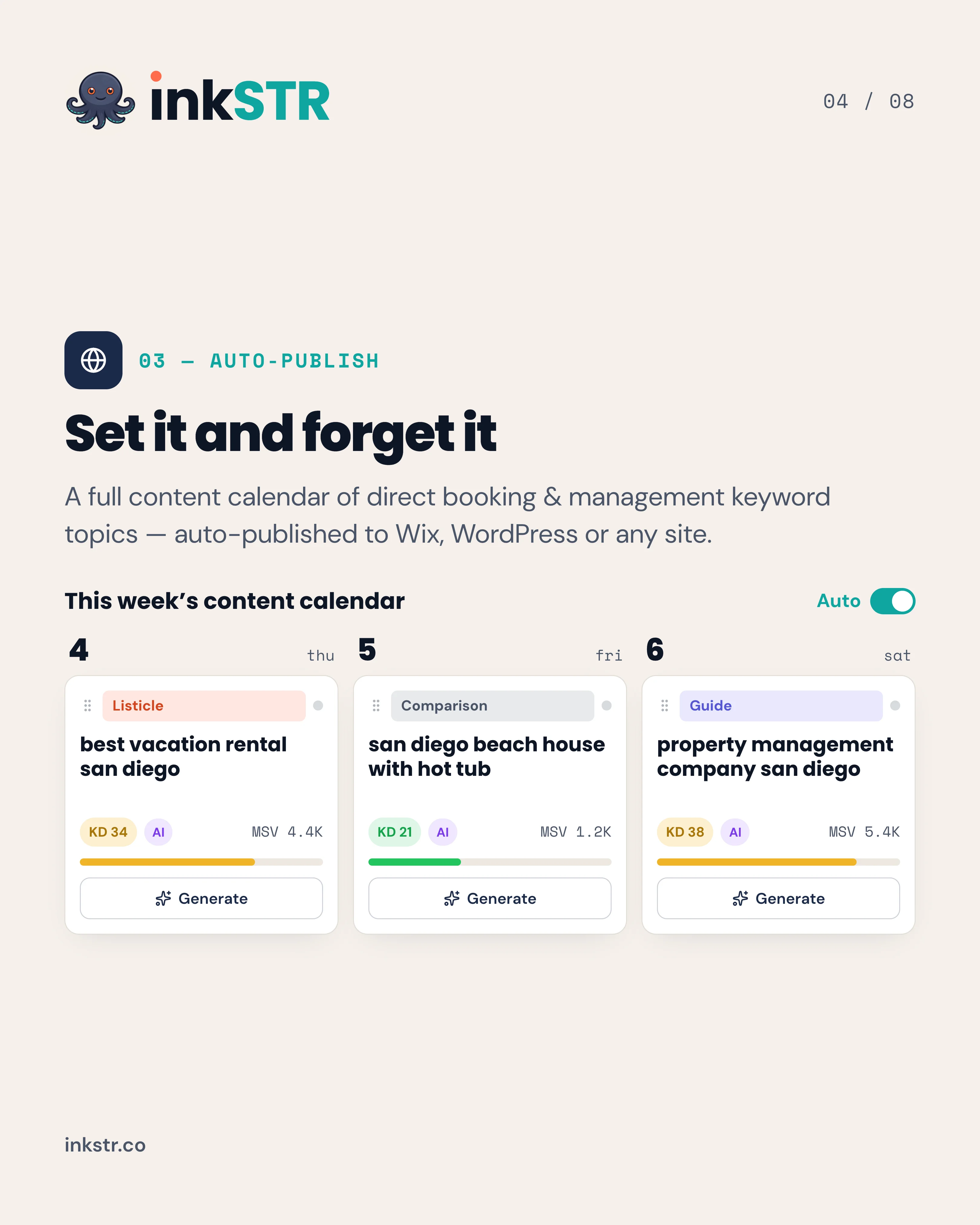
We built inkSTR to take this on end to end. Keyword Research finds the searches your target guests use. The AI Content Writer drafts SEO-optimized articles from that research. The Content Calendar schedules them, and Auto-Publishing sends them to Wix, WordPress, or your custom site. The full flow is explained on How InkSTR Works.
The proof is in our customer data. Hemlock Hills, a Smoky Mountains cabin rental brand, grew monthly Google Search clicks from 788 to 5,195 in 11 months and attributed $309,775 in direct booking revenue to its first 14 months on inkSTR. The Peak Properties, a five-market mountain rental brand, moved from 26 to 1,924 monthly Google search visits in four months and closed its first $2,500+ in commission-free direct bookings.
Search takes patience. Most sites see meaningful traffic gains within 3 to 6 months of consistent publishing, not days. If you want to know why a site stalls, read why vacation rental websites fail to rank, and for topic ideas see our vacation rental blog topics list.

Step 5: How Do You Measure Incremental Direct Bookings for Free?
Measuring incremental direct bookings means separating reservations that came from your effort from ones that would have happened anyway. You need three buckets: organic search, repeat guests, and OTA-assisted conversions. A free spreadsheet and two Google tools can track all three.
Without measurement, the work feels invisible. A booking arrives, and you cannot say whether the blog, the email, or a friend sent it. You then drop the channel that was working because you could not see it.
- Install Google Analytics and mark the booking confirmation page as a conversion.
- Connect Google Search Console to see which queries bring visitors to your articles.
- Add a required "How did you find us?" field with options like Google, email, past stay, friend, Airbnb or VRBO.
- Give each email campaign a unique link tag so clicks are traceable.
- Log every direct booking in one sheet with source, guest type, and revenue.
Count a booking as OTA-assisted when the guest first saw you on Airbnb or VRBO, then rebooked through your site. That group is easy to miss and is the exact audience your thank-you email targets.

inkSTR connects with Google Search Console, so you see rankings next to the articles that earned them. Our guide to blog content that converts shows how to read those numbers.
Ready to automate your content marketing?
inkSTR handles keyword research, content strategy, article writing, and publishing, all on autopilot.
What Does the Zero-Ad-Budget Sequence Cost in Time and Money?
The zero-ad-budget sequence costs a few weekends of setup and one monthly tool subscription. Ordered by effort and payoff, it runs: booking page fixes, email capture, perks, content, then measurement. The only large recurring cost is content, and that is where the comparison below matters.
| Content approach | Time or cost per post | Consistency |
|---|---|---|
| Write it yourself | 3-5 hours of research and writing | Stalls when guests are checking in |
| Hire a freelance travel writer | $300-$700 per quality post | Depends on budget each month |
| inkSTR | $99/month for automatic generation, scheduling, and publishing | Runs on a set schedule |
Consider the break-even. One direct booking is typically worth $1,000 to $4,000, so a single reservation from organic search covers many months of the $99 plan. A weekly freelance post at the $300 low end runs about $1,200 a month, roughly twelve times the inkSTR plan. See the current options on our pricing page.
Across inkSTR customer sites, we have published more than 4,900 articles as of October 2026. That volume comes from running the same pipeline described above, month after month.
How Do You Adapt This If You Run One Property, Not a Hotel?
A single-property owner adapts the plan by shrinking it: one booking page, one guest email list, one pillar article per month. Hotel advice assumes a front desk and a CRM. You have a phone and a Saturday. Aim for a short list you will finish.
Many owners hit this wall: the advice assumes staff, so they try everything, finish nothing, and quit. We recommend a 30-60-90 plan instead. In the first 30 days, fix the booking page and add the email capture card. By day 60, launch the thank-you email and two perks. By day 90, have a content schedule running without you.
A well-known proof point: Kindling Home, a vacation rental run by Mackenzie and Joe Precht, gets 60% of its bookings directly through its Wix website (Wix Blog). Their result shows that a small operation can win the majority of its bookings direct.
If you manage ten or more units, the same plan scales through separate content pipelines per property. If you want local content ideas, our local area guides that sell post shows which pages earn bookings and which only earn clicks.
What Mistakes Sink a Low-Budget Direct Booking Plan?
The most common mistake is sending traffic to a weak booking page. The second is discounting every direct stay. Close behind is publishing five articles in a burst, then nothing for four months. Search rewards consistency, and guests notice an abandoned blog.
- Skipping measurement. You cannot improve what you cannot see.
- Generic content. A post titled "10 things to do" rarely drives direct bookings; target buyer-intent searches tied to your actual property type.
- Hiding your direct site. Mention your website in every OTA message, guidebook, and email signature.
- Waiting for perfect. A page that loads fast and shows total price beats a redesign you never launch.
This is exactly why we built the Content Calendar: publishing stays on schedule even in your busiest season.
Frequently Asked Questions
How can vacation rental owners get more direct bookings?
Fix your booking page, capture guest emails, add low-cost perks, and publish content that ranks for buyer-intent searches. Start with the changes that cost nothing and add content as soon as the page converts. inkSTR automates the content step.
How does SEO help vacation rental managers drive direct bookings?
SEO brings travelers to your site when they search for stays like yours, before they open an OTA app. Each ranking article keeps attracting visitors for years. inkSTR's Keyword Research finds those searches for you.
How do short term rental direct bookings work?
A guest finds your website, checks availability in an embedded booking engine, pays you, and receives confirmation. You keep the guest's contact data and avoid the platform fee. A PMS or channel manager keeps your calendars synced.
What is the best direct booking software for vacation rentals?
Look for a booking engine that syncs with your PMS, embeds in Wix or WordPress, and shows total pricing before payment. Plans and fees vary, so compare sync reliability first. inkSTR drives search traffic to that engine but does not process payments.
How do you increase direct bookings for a boutique hotel?
The same fundamentals apply: a fast booking page, direct-only perks, guest email, and organic search. For hotel-specific tactics, see our guide on how to increase direct bookings for hotels.
How long does it take for content to bring direct bookings?
Most sites see meaningful traffic gains within 3 to 6 months of consistent publishing. Results vary by market and competition. Email and booking page fixes can produce bookings sooner.
Can AI-written content rank on Google?
Yes, when it is built on real keyword research and grounded in your property details. Our article automation and brand voice guide explains how to keep it on-brand.
Conclusion: Start Your Book Direct Strategy This Month
A book direct strategy does not need an ad budget. It needs a booking page that converts, perks that protect margin, a guest email habit, and content that keeps ranking. Each direct booking is typically worth $1,000 to $4,000, while Airbnb takes 17-19% of the ones you do not move.
The five steps below summarize the plan. Work through them in order, and expect the content step to compound over several months in 2026 and beyond.
- Audit and fix your booking page for speed, clarity, and a short checkout.
- Choose two or three non-discount perks that cost you little.
- Capture guest emails and send the post-stay sequence.
- Publish buyer-intent articles on a fixed schedule.
- Track sources in Analytics, Search Console, and a simple booking log.
If keeping up with keyword research and blog publishing feels impossible right now, inkSTR was built to automate exactly this. Start a free trial with inkSTR, or begin setup here to get your first content plan. You can also see how the whole platform fits together on our home page.
Content powered by inkSTR.co
Enjoyed this article? Share it:
Get more of inkSTR in Google Search
Add inkstr.co as a preferred source and our articles show up more in Top Stories, AI Overviews, and AI Mode — with a “Preferred” badge.
Get more guides like this
New SEO and AI-search guides, straight to your inbox. No spam, unsubscribe anytime.