Why Your Vacation Rental Blog Beats Airbnb Alone in 2026

A vacation rental blog is a content section on your own website that publishes articles targeting the searches your future guests type into Google before they ever open Airbnb or VRBO. A vacation rental blog builds a search-traffic asset you own outright, unlike an OTA listing you rent space on and lose 17 to 19% of every booking to in combined host and guest fees.
Key Takeaways
- A vacation rental blog captures search demand at the research stage, before travelers open Airbnb or VRBO, and redirects that traffic to your own booking page.
- Airbnb host and guest fees combined run 17 to 19% of every reservation, meaning a $2,500 stay quietly loses $400 to $475 to the platform before you see a dollar.
- A single direct booking is typically worth $1,000 to $4,000 in revenue. A well-ranked blog post can keep generating that traffic for 2 to 5 years after publishing.
- Writing one quality blog post manually takes 3 to 5 hours, and a freelance travel writer typically charges $300 to $700 per post: a cost that scales badly across a multi-property portfolio.
- One Smoky Mountains cabin brand grew monthly Google Search clicks from 788 to 5,195 in 11 months on a consistent blog content pipeline, attributing $309,775 in direct booking revenue in the first 14 months.
- inkSTR automates the vacation rental blog workflow from keyword research to scheduled publishing, so the content asset builds itself without consuming your operating hours.
If your entire online presence lives inside an Airbnb or VRBO listing page, you are renting your visibility. The platform decides your ranking and controls your guest relationship data, and the platform takes a cut of every booking whether or not you drove the traveler there yourself. A blog changes that equation because a blog is the one channel where you, not the OTA algorithm, decide what ranks.
We work with vacation rental operators across the country, and the pattern is consistent. Hosts who treat their website as a static brochure with a booking widget bolted on rarely show up in Google search results for anything beyond their own brand name. In contrast, hosts who publish structured, keyword-targeted content around their property and destination start appearing for the exact phrases travelers type when planning a trip: things to do near [destination], best [property type] for [occasion], [destination] cabin with hot tub.
This article makes the case for why a vacation rental blog belongs on your website in 2026, what a vacation rental blog needs to contain to work, and how a blog stacks up against staying purely OTA-dependent. We built inkSTR specifically because we watched this gap cost operators thousands of dollars a year in commissions they didn't have to pay.
Why Is My Vacation Rental Not Getting Direct Bookings?
Your vacation rental isn't getting direct bookings because your website has no independent way to appear in Google search results outside of branded searches for your own property name. Without published content targeting traveler search intent, your domain has nothing for Google to index and rank beyond a handful of thin pages, so search traffic never arrives at all.
Here's what that looks like in practice. A guest searches "pet friendly cabin near Gatlinburg with mountain view." Your competitor's blog has a post answering exactly that question, with photos and specific neighborhood detail. Your site has a homepage and a booking calendar. As a result, Google has nothing to match the query to your domain, so you never enter the results at all.
The manual fix is writing that content yourself, at 3 to 5 hours per post according to typical industry time estimates, or paying a freelance travel writer $300 to $700 per article. For a portfolio with five markets, that workload becomes a part-time job or a five-figure annual freelance bill before you've published anything close to a full content calendar.
This is exactly the problem inkSTR's AI Content Writer was built to solve. The AI Content Writer generates SEO-optimized articles between 2,500 and 3,500 words, targeting the specific searches your guests use, without you drafting a single sentence. Related search terms like vacation rental owners blog and vacation rental marketing blog show consistent, if modest, monthly search volume: travelers and fellow operators are actively looking for this kind of content.

How Much Does Airbnb Commission Actually Cost You Over Time?
Airbnb commission costs you 17 to 19% of every booking in combined host and guest service fees, a percentage that compounds silently across every reservation you take through the platform for the life of your listing. Unlike a one-time marketing expense, this fee never stops, no matter how long you've been hosting.
Run the math on a single property doing 150 bookings a year at an average $1,800 stay. At 18% combined commission, that structure costs roughly $48,600 paid to the platform annually, with no path to reducing the fee unless you build an alternative booking channel. By comparison, a blog post that, once ranked, keeps sending organic traffic for 2 to 5 years without an additional dollar spent per click.
Most operators never run this comparison because the commission feels invisible, deducted automatically before payout. This fee is the single largest recurring line item most short-term rental businesses have: larger than cleaning, larger than software, often larger than the mortgage on the property itself.
A vacation rental blog is how you build the alternative channel. Our guide to direct booking SEO signals breaks down which on-page and local ranking factors Google weighs most in 2026. inkSTR's Keyword Research feature identifies the specific search terms guests use in your market so every post targets demand that converts, not generic travel copy that ranks for nothing.
What Should I Blog About for My Vacation Rental Website?
Your vacation rental blog should cover four recurring content types: local area guides, property feature stories, seasonal travel planning content, and host or booking FAQs. Industry research on top-performing vacation rental content confirms these four categories generate the majority of organic search traffic for rental brands.
Local guides answer questions like "best restaurants near [your property]" or "family activities in [your destination] in winter." These posts work because local guides capture travelers at the planning stage, before they've chosen a specific listing, and position your brand as the local authority.
Property feature stories highlight specific amenities: a hot tub, a fireplace, a lake view. Multiple industry content guides recommend leading with these specific, tangible details rather than vague "great atmosphere" language, because specificity is what differentiates one cabin from a thousand similar listings.
Seasonal content and FAQs round out the calendar, covering event timing, weather expectations, and the practical questions guests ask before booking. If you're short on ideas, our roundup of vacation rental blog topics that actually drive bookings and our piece on local area guides that sell both go deeper into structuring these categories. inkSTR's content strategy wizard maps these categories into a pillar-and-cluster architecture automatically, so you're not guessing which post to publish next.
How Long Does It Actually Take to Write a Vacation Rental Blog Post?
Writing one quality vacation rental blog post manually takes 3 to 5 hours of research and drafting, a figure consistent with broader blogging industry time-investment data. This estimate assumes you already know your target keyword and have property details on hand; add keyword research and image sourcing and the real number climbs higher.
Multiply that time across a content calendar. If you're publishing twice a month, the workload adds up to 6 to 10 hours monthly on writing alone, on top of guest communication and cleaning coordination. For a property manager running 15 units, the math gets worse fast, because each market often needs its own distinct content.
This time cost is where hiring out starts to look attractive, until you price it. A freelance travel writer typically charges $300 to $700 per post. Twice-monthly publishing across a single property runs $7,200 to $16,800 a year, before you factor in scheduling delays, revision rounds, or a writer who doesn't know your specific market.
inkSTR compresses that workflow , research, drafting, image selection, internal linking , into an automated pipeline that runs on a set schedule at $99 a month. That $99 monthly fee is the full software cost for content that would otherwise consume days of your time or thousands in freelance fees. See the full breakdown on our pricing page.
Is It Worth Paying a Content Writer for My Short-Term Rental?
Paying a content writer for your short-term rental is worth it only if the resulting content is structured for search visibility and published on a consistent schedule, not as a one-off project. A single well-written post with no SEO structure and no follow-up publishing rhythm rarely ranks, regardless of writing quality.
We've reviewed portfolios where an operator paid for six posts, saw no traffic lift after two months, and concluded content marketing "doesn't work" for their niche. In nearly every case, the actual problem was inconsistent publishing and missing keyword targeting, not the writing itself. Google's own guidance rewards sites that publish regularly around a clear topical structure, not scattered one-off articles.
A freelance writer at $300 to $700 per post can produce solid individual articles, but few freelancers understand short-term rental-specific SEO: how Airbnb and VRBO ranking factors differ from Google's, or how to structure a pillar-and-cluster architecture for AI Overviews and ChatGPT citations. As a result, that specificity is where niche tools earn their cost.
inkSTR was purpose-built for this niche, not adapted from generic business content templates. Every inkSTR article understands short-term rental terminology, traveler search intent, and location-based SEO for markets from beach towns to mountain retreats. Compare that against manually managing freelancers with our guide on must-have tools for short-term rental managers scaling up.
Can AI Actually Write Good Content for a Vacation Rental Business?
AI can write effective vacation rental content when the underlying platform is trained on hospitality-specific search intent and property data, rather than generic AI writing tools applied to any industry. Generic AI tools produce grammatically correct but forgettable travel copy that reads the same whether the copy is describing a lake house in Michigan or a condo in Miami.
The distinction that matters is specificity. Generic AI writing tools output "cozy retreat with stunning views" language that says nothing concrete about a property. In contrast, niche-trained tools reference actual amenities and actual guest search phrasing, because the model understands what "ski-in ski-out," "walk to Broadway," or "lake access dock" signal to a traveler.
As of 2026, AI Overviews and tools like ChatGPT and Perplexity are increasingly the first stop for travel research, so content has to be structured for AI citation, not just traditional Google ranking. This citation-focused structure is a different discipline from writing for a human skimmer alone, and this discipline is one most generic tools weren't built to handle.
inkSTR includes built-in LLM citation optimization for AI Overviews, ChatGPT, and Perplexity alongside traditional SEO structure, plus quality scoring and pre-publish validation so drafts meet a bar before drafts go live. Our piece on ranking in AI search for STR operators covers this shift in more depth, and our complete guide to AI automation covers the broader landscape of tools beyond content alone.

How Do I Compete With Big Property Management Companies in Search?
You compete with larger property management companies in search by publishing hyper-specific, locally-detailed content that their scale and general-purpose marketing teams rarely bother to write. Bigger operators optimize for volume across dozens of markets; larger operators almost never go deep on a single neighborhood's specific character.
Large vacation rental companies like Vacasa or Evolve maintain broad content operations, but breadth comes at the cost of depth. Their blog posts tend toward generic travel advice applicable to any of their hundreds of listed markets. In contrast, a single independent cabin owner or boutique property manager who writes with real local knowledge , specific trail names, specific restaurant recommendations, specific seasonal timing , wins the long-tail searches the big players never target.
This gap is the exact content opportunity most competitor coverage misses: few vacation rental blogs actually build a structured, seasonal editorial calendar tied to a single property's specific character. Most publish scattered posts with no cluster logic connecting them, which means Google never recognizes the site as topically authoritative on that destination.
inkSTR's Keyword Research and competitor gap analysis surface exactly where larger, better-funded competitors have left search terms uncovered in your specific market. For example, one of our multi-market customers, a five-location mountain rental brand, went from averaging 26 monthly Google search visits to 1,924 in four months after publishing 114 targeted articles across their five markets, closing gaps larger operators had ignored.
What Is the ROI of Content Marketing for Short-Term Rentals?
The ROI of content marketing for short-term rentals is measured in reduced OTA commission dependency and organic booking revenue that compounds over years, not a single campaign's immediate return. A single direct booking is typically worth $1,000 to $4,000 in revenue, and unlike a paid ad, a ranking blog post keeps generating that traffic for 2 to 5 years after the post is published.
| Channel | Typical Cost | Ongoing Fee | Traffic Lifespan |
|---|---|---|---|
| Airbnb/VRBO listing only | Free to list | 17-19% per booking | Ongoing, tied to platform ranking |
| Freelance blog writer | $300-$700 per post | None per post, but recurring per article | 2-5 years if well-structured |
| DIY manual blogging | 3-5 hours per post (your time) | None | 2-5 years if well-structured |
| inkSTR automated pipeline | $99/month | Fixed monthly, no per-booking cut | 2-5 years, compounding across published articles |
The clearest proof point we have is our own case data. A Smoky Mountains cabin rental brand grew monthly Google Search clicks from 788 to 5,195 over 11 months using a continuous content pipeline, and search impressions climbed from 130,000 to 450,000 in the same window. As a result, that growth translated to $309,775 in attributed direct booking revenue within the first 14 months, measured directly in Google Search Console and Google Analytics.
A second customer, a management company operating around 50 properties in Charlotte and Lake Norman, North Carolina, saw four property-owner leads arrive from AI search within their first month of publishing owner-facing content, alongside a 4.6x increase in Google impressions over three months. This result represents revenue on the acquisition side of the business, generated from search visibility that didn't exist before.
Ready to automate your content marketing?
inkSTR handles keyword research, content strategy, article writing, and publishing, all on autopilot.
What Keywords Should I Target for My Vacation Rental Website?
The keywords you should target for your vacation rental website fall into three tiers: broad destination terms, property-specific long-tail phrases, and question-based searches travelers type while planning. Each tier serves a different stage of the booking journey and needs different content to match.
Broad destination terms like "cabin rentals near [destination]" carry the highest search volume but also the steepest competition, since every operator in the market is chasing the same phrase. In contrast, property-specific long-tail terms like "pet friendly lakefront cabin sleeps 8" carry lower volume but far higher intent, because the searcher has already narrowed their criteria.
Question-based searches , "how far is [property] from [attraction]," "is [destination] good in winter" , fill the informational gap and often rank faster since fewer competitors bother writing direct answers. These question-based searches also feed directly into AI Overview and chatbot citations, since AI systems favor content that answers a specific question in the opening sentence.
Guessing at keyword tiers wastes publishing time on terms nobody searches. inkSTR's Keyword Research tool and built-in research chat surface real search volume and competitor gaps for your specific market before you commit to a topic, and our guide on ranking on Google for STR-specific factors explains why generic SEO advice often misses hospitality-specific signals entirely.
How Do I Build an Email List From My Vacation Rental Blog?
You build an email list from your vacation rental blog by embedding a newsletter signup within high-traffic posts, typically local guides and seasonal content, and offering something specific in exchange, like a downloadable packing checklist or a seasonal events calendar for your destination. Generic "sign up for updates" forms convert poorly compared to a specific, useful offer.
Blog traffic without an email capture mechanism is a missed opportunity. First-time visitors researching a trip six months out rarely book on that visit; instead, these visitors research, close the tab, and forget the site exists by the time they're ready to reserve. An email list is how you stay present in that gap.
Once captured, that list becomes a direct bookings channel with zero ongoing commission, unlike OTA messaging systems that keep guest contact information locked inside the platform. Our piece on direct booking strategies for hospitality operators covers list-building tactics in more depth, alongside conversion mechanics that apply just as well to vacation rentals.
Blog content is also the raw material for that list once someone's subscribed. A single well-researched local guide can be repurposed into an email newsletter segment or a booking page callout, multiplying the return on the hours it took to produce. inkSTR's internal link management connects each new post back to relevant older content automatically, keeping subscribers engaged with your growing library instead of a single static page.
What Mistakes Kill a Vacation Rental Blog Before It Gets Traction?
The mistakes that kill a vacation rental blog before it gains traction are inconsistent publishing schedules, generic content with no local specificity, and abandoning the effort after two or three posts show no immediate traffic. Google's ranking systems reward sites that publish steadily around a clear topic cluster, and a blog that goes quiet for months signals the opposite.
- Publishing sporadically. A burst of five posts followed by three months of silence tells Google the site isn't an active, maintained resource. Most successful vacation rental blogs settle into a steady rhythm, commonly biweekly or monthly, rather than front-loading effort at launch.
- Writing generic travel copy. "Beautiful views and unforgettable memories" describes every listing on Earth and ranks for nothing. Specific detail , actual trail names, actual restaurant names, actual distances , is what differentiates content enough to rank.
- Skipping internal linking. Posts that don't link to each other or to your booking page leave Google and readers with no path deeper into the site, weakening both SEO signals and conversion opportunities.
- Never updating old content. A 2023 post about seasonal events with outdated dates actively hurts credibility. Refreshing existing posts is often more valuable than publishing something entirely new.
- Giving up after two months. Organic search growth compounds; it rarely spikes immediately. Expecting first-month traffic parity with an established competitor's years-old content sets an unrealistic bar and causes premature abandonment.
inkSTR's Content Calendar solves the consistency problem, with drag-and-drop scheduling and automated publishing so posts go live on rhythm even during weeks you're fully consumed by guest turnovers. And Auto-Publishing pushes each article directly to your Wix or WordPress site without a manual copy-paste step that too often becomes the reason a post sits in drafts for weeks.
How Does a Vacation Rental Blog Fit Into Multi-Property Portfolio Management?
A vacation rental blog fits into multi-property portfolio management by running as an independent content pipeline for each property or market, rather than a single generic blog trying to cover every listing at once. A five-property manager needs five distinct sets of local content, since a lake house in the Poconos and a cabin in Fairplay serve entirely different traveler search intent.
Treating a multi-market portfolio as one undifferentiated content stream is the most common mistake we see in property management marketing. Guests searching "cabin near Whitefish" have no interest in a post written generically about "our beautiful properties." Instead, each market needs its own destination-specific content cluster.
This need for market-specific content is exactly why we built multi-project support into inkSTR: each property or brand runs its own independent content pipeline, so a manager overseeing 15 properties can run 15 parallel content calendars without duplicating research or writing effort across markets that share nothing but a management company. Our Property Management page covers how this setup scales across growing portfolios in more detail. If you're just getting your content pipeline off the ground, Start here to see how inkSTR sets up your first project.
Data Snapshot: What Blogging Actually Delivers for Vacation Rental Operators
The data on vacation rental blogging shows a consistent pattern across different portfolio sizes: modest starting traffic, meaningful growth within months of consistent publishing, and revenue that compounds well past the initial publishing effort. This pattern holds whether the operator runs a single cabin or a five-market luxury portfolio.
| Metric | Before | After | Timeframe |
|---|---|---|---|
| Monthly Google Search clicks (Smoky Mountains cabin brand) | 788 | 5,195 | 11 months |
| Monthly search impressions (same brand) | 130,000 | 450,000 | 11 months |
| Monthly Google visits (5-market mountain brand) | 26 | 1,924 | 4 months |
| Google impressions (NC property management company) | Baseline | 4.6x increase | 3 months |
As of August 2026, articles published across inkSTR customer sites have surpassed 3,100 all-time, generating over 2.3 million Google Search impressions across connected sites in the trailing 90 days alone. That volume of published, indexed content is the raw asset a vacation rental blog needs before it can compete against established Airbnb, VRBO, or Booking.com listings on brand-independent search terms.
Frequently Asked Questions
How seo helps vacation rental managers drive direct bookings and growth?
SEO helps vacation rental managers drive direct bookings by matching your website's content to the exact searches travelers run before choosing a property, capturing that traffic on your own domain instead of losing traffic to an OTA listing. Growth compounds because ranking content, unlike a paid ad, keeps generating traffic for 2 to 5 years after publishing. As a result, SEO steadily reduces your dependence on Airbnb and VRBO's 17 to 19% commission structure over time, shifting revenue away from platform fees and toward direct, commission-free reservations booked straight through your own site.
How many blog posts do I need before I start ranking for local vacation rental searches?
There's no fixed number, but most operators need a consistent cluster of related posts, commonly 10 to 20, targeting a single market before Google recognizes the site as topically authoritative on that destination. A steady publishing rhythm over several months matters more than hitting any specific post count quickly.
Can I use inkSTR if I manage more than one property or brand?
Yes. inkSTR's multi-project support runs a fully independent content pipeline for each property or brand you manage, meaning every market gets its own dedicated workflow rather than one shared, generic blog. For example, a portfolio spanning five markets, or an operator running fifteen individual units, can each receive their own keyword research, content calendar, and publishing schedule automatically. As a result, none of that setup requires manual duplication of research or writing effort across properties, and each brand's content stays distinct to its own local search intent.
Does blog content actually reduce dependence on Airbnb and VRBO?
Yes, over time. A blog builds organic search traffic that lands directly on your own booking page instead of a platform listing, and every booking that arrives that way skips the 17 to 19% combined host and guest fee Airbnb charges. This shift doesn't happen overnight, but the effect compounds as more posts rank.
What's the difference between writing vacation rental content myself and using an automation platform?
Writing vacation rental content yourself means handling keyword research, drafting, image sourcing, and publishing as separate manual steps, typically consuming 3 to 5 hours per post. An automation platform such as inkSTR instead runs that entire pipeline, research through scheduled publishing, on autopilot for a fixed monthly cost of $99. As a result, the platform approach frees those hours for guest operations and property management, while still producing SEO-structured articles on a consistent schedule without requiring your direct involvement in each drafting step.
How does AI generated vacation rental content get cited in tools like ChatGPT and Google AI Overviews?
AI systems favor content structured with a clear, direct answer in the opening sentence of each section, specific named details, and factual density rather than vague marketing language. inkSTR builds LLM citation optimization into every article for this purpose, targeting visibility in AI Overviews, ChatGPT, and Perplexity alongside traditional Google rankings.
Do I need existing SEO knowledge to run a vacation rental blog with inkSTR?
No prior SEO knowledge is required. inkSTR's keyword research, content strategy wizard, and quality scoring handle the technical SEO decisions automatically on your behalf, covering keyword selection, topic clustering, and pre-publish quality checks. As a result, you don't need prior experience with keyword tools or on-page optimization to publish content that is already structured to rank, since the platform performs those technical steps in the background before each article goes live.
Conclusion: A Vacation Rental Blog Is the Asset an OTA Listing Can Never Be
An Airbnb or VRBO listing disappears the moment you stop paying commission or the platform changes its ranking algorithm. A vacation rental blog is a search asset you own outright, one that keeps generating direct bookings traffic for years after each post goes live, without a recurring cut of the revenue the blog produces.
The math is straightforward once you run it: 17 to 19% in combined OTA fees on every booking, against a $99 monthly platform cost that replaces 3 to 5 hours of manual writing per post or $300 to $700 in freelance fees. For example, one customer turned that math into $309,775 in attributed direct booking revenue within 14 months. As 2026 continues to shift more travel research into AI-powered search tools, the operators who built this asset early hold a structural advantage over the ones still purely OTA-dependent.
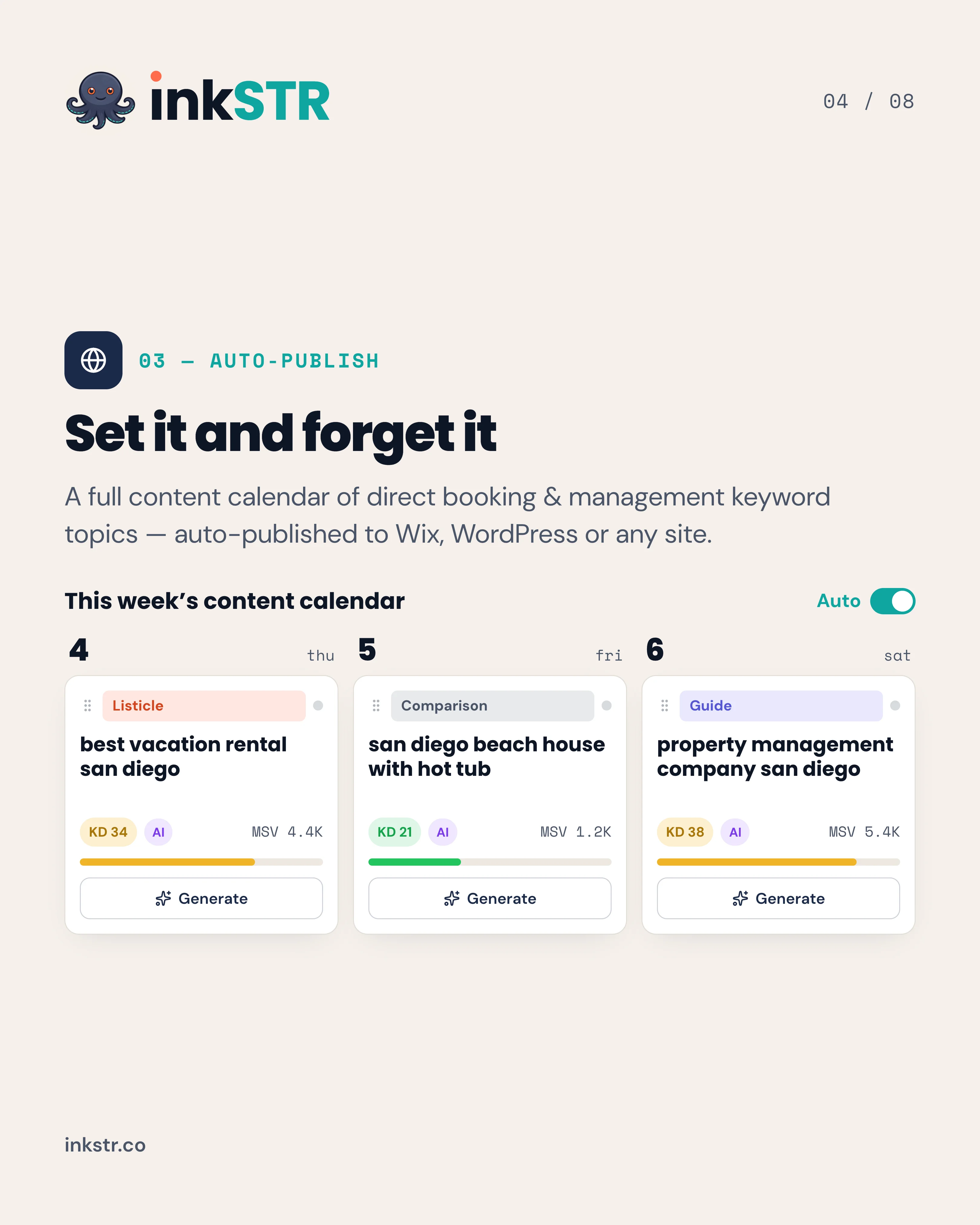
If your website has a booking calendar but no content pulling in search traffic to fill it, that's the gap inkSTR was built to close. Get started with inkSTR and see your first vacation rental blog draft generated, scheduled, and ready to publish this week.
Content powered by inkSTR.co
Enjoyed this article? Share it:
Get more of inkSTR in Google Search
Add inkstr.co as a preferred source and our articles show up more in Top Stories, AI Overviews, and AI Mode — with a “Preferred” badge.
Get more guides like this
New SEO and AI-search guides, straight to your inbox. No spam, unsubscribe anytime.