Vacation Rental Blog Topics That Actually Drive Bookings

The most effective vacation rental blog topics are not about inspiration. They are about search intent: matching what travelers type into Google at the exact moment they are deciding where to stay. Get that match right, and your blog becomes a direct booking engine. Get it wrong, and you publish dozens of posts that attract readers who never book a night.
- Vacation rental blog topics fall into four proven categories: local area guides, property features, seasonal travel content, and guest FAQs. Each category serves a different stage of the guest decision journey.
- According to CUFinder (2026), 38% of vacation rental website traffic comes from organic search, making blog content the single highest-volume channel you can build without paying per click.
- Most operators publish generic attraction lists that attract readers but never convert them. The fix is tying every topic to a direct booking action, such as "cabins near X with hot tubs" rather than just "things to do in X."
- A single ranking blog article can drive organic search traffic for 2 to 5 years, making each post a long-term asset worth far more than a single paid ad spend.
- Freelance travel writers charge $300 to $700 per quality post. Writing one manually takes 3 to 5 hours. At that rate, building a 20-article library costs operators $6,000 to $14,000 and months of effort.
- inkSTR automates vacation rental blog topic research, article generation, and publishing on a set schedule, so operators build topical authority without spending hours on content every week.
What Should You Actually Blog About on a Vacation Rental Website?
Vacation rental blog content refers to keyword-targeted articles published on your direct booking website that attract travelers through organic Google search and guide them toward booking your property. The most effective topics address what guests are already searching for: local experiences, property-specific features, seasonal travel planning, and practical trip logistics. These are not random ideas. They are structured categories that map directly to how travelers research and decide where to stay.
Here is the problem most operators run into. They sit down to write a blog post, draw a blank, and end up publishing something like "Top 10 Things to Do in [City]." That article might attract traffic, but it will almost never convert a reader into a direct booking guest, because it gives travelers zero reason to choose your property over the next search result. Generic travel content has its place, but only when it is strategically connected to your listing.
The vacation rental operators who drive real direct booking revenue from their blogs are doing something different. They are writing content that intercepts travelers at the decision stage, not just the inspiration stage. "Best cabin rentals near Bryson City with a hot tub" converts at a rate that "Top things to do in Western North Carolina" never will. The topic strategy is the difference, and in our experience working with STR operators, it is the piece most hosts skip entirely.
In 2026, Google's search results for vacation-related queries are increasingly dominated by large OTAs like Airbnb and VRBO, making it harder for individual operators to rank on broad terms. The winning strategy is to go specific, publishing articles targeting long-tail, location-specific, and amenity-specific queries where the big platforms have thinner coverage. That is exactly where independent property blogs can compete and win.
Step 1: Start With Local Area Guides That Match Guest Search Intent
Local area guides are the foundation of any vacation rental blog strategy. A local area guide is a destination-focused article that answers the questions travelers ask before they book: what is nearby, what is worth doing, and what makes this location special. The key distinction is that effective local guides are written with your property type and target guest in mind, not as generic travel editorial.
Without this content, you are invisible during the most critical phase of the guest journey. A traveler researching "pet-friendly cabins near Asheville" is already close to booking. If your site does not surface for that query or anything related to it, that guest lands on an OTA, pays the platform fee, and you lose both the booking and a direct relationship. That is what life looks like without a content strategy: you pay Airbnb 17 to 19% in combined fees on every reservation, and you never build any organic traffic to your own site.
The fix is writing local guides that are specific enough to rank and strategic enough to convert. Instead of "Things to Do in the Smoky Mountains," write "Best Hiking Trails Near Gatlinburg for Families With Young Kids." Instead of "Restaurants in Gulf Shores," write "Where to Eat in Gulf Shores Within 10 Minutes of the Beach." Each article should target a real search phrase and include a soft anchor back to your property. A closing line like "If you're planning a family hiking trip in this area, our three-bedroom cabin is 15 minutes from the trailheads above" turns a reader into a prospect.
How to Structure a Local Guide That Converts, Not Just Ranks
A converting local guide follows a simple structure. Open with a direct answer to the search query (name the top picks immediately). Use H2 or H3 subheadings for each location, attraction, or activity. Include practical logistics: distance from your property, parking, best time to visit, what to bring. Close with one sentence that connects the experience back to your listing.
The internal linking matters, too. A guide about hiking near your cabin should link to your "packing list for mountain hikes" article and your "best seasons to visit" post. This cluster structure signals topic authority to Google and keeps readers on your site longer, both of which improve rankings. Our article on local area guides that sell goes deeper on the exact content architecture that turns readers into guests.
inkSTR's Keyword Research tool identifies the specific local search queries your target guests are typing, filtered by your destination market. Rather than guessing which location-specific angles will rank, you get a prioritized list of topics based on actual search volume and competitor gap data. That research step alone typically takes operators 2 to 3 hours to do manually. We reduce it to minutes.
Step 2: Write Property Feature Content That Sells the Stay
Property feature content refers to blog posts that spotlight specific amenities, rooms, or experiences your rental offers. These articles target guests who are searching for a specific type of property rather than a destination. Think "cabins with outdoor hot tubs in the Smoky Mountains," "Airbnb with a game room for a family reunion," or "beachfront condo with a private pool in Gulf Shores." These searches are high-intent and convert well because the guest is describing your property.
Most operators skip this category entirely, assuming their listing description does the job. It does not. Airbnb and VRBO listing pages are indexed by search engines, but they compete for traffic against millions of other listings on the same domain. Your own blog article targeting "large vacation rental with a theater room near Nashville" is competing in a much smaller pool. That is where independent operators have a real advantage.
Effective property feature posts go beyond a description. A post about your hot tub should include content about what guests typically do in the evenings in your area, why a soak after a day of hiking or skiing is the best recovery option, and which months make outdoor soaking especially appealing. You are selling the experience of the amenity, not just listing it. Include a photo, a guest testimonial if you have one, and a direct booking link. This format consistently outperforms generic attraction posts in conversion rate, based on what we see across the content pipelines we build for STR operators.

Step 3: Build a Seasonal Content Calendar That Compounds Over Time
Seasonal content is blog material tied to specific times of year: fall foliage, holiday travel, spring break, summer beach season, ski season, and local events. Seasonal vacation rental blog topics are particularly valuable because they target high-intent travelers during their peak booking window and they can be republished, updated, and reused each year without starting from scratch.
The problem with seasonal content is timing. Most operators think about fall foliage articles in late September, which is already too late. By the time a new article ranks on Google, the season is over. Without a structured content calendar, you are always chasing the season instead of leading it. You miss the traffic window, and your competitors who planned ahead capture the bookings.
A seasonal article published 8 to 12 weeks before the relevant season has time to rank and drive traffic during peak demand. That means your "Ultimate Guide to Smoky Mountains Fall Color" should publish in late July. Your "Best Fourth of July Weekend Getaways Near the Lake" should go live in early May. Planning matters as much as writing.
How to Plan 12 Months of Seasonal Topics in One Sitting
Start by mapping every major season, holiday, and local event in your destination. Assign each one a target publish date that is 8 to 10 weeks before peak demand. Then layer in evergreen content (property features, local guides) to fill the calendar between seasonal peaks. You should be publishing at minimum twice per month to build any meaningful domain authority.
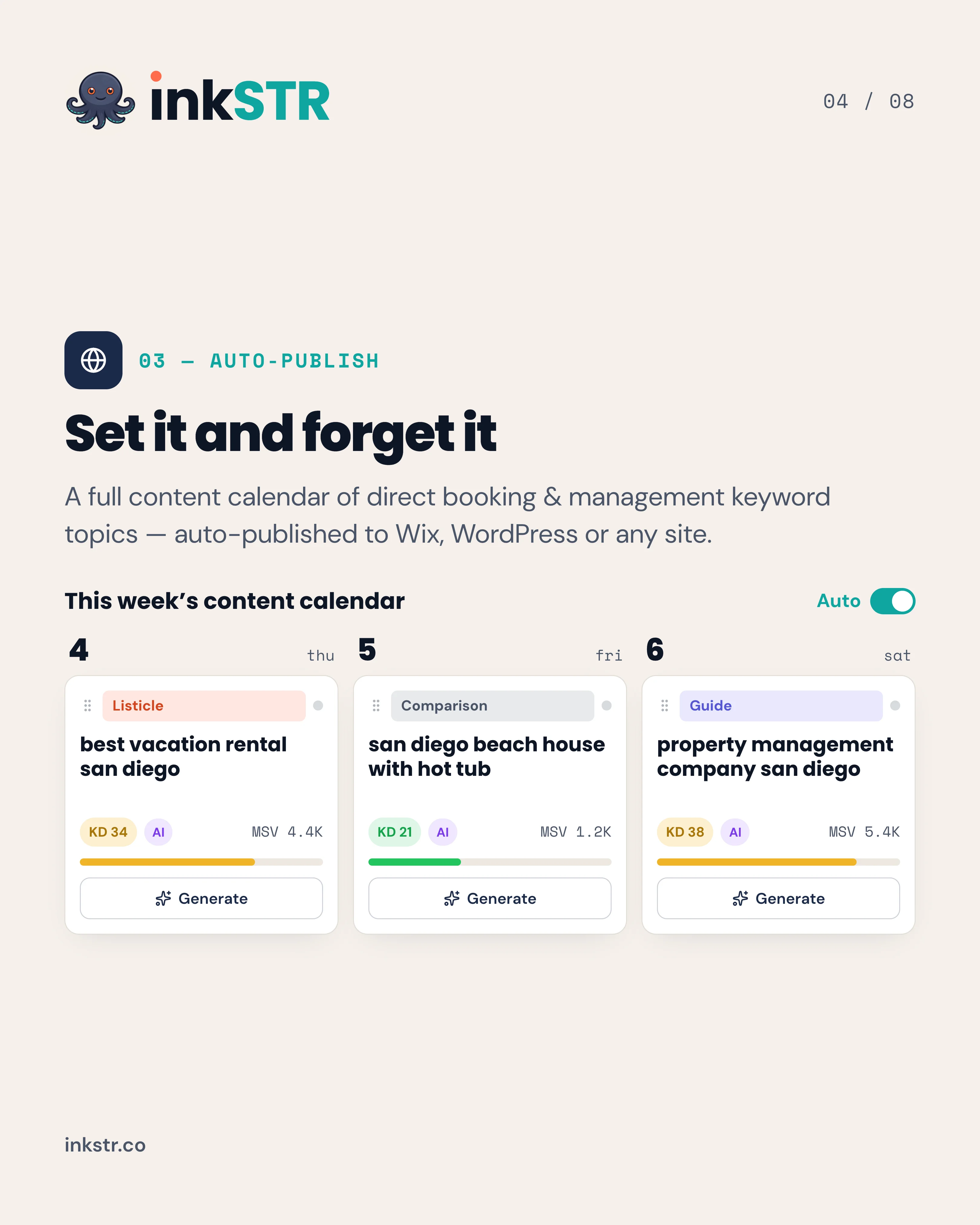
This is where most operators stall. Mapping 24 articles across 12 months sounds manageable until you realize each one requires keyword research, an outline, 2,500+ words of optimized content, and a publish workflow. That is why inkSTR's Content Calendar exists. We built it specifically because operators know what topics they want to cover but get buried in the execution. You set the schedule; inkSTR handles the research, writing, and publishing on autopilot.
For a deeper look at how seasonal content fits into a broader ranking on Google strategy for STR sites, we cover the pillar-cluster architecture that makes seasonal posts work in concert with your evergreen content.
Step 4: Publish Guest FAQ Posts That Intercept Booking-Ready Searches
Guest FAQ posts are articles that answer the practical questions travelers ask in the final hours before booking: what is the check-in process, is the property pet-friendly, is there parking, what do you need to bring for a lake house stay. These queries represent the highest-intent traffic you can capture with organic content because the traveler is already committed to booking a trip. They are choosing between you and a competitor.
The manual alternative is answering the same questions in your Airbnb listing description, your VRBO FAQ section, and your email inbox, over and over again. That is reactive, invisible to Google, and does nothing to build your direct booking channel. Every question you answer on your own website is a search query your site can rank for.
FAQ posts also serve a second function: they reduce guest friction and pre-qualify bookings. A thorough "What to Pack for a Lake House Stay" post positions you as a thoughtful, knowledgeable host before the guest even contacts you. Combined with a call to action linking to your direct booking page, that trust translates into reservations. Our piece on why blog content fails to convert visitors into guests explains the friction points that FAQ content specifically removes.
inkSTR's AI Content Writer generates FAQ-style articles pre-structured for featured snippet capture, which means your content has a stronger chance of appearing in Google's answer box and AI Overviews. That positioning is especially valuable for booking-intent queries where the searcher is seconds away from making a decision.
Ready to automate your content marketing?
inkSTR handles keyword research, content strategy, article writing, and publishing, all on autopilot.
Step 5: Connect Every Topic to a Direct Booking Conversion Path
A direct booking conversion path refers to the sequence of content, links, and calls to action that moves a blog reader from "I'm researching a trip" to "I just booked directly on your site." This step is what separates content that drives revenue from content that just drives page views. Most vacation rental blogs fail here: they attract traffic but never guide that traffic toward a booking.
The gap is real and painful. You spend 4 hours writing a local area guide. It ranks on page one for a solid long-tail keyword. Readers arrive, enjoy the content, and leave. They book on Airbnb because that is where the booking button was. Your blog generated revenue for the OTA, not for you. This is the most common and most expensive mistake we see in vacation rental content strategies.
Every blog post needs three things to complete a conversion path. First, a property-relevant internal link woven naturally into the content (not bolted on at the end). Second, a clear call to action directing the reader to your direct booking page or availability calendar. Third, a reason to bypass the OTA: a direct booking discount, an included add-on, or simply the promise of a faster response and no service fees. When all three are present, blog traffic converts. Without them, you are building an audience for Airbnb.
The psychology behind vacation rental booking strategies goes deeper on why guests choose to book directly when given a clear path, and how subtle content choices drive that decision. Understanding that psychology makes every blog post you write more effective.

How Do Vacation Rental Blog Topics Compare by Conversion Potential?
Not all blog topics convert equally. Local area guides generate the most traffic but require strong internal linking to convert. Property feature posts generate less total traffic but convert at a significantly higher rate because the search intent is closer to booking. Understanding this trade-off helps you allocate your publishing effort strategically.
| Blog Topic Category | Primary SEO Goal | Typical Search Intent | Conversion Potential | Best Publishing Timing |
|---|---|---|---|---|
| Local Area Guides | Build organic traffic volume | Informational / early research | Moderate (requires strong CTA) | Evergreen, update annually |
| Property Feature Posts | Capture high-intent property searches | Commercial / comparison | High (intent is near-booking) | Evergreen, no seasonal dependency |
| Seasonal Travel Content | Capture peak-season traffic | Informational / transactional | High during peak windows | Publish 8 to 12 weeks before season |
| Guest FAQ Posts | Intercept booking-ready searches | Transactional / navigational | Very high (lowest friction) | Evergreen, prioritize early |
| Packing Lists and Travel How-Tos | Build broad audience and trust | Informational | Low direct, high brand trust | Evergreen, good for early publishing |
| Itinerary and Trip Planning Posts | Rank for "X day trip" queries | Informational / early commercial | Moderate (requires property anchor) | Evergreen with seasonal variants |
A balanced content calendar should include all six categories, weighted toward property feature posts and guest FAQ posts in the first 90 days. These convert fastest and build the direct revenue case for continuing to invest in content. Once those foundation articles are live, layer in local guides and seasonal content to expand your traffic footprint.
For operators managing multiple properties, this structure becomes the backbone of a portfolio-wide content strategy. Each property gets its own set of feature posts, its own localized guides, and its own seasonal calendar. That is exactly the kind of multi-project content architecture that inkSTR was designed to handle without requiring a separate workflow for each listing.
What Most Operators Get Wrong About Blog Topic Strategy
The most common mistake in vacation rental content strategy is writing for inspiration rather than intent. Operators choose topics that feel interesting to them rather than topics that match what their ideal guests are actually searching. "A Day in the Life at Our Mountain Cabin" might be a genuinely charming article, but if no one is searching that phrase in Google, it generates no organic traffic and no direct bookings.
The second mistake is ignoring the progression from beginner to advanced content. Most operators publish 5 to 10 articles and then wonder why nothing is ranking. Domain authority builds slowly. Google needs to see consistent, quality publishing over 3 to 6 months before organic rankings meaningfully improve. Operators who stop publishing after a few posts never get past the initial plateau. The ones who rank are the ones who kept going long enough for the system to work.
Third: most operators never repurpose their blog content. A 2,500-word local area guide contains enough material for 8 to 10 social media posts, a 3-email welcome sequence, and a seasonal newsletter. Writing that article once and publishing it once is a significant underutilization of your effort. The operators building sustainable direct booking channels are extracting content value across every channel, not just the blog.
The deeper issue is that building a blog that ranks requires consistent execution over time. Most hosts fail not because the strategy is wrong, but because the production bottleneck kills the calendar. Writing one post per week manually takes 3 to 5 hours. Doing that consistently while managing a short-term rental business is genuinely difficult. inkSTR's Auto-Publishing feature addresses this directly: articles are generated, optimized, and published on a set schedule without the operator doing any of the production work.
If you want to understand the full pipeline, from topic selection through to a ranked, converting article, our guide to how to rank your vacation rental website on Google walks through the complete process with the specificity this topic deserves.
Frequently Asked Questions
How often should I publish new vacation rental blog posts?
Most vacation rental websites begin building meaningful organic traffic after publishing 12 to 20 articles targeting a mix of destination keywords and booking-intent queries. To reach that milestone within 6 months, you need to publish at minimum twice per month. Publishing weekly is more effective if you can maintain that pace. inkSTR's Content Calendar automates this schedule so the cadence stays consistent without requiring manual effort every week.
What is the best length for a vacation rental blog post?
For most vacation rental blog topics, 2,000 to 3,000 words is the target range. Long-form content signals depth and authority to Google, and it provides more surface area to cover related search queries that build topical relevance. Short posts under 800 words rarely rank for competitive queries in 2026. The exception is FAQ-style posts targeting very specific, low-competition questions, where a thorough 700 to 1,000-word answer can rank well if it directly addresses the query.
Should I write separate blogs for each property I manage?
If each property has its own direct booking website, yes: separate blogs with separate keyword strategies will outperform a combined blog that tries to serve multiple destinations from one domain. Keyword research for a beach rental in Gulf Shores looks nothing like keyword research for a mountain cabin in Asheville. Mixing them on one site dilutes topical authority. inkSTR supports multi-project publishing with isolated content pipelines per property, so you can maintain separate strategies without building a separate workflow from scratch for each listing.
Can AI-generated blog content rank on Google for vacation rental keywords?
Yes, when the content is properly structured, keyword-targeted, and written with genuine specificity rather than generic filler. Google's helpful content guidelines reward articles that demonstrate experience and expertise. AI-generated articles that are thin, generic, or factually shallow do not rank, but AI-generated content built around real keyword research, real destination context, and a clear editorial structure performs well. inkSTR's AI Content Writer is trained specifically on STR industry terminology and traveler search intent, which produces more rankable content than general-purpose AI tools.
How long does it take for vacation rental blog posts to rank on Google?
Most vacation rental blog articles begin appearing in search results within 3 to 6 months of publication. A single ranking article can then drive organic search traffic for 2 to 5 years. Low-competition, long-tail queries can rank faster, sometimes within 4 to 8 weeks. Broad, competitive destination queries take longer. Consistent publishing is the biggest variable: sites that publish 2 to 4 articles per month build domain authority faster than sites that publish sporadically.
What vacation rental blog topics drive the most direct bookings?
Property feature posts and guest FAQ posts convert at the highest rate because they target travelers who are close to a booking decision. A post titled "Lakefront Cabin Near X With Private Dock and Hot Tub" captures a search from someone who already knows what they want. Combined with a clear call to action linking to your direct booking page, these posts convert readers into guests more reliably than general travel inspiration content. Local area guides drive more total traffic but require stronger internal linking to push readers toward a booking.
How do I find out what keywords my rental competitors are ranking for?
Tools like SEMRush and Ubersuggest allow you to enter a competitor's URL and see which keywords drive their organic traffic. Look specifically for location-based and amenity-specific terms where competitors rank in positions 4 through 10: those are the gaps your content can step into. inkSTR's Keyword Research tool includes competitor gap analysis built specifically for STR markets, surfacing the exact keywords your direct competitors are ranking for so you can target the most valuable opportunities first.
The Right Blog Topics Are Only Half the Battle
Choosing the right vacation rental blog topics is the strategic foundation. Executing consistently on that strategy is where most operators fall short. A content plan with 24 topics does nothing if you publish 3 posts and stop. A beautifully written local guide generates no revenue if it does not include a conversion path back to your booking page. And a seasonal content calendar produces no results if articles go live after the season has peaked.
The operators capturing real direct booking revenue from organic search in 2026 are not necessarily the ones with the best writing or the biggest marketing budgets. They are the ones with a system that keeps publishing, month after month, while their competitors stay stuck on Airbnb paying 17 to 19% on every booking they could have captured directly.
Building that system manually is possible. It just costs 3 to 5 hours per article, $300 to $700 per post if you hire a freelancer, and months of calendar management to keep the publishing schedule on track. Most operators do not have that margin. If you want that content engine running without doing every piece yourself, inkSTR's AI Content Writer and automated publishing pipeline make it possible at a fraction of that cost.

If your vacation rental website needs consistent, keyword-targeted blog content that ranks on Google and converts readers into direct booking guests, get started with inkSTR. The platform handles keyword research, article generation, scheduling, and publishing automatically, so your content strategy runs while you focus on managing the properties that earn the revenue. Plans start at $99/month.
Content powered by inkSTR.co
Enjoyed this article? Share it:
Get more of inkSTR in Google Search
Add inkstr.co as a preferred source and our articles show up more in Top Stories, AI Overviews, and AI Mode — with a “Preferred” badge.
Get more guides like this
New SEO and AI-search guides, straight to your inbox. No spam, unsubscribe anytime.