Content Marketing vs Paid Ads for Airbnb Hosts: Which Wins?
For most Airbnb hosts, content marketing beats paid ads on any horizon longer than a few months. A published article keeps earning direct bookings for years, while an ad stops delivering the day the budget does. In the content marketing vs paid ads for Airbnb hosts debate, use ads to fill near-term gaps and build content as the asset you own.
Key Takeaways
- Content marketing is slower to start but compounds: a ranking blog article can drive organic search traffic for 2 to 5 years, while paid ads stop the moment spending stops.
- Airbnb host and guest fees combined take 17-19% of every booking, which is the cost both channels try to reduce by sending guests to a site you control.
- A single direct vacation rental booking is typically worth $1,000 to $4,000 in revenue, so measure cost per booking, not clicks.
- Paid ads work best for new listings, shoulder-season gaps and event spikes, and only after your photos, listing copy and booking page are solid.
- Writing one quality blog post manually takes 3 to 5 hours, and a freelance travel writer charges $300 to $700 per post.
- At $99/month, inkSTR generates, schedules and publishes SEO articles automatically, so the content side of this comparison no longer depends on your free hours.
You are probably weighing this because Airbnb keeps a cut of every stay and you want guests who book on your own site. Both channels can get you there. They behave very differently once the first month is over.
In 2026, hosts across the country are choosing between boosting posts, buying Google and Meta clicks, and publishing articles that rank. This guide compares them on cost per booking, speed, control and effort, then gives you a decision framework and a test plan most comparison pages skip.
At inkSTR, we have watched hosts and property managers burn ad budgets on traffic that had nowhere good to land, and we have watched others quietly build search visibility that books rooms every week. The difference is rarely talent. It is sequence.
What Is the Difference Between Content Marketing and Advertising?
Content marketing is the practice of publishing useful, searchable material, such as area guides and booking-intent articles, that earns traffic over time. Advertising is paid placement that delivers traffic only while you fund it. Content builds an asset you own; ads rent attention by the click.
The pain shows up in the manual version. Writing one quality post takes 3 to 5 hours of research and drafting, and a freelance travel writer charges $300 to $700 for each one. Most hosts publish two or three posts, get no immediate result, and quit before search engines have had time to respond.
Ads have the opposite problem. Results appear in days, so spending feels productive, but the traffic vanishes when the card stops charging. You finish the month with no more owned visibility than when you started.
We built the AI Content Writer to remove the cost and time barrier on the content side. It generates SEO-optimized articles from keyword research, written around vacation rental terminology and traveler search intent. You keep your evenings and still build rankings. That matters most for a solo host with one or two properties and a day job, where every hour of writing competes with guest messaging, cleaning schedules and pricing updates.
What Is the Best Way to Promote My Airbnb Listing?
The best way to promote an Airbnb listing is to separate two goals: ranking inside Airbnb's own search, and building a host-owned website that captures guests directly. Platform ranking depends on listing quality and guest signals. Direct bookings depend on traffic you generate yourself through content, email or ads.
Many hosts blur these goals and pay for ads that send people straight back to the Airbnb listing. You are then funding Airbnb's marketplace and still paying the 17-19% in combined fees. Airbnb publishes its own explanation of what factors determine how your listing appears in search results, and improving those factors is free.
For the direct-booking side, you need a destination worth sending people to. Our guide on direct bookings covers that foundation. Once it exists, a guest searching for a pet-friendly cabin with a hot tub can find your article first, then your booking page, without any per-click cost.
This is where inkSTR's Keyword Research earns its place. It finds the specific phrases your target guests type, which is the same work that makes ad targeting precise. Specific phrases such as a pet-friendly rental in your city usually outperform broad keywords in paid campaigns too, so one round of research serves both channels.

Content Marketing vs Paid Ads for Airbnb Hosts: Which Costs Less Per Booking?
Content marketing usually costs less per booking over time, because production cost is spread across every visit an article earns for years. Paid ads cost less to start but charge again for every click. According to SEO vs. PPC for Small Businesses (2026), organic leads cost about 84% less than paid search leads.
The danger is judging either channel by clicks. A click costs money whether or not it ends in a stay. Since a single direct booking is typically worth $1,000 to $4,000, the only number that matters is what you spent to earn that booking. The iGMS marketing guide makes the same recommendation: set a budget first and measure cost per booking instead of clicks.
Paid ads can still pay off in the right place. A small daily budget on promoted posts is a sensible test, and a modest monthly retargeting budget aimed at people who visited your site but did not book is another. Treat any published example of bookings per dollar as illustrative, not a promise, and judge your own campaign by your own numbers.
| Factor | Content marketing | Paid ads |
|---|---|---|
| Speed to first bookings | Slower; most sites see meaningful gains within 3 to 6 months of consistent publishing | Fast; can start the day a campaign launches |
| Cost pattern | Upfront production, then low marginal cost per visit | Ongoing spend; traffic stops when budget stops |
| Lifespan | A ranking article can drive traffic for 2 to 5 years | Lasts only while funded |
| Ownership | Host-owned site and email list | Rented audience; retargeting pools need continued spend |
| Best for | Direct booking growth and AI search citations | New listings, shoulder-season gaps, event spikes |
| Main risk | Inconsistent publishing stalls results | Clicks sent to a weak page waste budget |
| Cost per booking | Falls as articles accumulate | Depends on bidding and conversion; measure, do not assume |
The manual alternative on the content side is a freelancer at $300 to $700 per article, which is why many hosts conclude that content is too expensive. inkSTR is $99/month, and you can see the pricing plans before committing to anything. At that price, a freelancer's single article costs three to seven times a full month of automated publishing, so the comparison favors automation quickly.
How Long Does Content Marketing Take to Drive Direct Bookings?
Content marketing typically takes several months of consistent publishing to produce meaningful search traffic, and direct bookings follow once rankings stabilize. Most sites see meaningful gains within 3 to 6 months. Ranking is never guaranteed, and anyone promising a specific position or timeline is guessing.
That gap is where hosts give up. You publish four posts, see no traffic in week six, and decide content does not work. Meanwhile an ad campaign delivers a visible number every morning, which feels like proof even when the cost per booking is poor.
Consistency is the variable you control. In one case, a Smoky Mountains cabin rental brand grew monthly Google Search clicks from 788 to 5,195 in 11 months on a continuous inkSTR content pipeline, and attributed $309,775 in direct booking revenue in its first 14 months. Those figures were measured in Google Search Console and Google Analytics, not estimated.
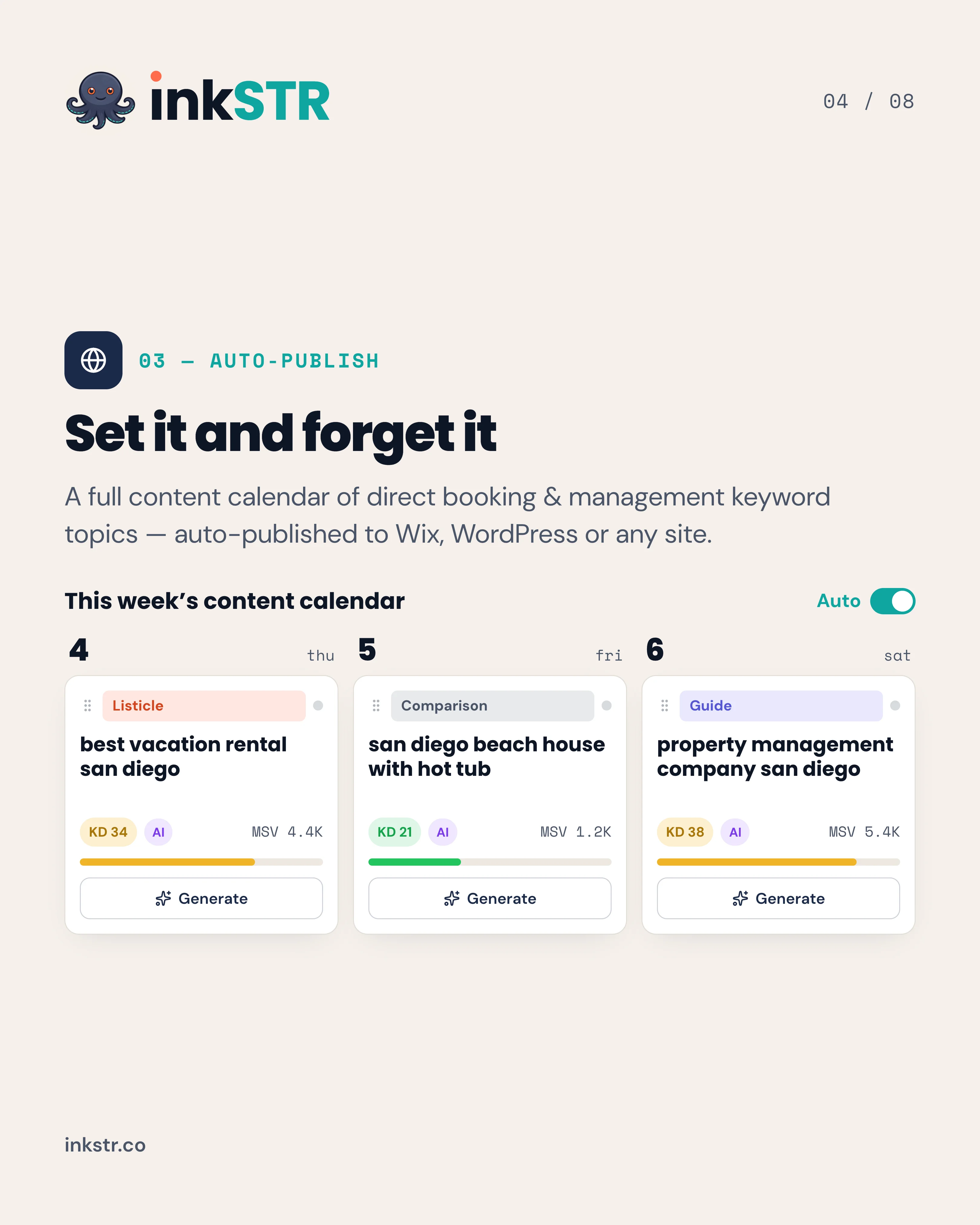
The pipeline behind that result is a schedule, not a burst of effort. Our Content Calendar plans and manages publishing on autopilot, and Auto-Publishing pushes each article straight to Wix, WordPress or your custom site. If you want the mechanics, our guide to ranking your vacation rental website on Google walks through them.
What Is the 80/20 Rule in Airbnb?
The 80/20 rule is an informal idea borrowed from the Pareto principle, not an official Airbnb policy. It suggests a small share of your efforts produces most of your results. For marketing, that means a few pages or campaigns will usually drive most of your bookings, though the exact split varies by host and no verified figure says it will be 80/20 for you.
Practical guidance follows from that idea. Look at your own data after a few months: which articles bring visitors who reach the booking page, and which ad sets produced actual reservations. Put more effort into the winners and stop feeding the rest. Airbnb does not publish a formula for this, so your analytics are the only authority.
The pain is that most hosts cannot see which pieces are the winners. They spread effort evenly across social posts, ads and listing tweaks, then cannot say what worked. inkSTR's Google Search Console integration puts query and page data next to your publishing schedule, so you can tell which topics deserve a sequel and which can be dropped.
A simple monthly habit makes this concrete. List your top five pages by clicks and your top ad sets by reservations, then ask which ones led to a booking request. Write a follow-up for each winning article, and cut any ad set that spent its cap with nothing to show. Within a quarter, you will know where your next hour or dollar belongs.

Ready to automate your content marketing?
inkSTR handles keyword research, content strategy, article writing, and publishing, all on autopilot.
How Do You Decide Between Content and Ads Based on Your Situation?
The right mix depends on four things: whether you have a direct booking website, how many properties you run, how many hours you can spare, and how much cash you can risk. Hosts without a site should build one before buying traffic. Hosts with a site should publish first and spend selectively.
Most comparison pages stay generic here, so here is our position by situation.
One listing and no direct booking website
Do not buy ads yet. You would be paying to send people to a page you do not control. Build a simple site on WordPress or Wix first, then start publishing.
One to five properties with a site and little time
Lead with content on autopilot and add a small retargeting budget once visitors exist. The Fiverr International survey of small businesses found that 70% spend less than five hours weekly on marketing, which is why a hands-off pipeline matters more than a clever tactic.
Ten or more properties
Content is the only option that scales without multiplying workload, since each market can get its own pillar and cluster articles. Ads work as a supplement for specific units or dates.
A new listing with no reviews or traffic
Paid promotion is reasonable here, as the iGMS guide notes, because there is no organic traffic to build on. Run it alongside content, not instead of it.
If you run several properties, inkSTR's multi-project support gives each one an independent content pipeline from a single dashboard.
How Do You Test and Measure Content and Paid Ads Fairly?
A fair test gives each channel a defined budget, a fixed window, a tracked booking page and a stop rule set in advance. Without those four elements, you end up comparing a month of ad data against a month of content that had not matured. Compare like with like.
Most hosts never set this up, so every channel looks equally mysterious. You pay for ads, publish a few posts, see a few bookings, and cannot attribute any of them. The result is gut-feel budgeting and expensive guesses.
- Confirm your foundation: sharp photos, complete listing copy and a booking page that loads fast. Ads rarely fix a weak page.
- Set up Google Analytics and Google Search Console so every booking has a traceable source.
- Publish content on a fixed cadence for at least 3 to 6 months before judging it.
- Run ads with a small, capped budget aimed at one dated goal, such as a local event weekend or a shoulder-season gap.
- Record cost per booking for each channel, plus repeat-booking value if you collect guest emails.
- Stop an ad set that has spent its cap without a booking. Revise it once, then stop. Scale only what clears your target cost per booking.
For cadence, publish on a schedule you can sustain and prioritize topics by guest intent and season. Booking-intent topics, such as specific amenity-and-location searches, come before generic roundups. Our vacation rental blog topics list is a good starting menu, and our post on why blog content fails to convert visitors into guests covers the page-level fixes.
That sustained cadence is what inkSTR automates. Across inkSTR customer sites, we have published more than 4,800 articles as of October 2026, and the workflow behind each one is the same: keyword research, generation, scheduling, publishing. You can see the sequence on the How inkSTR Works page.
What Are the Best Marketing Tools for Vacation Rental Hosts?
The best marketing toolkit for a vacation rental host has four layers: a host-owned website, analytics, an email list and a content engine. Each one removes a specific gap. Together they turn either channel into measurable bookings.
Hosts typically juggle several tools with little integration between them, and the content layer is the one most often skipped because it eats the most hours. A site with no articles has no organic traffic to retarget, which weakens your paid ads too, since retargeting pools depend on visitors.
Content also feeds a newer channel. As of October 2026, we have secured more than 1,400 verified AI-search citations for customer content across inkSTR customer sites. Answer-first articles are what ChatGPT and Google AI Overviews quote, a topic we cover in our guide to ranking in AI search. Paid ads cannot earn that kind of citation.
That is the reason we built inkSTR as a blog automation, content writing and SEO research tool in one product. It handles keyword research, writing, scheduling and publishing to Wix or WordPress, so the content layer stops being the part you skip.
Frequently Asked Questions
Will SEO help me rank higher than Airbnb and large booking platforms?
For broad destination searches, large platforms usually win. For specific, long-tail searches such as a pet-friendly cabin with a hot tub in a named town, your own site can compete. Publishing consistently on those narrow topics is the path, and inkSTR's Keyword Research finds them.
What is the difference between content marketing and paid ads for Airbnb hosts?
Content marketing earns free search traffic over time through articles on your own site. Paid ads buy traffic that stops when you stop paying. Content builds an owned asset; ads supply speed.
Are paid ads worth it for a new Airbnb listing?
They can be, because a new listing has no organic traffic or reviews yet. Keep the budget small, target a specific date range, and send clicks to a page you control. Ads rarely fix weak photos or thin listing copy, so fix those first.
How much should I spend on ads to test them?
Start with a small daily budget on promoted content and a modest monthly amount for retargeting. Treat any figure as a starting point, not a guarantee, and set a stop rule before you spend anything.
What tools automate an AI content pipeline from keyword research to WordPress publishing?
inkSTR covers the full pipeline for short-term rental operators: keyword research, article generation, a scheduling calendar and one-click publishing to WordPress or Wix. You can see the steps on the How inkSTR Works page.
When should I refresh versus rewrite an underperforming article?
Refresh when the topic still matches what guests search for but the facts, internal links or structure are dated. Rewrite when the article targets the wrong intent or never ranked. Check Search Console impressions first: impressions with few clicks usually call for a refresh of the title and opening.
Is content marketing worth it for a small, independent host?
Yes, if you can sustain it. Because a single direct booking is typically worth $1,000 to $4,000, even a small number of attributable bookings changes the math. The obstacle for small hosts is time, which is the problem automation addresses.
So Which Should You Choose in 2026?
In the content marketing vs paid ads for Airbnb hosts decision, build content first and use ads selectively. Content compounds into direct bookings that avoid the 17-19% Airbnb fees, while ads make sense for new listings and date-specific gaps. Start the pipeline now, because rankings take months and AI search keeps rewarding sites with clear answers.
If keeping up with keyword research and blog publishing across your properties feels impossible right now, inkSTR was built to automate exactly this. It generates, schedules and publishes SEO content on autopilot, anywhere in the U.S., with no writing required. Our start page shows the first step, or start a free trial with inkSTR and see your first content plan.
Content powered by inkSTR.co
Enjoyed this article? Share it:
Get more of inkSTR in Google Search
Add inkstr.co as a preferred source and our articles show up more in Top Stories, AI Overviews, and AI Mode — with a “Preferred” badge.
Get more guides like this
New SEO and AI-search guides, straight to your inbox. No spam, unsubscribe anytime.