How to Rank on Google Without a Writer: 7 STR Methods
A vacation rental site can rank on Google without a writer by turning real property facts, guest questions, and verified local details into one useful page at a time, then publishing on a steady schedule. The workflow repeats easily, and automation handles the drafting, scheduling, and publishing you would otherwise outsource.
Key Takeaways
- You rank on Google by matching pages to specific guest searches, not by publishing as much as possible.
- A freelance travel writer charges $300-$700 per quality post, and one post takes 3-5 hours to write manually.
- Google Search Console is the free, reliable way to check your Google ranking through impressions, clicks, and average position.
- Position one is not a realistic promise for every keyword; a steady climb on specific, booking-intent searches is.
- Page length has no universal target; completeness and accuracy matter more than a word count.
- inkSTR automates keyword research, article generation, scheduling, and publishing for $99/month, so your site can rank on Google without hiring a writer.
You have a direct booking site, a few good properties, and almost no organic traffic. Hiring a writer feels expensive, and writing yourself competes with guest messages and turnovers.
At inkSTR, we work with operators who hit this wall every week. As of September 2026, more than 4,400 articles have been published across inkSTR customer sites, so the pattern below comes from repeated practice, not theory.
In 2026, travelers still start many trips in a search box. According to ShortTermRentalz (2023), 42% of US leisure travelers said Google Search impacted their travel provider decision for their last trip. This guide gives you seven methods to earn that visibility.

1. How Do You Rank on Google When You Have No Writer?
To rank on Google without a writer, you feed your real property facts, guest questions, and local knowledge into a repeatable process, then publish one focused page per search intent. The writing itself can be automated; the facts must come from you.
The manual alternative is painful. Writing one quality post takes 3-5 hours of research and drafting, and a freelance travel writer charges $300-$700 per post. Ten posts means a mortgage-sized invoice or ten lost weekends, and most operators quit after post three.
Start with a fact sheet for each property: bedrooms, sleeping capacity, amenities, nearby landmarks, typical guest profile, and the questions guests ask before booking. Every article then draws from that sheet instead of generic travel filler.
We built inkSTR's AI Content Writer around exactly this. It generates SEO-optimized posts from keyword research and your property details. For the broader picture, our guide on ranking on Google for STR sites covers the factors that differ from generic SEO.
2. What Should You Publish First to Rank on Google?
Publish first the pages closest to a booking decision: property pages, then pages answering pre-booking questions, then area guides that link back to your properties. Pages deep in the decision funnel convert best, and most competitor guides never say which to build first.
A blog full of "10 things to do" posts draws curious readers who never book. Months go by, impressions stay flat, and you blame Google.
A sensible order looks like this:
- One unique page per property with its own title, description, and details.
- Pages built on long-tail searches such as property type plus amenity plus destination.
- Answers to pre-booking questions: pets, parking, seasonal access, check-in.
- Local guides that link to specific properties.
Skip a guide when it duplicates what another page already says or when you cannot verify its facts. The Keyword Research feature in inkSTR finds the terms your target guests search, so you choose topics by intent instead of guesswork. Our list of vacation rental blog topics that drive bookings helps you sort what to write.
3. How Do You Keep Automated Content Accurate and Original?
Accurate automated content starts with verified inputs: your own property data, guest questions you have actually received, and local facts you can confirm from an official source. Automation drafts faster than you can, but you supply the ground truth.
Generic copy lifted from a listing site can lead Google to favor the original listing page over yours. A fabricated local detail damages trust the moment a guest arrives.
Here is a worked example. Your draft says the cabin is "five minutes from the trailhead." Open a map, enter the cabin address and the trailhead's parking lot, and read the drive time. If it shows 14 minutes, the draft is wrong by nine minutes, and you change the sentence to "a 14-minute drive to the trailhead parking lot." Then check the park's official page for seasonal closures and fix any hours the draft guessed. That check takes about two minutes per claim.
Use a short review routine before anything goes live:
- Confirm every distance, hours, and seasonal claim against a current source.
- Replace any sentence that could describe any rental in any town.
- Rewrite OTA text rather than reusing it.
- Check that the page offers something the reader cannot find elsewhere on your site.
That is why inkSTR grounds articles in real property data and runs quality scoring and pre-publish validation. Budget about ten minutes per draft: five for fact checks and five for cutting generic sentences. Operators who do this get far better pages than those who publish blind or write from scratch.
4. How Can You Check Your Google Ranking?
You check your Google ranking most reliably with Google Search Console, a free tool that reports the queries your site appears for, your impressions, clicks, and average position. Manual searches mislead because Google personalizes results by location and search history.
Typing your town plus "vacation rental" into Google every Monday leaves you hopeful or sick, and it says nothing about the dozens of long-tail queries where you may already appear.
Set up Google Search Console once, then check three things monthly: which queries earn impressions, which pages earn clicks, and where impressions are high but clicks are low. High impressions with low clicks usually means the title or description needs work; you can preview it with the Google SERP Simulator. If pages are missing entirely, check indexing, sitemaps, and mobile usability.
inkSTR connects to Google Search Console, so performance data sits next to your content plan. Our post on why a vacation rental website is not ranking on Google walks through common diagnostic findings.
5. How Do You Rank One on Google for Vacation Rental Searches?
To rank one on Google for a vacation rental search, you need a page that matches the searcher's intent more precisely than competing pages, backed by technical basics and trust signals. You earn it per keyword, not once for your whole site.
Many operators chase a broad term like "cabin rentals" and compete with the largest booking platforms. That fight is expensive and usually lost. According to BuildUp Bookings (2019), VRBO ranks on the first page of Google for 94% of the vacation rental markets analyzed, so broad terms are crowded.
Win on specificity instead. A guest searching for a pet-friendly cabin with a hot tub near a specific trailhead is deep in the funnel and far less contested. Also separate three surfaces: organic results, Google Vacation Rentals listings, and your Google Business Profile. Each has different rules, and a tactic for one does not automatically move another.
inkSTR's Content Calendar schedules a steady run of these specific pages, and our breakdown of local signals Google cares about in 2026 explains the supporting signals.

6. What Is the Highest Rank in Google, and Is It Realistic?
The highest rank in Google is position one, the top organic result, though paid ads, map packs, and AI Overviews can sit above it. For a small rental site, the goal is reaching page one for many specific queries, not owning one trophy keyword.
Chasing position one on a single term is a trap: you wait for months, get nothing, and conclude SEO does not work. Meanwhile, competitors collect traffic from hundreds of narrower searches.
Volume of well-targeted pages is how smaller sites gain ground. One Smoky Mountains cabin rental brand using inkSTR grew monthly Google Search clicks from 788 to 5,195 in 11 months, and was ranking for more than 26,000 keywords. A five-market mountain rental brand went from 26 to 1,924 monthly Google search visits in four months after publishing 114 articles. Both were measured in Google Search Console and site analytics.
Results vary, and nobody can guarantee a position. inkSTR keeps the publishing cadence going, because consistent output over several months compounds. Our guide on how to rank a vacation rental website on Google covers the on-page basics.
Ready to automate your content marketing?
inkSTR handles keyword research, content strategy, article writing, and publishing, all on autopilot.
7. Which Keywords and Tools Attract Direct Bookings?
Keywords that attract direct bookings combine a property type, a feature, and a place or occasion, such as "lakefront cabin with dock for family reunions". Good SEO tools for operators find these phrases, show competition, and track which pages earn clicks.
Doing this by hand means spreadsheets, tab-hopping, and a weekend of trial and error for a few dozen terms. By the time the list is ready, you have no energy left to write the pages.
A workable approach: start with one flagship property, list name variants, two or three descriptors, and one location term, then group keywords by intent and map each group to a single page. Direct bookings matter financially. A single direct booking is typically worth $1,000 to $4,000 in revenue, while Airbnb host and guest fees combined take 17-19% of every booking.
inkSTR runs keyword research and competitor gap analysis for you, then generates articles against that plan. If direct revenue is your goal, see how inkSTR supports direct bookings, and read what inkSTR does and who should use it.
How Do the Ways to Produce Content Compare?
You can produce SEO content three ways: write it yourself, hire a freelancer, or automate the pipeline. The right pick depends on how many pages you need per month and how much time you can spend on each. The table below compares them on verified figures.
| Approach | Cost per post | Time from you | Consistency |
|---|---|---|---|
| Write it yourself | Your time | 3-5 hours per post | Stops when you get busy |
| Freelance travel writer | $300-$700 | Briefing and review | Depends on budget |
| inkSTR | Included in $99/month | Review and approve | Publishes on a set schedule |
A ranking article can drive organic search traffic for 2-5 years, so the cost of each page spreads over a long stretch. According to CUFinder (2026), 38% of vacation rental traffic comes from organic search, which is why that channel deserves steady investment. See inkSTR pricing for plan details.
How Long Should a Page Be, and How Do You Know It Is Working?
A vacation rental page should be as long as it takes to answer the guest's question completely, with no universal word count. Guides disagree: some suggest 300-500 words per property page, others at least 800. Completeness and accuracy decide the answer.
Measurement is the bigger problem. Most small operators publish, never look at the data, and keep investing in topics nobody searches. Each month, open Search Console and sort pages by impressions. Refresh pages with impressions but no clicks, expand pages stuck on page two, and stop writing topics that draw nothing after several months.
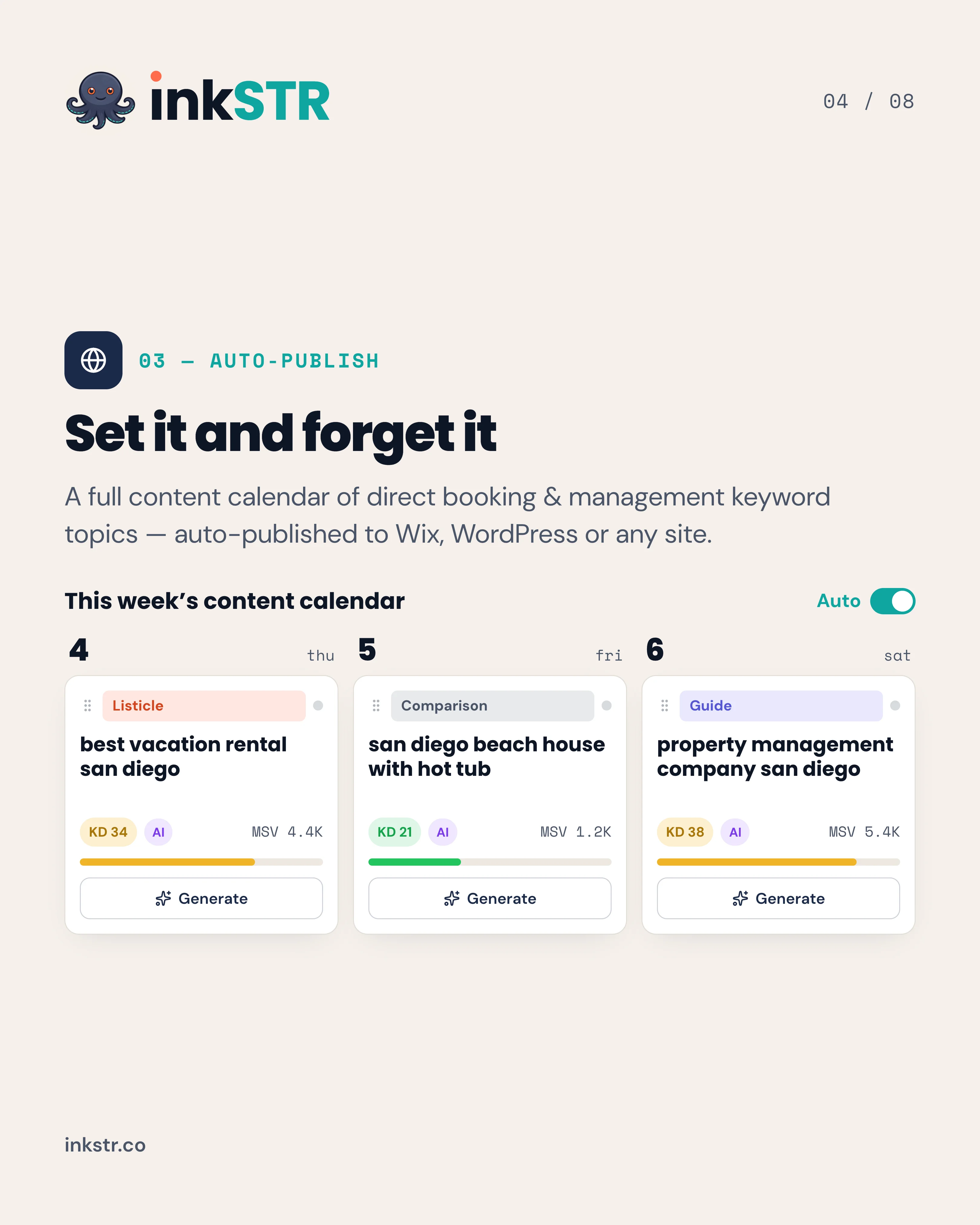
Expect time. Ranking on Google for competitive rental terms typically takes consistent publishing over several months, not days. That is exactly why automation matters: inkSTR's Auto-Publishing sends posts straight to Wix, WordPress, or a custom website, and the how it works page shows the full path from keyword to live post. Property managers running many listings can see our approach for property management teams.
Common mistakes to avoid: copying OTA descriptions, publishing without verifying local facts, targeting only broad terms, and abandoning the schedule after a slow first month.

Frequently Asked Questions
Will SEO help me rank higher than the big booking platforms?
Not on broad terms, where the large platforms dominate. You can outrank them on specific, long-tail searches tied to your exact property type, amenities, and location. Those searches also bring guests who book direct and skip the 17-19% in combined Airbnb fees.
How long does it take to rank on Google?
Most sites see meaningful gains after roughly three to six months of consistent publishing, though results vary by market and competition. No one can guarantee a timeline. A steady content calendar keeps the effort from stalling.
Can AI-written content rank on Google?
Yes, when it is useful, accurate, and grounded in real property and local facts. Google rewards helpfulness, not who typed the words. inkSTR structures articles to answer questions directly so they can also be cited in AI search results.
What is SEO for vacation rental websites?
It is the practice of making your direct booking site visible for guest searches. That includes unique property pages, long-tail keywords, technical basics like mobile usability and sitemaps, and helpful local content. The aim is organic traffic that converts to bookings.
What is Google Vacation Rentals and do I need it?
Google Vacation Rentals is a travel surface where listings with photos, pricing, and availability can appear. It is separate from regular organic results, so a blog post does not affect it directly. Complete listings and a strong organic presence work together.
How can I check my Google ranking for free?
Use Google Search Console. It shows which queries show your site, how often, and at what average position. Verify your site once and review it monthly.
Do I need a blog if I already have a direct booking site?
Yes, for most operators. Property pages alone cover few searches, while blog posts capture questions guests ask before booking. Our post on turning blog visitors into guests explains how to convert that traffic.
Is content marketing worth it for a small independent host?
It usually is, because one direct booking is typically worth $1,000 to $4,000 and a ranking article can drive traffic for 2-5 years. At $99/month, inkSTR costs less than a single freelance post. Start by reviewing how to get started.
Can You Rank on Google Without Hiring a Writer?
Yes. You rank on Google by choosing specific searches, grounding every page in verified property facts, measuring results in Search Console, and publishing consistently for months. Automation covers the drafting and scheduling that used to require a writer, and in 2026 that is a practical option for even a single-property host.
Ranking and turning traffic into direct bookings depends on publishing the right content consistently. That is the gap inkSTR was built to close for operators anywhere in the U.S. If keyword research and weekly publishing feel impossible right now, inkSTR generates, schedules, and publishes SEO content on autopilot. Start a free trial and see your first content plan.

Content powered by inkSTR.co
Enjoyed this article? Share it:
Get more of inkSTR in Google Search
Add inkstr.co as a preferred source and our articles show up more in Top Stories, AI Overviews, and AI Mode — with a “Preferred” badge.
Get more guides like this
New SEO and AI-search guides, straight to your inbox. No spam, unsubscribe anytime.