Airbnb Direct Booking Website: 2026 Review of Your Options
An Airbnb direct booking website is your own branded site where guests check availability, pay, and reserve without Airbnb taking a cut. For most hosts in 2026, the strongest setup is a simple site built on a property management tool or website builder, synced to your Airbnb calendar, and fed by search-optimized blog content from inkSTR so guests find you on Google.
Key Takeaways
- Four setups cover most hosts: Airbnb's shareable direct booking link, a PMS-built site, a website builder with a booking widget, and WordPress with a booking plugin.
- A single direct booking is typically worth $1,000 to $4,000 in revenue, so a handful of extra direct stays can pay for your software.
- Direct traffic converts at an average of 3-5% for vacation rentals, according to the hostAI Blog (2026), but only if people can find your site.
- Payments, cancellation terms, tax collection, and calendar sync need to be settled before your first direct guest pays.
- inkSTR writes, schedules, and publishes the SEO blog content that brings search traffic to your direct booking site for $99/month.
Introduction
Most hosts we talk to already have a decent Airbnb listing and a nagging feeling that they pay too much for the privilege. A direct booking site is the obvious fix, and building one takes an afternoon. The harder part is the question that follows: who will ever visit it?
At inkSTR, we build AI content tools for short-term rental operators, so we see both halves of this problem. This review covers the four main ways to set up a direct booking site, what each costs you in effort and risk, and how to launch one that actually receives guests.
What Is an Airbnb Direct Booking Website and How Do Direct Bookings Work?
A direct booking website is a site you control where guests view your property, see live availability, pay through your own payment processor, and receive confirmation without going through an online travel agency. You keep the guest relationship and the data. Most of the revenue stays with you too.
Without one, you depend entirely on a platform that sets the fees and the rules. It also controls the search ranking. Picture a slow February. Your listing slides down Airbnb's results, and nobody has your email address. Past guests who loved the place have no way to rebook except through the same marketplace that charges you again.
A working direct booking flow has four pieces. These are a property page with photos and rules, and a booking engine that shows availability and takes payment. The other two are a calendar connection to your other channels, and a way for guests to arrive. The first three are software. The fourth is marketing, and it is where most direct booking sites quietly fail.
That fourth piece is why we built inkSTR. Our direct bookings workflow generates the articles that answer what travelers search before they book, then links them to your booking page.
How Should You Judge a Direct Booking Setup?
You should judge a direct booking setup on five criteria: setup effort, ongoing cost, calendar sync reliability, payment and policy control, and how well it supports search traffic. A tool that scores well on features but poorly on sync will cost you more in double bookings than it saves in fees.
Many hosts pick a platform by looking at a demo page and a monthly price. Then the first cancellation hits, a calendar block fails to carry over, or the template cannot hold a blog. Fixing that after launch means rebuilding pages and re-explaining terms to guests.
Here is how the four common setups compare on those criteria. Cells are qualitative because pricing changes often; confirm current costs with each provider.
| Setup | Setup effort | Cost pattern | Calendar sync | Blog and SEO control |
|---|---|---|---|---|
| PMS-built website | Low to moderate | Subscription, sometimes plus per-booking fees | Strong, usually API-based | Varies by tool |
| Website builder with booking widget | Moderate | Site plan plus booking tool | Depends on the widget | Good |
| WordPress with booking plugin | Highest | Hosting plus plugin licenses | Often iCal, with delays | Excellent |
inkSTR does not replace any of these. It plugs into the last column, publishing to Wix or WordPress and generating the blog posts through our AI Content Writer.
Which Direct Booking Option Fits Your Rental Best?
The best direct booking option depends on how many properties you run and how much you want to own. A single-property host who wants speed will choose differently from a manager with a portfolio who needs search visibility and a branded site.
Pros: nothing to build, calendar already synced. Cons: the guest still lives inside Airbnb's ecosystem, you cannot add a blog, and you own no search traffic. Best for: repeat guests you already message. Review Airbnb's current terms on Airbnb before relying on it.
PMS-built website
Pros: reservations, payments, and sync live in one dashboard. Cons: templates are often rigid, and some tools add per-booking fees. Best for: managers with ten or more units who already run a PMS.
Website builder with a booking widget
Pros: design freedom and a built-in blog. Cons: you stitch the booking tool and the site together yourself; the Wix Help Center guide to rental sites shows how. Best for: one to five properties.
WordPress with a booking plugin
Pros: full control of SEO, structure, and content. Cons: you handle hosting, updates, and security, and iCal sync can lag. Best for: hosts who treat their site as a long-term traffic asset on WordPress.
How Much Does a Direct Booking Website Cost, and What Do You Save?
Whether you come out ahead depends on how many guests actually book through it.
For illustration, take a $2,000 stay. A single direct booking of that size can cover several months of a site plan, which is why even small direct volume matters.
But direct is not free. Your payment processor charges per transaction, your booking tool bills monthly or per reservation, and you absorb the cost of chargebacks. Before you commit, ask every vendor to itemize subscription and processing costs. Ask about any guest-facing fees as well. Vendor comparison pages tend to highlight only their own cheap line.
On price parity, our position is simple: do not undercut yourself on Airbnb and do not charge direct guests more than the platform price. Matching rates, or offering a small perk such as early check-in, gives guests a reason to book direct without damaging your standing on Airbnb.
On the marketing side, a freelance travel writer charges $300-$700 per quality post and each post takes 3-5 hours to write yourself. inkSTR costs $99/month; see pricing for the plan details.
What Payments, Terms, and Taxes Do You Need Before Launch?
A direct booking site needs a payment processor and written cancellation and deposit terms. It also needs a damage and security deposit policy, plus a clear approach to occupancy taxes.
Picture a first-time direct guest at 11 p.m. wondering whether the confirmation email means the cabin is really theirs. If the total price, payment timing, cancellation terms, and a reliable contact route are not spelled out in writing before payment, they will hesitate or ask for a refund after a dispute.
Start with a processor such as Stripe or PayPal, both widely used for direct bookings; compare their fees and dispute handling. Then write plain-language terms about what is refundable and when, and how deposits work. Say what happens if a guest damages the property. Consider ID verification for first-time guests.
Tax rules are local. State and city laws may require you to collect and remit occupancy or sales taxes on direct bookings, and the rules, rates, and filing deadlines change. Confirm current requirements with your local tax or housing office and your insurance provider before taking your first payment.
We use inkSTR's Keyword Research to surface the questions guests ask about these exact concerns, then draft trust-building posts about booking direct. A clear explainer also helps your page convert; our booking page conversion guide covers the details.
Ready to automate your content marketing?
inkSTR handles keyword research, content strategy, article writing, and publishing, all on autopilot.
Is It Allowed, and How Do You Avoid Double Bookings?
Promoting a direct booking site is allowed in some forms and restricted in others, and calendar sync is the technical safeguard against double bookings. You need to understand both before you send a single guest to your site.
Airbnb's terms restrict certain ways of steering guests off the platform, particularly before a booking exists. Read the current rules in the Airbnb Help Center, and stay out of the gray zone: do not put links in listing descriptions or messages to guests who have not booked yet. Past guests, your own email list, and Google search are safe channels.
For calendars, an API connection between your booking tool and Airbnb updates quickly. An iCal feed is simpler but can lag. Owner blocks may not carry over cleanly, and neither may cleaning buffers. Test by blocking a date on each side and confirming it appears on the other before launch. A double booking costs far more than any commission you saved.
If you use VRBO as well, connect it through the same tool rather than a separate manual calendar. Our content calendar sits on the marketing side only: inkSTR does not sync reservations. What it does is plan weeks of blog posts at once, so you are not scrambling to publish while managing availability.
Why Does Your Direct Booking Site Get No Traffic, and What Fixes It?
A direct booking site gets no traffic when it has few pages that match what travelers search, so Google has nothing to rank. Property pages alone rarely compete. Blog content aimed at destination and season searches, or at trip planning, brings guests who have not chosen a place yet.
Consider the manual route. You research keywords, write 3-5 hours per post, format it, find photos, upload it, and repeat weekly. Most hosts stop after a month. Meanwhile a competing management company publishes steadily and owns the first page for the exact search your guests make.
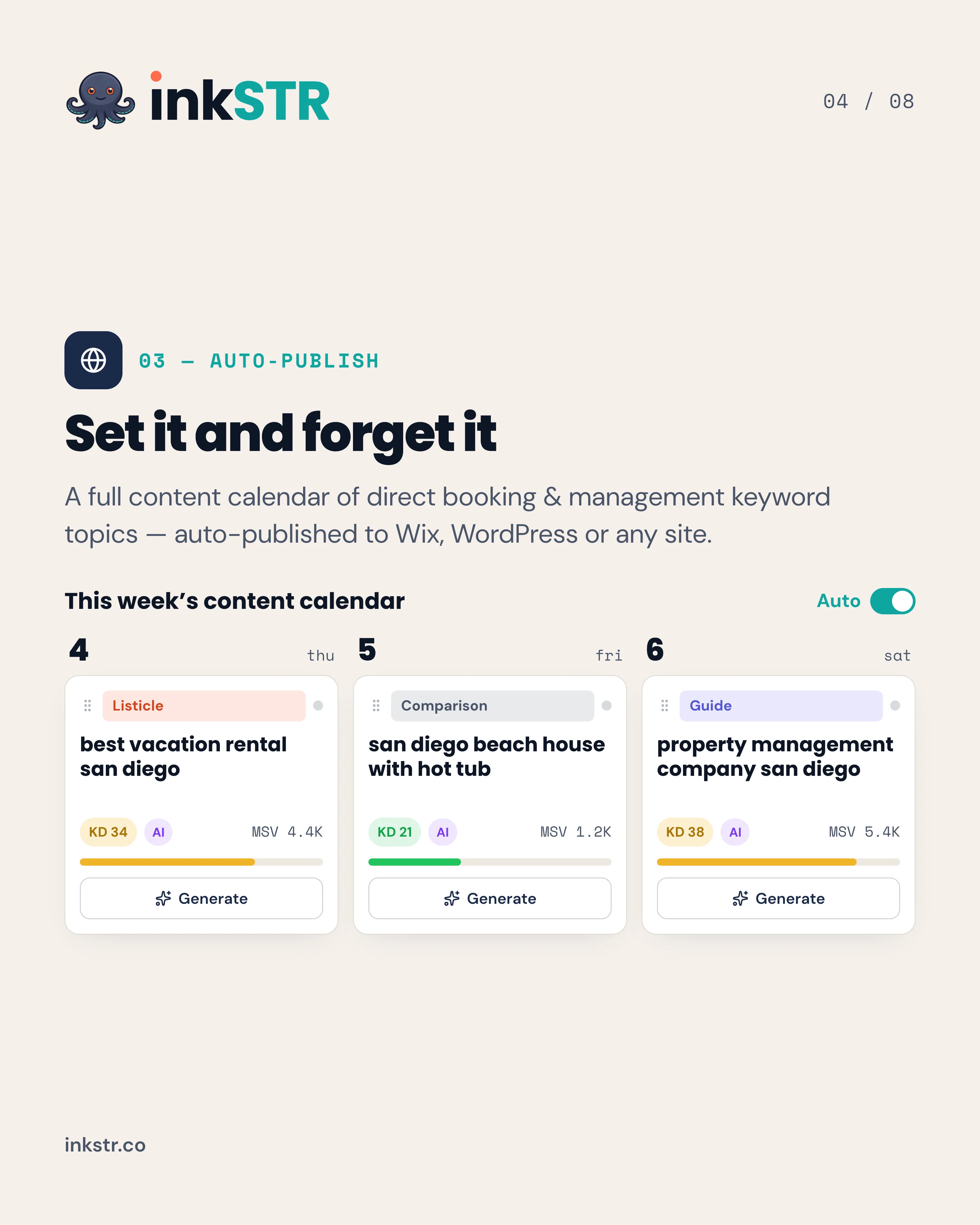
Consistency is the part we built inkSTR to remove. Our Content Calendar schedules posts ahead of time, and Auto-Publishing sends them to Wix or WordPress without manual steps. Our workflow runs from keyword to published post.
The results can be large, though they take time. In one case, Hemlock Hills, a Smoky Mountains cabin rental management company, grew monthly Google Search clicks from 788 to 5,195 in 11 months. It attributed $309,775 in direct booking revenue over its first 14 months. The figures were measured in Google Search Console and Google Analytics. As of November 2026, inkSTR has published more than 5,400 articles across customer sites.
If your site already exists but sits invisible, start with why your vacation rental website is not ranking and the local signals Google cares about in 2026. Setting up a Google Business Profile also helps local discovery, and Google Analytics shows what is working.
What Does a Direct Booking Launch Checklist Look Like?
A direct booking launch checklist is the ordered set of tasks that takes a property from no site to a tested, bookable, searchable page. Following the order matters because payments and sync must work before you invite any guest.
Skipping steps is how hosts end up with a pretty site that cannot take a deposit. Work through these in sequence:
- Choose your platform from the four options above and register a domain that matches your property or brand name.
- Build property pages that match the real listing: beds, capacity, amenities, photos, house rules, and contact details.
- Connect a payment processor and run a test charge and a test refund.
- Publish clear terms covering total price, payment timing, cancellation, deposits, and a contact route.
- Link your calendar and test by blocking dates on both sides.
- Confirm your local tax and permit obligations for direct bookings.
- Make a test booking from start to finish on a phone.
- Set up blog publishing and a keyword plan so traffic starts building.
For the final step, you can start an inkSTR project and connect your Wix or WordPress site. Our property management page covers multi-property setups. Expect SEO to take months, not days; a ranking article can drive organic traffic for 2-5 years once it earns its place.
Frequently Asked Questions
For searches that include your property name or specific local terms, yes, your own site can outrank listings. For broad searches such as "vacation rental" plus a town, large platforms usually win, so target specific, long-tail searches. Our guide on ranking your vacation rental website on Google explains how.
Which booking solution is worth the investment for direct channels?
Choose the tool that handles payments and calendar sync, with solid policy control. Then pair it with content that earns traffic. A booking engine with no visitors saves nothing. inkSTR covers the traffic side at $99/month.
Which property management systems include website builders and booking engines?
Many all-in-one property management systems include a direct booking website and engine. Compare templates and per-booking fees, since some builders limit SEO. Check blog support too. If the built-in site cannot host a blog, you can publish to Wix or WordPress with inkSTR instead.
How much does direct booking software cost?
Costs typically combine a monthly subscription with payment-processing fees. Some setups add per-booking charges. Prices change often, so ask each vendor for an itemized quote.
A guest finds your site, picks dates, pays through your processor, and receives confirmation from you. Your booking tool then blocks those dates on Airbnb through calendar sync. Always follow Airbnb's current rules on promoting off-platform bookings.
What is the best direct booking setup for a small host?
A single-property host usually does best with a website builder or PMS-built site, plus a short list of blog posts targeting local searches. Our guide to ranking in AI search shows how to get cited by AI tools too.
Conclusion
Choose the setup that matches your portfolio size, launch with the checklist above, and treat blog content as the engine that fills it. In 2026, hosts who own their search traffic hold the advantage over those who rent theirs.
If you want an Airbnb direct booking website that earns steady visitors, Start Free Trial with inkSTR. Our AI Content Writer drafts search-optimized articles, and the Content Calendar and Auto-Publishing send them to your Wix or WordPress site on schedule, so your blog keeps working while you host.
Content powered by inkSTR.co
Enjoyed this article? Share it:
Get more of inkSTR in Google Search
Add inkstr.co as a preferred source and our articles show up more in Top Stories, AI Overviews, and AI Mode, with a “Preferred” badge.
Get more guides like this
New SEO and AI-search guides, straight to your inbox. No spam, unsubscribe anytime.