Booking Page Conversion Optimization: The One Mistake Costing You Thousands
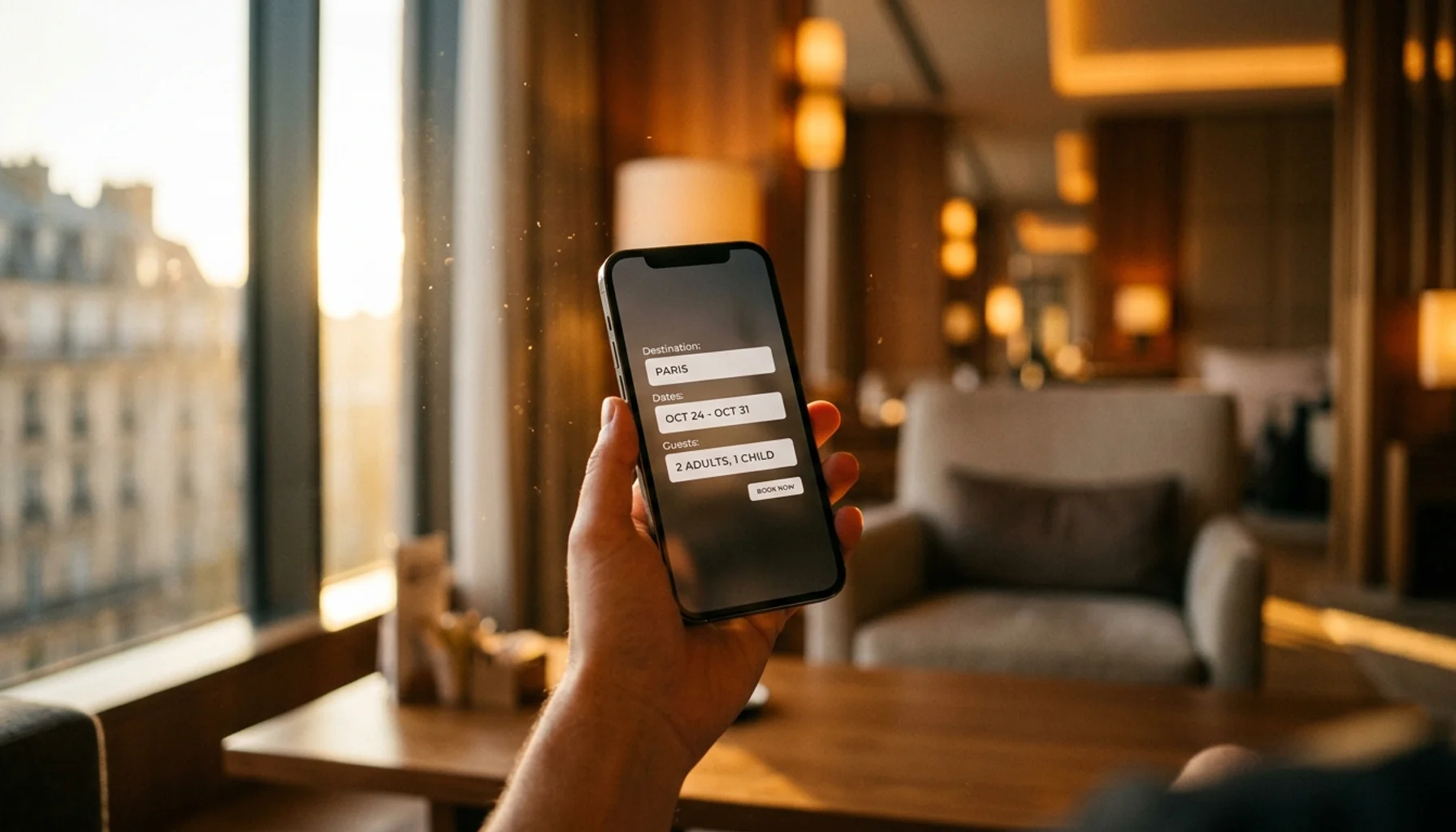
Booking page conversion optimization refers to the systematic process of removing friction, building trust, and reducing decision paralysis on the page where potential guests commit to a reservation. Most short-term rental operators focus obsessively on driving traffic to their booking pages while ignoring the leak already draining thousands of dollars from the traffic they already have. According to the Unbounce Conversion Benchmark Report, the median landing page conversion rate across all industries is just 6.6%, while top-performing booking pages in the travel and hospitality space reach 22%. If your booking page sits anywhere near the average, you are leaving real money on the table every single month.
TL;DR
- The average booking page converts at roughly 13%; top performers reach 22%. The gap between those two numbers is worth thousands of dollars annually for most STR operators.
- The single most costly mistake is form friction: each field added beyond three reduces conversion by approximately 25%, according to the Unbounce Form Field Study.
- 53% of mobile users abandon a booking page when load time exceeds 3 seconds (Google Speed Study), and 58% of all booking page traffic arrives via mobile devices (Statista).
- Social proof elements such as reviews produce 3.2x higher conversion compared to pages without them, per Yotpo Social Proof Report data.
- Abandoned booking recovery through email retargeting and exit-intent tactics is the most consistently overlooked growth lever in the STR space, with global cart abandonment exceeding 70%.
- inkSTR's AI Content Writer generates SEO-optimized blog content that drives qualified traffic to your booking page, so the visitors arriving already understand your property and arrive with higher purchase intent.
Table of Contents
- What Is Booking Page Conversion Optimization?
- Is a 2.5% Conversion Rate Good for a Vacation Rental Booking Page?
- The One Mistake Costing You Thousands: Form Friction
- Is a 30% Conversion Rate Good? What Top-Performing Pages Actually Do
- Psychological Friction vs. Technical Friction: Why Most Guides Miss This
- Is a 70% Conversion Rate Good? Understanding What Those Numbers Really Mean
- What Is an Example of Conversion Optimization for a Vacation Rental?
- Abandoned Booking Recovery: The Strategy Almost Nobody Uses
- Mobile Optimization: Where Most STR Booking Pages Fail
- Trust Signals and Social Proof: The Fastest Conversion Win Available
- Calculate Your Conversion Revenue Gap Before Spending Another Dollar on Ads
- The Booking Page Conversion Optimization Checklist for STR Operators
- Frequently Asked Questions
- What to Do Next
What Is Booking Page Conversion Optimization?
Booking page conversion optimization is the practice of systematically identifying and removing every element on a reservation page that causes a potential guest to hesitate, doubt, or abandon their booking. The conversion rate itself is calculated simply: divide completed reservations by total booking page visitors, then multiply by 100. If 75 guests complete a reservation out of 3,000 visitors, your conversion rate is 2.5%.
Understanding that formula matters because it reveals where your revenue ceiling actually sits. You can double your bookings either by doubling your traffic or by doubling your conversion rate. Doubling traffic requires sustained ad spend or months of SEO work. Doubling your conversion rate is often faster, cheaper, and more durable.
At inkSTR, we work with vacation rental operators who obsess over their Airbnb listing photos while their direct booking page quietly bleeds revenue through entirely fixable problems. The benchmark data is clear: pages with fewer than three form fields convert at an average of 18%, according to the Formstack Form Conversion Report. Most STR booking pages have far more than three fields. That gap alone accounts for a significant share of the thousands operators lose monthly to poor conversion design.
Specifically, booking page conversion optimization covers six categories: form design and friction reduction, mobile experience, page load speed, trust signals, urgency and social proof, and abandoned booking recovery. Each category contributes to whether a visitor who arrived with genuine intent actually completes their reservation.
Is a 2.5% Conversion Rate Good for a Vacation Rental Booking Page?
A 2.5% booking page conversion rate is not good for a vacation rental direct booking website. It sits at the low end of the industry range. According to Hotel Tech Report data, average hotel website conversion rates fall between 1.5% and 2.5%, meaning a 2.5% rate is approximately average for the broader travel and hospitality category. But average is not a goal; it is a warning sign.
Here is why that number should concern you. If your booking page receives 1,000 visitors per month and converts at 2.5%, you generate 25 bookings. At an average direct booking value of $1,000 to $4,000 per reservation, that is between $25,000 and $100,000 in monthly revenue. Raise your conversion rate to 5%, which is achievable with the tactics in this guide, and you generate 50 bookings from the same traffic. You have just doubled revenue without spending a single additional dollar on advertising.
The painful part is that most operators do not even measure their booking page conversion rate. They feel the result in their bank account without understanding the cause. Manual tracking through Google Analytics takes time to set up and interpret correctly. Writing content to attract qualified traffic compounds the problem: you might be sending the right visitors to a page that is actively undermining their intent.
This is exactly the problem we designed inkSTR to address from the content side. Our Keyword Research tool identifies the specific search queries that signal booking intent, not just casual browsing. When the traffic arriving at your booking page already understands your property's value because they read an optimized blog post about your area, their baseline conversion rate is meaningfully higher. Traffic quality and page quality work together. You cannot fix conversion by optimizing one and ignoring the other.
The One Mistake Costing You Thousands: Form Friction
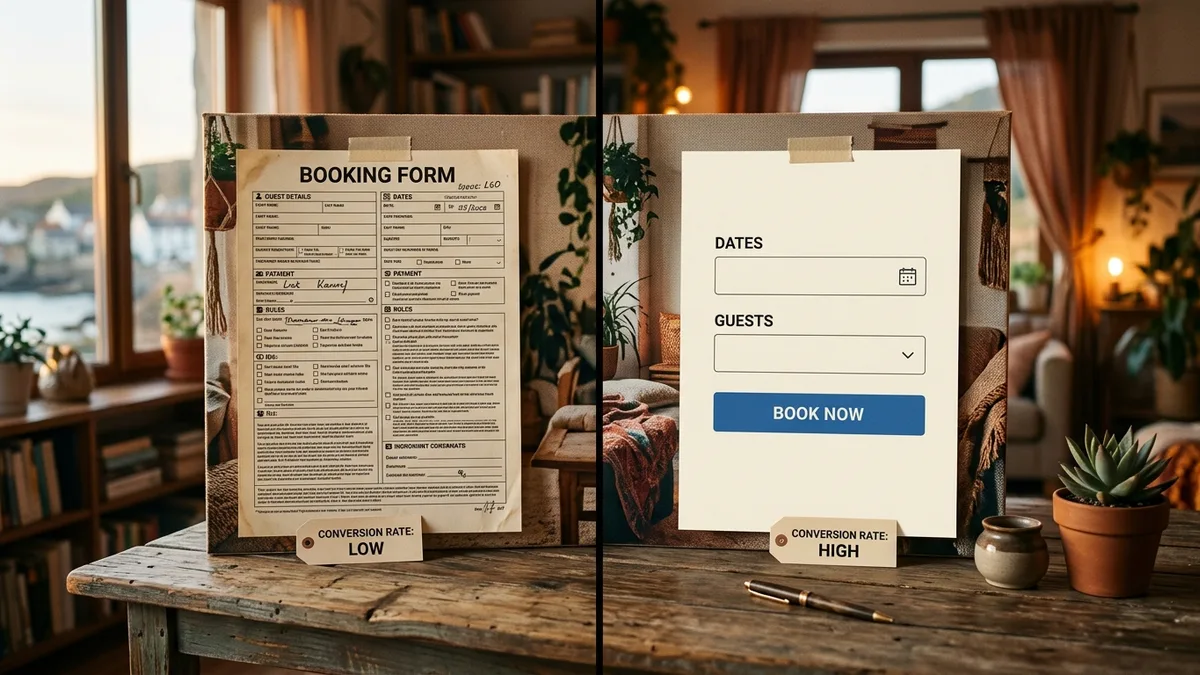
Form friction is the single most costly and most consistently overlooked mistake on vacation rental booking pages. Form friction refers to any element of the reservation form that creates unnecessary effort, confusion, or doubt for the visitor attempting to complete their booking. Every field you ask a guest to fill out that is not strictly necessary to process their reservation is costing you money.
The data on this is direct. According to the Unbounce Form Field Study, each additional field beyond three reduces conversion by approximately 25%. A form with six fields converts roughly 50% worse than a three-field form, all else being equal. A study of a UK-based travel company found that reducing form fields increased form submissions by 35%. Expedia famously discovered that a single optional "Company" field was causing guests to enter their bank name instead of their home address, causing credit card transactions to fail. Deleting that one field increased their conversions measurably.
Most STR operators build their booking forms by adding fields over time as questions arise from guest communications. "We keep getting asked about check-in time, so let's add that to the form." "We need to know about pets before confirming." Each addition feels logical in isolation. Collectively, they create a form that demands 10 minutes of a guest's time and sends a psychological message: this process is complicated, this operator is uncertain about your stay.
Furthermore, 46% of booking abandonment is directly attributed to too many steps or form fields, according to Formstack Form Conversion research. Add to that the finding from Baymard Institute that 53% of visitors abandon a booking when the experience takes more than three minutes, and you have a clear diagnosis: most STR booking pages are friction machines, not conversion engines.
In our experience working with STR operators across the country, the operators who improve conversion fastest are the ones willing to make a ruthless decision: keep only the fields genuinely required to process a reservation. Name, dates, and payment. Everything else can be handled post-booking through an automated guest communication sequence. That mindset shift, not a redesigned logo or a new hero photo, is what separates 2.5% converters from 8% converters.
Is a 30% Conversion Rate Good? What Top-Performing Pages Actually Do
A 30% booking page conversion rate is exceptional and represents genuinely top-tier performance. To contextualize it: the Unbounce Conversion Benchmark Report, based on analysis of more than 57 million conversions across 41,000 landing pages, puts the median conversion rate across all industries at 6.6%, with an industry range of 3.8% to 12.3%. A 30% rate sits well above the 99th percentile for most commercial categories.
That said, 30% is achievable in specific scenarios. Email traffic converts at an average of 19.3%, the highest of all traffic channels according to the same Unbounce report. When you layer in personalized content, a simplified form, trust badges, and real-time availability, email-driven visitors arriving at a highly optimized page can reach or exceed a 30% booking completion rate. Instagram converts at 17.9% and Facebook at 13% among paid social channels, so a warm audience arriving from a well-targeted social campaign can also approach this range.
What do the pages achieving 30% actually do differently? Based on the patterns we see across high-performing STR direct booking sites, three factors appear consistently. First, they show real-time availability. Pages displaying live availability indicators see a 32% conversion increase, per SimplyBook.me A/B test data. Second, they display prominent social proof. Third, and most importantly, they make the cancellation and rescheduling policy unmissable. Zocdoc booking completion data shows that clearly displaying cancellation terms increases conversion by 28%. Guests are not afraid to book; they are afraid to commit to something they cannot change. Removing that fear is more powerful than any design tweak.
We built inkSTR's content strategy around this insight. A guest who arrives at your booking page having already read a well-written, specific blog post about your property's location, what makes it unique, and how the check-in process works arrives with dramatically less anxiety than a cold visitor. That pre-qualified traffic is why vacation rental booking strategies grounded in psychology consistently outperform generic advertising approaches.
Psychological Friction vs. Technical Friction: Why Most Guides Miss This
Psychological friction and technical friction are two distinct conversion killers that require different remedies. Technical friction refers to objective barriers: slow page load times, broken form elements, poor mobile responsiveness, or a payment system that rejects valid cards. Psychological friction refers to internal doubt: "Is this property actually as described?" "What if something goes wrong?" "Am I making the right choice when I could look at five more options?"
Most conversion optimization guides focus almost entirely on technical friction because it is measurable and fixable with code. But in our experience working with STR operators, psychological friction is the more persistent and expensive problem. A guest with a technically perfect booking form will still abandon if they feel uncertain about the property, the operator, or the commitment they are about to make.
The specific psychological barriers on vacation rental booking pages include three primary patterns. Decision paralysis occurs when guests see too many room types, date options, or add-on selections without clear guidance about which choice is right for them. Commitment anxiety spikes when refund policies are buried in fine print or written in legal language. Trust deficit emerges when the booking page looks different from the listing page the guest came from, or when there are no visible signals that the operator is legitimate and responsive.
Notably, a McKinsey case study found that one company reduced churn rates by 75% after identifying and resolving key customer friction points, specifically psychological ones tied to uncertainty in the purchase process. The principle applies directly to vacation rental booking pages: guests do not abandon because the process is too slow; they abandon because they do not yet feel certain enough to commit.
Addressing psychological friction requires content, not code. A well-written FAQ section on your booking page that answers the top five anxieties guests have before confirming does more conversion work than a page speed improvement from 2.1 seconds to 1.8 seconds. This is where inkSTR's content approach connects directly to conversion outcomes: the blog posts and local area guides we help operators publish at scale build the trust and familiarity that reduce psychological friction before the guest even reaches the booking form.
Is a 70% Conversion Rate Good? Understanding What Those Numbers Really Mean
A 70% booking page conversion rate is exceptional and uncommon in the standard digital marketing sense. However, the context matters significantly. Some booking metrics reported at 70% or above refer to different stages of the funnel: the percentage of guests who complete a booking after initiating the checkout process, not the percentage of all page visitors who book. These are fundamentally different measurements.
To understand where a 70% figure could legitimately appear, consider the funnel structure. A vacation rental website might convert 5% of all visitors into guests who visit the booking page. Of those guests who visit the booking page and begin entering their dates, roughly 30-40% initiate the checkout form. If 70% of those form-starters complete their booking, that is an excellent form completion rate, but the overall site conversion from visitor to booked guest might still be around 1-2%.
For STR operators, the relevant benchmarks are these: the average booking page conversion rate sits at 13%, with top performers reaching 22%, according to SimplyBook.me Analytics data. Booking completion rate is 2.8x higher when the process takes under two minutes, per Baymard Institute research. A 70% figure at the booking page level, measured from all page visitors to completed reservations, would represent extraordinary performance that requires near-perfect alignment of traffic quality, page design, trust signals, and offer clarity.
What this means practically: stop benchmarking your conversion rate against idealized numbers you find on marketing blogs. Instead, calculate your current rate using the formula above, compare it to the 13% average, and identify how many additional bookings you would generate by closing that gap. At $1,000 to $4,000 per direct booking, even a 3-point improvement in conversion rate generates meaningful annual revenue. The goal is not 70%; the goal is consistently above the 13% average with a clear path toward the 22% top-performer benchmark.
What Is an Example of Conversion Optimization for a Vacation Rental?
A concrete example of booking page conversion optimization is the Dutch travel agency Djoser's approach: by running structured A/B tests over seven weeks, they achieved a 33% increase in online travel bookings. The specific changes tested included headline copy, CTA button placement, trust badge positioning, and the display format for cancellation policy. No new traffic was purchased. No new properties were added. The same visitors converted at a meaningfully higher rate because the page answered their decision-making needs more efficiently.
For a vacation rental operator, a practical conversion optimization example works as follows. Imagine a mountain cabin rental page generating 800 monthly visitors at a 3% conversion rate, producing 24 bookings. The operator runs two changes simultaneously: they reduce their booking form from seven fields to three (name, dates, payment), and they add a prominently placed cancellation policy statement above the booking button. Based on the benchmark patterns we covered, those two changes alone could push conversion toward 6-7%. At 6.5%, the same 800 visitors produce 52 bookings instead of 24. At an average booking value of $2,500, that is $70,000 in additional annual revenue from two structural page changes.
A second real-world conversion optimization example worth noting: TravelPass Group doubled their conversion rates within one year by focusing on customer-centric design, specifically by testing CTA placement on both desktop and mobile interfaces and by running iterative A/B tests across multiple page elements. No single change drove the doubling; it was the accumulation of small, tested improvements over time.
The pattern we see consistently at inkSTR is that operators who combine content-driven traffic (blog posts that attract qualified guests with specific intent) with optimized booking pages outperform those who optimize only one side of the equation. Specifically, our Auto-Publishing feature keeps a steady stream of SEO-optimized content live on your site, sending higher-intent traffic to your booking page month after month. That warm traffic converts at a higher baseline rate before you make a single change to the booking form itself.
Ready to automate your content marketing?
inkSTR handles keyword research, content strategy, article writing, and publishing, all on autopilot.
Abandoned Booking Recovery: The Strategy Almost Nobody Uses
Abandoned booking recovery refers to the set of tactics used to re-engage visitors who began the booking process but did not complete their reservation. Global online cart abandonment exceeded 70% in 2023 and continues to climb. For vacation rental booking pages, that means roughly 7 out of every 10 potential guests who start to book a stay never finish. Most operators accept this as inevitable. It is not.
The simplest and most underused recovery tactic is email retargeting. If your booking page captures an email address early in the form (as the first field, before guests enter payment details), you can trigger an automated follow-up sequence when the form is abandoned. A two-email sequence sent within 24 hours of abandonment, the first within one hour and the second within 24 hours, is standard practice in e-commerce and almost entirely absent from the STR direct booking space.
Exit-intent popups represent a second recovery mechanism. When a visitor's mouse movement signals they are about to leave the booking page, a targeted overlay can offer a specific value: a saved booking link, a reminder of the dates they searched, or a note about limited availability for their chosen period. None of these tactics require expensive software. Most email marketing tools used by STR operators already support behavioral triggers of this kind.
The third recovery approach is retargeting advertising. Visitors who reached your booking page but did not convert are the highest-intent audience available to you. Retargeting those specific visitors with a tailored ad ("Still thinking about your trip to the mountains?") costs significantly less per conversion than acquiring cold traffic. Yet most STR marketing budgets spend the majority of their dollars on cold audience acquisition and near-zero on warm audience recovery.
At inkSTR, we have watched operators double their effective conversion rate not by improving their booking page but by simply recovering a fraction of the visitors they were already losing. Content marketing connects to this strategy directly: blog readers who subscribe to an email list become a warm, retargetable audience for future availability and promotional emails. Our Content Calendar keeps your publishing consistent, which keeps your email list engaged and your retargeting audiences fresh.
Mobile Optimization: Where Most STR Booking Pages Fail
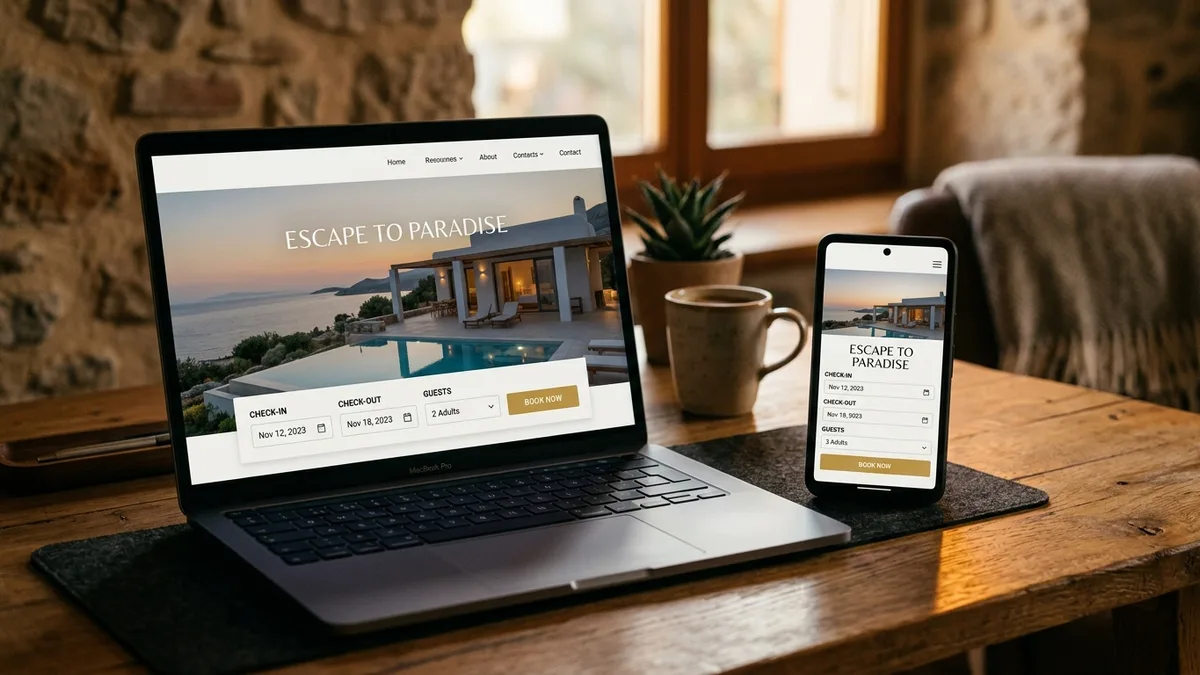
Mobile optimization for vacation rental booking pages is non-negotiable as of 2026. According to Statista data, 58% of all booking page traffic arrives from mobile devices. Google Speed Study data shows that 53% of mobile users abandon a booking page when load time exceeds three seconds. The optimal load time for maximum conversion is 1.5 seconds, per Google Core Web Vitals benchmarks. Most STR direct booking pages load in 4-6 seconds on mobile. The math is brutal.
Beyond speed, 41% of mobile booking abandonment is caused specifically by poor touch-target design, according to Baymard Mobile UX research. Touch targets are the tappable buttons, form fields, and links on a mobile screen. When they are too small, too close together, or positioned where thumbs naturally rest, guests make errors, become frustrated, and leave. Mobile-optimized booking forms convert 31% better than non-optimized equivalents (Unbounce Conversion Report), which represents one of the highest single-intervention conversion gains available.
The specific mobile failures we see most often on STR booking pages include: date picker widgets that require precise tapping on small calendar cells, form fields that do not trigger the correct mobile keyboard type (numeric keypad for phone numbers, email keyboard for email fields), and CTA buttons positioned where they are obscured by the mobile browser's navigation bar.
Fixing these issues requires a direct booking website built with mobile-first principles. But getting guests to that optimized mobile booking page requires search visibility. Our Keyword Research tool identifies the mobile search queries your target guests use, so your content strategy targets the right visitors from the start. Traffic from mobile-intent search queries carries even higher conversion urgency: according to Yelp Business Insights data, 44% of mobile bookings are same-day or next-day reservations, meaning those visitors are often the most motivated guests in your entire funnel.

Trust Signals and Social Proof: The Fastest Conversion Win Available
Trust signals on a vacation rental booking page are visible elements that reduce a guest's perceived risk of completing a reservation. Social proof is the most powerful category of trust signal. According to Yotpo Social Proof Report data, pages displaying reviews and ratings produce 3.2x higher conversion compared to pages without them. A separate finding from Drift Social Proof Analytics shows that displaying how many other guests have recently booked makes visitors 3.7x more likely to complete a booking themselves.
BrightLocal Trust Survey data reinforces why this matters so much: 88% of consumers trust online reviews as much as personal recommendations from people they know. And 34% of consumers check reviews specifically before completing a booking. These are not passive browsing behaviors; they are active decision-making steps. A booking page without visible social proof is asking guests to skip a step they are psychologically wired to take.
Beyond reviews, security badges increase booking page conversion by 15%, per Baymard Trust Signals research. This matters because guests completing a direct booking are not protected by an OTA's payment processing guarantees. A visible SSL certificate badge, secure payment processor logo, or refund protection symbol signals that their financial information and reservation commitment are protected.
Adding host photos and property manager bios to booking pages increases conversion by 17%, per Zocdoc Provider Insights data. Guests booking directly are choosing to trust an individual operator rather than a platform's reputation. Showing a face, a name, and a brief bio converts that abstract trust into a personal relationship, which is both more persuasive and more defensible against OTA competition.
In our work at inkSTR, we find that the content operators publish builds social proof over time in a way that compound returns cannot replicate. A blog post about your property's neighborhood, written with specific local knowledge, signals expertise and authenticity to guests who find it through search. That content functions as a long-form trust signal before the guest reaches your booking page. You can read more about why generic travel content kills conversions and what specific, expert-driven content does instead.
Calculate Your Conversion Revenue Gap Before Spending Another Dollar on Ads
Your conversion revenue gap is the dollar amount you are losing monthly because your booking page performs below the top-performer benchmark of 22%. Calculating it takes three numbers: your monthly booking page visitors, your current conversion rate, and your average booking value. The formula is straightforward, and running through it once will clarify exactly why booking page conversion optimization deserves your attention before your next ad campaign.
| Scenario | Monthly Visitors | Conversion Rate | Bookings | Revenue (at $2,000 avg) |
|---|---|---|---|---|
| Current (average) | 1,000 | 2.5% | 25 | $50,000 |
| Industry average | 1,000 | 13% | 130 | $260,000 |
| Top performer | 1,000 | 22% | 220 | $440,000 |
| Quick-win target | 1,000 | 6% | 60 | $120,000 |
The table above makes the revenue gap viscerally clear. An operator receiving 1,000 monthly visitors and converting at 2.5% is generating $50,000 in monthly direct booking revenue. Simply reaching a 6% conversion rate, which is below the industry average and achievable through form simplification and trust signal additions, doubles that revenue to $120,000. No new traffic. No additional ad spend. Just better page performance.
Compare that math to what you pay in OTA commissions. Airbnb host and guest fees combined represent 17-19% of every booking. On a $2,000 reservation, that is $340 to $380 in fees paid to the platform. Improving your direct booking conversion rate shifts those dollars entirely to your revenue. At 60 monthly bookings, the difference between OTA distribution and direct booking is $20,400 to $22,800 in fees retained per month.
The opportunity cost of inaction is real and specific. inkSTR starts at $99 per month. A single additional direct booking generated through better content and an optimized booking page covers that cost many times over. See our pricing page for the full detail. The content we help operators produce stays live and continues driving traffic for two to five years per article, which means the revenue compounding effect grows over time rather than resetting with each ad campaign.

The Booking Page Conversion Optimization Checklist for STR Operators
This booking page conversion optimization checklist covers the specific, actionable changes that produce the highest measurable impact for short-term rental direct booking pages. Work through these in order: form friction has the highest leverage, followed by mobile performance, trust signals, and abandoned booking recovery.
Form and Checkout Friction
- Reduce booking form to three fields maximum: name, dates, payment. Move all other questions to a post-booking communication sequence.
- Remove any optional fields entirely. The Expedia "Company" field case study is a reminder that optional fields create confusion even when guests choose not to fill them.
- Ensure the booking form requires no account creation before completion. Guest checkout should always be available. Forcing account registration before payment is a primary conversion killer.
- Place the most important field (dates or name) as the first field, not email or phone number. Asking for contact information too early triggers privacy anxiety before trust is established.
- Test that your payment processor accepts all major credit cards, Apple Pay, and Google Pay. Payment failure at checkout is the most expensive single friction point in the entire funnel.
Mobile Performance
- Test your booking page load time on a 4G mobile connection. Target 1.5 seconds or below. Anything over 3 seconds is losing more than half your mobile visitors.
- Audit all touch targets. Buttons should be at least 44px tall and 44px wide. Form fields should be large enough to tap accurately without zooming.
- Test the date picker widget on an actual smartphone, not an emulator. Most calendar widgets built for desktop are nearly unusable on mobile.
Trust Signals and Social Proof
- Add a minimum of five recent guest reviews directly on the booking page, above the fold if possible. Do not link to a separate reviews page; friction between trust and commitment reduces conversion.
- Display your cancellation and rescheduling policy in plain language immediately above the booking button. "Free cancellation up to 14 days before arrival" converts better than a terms link.
- Add a host photo and two-sentence bio. For property management companies, use the property manager's photo, not a company logo.
- Display a security badge from your payment processor, especially if you accept direct credit cards outside a major OTA platform.
Abandoned Booking Recovery
- Capture email as the first form field so abandoned booking recovery emails are possible even when guests do not complete payment.
- Set up a two-email abandonment sequence: first email within one hour, second within 24 hours. Keep both emails short, specific to the dates the guest searched, and focused on one call to action.
- Install an exit-intent popup on the booking page that fires only when the visitor's behavior signals they are leaving. Offer a saved booking link or a simple availability reminder, not a discount.
Content-Driven Conversion
- Publish at least one detailed local area guide that answers the top five questions your guests ask before booking. Link this guide prominently from your booking page to reduce pre-commitment anxiety.
- Add an FAQ section directly to your booking page covering: check-in process, pet policy, parking, and refund timeline. These four topics account for the majority of pre-booking inquiries and are the most common sources of psychological friction.
Running through this checklist manually is a multi-week project for most STR operators. The content side, specifically the local guides and FAQ content that reduce psychological friction, takes the longest. That is precisely why operators working with inkSTR's AI Content Writer publish that trust-building content faster. A ranking blog article drives organic traffic for two to five years, and each piece compounds the authority of your direct booking website over time. You can see how the full workflow comes together at How InkSTR Works.
Frequently Asked Questions
What is a good conversion rate for a vacation rental booking page?
A good conversion rate for a vacation rental direct booking page sits above 13%, which is the average for booking pages broadly. Top-performing pages reach 22%, according to SimplyBook.me Analytics data. If your page converts below 5%, form friction, mobile performance, or missing trust signals are likely the primary causes. Focus on reducing form fields to three or fewer as the first intervention.
Why are guests visiting my booking page but not completing reservations?
The most common causes of booking page abandonment are too many form fields, slow mobile load times, missing cancellation policy information, and the absence of visible social proof like reviews and ratings. According to Baymard Institute research, 53% of visitors abandon when the experience takes more than three minutes. Audit your booking form length and your page load speed on mobile as your first two diagnostic steps.
How can I recover bookings from guests who abandoned my booking page?
Abandoned booking recovery works through three mechanisms: email retargeting triggered when a guest abandons mid-form, exit-intent popups that fire when leaving behavior is detected, and paid retargeting ads targeted at users who visited your booking page without converting. Capturing the guest's email as the first form field is a prerequisite for the email approach. Building a content-engaged email audience through consistent blogging, which inkSTR's Content Calendar automates, creates a warm retargeting list over time.
Does blog content actually improve booking page conversion rates?
Yes, through traffic quality. Guests who arrive at your booking page after reading a specific, authoritative blog post about your property's location already understand your value proposition and have lower pre-commitment anxiety. This reduces the psychological friction that causes abandonment even on technically well-designed pages. According to our experience at inkSTR, content-driven traffic converts at a meaningfully higher baseline rate than cold paid traffic. You can read more about how content strategy connects to direct booking performance in our guide on ranking on Google for STR operators.
Should I force guests to create an account before booking?
No. Requiring account creation before a guest can complete a reservation is one of the most consistently documented conversion killers across booking pages and e-commerce. Guest checkout should always be available. You can invite guests to create an account after their reservation is confirmed, at which point they already have a reason to do so and their payment is secured.
How long does it take to see improvement after optimizing a booking page?
Structural changes like form field reduction and cancellation policy visibility can show measurable conversion improvement within the first two to four weeks, provided your traffic volume is sufficient to generate statistically reliable data. Mobile optimization and page speed improvements often show results even faster because they remove objective barriers rather than persuasive ones. Content-driven improvements to traffic quality build over two to five years as articles accumulate ranking authority and organic traffic.
What is the difference between landing page conversion and booking page conversion?
A landing page conversion typically measures whether a visitor takes an action such as submitting an email form or clicking through to a product, while a booking page conversion measures whether a visitor completes a financial transaction. Booking page conversions carry higher psychological stakes for the visitor, which is why trust signals, cancellation policies, and friction reduction have a larger impact on booking pages than on standard lead generation pages. The median landing page conversion rate across all industries is 6.6%, per Unbounce; booking page averages depend heavily on traffic source and property type.
What to Do Next
Booking page conversion optimization is not a one-time project; it is a recurring practice of measuring, testing, and improving every element that stands between a motivated visitor and a confirmed reservation. The single most costly mistake, form friction, is also the most fixable. Reducing your form to three fields, making your cancellation policy unmissable, and adding genuine guest reviews to your booking page are changes you can implement this week. The conversion benchmarks are clear: you are targeting above 13% as your baseline, with 22% as a realistic ceiling for high-quality direct booking traffic.
Beyond the page itself, the traffic arriving at that page determines your conversion ceiling. Qualified visitors who found your property through specific, helpful content about your area arrive with lower anxiety, higher intent, and a shorter path to booking confirmation. That is the connection between content marketing and conversion optimization that most guides skip entirely. Consistent, SEO-optimized content is not just a traffic strategy; it is a conversion strategy.
As of 2026, nearly two-thirds of short-term rental operators generate less than 25% of their bookings through direct channels, according to the Hostaway 2026 STR Report. The operators who close that gap fastest are the ones treating their booking page and their content strategy as a single system, not two separate projects. Improving one without the other leaves significant revenue unrealized.

If you want to build the content foundation that sends higher-intent traffic to your optimized booking page, inkSTR generates, schedules, and publishes SEO-optimized blog posts automatically on a set schedule. Starting at $99 per month, a single additional direct booking, worth $1,000 to $4,000 in revenue, covers the investment many times over. And every article we publish continues driving organic traffic for years. Start your free trial at inkSTR.co and publish your first conversion-focused blog post this week.
Enjoyed this article? Share it:
Get more of inkSTR in Google Search
Add inkstr.co as a preferred source and our articles show up more in Top Stories, AI Overviews, and AI Mode — with a “Preferred” badge.
Get more guides like this
New SEO and AI-search guides, straight to your inbox. No spam, unsubscribe anytime.