How to Fix Low Vacation Rental Conversion Rate

Low vacation rental conversion rate is fixed by auditing your booking funnel stage by stage: fixing pricing transparency, removing mobile checkout friction, adding trust signals like reviews and instant confirmation, and following up with guests who browse but don't book. Most vacation rental websites convert somewhere between 0.4% and 0.6% of visitors into confirmed bookings, and the gap between that number and a healthy 2 to 4% is almost always a fixable, specific problem rather than bad luck.
Key Takeaways
- Standard vacation rental website conversion rate sits between 0.4% and 0.6%, while organic search traffic converts at 2 to 4%, making channel mix a major lever for improving overall performance.
- Conversion rate is calculated as (confirmed bookings divided by total listing views or inquiries) multiplied by 100. For example, 500 views resulting in 15 bookings equals a 3% conversion rate.
- Flexible cancellation policies convert 10 to 20% better than strict policies, according to industry data from Hostaway.
- Roughly 1 in every 8 vacation rental operators has analytics or tracking configured incorrectly, which means the conversion problem you're chasing might not even be real.
- A single direct booking is typically worth $1,000 to $4,000 in revenue, so even a small conversion lift compounds quickly across a season.
- inkSTR's AI Content Writer and internal link management automatically route organic search traffic toward direct booking pages, closing the gap between "visitors who browse" and "guests who book."
If you've watched your analytics dashboard climb in traffic while your booking count stays flat, you already know the frustrating part: getting eyes on your listing was never the hard problem. Converting those eyes into confirmed reservations is where most vacation rental websites quietly fail, month after month, without anyone noticing why.
We built inkSTR because we kept seeing the same pattern across property management portfolios and independent host sites: strong SEO rankings, decent traffic volume, and a conversion rate stuck well below industry benchmarks. In 2026, with vacation rental supply growing and guest expectations rising, a low conversion rate isn't a minor inefficiency. It's the difference between a profitable direct booking channel and one that just burns marketing effort.
This guide walks through the specific, diagnosable reasons vacation rental conversion rates stall, using a funnel-based framework you can apply this week. We'll cover pricing psychology, the 75/55 and 80/20 rules hosts ask about, mobile booking friction, trust signals, and the retargeting tactics almost no one in this space is writing about.
What Is a Good Vacation Rental Conversion Rate?
A good vacation rental conversion rate depends on traffic source, but as a baseline, most vacation rental websites convert between 0.4% and 0.6% of visitors into bookings, while sites pulling from organic search traffic often see 2 to 4% conversion, according to industry benchmarking data. Direct traffic, meaning repeat visitors who type your URL directly, typically converts even higher, in the 3 to 5% range.
The formula itself is simple: take confirmed bookings, divide by total listing views or inquiries, then multiply by 100. A property with 500 monthly listing views that closes 15 bookings sits at a 3% conversion rate, which is considered strong for this industry. Paid search traffic usually lands in the 2 to 3% range, referral traffic in 1 to 2%, and social media traffic under 1%, since social discovery skews toward browsing rather than booking intent.
Here's where most operators get the benchmark wrong: they compare their overall site conversion rate against organic-only benchmarks, then panic when the blended number looks low. If your traffic mix includes heavy social media referral traffic, your blended average will always sit below the 2 to 4% organic figure, even if each individual channel is performing exactly as expected.
| Traffic Source | Typical Conversion Rate | Booking Intent |
|---|---|---|
| Direct traffic (repeat visitors) | 3-5% | Very high |
| Organic search | 2-4% | Very high |
| Paid search | 2-3% | High |
| Referral traffic | 1-2% | Variable |
| Social media | Under 1% | Low (discovery-focused) |
This is exactly why we built inkSTR's Keyword Research tool around organic intent signals rather than generic traffic volume. Ranking for the searches that convert at 2 to 4% moves your blended average up far faster than chasing raw visitor counts from lower-intent channels like social media.
What Is the 75/55 Rule in Airbnb?
The 75/55 rule refers to a pricing guideline some hosts use where a property's nightly rate should be set so roughly 75% of potential bookers see it as reasonable, while the remaining flexibility accounts for the 55% of guests who compare at least one competing listing before booking. In practice, this framework is less a formal Airbnb policy and more a shorthand some hosts use to think about competitive pricing positioning.
The actual lesson underneath the 75/55 concept matters more than the specific numbers: guests almost never book the first listing they view. They compare, they hesitate, and pricing that looks even slightly out of step with comparable properties nearby causes hesitation that kills conversion before a guest ever reaches your checkout page. If your nightly rate sits noticeably above or below similar properties in your market without a clear reason (view, amenities, location), you're creating friction rather than value perception.
Without a clear pricing story on your listing page, browsing guests default to the safest option: leaving to compare elsewhere and often not returning. That's lost revenue you never see reflected in a bounce rate metric.
The fix isn't just adjusting your nightly rate. It's explaining your pricing on the page itself, breaking down what's included (cleaning, taxes, amenities) so guests don't hit a surprise total at checkout. inkSTR's content strategy work with property managers consistently shows that listing and blog pages explaining "what's included in your total" reduce the sticker-shock abandonment that happens when guests reach a final price that's 20 to 30% higher than the advertised nightly rate.
How to Improve Airbnb Conversion Rate?
Improving your Airbnb or direct booking conversion rate requires fixing friction at each funnel stage: listing view, inquiry, quote, and checkout. Specifically, that means enabling instant booking to remove approval delays, tightening your response time, using professional photography, and making cancellation policies flexible enough to reduce hesitation, since flexible policies convert 10 to 20% better than strict ones.
Start with response time. A guest who messages with a question and waits six hours for a reply has usually already booked somewhere else. Instant Book removes this friction entirely by letting qualified guests confirm without waiting on host approval, which is why platforms increasingly favor and promote listings using it.
Next, look at your photos and description honestly. Guests booking mountain cabins, beach condos, or urban lofts all searching with different intent, but they share one behavior: they scan photos first, and unclear or dated photos trigger an immediate exit. If your description reads like a generic template rather than describing the actual guest experience, specifically what a family gets from a lake house versus what a solo traveler gets from a downtown loft, you're losing conversion to competitors who wrote theirs with more care.
Additionally, review your cancellation policy against comparable listings in your market. A strict policy might protect your calendar, but it also filters out risk-averse guests who would otherwise book. Most operators underestimate how much a flexible policy signals trustworthiness to a first-time guest evaluating an unfamiliar property.
Beyond your OTA listing, your own website content plays a direct role here too. Blog content that ranks for "what to pack for [destination]" or "best time to visit [region]" builds the kind of pre-booking trust that shortens hesitation once a guest lands on your booking page. We cover this dynamic in more depth in our piece on why blog content isn't converting visitors into guests, which walks through the psychological gap between reading content and clicking "book now."
What Is the 80/20 Rule for Airbnb?
The 80/20 rule, applied to vacation rentals, generally means that roughly 80% of your bookings come from 20% of your traffic sources or marketing efforts, meaning most operators are spending disproportionate time on channels that generate minimal booking volume. In our experience reviewing STR content calendars, this pattern shows up almost identically across independent hosts and multi-property portfolios.
For most operators, the 20% that drives 80% of bookings turns out to be a combination of organic search traffic, repeat direct visitors, and a handful of high-intent blog posts, not the social media posts consuming most of their weekly marketing hours. Social media traffic converts under 1%, according to industry benchmarking, which means an operator spending three hours a week on social content and thirty minutes on SEO has the ratio backwards relative to actual booking output.
This is where content strategy decisions matter more than most hosts realize. If you're publishing inconsistently, or publishing generic travel content that doesn't match what your ideal guest is actually searching, you're diluting your 20% instead of strengthening it. A property manager overseeing 15 units, for example, often has the bandwidth to write for two or three properties consistently and lets the rest go stale, which drags down portfolio-wide conversion.
inkSTR's content workflow exists specifically to solve this imbalance. Instead of spreading manual effort thin across every property and losing consistency, our multi-project support runs an independent content pipeline for each property, so the 20% of effort that actually drives bookings, consistent, keyword-targeted publishing, happens automatically for every unit in a portfolio rather than just the two or three a manager has time to prioritize by hand.

Can You Negotiate Vacation Rental Prices?
Yes, vacation rental prices are often negotiable, particularly for longer stays, off-peak dates, or last-minute bookings where a host would rather fill a calendar gap at a reduced rate than leave it vacant. Whether negotiation is appropriate depends heavily on your occupancy pattern and how close the stay date is to the current date, since accepting a discount on a date you'd likely fill anyway erodes revenue for no reason.
Here's the conversion angle most articles miss entirely: guests who message asking about a discount are showing extremely high booking intent. They're not bouncing, they're negotiating, which means your response speed and flexibility at this exact moment determines whether that inquiry converts or disappears. A slow or rigid response to a negotiation inquiry converts a near-certain booking into a lost one.
Consider building a simple internal policy: offer modest flexibility on rate for stays longer than five nights, or for bookings inside a two-week window where the alternative is an empty calendar. Communicate this proactively in your listing description rather than waiting for guests to ask, since many guests won't negotiate at all, they'll simply leave if the price feels non-negotiable and too high relative to comparable options.
This is also where a documented pricing strategy blog post pays off. A page explaining your seasonal pricing logic, why rates rise in July, why shoulder-season stays are discounted, gives hesitant guests the context to book without needing to negotiate at all. For a deeper breakdown of pricing psychology and how it intersects with booking behavior, our guide on the hidden psychology behind vacation rental booking strategies covers the guest decision-making process in more detail than we have room for here.
Why Is Your Vacation Rental Booking Page Losing Guests at Checkout?
Your booking page loses guests at checkout primarily due to unclear pricing breakdowns, slow-loading booking widgets, and a lack of visible trust signals at the exact moment a guest is entering payment information. This is the single most under-covered part of the vacation rental conversion conversation, and it's costing operators bookings they never even see as lost, since most analytics tools don't clearly flag checkout abandonment as its own metric.
Walk through your own booking page as if you were a first-time guest. Does the total price update transparently as dates and guest count change, or does a hidden cleaning fee and tax total appear only on the final screen? That kind of late-stage price jump is one of the most reliable conversion killers in e-commerce generally, and vacation rentals are no exception.
Next, check load speed specifically on mobile. Given how much vacation rental browsing happens on phones, a booking widget that takes more than a few seconds to load, or requires excessive zooming and scrolling to complete, will lose guests who simply give up and go back to search results. Neither competitor content nor most host guides address this mobile-specific friction point directly, despite mobile traffic representing a major share of vacation rental discovery behavior.
Finally, look for trust signals: visible guest reviews near the booking button, a security badge near the payment field, and a clear cancellation policy stated before checkout rather than buried in terms. Guests hitting a payment screen with no visible reviews or security cues will second-guess a purchase they were seconds from completing.
How Do You Recover Guests Who Browse but Don't Book?
Recovering guests who browse but don't book requires an email or SMS follow-up sequence triggered when a visitor views your booking page but exits before completing a reservation, similar to abandoned cart recovery in retail e-commerce. Almost no vacation rental content addresses this tactic directly, despite it being one of the highest-leverage fixes available to operators with any existing email capture on their site.
If a guest enters dates, sees pricing, and leaves without booking, that's not a lost cause, it's a warm lead. A simple automated follow-up within 24 to 48 hours, offering to answer questions or highlighting a limited-availability window, recovers a meaningful share of these near-bookers who simply got distracted or wanted to compare one more option.
Building this requires an email capture mechanism on your site before checkout, something many vacation rental websites skip entirely. Even a simple "save these dates" prompt that asks for an email address before showing final pricing gives you a retargeting list you wouldn't otherwise have.
This is closely tied to broader email list building for direct bookings, and if you haven't built this infrastructure yet, it's worth prioritizing alongside your content strategy rather than after it. A blog post that ranks and drives traffic is only half the funnel. Capturing and following up with the guests who don't convert on the first visit is the other half most operators leave on the table.
Why Does Your Analytics Data Say Your Conversion Rate Is Lower Than It Actually Is?
Your analytics data frequently understates your true conversion rate because of tracking configuration errors, attribution gaps, and Google Analytics 4's data thresholding behavior, all of which distort the numbers you're basing decisions on. Industry data suggests roughly 1 in every 8 vacation rental operators has analytics or tracking set up incorrectly in some way, meaning the "low conversion rate" you're troubleshooting might be partially a measurement problem, not a guest experience problem.
Specifically, when operators lack advanced call tracking, phone bookings, PPC-driven bookings, and social-driven bookings often get miscredited or dropped entirely from standard analytics reporting. Industry analysis suggests these untracked channels can contribute roughly 30% more to actual booking value than what's reflected in standard Google Analytics reporting alone.
This matters enormously for older-demographic markets. On properties catering to guests aged 45 and up, phone bookings remain common, with a meaningful share of these guests still preferring to call rather than book online. If your analytics setup only tracks online conversions, you're structurally underreporting your real performance on any property with this guest profile.
Before chasing conversion rate fixes on your site, confirm your tracking is accurate. GA4's thresholding, where certain data gets suppressed below reporting minimums, can also quietly distort year-over-year comparisons if you're not checking raw data against dashboard summaries. A conversion rate "problem" that's actually a tracking gap wastes weeks of optimization effort chasing a number that was never accurate to begin with.
Ready to automate your content marketing?
inkSTR handles keyword research, content strategy, article writing, and publishing, all on autopilot.
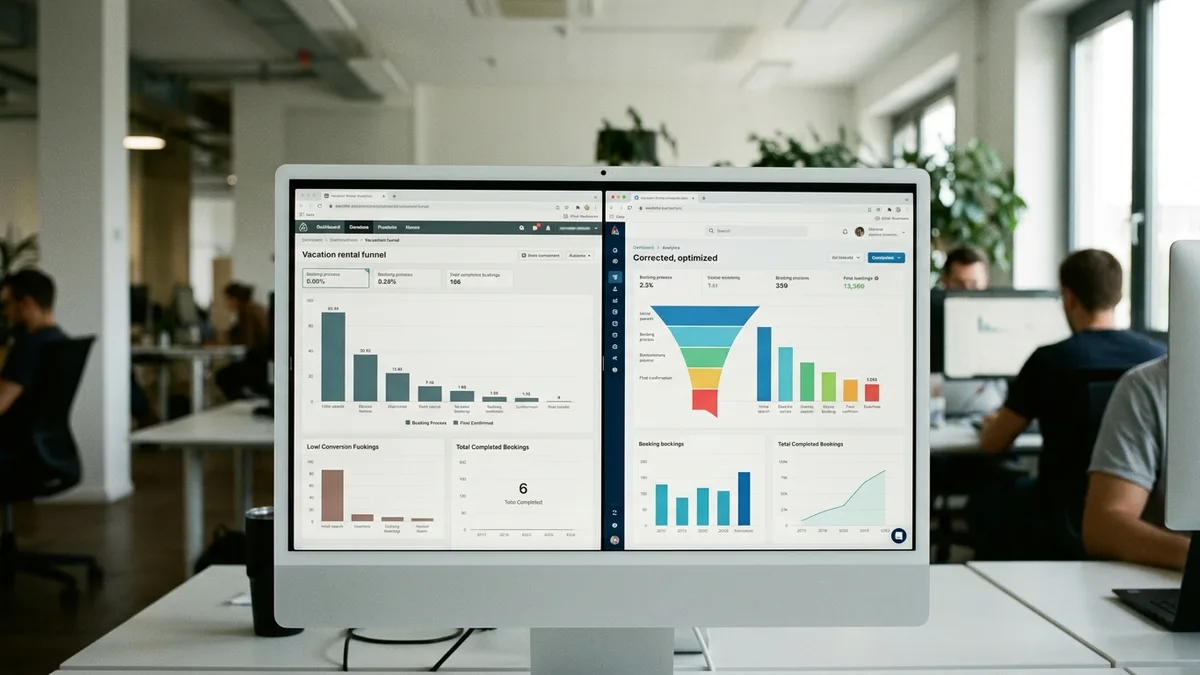
What Does a Full Vacation Rental Booking Funnel Audit Look Like?
A full booking funnel audit examines four distinct stages, awareness, listing view, inquiry, and checkout, identifying exactly where guests drop off rather than treating conversion rate as one single metric. Most vacation rental content skips this stage-by-stage breakdown entirely, which means operators fix symptoms instead of root causes.
- Awareness stage: Measure how guests find you, organic search, paid ads, social media, or referral traffic, and confirm your tracking correctly attributes each source. Fix analytics gaps before optimizing anything downstream.
- Listing view stage: Check bounce rate on your listing or booking page. If guests leave within seconds, your photos, headline pricing, or page load speed are likely the problem, not your actual rate or policies.
- Inquiry stage: Track how many listing viewers send a message or start a booking request. A low number here often points to unclear pricing, confusing availability calendars, or missing trust signals like reviews.
- Quote to checkout stage: This is where late-stage price jumps, slow booking widgets, and missing security signals cause the most damage. Guests who reach this stage have high intent; losing them here is the most preventable drop-off in the entire funnel.
Run this audit quarterly, not once. Seasonality changes guest behavior, and a funnel that converts well in July may show entirely different friction points during shoulder season. Publishing next year's rates earlier, in August rather than waiting until November, is one specific timing fix that measurably improves advance booking conversion by giving planning-stage guests a rate to commit to sooner.
This kind of structured, stage-by-stage thinking is exactly what informs how inkSTR builds content strategy for clients. Instead of guessing which blog topics might help, our Keyword Research tool identifies where guests are searching before they ever reach your funnel, so your content addresses hesitation before a listing view even happens.

What Trust Signals Actually Move Vacation Rental Conversion Rate?
Trust signals that measurably move conversion rate include visible guest review counts near your booking button, a clearly stated cancellation policy before checkout, fast response time badges, and instant confirmation availability. Guests evaluating an unfamiliar property look for these cues specifically at the moment of decision, not buried elsewhere on the page.
Reviews carry more weight than most hosts assume, particularly review recency. A property with strong reviews from three years ago but nothing recent reads as a red flag to a guest checking whether the place is still actively and well managed. Encourage recent reviews actively, and display your most recent five or six prominently rather than burying them beneath older, less relevant feedback.
Flexible cancellation policies deserve repeating here because the data is specific: flexible policies convert 10 to 20% better than strict ones. If your calendar management can tolerate the added risk, this is one of the highest-leverage, lowest-effort changes available to most operators.
Response time matters too, particularly for guests who message before booking. A visible "responds within an hour" indicator, where platforms support it, reduces the hesitation that comes from wondering whether anyone is actually managing the property actively.
Vacation Rental Conversion Rate Data at a Glance
The table below consolidates the verified benchmarks referenced throughout this guide, useful as a quick diagnostic reference when auditing your own funnel performance in 2026.
| Metric | Benchmark | What It Means for You |
|---|---|---|
| Standard website conversion rate | 0.4% to 0.6% | Baseline; below this signals a funnel problem |
| Organic search conversion rate | 2% to 4% | Healthy target for content-driven traffic |
| Flexible vs. strict cancellation policy | 10-20% higher conversion | One of the fastest fixes available |
| Analytics setup error rate | 1 in 8 operators | Confirm tracking before optimizing |
| Untracked booking value (call/social) | Up to 30% underreported | Your real conversion may be higher than reported |
| Direct booking revenue value | $1,000 to $4,000 per booking | Even small conversion gains compound fast |
Notably, industry research also shows that SEO can move a website's rank on Google from position five to position two, and roughly 40% of Google users making regional hotel queries are actually open to booking a vacation rental instead. That means the organic search channel, the one converting at 2 to 4%, is also the one with the most room to grow relative to where most operators currently invest their marketing time.
What Common Mistakes Keep Vacation Rental Conversion Rate Low?
The most common mistakes suppressing conversion rate are treating all traffic as equal, ignoring mobile checkout friction, skipping analytics audits, and publishing content that attracts low-intent visitors instead of high-intent bookers. Each of these is fixable without a website rebuild, but they require deliberate diagnosis rather than guesswork.
- Blending traffic sources into one conversion number. A single high-traffic, low-conversion blog post, something like a generic area guide, can drag your entire site average down even while your booking-focused pages perform well.
- Ignoring mobile-specific friction. Desktop testing a booking widget tells you nothing about how it performs on a phone with a spotty connection.
- Skipping a tracking audit before optimizing. Fixing a "problem" that's actually a measurement error wastes time and can lead to changes that hurt real performance.
- Publishing generic content instead of intent-matched content. A blog post about local ice cream shops might drive traffic, but it rarely drives bookings, and it dilutes your overall conversion metrics in the process.
- Waiting too long to publish next year's rates. Publishing in August rather than November captures advance-planning guests who would otherwise book elsewhere.
inkSTR's quality scoring and pre-publish validation exist specifically to prevent the fourth mistake: content that ranks but doesn't convert. Every article our AI Content Writer generates is built around keyword intent that maps to actual booking behavior, not just search volume, because traffic without booking intent doesn't move your conversion rate. It just inflates a vanity metric.
How Do Property Managers Fix Conversion Rate Across Multiple Properties?
Property managers fix conversion rate across a portfolio by standardizing the funnel audit process across every unit, then automating content and analytics review so no property gets neglected simply due to time constraints. A 20-unit portfolio manager auditing funnels by hand for every property, every quarter, faces a workload that simply doesn't scale without dedicated staff.
The pattern we see most often: a portfolio has two or three "flagship" properties that get consistent attention, updated photos, fresh content, active review management, while the remaining units are set up once and left alone. Conversion rate across the neglected units drags down the portfolio average, even though the fix (consistent content and funnel maintenance) is identical to what's already working on the flagship properties.
This is precisely the problem inkSTR's Content Calendar and multi-project support were designed to solve. Instead of a manager choosing which two properties get real marketing attention this month, each property runs its own independent, automatically scheduled content pipeline. Consistency across the portfolio, not just the flagship units, is what actually moves a blended conversion rate.
For managers looking to build this out further, our guide on must-have tools for short-term rental managers scaling up covers the broader technology stack that supports funnel consistency at scale.
Frequently Asked Questions
What is a normal conversion rate for a vacation rental website?
A normal, blended conversion rate for a vacation rental website typically falls between 0.4% and 0.6%, while organic search traffic specifically converts higher, often in the 2 to 4% range. Your blended number depends heavily on your traffic mix, so a low overall rate doesn't necessarily mean every channel is underperforming.
How is vacation rental conversion rate calculated?
Vacation rental conversion rate is calculated by dividing confirmed bookings by total listing views or inquiries, then multiplying by 100. For example, 500 monthly views resulting in 15 confirmed bookings produces a 3% conversion rate, which sits comfortably above the industry baseline.
Does a flexible cancellation policy really improve conversion rate?
Yes, flexible cancellation policies convert 10 to 20% better than strict policies, according to industry benchmarking data. This makes cancellation policy one of the highest-leverage, lowest-cost changes an operator can test without touching pricing or marketing spend.
Why does my conversion rate look low even though my traffic is growing?
Growing traffic without growing bookings usually means your new visitors are coming from lower-intent channels like social media, which converts under 1%, while your booking-focused content isn't growing proportionally. It can also indicate analytics tracking gaps, since roughly 1 in 8 operators has tracking configured incorrectly in some way.
Can inkSTR help fix a low conversion rate directly?
inkSTR doesn't touch your booking widget or payment processing directly, but it addresses the traffic quality half of the conversion equation. Our Keyword Research and AI Content Writer tools target high-intent search queries that convert at 2 to 4%, rather than generic content that drives traffic without booking intent.
Should I focus on Airbnb conversion rate or my own website's conversion rate?
Both matter, but your own website deserves more attention since you control pricing transparency, trust signals, and checkout flow entirely, unlike on Airbnb or VRBO where the platform sets many of the rules. Direct booking traffic also avoids the 17 to 19% combined host and guest fees charged on OTA bookings, making conversion improvements on your own site more profitable per booking.
How often should I audit my vacation rental booking funnel?
Audit your booking funnel quarterly at minimum, since seasonality changes guest behavior and friction points that don't matter in peak season can quietly suppress bookings during shoulder season. Pair funnel audits with an analytics tracking check each time, since measurement errors can masquerade as conversion problems.
Conclusion: Fixing Conversion Rate Starts With the Funnel, Not the Listing
Low vacation rental conversion rate rarely comes from one single cause. It's the accumulation of pricing friction, mobile checkout delays, missing trust signals, and, often, inaccurate analytics that make the problem look worse or different than it actually is. The fastest wins available to most operators in 2026 are a flexible cancellation policy, a mobile-first checkout review, and a genuine tracking audit before anything else.
The bigger opportunity sits upstream of the funnel entirely: the traffic you attract in the first place. Organic search traffic converts at 2 to 4%, nearly ten times the blended site average, which means the content strategy driving that traffic matters as much as anything happening on your booking page.

If you're managing this funnel audit process manually across even a handful of properties, you already know how much time gets consumed just keeping content current, let alone diagnosing conversion friction. Get started with inkSTR and let our automated keyword research and content publishing handle the traffic quality half of your conversion equation, so you can focus your time on the checkout and pricing fixes that need a human eye.
Content powered by inkSTR.co
Enjoyed this article? Share it:
Get more of inkSTR in Google Search
Add inkstr.co as a preferred source and our articles show up more in Top Stories, AI Overviews, and AI Mode — with a “Preferred” badge.
Get more guides like this
New SEO and AI-search guides, straight to your inbox. No spam, unsubscribe anytime.