Short-Term Rental Ranking on Google: A Step-by-Step Plan
Short-term rental ranking on Google comes from three separate systems: local map results tied to a Google Business Profile, standard organic website results, and Google Vacation Rentals listings. You rank by qualifying for the right surface, fixing your site's technical basics, targeting destination-specific keywords, publishing consistently, and tracking results in Google Search Console.
Key Takeaways
- Google Maps visibility, organic website rankings, and Google Vacation Rentals placement are three different systems with different eligibility rules, so diagnose which one you are missing before you act.
- A Google Business Profile generally fits a property management company better than every individual private rental; confirm eligibility in Google's current guidelines.
- Technical basics (HTTPS, mobile usability, speed, crawlability, and indexing) come before content, because Google cannot rank pages it cannot crawl or index.
- Multi-property operators should build destination hubs with property pages beneath them and avoid thin, repetitive neighborhood pages.
- A single direct booking is typically worth $1,000 to $4,000, while Airbnb host and guest fees combined take 17-19% of every booking, so each ranking page has a clear payoff.
- inkSTR handles keyword research, article generation, scheduling, and publishing for short-term rental operators, so the content half of ranking on Google no longer depends on your free hours.
You already know the frustration. Your site loads and your photos are good, yet a search for your town plus "vacation rentals" shows the big platforms and three competitors you have never heard of. Your listing may sit on page one of Airbnb while your own website does not appear at all.
We build AI content tools for short-term rental operators, and the question we hear most is how to get a website to earn bookings, not just views. This walkthrough covers eight steps in the order we would do them in 2026, with honest notes on what takes time. Expect months, not days, before a new site earns steady traffic.
Step 1: Which Google System Decides Where Your Rental Appears?
Google surfaces vacation rentals through three systems, and they work differently. The local pack on Google Maps and organic website results sit alongside Google Vacation Rentals, the travel-style listing experience that shows properties with dates and prices. Each has its own requirements, so you rank for short-term rentals by identifying which of the three you are missing first.
Most guides blur these together. Local map results depend heavily on a verified Business Profile and proximity. Organic results depend on your website's pages and links. Google Vacation Rentals placement typically depends on a property feed delivered through a supported software provider, such as your property management system or channel manager. Check Google's current documentation for the exact requirements, because they change.
The painful alternative is optimizing everything at once. You rewrite meta titles, claim profiles, and edit listings for weeks without knowing which lever moves which result. Many operators burn a month this way and learn nothing.
Our rule of thumb is simple: your blog and site pages drive the organic system, and that is the system you own outright. This is why we built the Keyword Research feature in inkSTR around organic search first. It finds the destination and intent searches your target guests type, so your effort goes where a website can actually win.
Step 2: Does Your Business Qualify for a Google Business Profile?
A Google Business Profile is a free listing that controls how your business appears on Google Maps and in local results. A property management company with a staffed or service-area operation generally fits the format; an individual private rental may not qualify for its own profile. Confirm eligibility in Google's current guidelines before you create anything.
This is a content gap in most walkthroughs, and it matters. Creating a profile for every cabin in your portfolio can trigger suspensions, and a suspended profile takes weeks of back-and-forth to fix. If you run a management company, a single profile for the company, with accurate service areas, is the safer starting point.
Keep your business name, address, and phone number identical everywhere your company appears online. Add accurate categories and current photos, then respond to reviews. None of this replaces a ranking website; it supports it.
Here is the cost of skipping the website side: a profile can send someone to your site, but if the site has no pages answering their search, they bounce to an OTA. Our property management workflow pairs the profile with a steady stream of owner-facing and guest-facing articles. The profile gets the click, and inkSTR's content gives the visitor something to read and a path to your booking or inquiry page.
If you are weighing owner leads against guest bookings, the full guide to ranking a vacation rental website on Google covers both.
Step 3: How Do You Fix the Technical Foundations Google Checks First?
Technical SEO for a rental site means Google can crawl and index your pages quickly on mobile over HTTPS. It also has to render them. You fix it by confirming every important page is indexed in Google Search Console and passing basic speed and mobile checks. Then give each property one clean URL.
Start with a crawl. A tool like Screaming Frog lists broken links, duplicate titles, and pages blocked from indexing. Then open the Page indexing report in Search Console and look for pages marked as discovered or crawled but not indexed. Those are your first repairs.
Structured data helps Google understand a page, though it is not a ranking factor on its own. Vocabulary such as LodgingBusiness and VacationRental exists for this purpose; verify which types Google currently supports in its own documentation before you add markup.
Check how your titles look in results with the Google SERP Simulator. Each listing page also needs a map, a calendar, an amenity list, and an obvious booking button, because ranking without converting wastes the traffic.

Doing this by hand means a spreadsheet of URLs and a crawl export, plus a lot of squinting. We built inkSTR's quality scoring and pre-publish validation so new articles do not add fresh technical problems. Each post is checked before it goes live, which keeps your fix list from growing while you clear the old one.
Step 4: What Keywords Should Your Vacation Rental Website Target?
Vacation rental keywords are the destination and property-type phrases guests type before they choose where to book. Trip-intent phrases count too. You should target long-tail searches like a lake house with a dock near a specific town, because broad national terms are dominated by large platforms you cannot outrank.
Build your list in layers. First, destination plus lodging type. Second, trip intent such as weekend getaway or family reunion. Third, the local questions guests ask before booking, such as parking, seasonal closures, and nearby trails. Free tools like Ubersuggest can start the list, though checking competition by hand takes hours per market.
Picture the manual version: a spreadsheet with a hundred phrases, a browser full of search results tabs, and no clear order of attack. Writing one quality post manually takes 3-5 hours of research and writing, so a bad keyword choice costs you an afternoon.
That is the problem inkSTR's keyword research and brand audit solve together. The audit surfaces competitor keyword gaps, and the research feature turns them into a plan built around your market. In an off-season lake house market, for example, it points you toward weekend-getaway queries instead of July family-reunion queries you would not win anyway.
For topic ideas beyond pure keywords, see our list of vacation rental blog topics that drive bookings.
Step 5: How Should You Structure Pages Across Several Properties?
A hub-and-spoke site structure puts a destination page above property-type pages, with individual property pages beneath and local content linking into the right ones. Multi-property operators should build this in priority order and avoid publishing near-identical neighborhood pages with only the place name swapped.
Thin duplicates are the most common mistake we see in portfolios. Fifteen pages with the same paragraph and a different town name tell Google you have nothing unique to say. Each page needs real property details and local specifics, plus a reason to exist.
A sensible sequence for a portfolio:
- Start with the destination where you have the most units and the strongest reviews.
- Write the hub page, then one property page per unit with unique details.
- Add supporting articles that answer local questions and link back to the hub.
- Only then expand to your next market.
Managing this across 15 or more properties eats entire days when every site edit, draft, and login is separate. inkSTR's multi-project support gives each property or brand its own pipeline, and internal link management routes readers to the right booking page. When a Hospitable or OwnerRez connection is in place, real reviews and photos ground the copy, which is what keeps pages from reading as copies of each other.
A website that is still not ranking after a restructure usually has an indexing or duplication problem, and the troubleshooting table in Step 8 will help you find it.

Step 6: How Do You Publish Enough Content to Earn Rankings?
Consistent publishing means releasing search-targeted articles on a steady schedule so Google has fresh, relevant pages to index and rank. You do it by planning a calendar of keyword-matched posts, writing each one fully, and publishing to your own site without manual formatting. Skipped weeks are the usual reason it fails.
The manual route is expensive in a specific way. A freelance travel writer charges $300-$700 per quality blog post, and doing it yourself costs 3-5 hours each. Most operators publish four enthusiastic posts, get busy with a turnover week, and the calendar dies by week six.
The upside of persistence is real. A ranking blog article can drive organic search traffic for 2-5 years. In one case, a Smoky Mountains cabin rental brand running a continuous inkSTR content pipeline grew monthly Google Search clicks from 788 to 5,195 in 11 months.
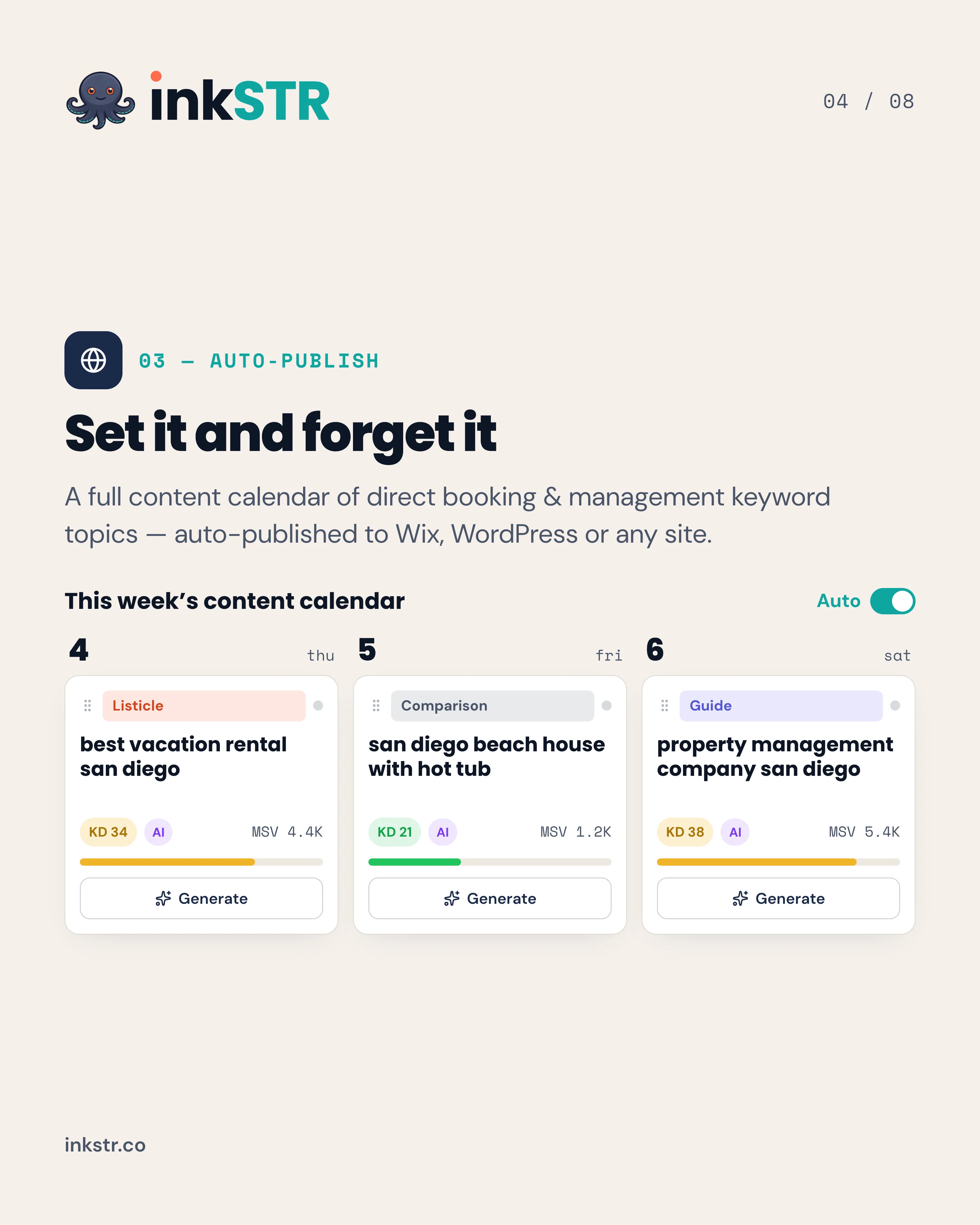
Here is how we handle the work. The AI Content Writer generates full-length, SEO-optimized articles from your keyword plan. The Content Calendar lets you drag an article to Tuesday, and Auto-Publishing sends it to your Wix or WordPress site at the scheduled time.
Plenty of operators ask whether AI-written posts can rank. Our position: they can when they are grounded in real property details, edited for your voice, and answer a specific search. Generic filler fails regardless of who or what wrote it.
What Does It Cost to Publish Enough Content to Rank?
Content cost for rental SEO is the combined price of research and writing for each article. Publishing adds to it. Writing in-house costs your time, hiring a freelancer costs money per post, and an automation platform costs a flat monthly fee. The right choice depends on how many posts you need per month.
| Approach | Cost per article | Time you spend | Publishing |
|---|---|---|---|
| Write it yourself | Your hours | 3-5 hours of research and writing | Manual upload and formatting |
| Freelance travel writer | $300-$700 per post | Briefing and revisions | Manual upload and formatting |
| inkSTR | Included in $99/month | Review and approve | Scheduled and published automatically |
Run the math at your own pace. Eight freelance posts a month at the low end of that range already costs more than a year of inkSTR's entry price. You can see current plans on the pricing page.
Across inkSTR customer sites, we have published more than 5,000 articles as of October 2026. That volume is only possible because the pipeline from keyword to published post runs without a person re-entering data at each stage.
Ready to automate your content marketing?
inkSTR handles keyword research, content strategy, article writing, and publishing, all on autopilot.
Step 7: How Do Reviews, Local Signals, and Backlinks Fit In?
Local trust signals are the reviews, photos, consistent business details, and links from destination organizations that tell Google your business is real and relevant to a place. They support both map visibility and organic rankings, and they work slowly, so start collecting them while your content builds.
Reviews matter for profile visibility and for converting a visitor into a guest. Photos and regular profile updates signal an active business. Be skeptical of any guide that promises exact review counts or ranking percentages without a source; those figures are usually vendor assertions.
Backlinks come from local relationships: a chamber of commerce listing, a partner activity company, a local event page that credits your area guide. Cold outreach by hand is tedious and slow, and the response rate is humbling.
Quality local content is the easiest thing to earn links to, because other sites want to cite a genuinely useful area guide. Our breakdown of the local signals Google cares about in 2026 goes deeper, and the backlink explainer for STR operators covers how links work. For owners running multiple sites, inkSTR also offers a backlink exchange between projects with the same owner.
One more honest note: for some purely local searches, a well-maintained Google Business Profile does more than a blog post. Do not skip it because content is the exciting part.
Step 8: How Do You Track Short-Term Rental Ranking on Google?
Tracking short-term rental ranking on Google means watching impressions, clicks, average position, and indexing status in Google Search Console, then connecting clicks to bookings in Google Analytics. Review both monthly, and look at the trend line rather than any single day's number.
Without a routine, most operators check rankings by Googling their own name from their own laptop. That result is personalized and misleading. Search Console shows what real searchers saw. Filter its search results report by page and by query, and note which pages gain impressions but earn few clicks.
Use this table to diagnose what you find:
| Symptom | Likely cause | First fix |
|---|---|---|
| Page not appearing at all | Not indexed | Check the Page indexing report and request indexing |
| Impressions but few clicks | Weak title or description | Rewrite the title to match the search intent |
| Clicks but no bookings | Booking path unclear | Link the article to your booking page and simplify the page |
| Rankings stalled across a market | Thin or duplicate pages | Merge or rewrite pages with unique property details |
The Google Search Console integration in inkSTR pulls keyword tracking and opportunity detection into the same place you plan content, so you do not export reports to guess what to write next. For a view of how AI search changes the picture, read our guide to ranking in AI search.
A five-market luxury rental brand that worked with us went from 26 monthly Google search visits to 1,924 in four months after publishing 114 articles. Your timeline depends on your market, but that is what consistent output looks like.

Why Is Ranking on Google Worth the Effort for Direct Bookings?
A single direct vacation rental booking is typically worth $1,000 to $4,000 in revenue. Airbnb host and guest fees combined run 17-19% of every booking.
Think about one reservation at the middle of that range. Booked through an OTA, nearly a fifth of it goes to fees, and you get no guest email and no repeat relationship. You also lose control over how your property is presented. Booked direct, the guest lands on your site and your brand.
That is why we frame ranking as an asset rather than a marketing expense. Each article you publish is a page that can keep working for years. Our direct bookings approach connects every article to a booking or inquiry page so traffic ends somewhere useful.
Operator adoption is moving fast. Hostaway's 2026 Short-Term Rental Report puts AI adoption among short-term rental operators at over 60% in 2026. Operators who use automation to publish consistently will be competing against one another, and the ones who started earlier hold the ranking positions.
What Mistakes Cost Rental Websites the Most Search Traffic?
The costliest SEO mistakes for rental websites are creating profiles you are not eligible for and publishing thin duplicate pages. Ignoring indexing errors hurts as well, as does starting a blog that stops after a month. Each one wastes effort that could have gone toward pages Google can actually rank.
- Chasing broad terms. Competing for "vacation rentals" nationwide is a losing fight; destination long-tail wins.
- Skipping measurement. Without Search Console data, you cannot tell a stalled page from an unindexed one.
- Unsourced benchmarks. Specific claims about photo counts or ranking-weight percentages often come without a source. Treat them as opinion.
- Letting the calendar die. A quiet blog is better than a bad one, but an abandoned one wastes the foundation you built.
We designed the Content Calendar and scheduler for the last mistake in particular. You can plan weeks of posts in a single sitting, then spend your Tuesdays on guests instead of drafts. A one-property host may not need a full cluster strategy on day one; start with the five or six searches closest to a booking, and let inkSTR grow the plan from there.
Quick-Reference Summary: The Eight Steps
- Identify the system. Decide whether you are missing Maps visibility, organic rankings, or Google Vacation Rentals placement.
- Check Business Profile eligibility. Create one for a qualifying management company and confirm rules with Google.
- Fix the technical basics. Confirm HTTPS, mobile usability, speed, and indexing in Search Console.
- Choose destination keywords. Target long-tail destination and trip-intent searches, not broad national terms.
- Structure your pages. Build a destination hub with unique property pages beneath it.
- Publish on a schedule. Use a content calendar and automated publishing to stay consistent.
- Build local signals. Collect reviews, keep details consistent, and earn local links.
- Track and troubleshoot. Review Search Console monthly and match symptoms to fixes.
Frequently Asked Questions
How long does it take to see results from vacation rental SEO?
Expect months, not days. New pages need to be crawled and indexed before they earn steady traffic. They also get tested against competitors, and consistency is the lever you control. Our workflow from keyword to published post is built to keep that cadence going.
Google Vacation Rentals is the travel-style listing experience that shows rental properties with dates and prices. Listing typically goes through a property feed from a supported software provider such as your property management system or channel manager. Check Google's current requirements, since eligibility changes along with partners.
How does SEO help vacation rental managers drive direct bookings?
SEO puts your own website in front of guests who are searching before they open an OTA. Each ranking article can bring visitors who book without the 17-19% combined Airbnb host and guest fees. You need a clear path from every article to your booking or inquiry page.
What are the best SEO tools for vacation rental operators?
You need a keyword research tool, a crawler for technical checks, and Google Search Console for tracking. Free options like Ubersuggest cover basic research. inkSTR combines keyword research and brand audit with article generation in one platform built for short-term rentals. Search Console tracking is included.
Yes, though a single private rental may not qualify for its own Business Profile. Focus on organic results with destination long-tail keywords, such as a specific lake or town plus the trip type. A small, well-targeted set of pages often beats a large generic site.
It can when it is grounded in real property details, edited for your voice, and written to answer a specific search. Generic filler does not rank, whoever writes it. inkSTR drafts 2,500 to 3,500 word articles for rental operators and scores quality before publishing.
Conclusion: Where to Start With Short-Term Rental Ranking on Google in 2026
Short-term rental ranking on Google is built in a clear order: pick the right system, qualify for the right profile, fix indexing, target destination keywords, structure your pages, publish consistently, and measure monthly. Most of that is one-time setup. The part that never ends is the content, and that is where most operators stall.
Start this week with Search Console: confirm your key pages are indexed and write down the five searches closest to a booking. As Google's AI results keep changing how travelers find rentals, owned pages with specific local answers remain the asset you control.
If you would rather not draft, format, and publish every post by hand, start a free trial of inkSTR. Our keyword research builds a plan around your market, and the Content Calendar publishes finished articles to your Wix or WordPress site on your schedule. You can also get started here and see the plan in your own dashboard.

Content powered by inkSTR.co
Enjoyed this article? Share it:
Get more of inkSTR in Google Search
Add inkstr.co as a preferred source and our articles show up more in Top Stories, AI Overviews, and AI Mode — with a “Preferred” badge.
Get more guides like this
New SEO and AI-search guides, straight to your inbox. No spam, unsubscribe anytime.