Why Your Vacation Rental Website Is Not Ranking on Google
If your vacation rental website is not ranking on Google, the problem is almost never what you think it is. Most operators assume they just need "more SEO" or "better keywords," but the real blockers are usually more specific: thin content, duplicate descriptions copied from OTA listings, a mismatch between what you are publishing and what travelers actually search for, or technical errors that prevent Google from reading your site at all. This article diagnoses the exact root causes and gives you a clear path to fixing them.
TL;DR
- A vacation rental website not ranking on Google is almost always caused by one or more of seven diagnosable problems, not a single vague "SEO issue."
- Duplicate content from syndicating OTA property descriptions to your own site is one of the most common and damaging ranking killers for vacation rental operators in 2026.
- Search intent mismatch means your site may be targeting the wrong stage of the buyer journey, pulling informational readers who never book.
- Page speed and Core Web Vitals are confirmed Google ranking factors that almost no vacation rental site audit ever addresses.
- Organic search delivers 38% of vacation rental website traffic, making it the single largest traffic channel worth fixing (CUFinder, 2026).
- inkSTR automates the keyword research, content creation, and publishing schedule that turns a stalled vacation rental website into a consistent organic traffic source.
You built the website. You wrote the property description. You uploaded the photos. And then you waited for Google to notice. Nothing happened. This is the most common story we hear from vacation rental operators who come to inkSTR after months of frustration. The website exists, but it is invisible.
The frustrating truth is that simply having a website is not enough. According to CUFinder's 2026 data, organic search drives 38% of vacation rental website traffic, making it the largest single channel available to operators who want direct bookings. But capturing that channel requires more than a listing page and a contact form. It requires content that Google trusts, structured correctly, targeting the right queries, with none of the technical problems that silently kill rankings before a single visitor ever arrives.
What follows is a diagnostic framework built specifically for short-term rental websites. We cover the seven most common reasons a vacation rental site stalls on Google, explain why each one damages rankings, and show you exactly what to fix. By the end, you will know whether your site has a content problem, a technical problem, a search intent problem, or all three.
1. Why Is My Website Not Ranking Well? The Root Cause Diagnosis
A vacation rental website fails to rank well on Google when it lacks the three signals Google's algorithm requires: authority, relevance, and trust. Authority comes from other websites linking to yours. Relevance comes from publishing content that directly matches what travelers search for. Trust comes from technical signals like fast load times, proper indexing, and clean site structure. Most vacation rental sites fail on all three simultaneously, which is why "just doing some SEO" rarely moves the needle.
The painful alternative most operators live with is spending hours tweaking their homepage copy, changing a few title tags, and then refreshing Google Search Console hoping for movement. Without a systematic diagnosis, you are guessing. And guessing costs weeks.
In our experience working with short-term rental operators across dozens of markets, the ranking problem almost always traces back to one of seven specific causes. The sections below walk through each one with a clear explanation of the damage it causes and what a real fix looks like. If you want to skip the manual diagnostic process entirely, inkSTR's Keyword Research tool identifies which of these gaps your site has and surfaces the specific keyword opportunities your competitors are already capturing.
2. Is Duplicate Content From OTA Listings Killing Your Rankings?
Duplicate content is a critical and often invisible cause of vacation rental websites not ranking on Google. Duplicate content refers to blocks of text that appear in essentially the same form on multiple URLs, whether on your own site or across different sites on the internet. When you copy your Airbnb or VRBO property description directly onto your own website, Google sees two versions of the same text and has to decide which one deserves to rank. It almost always chooses the OTA, which has dramatically more domain authority than your standalone site.
This is one of the most widespread mistakes in the short-term rental industry. Operators spend real money building a direct booking website, then populate it with the exact same 300-word description that already lives on Airbnb and VRBO. From Google's perspective, the OTA version is the original source. Your version looks like a copy. The result: your site ranks for nothing.
The fix is original content, written differently, that goes substantially deeper than your OTA listing. Think neighborhood guides, seasonal activity roundups, local restaurant recommendations, and property-specific blog posts that travelers actually search for. This is precisely the content gap that inkSTR's AI Content Writer fills. It generates 2,500 to 3,500-word original articles built around the specific keywords your guests search, producing content that no OTA listing can compete with.
A single well-written, keyword-targeted blog article can drive organic search traffic for two to five years. Compare that to the cost of a freelance travel writer, typically $300 to $700 per post, and the math becomes clear.
3. What Is the Most Popular Vacation Rental Website? And Why That Question Explains Your Traffic Problem
The most popular vacation rental websites in the United States are Airbnb and VRBO, both of which dominate Google's search results for almost every high-volume vacation rental query. This is the core competitive reality every operator needs to understand: you are not just trying to rank against other property managers. You are trying to rank against platforms with billion-dollar marketing budgets, millions of backlinks, and decades of domain authority.
Research from BuildUp Bookings found that VRBO alone takes the first organic search result 24% of the time in analyzed vacation rental markets. Airbnb occupies similar real estate across coastal, mountain, and urban queries. For a standalone vacation rental website to compete, it cannot target the same generic keywords these platforms dominate. It has to go narrower and deeper.
The operators who successfully rank their own sites are not going after "beach vacation rental Florida." They are targeting long-tail, specific queries like "pet-friendly cabin with hot tub near Gatlinburg October" or "gulf-front condo sleeps 10 Panama City Beach." Research from Citedy in 2026 confirms that content based on real user intent has a three times higher chance of ranking in the top 10 than content built around broad keyword tools alone.
Keyword terminology also varies sharply by destination. Travelers in the Smoky Mountains search "cabin" while Panama City Beach visitors search "condo." This is not a minor detail. Getting the wrong term on your page means you are invisible to your actual audience. inkSTR's keyword research tool is built with this location-specific intent logic baked in, so every article it generates targets the precise language your market uses.

4. Is Search Intent Mismatch the Hidden Reason Your Site Gets No Bookings?
Search intent mismatch is the hidden cause behind many vacation rental websites that have some traffic but generate no direct bookings. Search intent refers to the underlying goal behind a search query: whether the person is researching destinations, comparing options, or ready to book. When your content targets informational intent but your revenue depends on transactional conversions, you attract visitors who will never book regardless of how good your property is.
Here is what this looks like in practice. You write a blog post titled "Things to Do in Asheville" and it starts pulling organic traffic. Visitors arrive, read the article, and leave. None of them book. Why? Because someone searching "things to do in Asheville" is in the early research phase. They are not yet looking for a specific rental. Your content attracted the wrong person at the wrong stage.
The fix is to build a content architecture that covers multiple stages of the traveler journey, not just the top of the funnel. Informational content like destination guides is valuable, but it must be paired with bottom-of-funnel content targeting transactional queries: "book private cabin Asheville sleeps 6," "Asheville vacation rental with mountain views," or "Asheville dog-friendly rentals with outdoor space." According to ShortTermRentalz's 2023 research, 42% of U.S. leisure travelers report that Google Search directly influenced their choice of travel provider for their most recent trip. That influence happens at every stage of the funnel.
We built inkSTR's Content Calendar specifically because most operators have no system for managing a multi-stage content strategy. The calendar automates scheduling across informational, navigational, and transactional content types, ensuring your site builds authority while simultaneously capturing guests who are ready to book. For more on how this connects to direct booking outcomes, see our guide on vacation rental booking strategies and the psychology behind guest decisions.
5. Are Technical SEO Problems Preventing Google From Reading Your Site?
Technical SEO problems are ranking killers that operate silently. Technical SEO refers to the behind-the-scenes configuration of a website that determines whether Google can find, read, and index your pages correctly. A vacation rental site with great content and no technical issues will outrank a technically broken site with excellent content every time. But most operators never look under the hood.
The most common technical problems on vacation rental websites include: pages not being indexed at all, slow load times that fail Core Web Vitals thresholds, broken H-tag hierarchies where the page jumps from an H1 directly to an H4, missing or duplicate meta descriptions, and incorrect URL structures. Any one of these can suppress rankings significantly. All of them together can make a site functionally invisible.
Page speed is a confirmed Google ranking factor that the vacation rental SEO space almost universally ignores. If your site takes more than three seconds to load on a mobile connection, Google demotes it in favor of faster alternatives. Tools like Screaming Frog can crawl your entire site and surface these issues in a single report. SEMRush and Moz offer technical site audits that flag crawl errors, missing meta data, and indexing problems across every page.
H-tag structure matters more than most operators realize. Google uses heading hierarchy to understand what a page is about. Using only one H1 per page is not optional; it is a rule. Skipping from H1 to H4 without using H2 and H3 headings in order confuses Google's content parser. Meta descriptions should stay under 160 characters to avoid truncation in search results. Google's John Mueller confirmed that while meta descriptions are not a direct ranking factor, they dramatically affect click-through rates, which are.
Registering your domain in Google Search Console and manually requesting indexing for your key pages takes minutes and can accelerate discovery significantly. If your site was recently launched or redesigned, this step is not optional.
Ready to automate your content marketing?
inkSTR handles keyword research, content strategy, article writing, and publishing, all on autopilot.
6. What Is the 75/55 Rule in Airbnb, and What Does It Mean for Your Google Rankings?
The "75/55 rule" is a shorthand that circulates in Airbnb hosting communities, generally referring to occupancy and pricing thresholds some hosts target: 75% occupancy at a rate that covers costs while leaving 55% gross margin after platform fees. While this rule is specific to Airbnb revenue management rather than Google rankings, the question itself reveals something important: operators who rely entirely on Airbnb for their revenue strategy are the same operators whose direct booking websites are not ranking on Google.
Airbnb takes 17 to 19% of every booking through combined host and guest fees. A single direct vacation rental booking is typically worth $1,000 to $4,000 in revenue. On a $2,000 booking, Airbnb keeps $340 to $380. Multiply that across 50 annual bookings and you are looking at $17,000 to $19,000 a year paid to a platform you do not control, in a market where Airbnb's algorithm changes can cut your visibility overnight with no warning or recourse.
The operators who have solved this problem are the ones who treat their direct booking website as a serious traffic channel, not a backup listing page. That requires a content strategy that compounds over time: local area guides that rank in Google, destination-specific articles that pull travelers in the research phase, and property-specific posts that convert readers who are ready to book. According to ShortTermRentalz's 2023 data, 40% of Google users who make regional hotel queries are actively considering vacation rentals. That audience is reachable through organic search, but only if your site gives Google enough high-quality, original content to rank.
Our article on ranking on Google for STR operators goes deeper into the specific signals that matter most for vacation rental sites in competitive markets.
7. Are Airbnb Bookings Declining? What That Means for Your SEO Strategy in 2026
Airbnb booking trends have shown increasing volatility in recent years, with demand fluctuating by market, season, and regulatory environment. Regardless of platform-level trends, the structural problem for hosts who depend entirely on OTA traffic is the same: you are building your business on someone else's audience. When that audience shifts, or when the platform changes its algorithm, your revenue moves without your input.
In 2026, the short-term rental operators with the most stable revenue are the ones who have diversified their booking sources. Direct booking websites with organic Google traffic are the most durable channel because they do not depend on any single platform's algorithm or fee structure. According to CUFinder's 2026 data, organic search drives 38% of vacation rental website traffic. That is a larger share than direct (32%) or paid search (16%). It is the biggest available channel, and it is the one most operators have never seriously invested in.
The content strategy required to capture that organic traffic does not happen from a single blog post. It requires a consistent publishing cadence: two to four articles per month, targeting a mix of destination queries, long-tail booking-intent phrases, and seasonal content written one season ahead of when travelers start planning. Writing one quality blog post manually takes three to five hours of research and drafting. At that pace, a solo operator publishing once a month will take years to build meaningful domain authority.
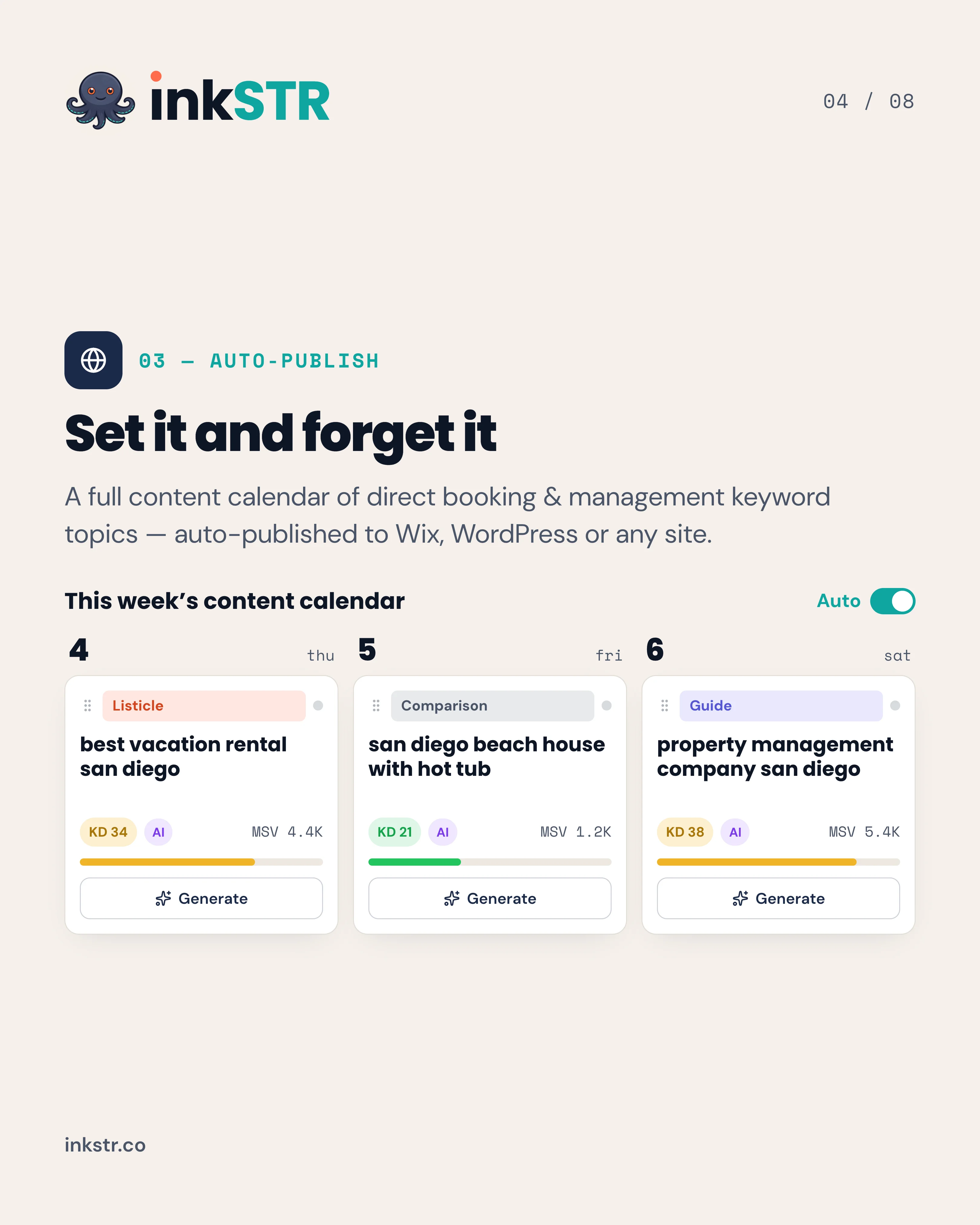
This is the exact problem inkSTR was designed to solve. The platform generates, schedules, and publishes keyword-targeted blog articles automatically, maintaining a consistent cadence without requiring the operator to write a single word. The Auto-Publishing feature connects directly to Wix and WordPress, moving articles from draft to live without manual intervention. For a deeper look at how content marketing converts readers into guests, our guide on why your blog content is not converting visitors into guests is worth reading alongside this one.

How Do the Most Common Ranking Problems Compare? A Quick Reference
Before you start fixing things, it helps to know which problem is likely the biggest drag on your specific site. The table below maps each ranking issue to its impact severity, how difficult it is to diagnose, and whether it is a content, technical, or authority problem.
| Ranking Problem | Impact on Rankings | Type | Fix Difficulty |
|---|---|---|---|
| Duplicate OTA content on your site | Very High | Content | Medium (requires original writing) |
| No keyword-targeted blog content | Very High | Content | Medium (requires consistent publishing) |
| Search intent mismatch | High | Content / Strategy | Medium (requires content audit) |
| Pages not indexed by Google | High | Technical | Low (Google Search Console fix) |
| Slow page speed / Core Web Vitals failures | High | Technical | High (requires developer input) |
| Broken H-tag hierarchy | Medium | Technical | Low (manual fix in CMS) |
| Zero backlinks from external sites | Medium-High | Authority | High (ongoing outreach required) |
Most vacation rental websites are dealing with the top three simultaneously. Content problems are the highest priority because they are the foundation everything else builds on. A technically perfect site with no original content will still not rank. A content-rich site with minor technical issues can often rank despite those imperfections.
What Should You Fix First? A Practical Prioritization Framework
When your vacation rental website is not ranking on Google, prioritization determines whether you see results in 90 days or 18 months. Here is the sequence we recommend based on what produces the fastest measurable improvement.
- Audit for duplicate content first. Check every page on your site against your OTA listings. If the descriptions match or are substantially similar, rewrite them. Your site needs to be the original source for its own content, not a mirror of your Airbnb listing.
- Fix indexing issues in Google Search Console. Go to the Coverage report and identify any pages with "Excluded" or "Not Indexed" status. Request indexing for your most important pages. This step costs nothing and often produces ranking movement within days.
- Correct your H-tag structure. Every page should have exactly one H1 tag. From there, use H2 tags for major sections and H3 tags for subsections. Never skip levels. This is a 30-minute fix in most CMS platforms.
- Start publishing keyword-targeted blog content. This is the highest-leverage long-term move. Two to four original articles per month targeting your specific market's search queries builds domain authority faster than any other content tactic. For operators who want to understand what to write, our guide on why generic travel content kills conversions is a strong starting point.
- Address page speed. Use Google's PageSpeed Insights tool to identify your site's Core Web Vitals scores. If you are scoring below 50 on mobile, contact your web developer or hosting provider. This is the most technically demanding fix but has real ranking impact in competitive markets.
- Build backlinks from local authority sources. Local tourism directories, regional travel blogs, and destination guides are the most natural sources of backlinks for vacation rental sites. Seasonal content timing also matters: write about winter activities in fall, and summer activities in spring, since travelers begin planning months before arrival.
- Implement LodgingBusiness schema markup. Schema markup is structured data that tells Google exactly what your property is. LodgingBusiness schema can generate rich results in search, including star ratings and property details, that dramatically improve click-through rates. Almost no vacation rental operator implements this, which makes it a genuine competitive advantage. For a full explanation of how schema supports rankings, our article on what backlinks are in SEO also covers how structured data fits into the broader authority picture.
If you want to run this process without doing each step manually, inkSTR's platform covers the content side automatically. The Keyword Research feature identifies the specific queries your market searches. The AI Content Writer generates original, structured articles that avoid duplicate content entirely. And the Content Calendar keeps the publishing cadence consistent so your site builds authority month over month without you managing each step. Plans start at $99/month, which is less than the cost of a single freelance blog post.
Frequently Asked Questions
Why is my vacation rental website not showing up in Google search results?
Your vacation rental website is likely not showing up on Google because of one or more of these causes: your pages have not been indexed yet, your content duplicates your Airbnb or VRBO listing, or your site has no keyword-targeted blog content for Google to rank. Start by checking Google Search Console for indexing errors, then audit your property descriptions for duplicate content from OTA listings. Publishing original blog articles targeting your specific market's search terms is the most effective long-term fix.
How long does it take for a vacation rental website to rank on Google?
Most vacation rental websites begin showing meaningful ranking movement after three to six months of consistent publishing and technical fixes. Sites that already have technical issues resolved can rank faster once content is in place. The key variable is publishing cadence: sites that publish two to four original, keyword-targeted articles per month build domain authority significantly faster than sites that publish sporadically. A ranking blog article can drive organic search traffic for two to five years once it reaches the first page.
Does having a listing on Airbnb or VRBO hurt my direct booking website's Google ranking?
Having OTA listings does not directly hurt your Google ranking. However, copying your OTA property description onto your own website creates a duplicate content problem that will suppress your site's rankings. Google attributes the original version of content to whichever site has more authority, which is almost always the OTA. The fix is to write original, more detailed content for your direct booking website rather than reusing any language from your OTA listings.
What keywords should a vacation rental website target to rank on Google?
Vacation rental websites rank best when they target location-specific, long-tail keywords that match the language travelers actually use. This varies by destination: mountain market travelers search "cabin" while coastal travelers search "condo" or "beach house." Pair destination terms with specific property features and traveler needs, for example "pet-friendly cabin with hot tub near Asheville." Broad terms like "vacation rental" are dominated by OTA platforms and are not realistic targets for standalone sites without significant domain authority.
Can AI-generated blog content rank on Google for vacation rental keywords?
AI-generated content can rank on Google when it is specific, well-structured, and genuinely answers the search query better than competing pages. Generic AI content fails because it lacks destination-specific detail and traveler intent alignment. inkSTR generates vacation rental blog content with STR-specific terminology, location-based keyword targeting, and content architecture designed for both Google rankings and AI search citation, which makes it meaningfully different from generic AI writing tools.
What is the most important thing I can do to fix my vacation rental website's ranking?
If you had to pick one thing: start publishing original, keyword-targeted blog content on a consistent schedule. No other tactic builds sustainable organic traffic without this foundation. Technical fixes, backlink building, and schema markup all amplify an existing content base. Without original content, those tactics have nothing to amplify. Two to four articles per month targeting your specific destination market is the publishing cadence that produces compounding results over a six to twelve month window.
Should I use Google Search Console for my vacation rental website?
Yes, Google Search Console is the single most important free tool for understanding why your vacation rental website is or is not ranking. It shows which queries your site appears for, which pages are indexed, which have errors, and how your click-through rates compare to your ranking positions. Registering your domain in Search Console and manually requesting indexing for new pages takes minutes and accelerates Google's discovery of your content significantly. Any serious effort to improve your site's rankings starts here.
Start Fixing the Rankings Problem Today
Your vacation rental website not ranking on Google is a solvable problem. The causes are specific and diagnosable: duplicate OTA content, no keyword-targeted blog articles, search intent mismatch, unindexed pages, technical errors, or the compounding effect of all of these together. The fix is not a mystery. It is a system: original content, published consistently, targeting the precise queries your guests search in your specific market.
The operators who generate reliable direct booking traffic are not doing anything magical. They have a publishing cadence that builds authority over time, keyword research that targets what travelers actually search, and content that covers both the research and booking stages of the traveler journey. In 2026, with organic search driving 38% of vacation rental website traffic and OTA fees consuming 17 to 19% of every booking, the cost of not solving this problem is measured in real money lost every month.
The next step is to audit your site against the seven problems in this article, fix the technical issues first since they are often the fastest wins, then build a content publishing plan that runs consistently for at least six months. If you want that content plan to run without manual effort, inkSTR handles the full pipeline: keyword research, article generation, scheduling, and publishing to your direct booking website automatically.

If your vacation rental website has been invisible on Google for months and you are ready to fix it with a content system that runs on autopilot, get started with inkSTR and see which keywords your competitors are already capturing in your market.
Content powered by inkSTR.co
Enjoyed this article? Share it:
Get more of inkSTR in Google Search
Add inkstr.co as a preferred source and our articles show up more in Top Stories, AI Overviews, and AI Mode — with a “Preferred” badge.
Get more guides like this
New SEO and AI-search guides, straight to your inbox. No spam, unsubscribe anytime.