WP SEO Plugin: What Vacation Rental Sites Actually Need

A WP SEO plugin is a WordPress tool that manages technical on-page elements like meta titles, XML sitemaps, schema markup, and robots.txt rules. It does not write content, generate keyword strategy, or fix the reason a vacation rental site fails to rank. Understanding that distinction is the single biggest factor separating hosts who rank in 2026 from hosts still wondering why their site sits on page three.
Key Takeaways
- A WP SEO plugin (like the popular free and paid tools built for WordPress) automates technical tasks: meta tags, sitemaps, schema markup, and readability checks.
- Plugins do not generate blog content, keyword research, or a content calendar. Those require a separate strategy or tool.
- Manually writing one quality blog post takes 3 to 5 hours of research and writing, a cost a WP SEO plugin cannot reduce because it doesn't touch content creation.
- Hiring a freelance writer to fill the content gap a plugin leaves open typically runs $300 to $700 per post.
- Airbnb and VRBO combined host and guest fees run 17 to 19% of every booking, which is exactly the cost a ranking, direct-booking blog post is designed to reduce over time.
- inkSTR handles the part a WP SEO plugin was never built to do: keyword research, article drafting, and scheduled publishing, so the technical plugin has something worth optimizing.
Every property management company and independent host we've worked with at inkSTR eventually installs a WP SEO plugin on their WordPress site. It's a reasonable first move. The problem is what happens next: most operators install the plugin, get a green checkmark next to their homepage, and assume the SEO work is finished. It isn't. As of 2026, a technical plugin without a content engine behind it is a car with a tuned engine and no fuel.
This guide breaks down exactly what a WP SEO plugin does, where it stops, and what actually needs to happen on a vacation rental website to convert search traffic into direct bookings instead of Airbnb referrals. We'll cover setup, common mistakes, and the content gap almost every STR site leaves unaddressed.
What Is a WP SEO Plugin, Exactly?
A WP SEO plugin is a WordPress add-on that manages the technical and structural signals search engines use to crawl, index, and display a website in search results. Specifically, it handles meta title and description fields, XML sitemap generation, canonical tags, schema markup, and internal readability scoring for individual pages and posts.
For a vacation rental site, this means the plugin can automatically generate a sitemap that includes your property pages, local area guide posts, and booking page, then submit that structure to Google Search Console. It can also flag when a page description is too long or a title tag is missing, both of which affect how your listing appears in search results.
What a WP SEO plugin cannot do is decide what your blog should say about Gatlinburg cabin rentals versus Scottsdale desert getaways, or which keywords a traveler searching for a lake house in 2026 actually types into Google. That distinction matters more than most setup guides admit. Technical optimization without a content strategy behind it produces a technically clean website that still has nothing worth ranking.
Why Does a Vacation Rental Site Still Not Rank After Installing an SEO Plugin?
A vacation rental website often fails to rank after plugin installation because the plugin only optimizes what already exists on the page. If your site has three thin pages and no blog content answering traveler questions, the plugin has nothing substantial to structure.
We see this constantly across property management portfolios: an operator installs a well-known WordPress SEO plugin, gets every checkbox green, publishes nothing new for six months, and wonders why organic traffic never moves. The plugin did its job. There was just no content for it to work with.
This is the gap that separates operators managing 10 to 100+ units from independent hosts with one or two properties. Larger portfolios often have staff to handle guest communication and cleaning coordination, but no dedicated content or marketing hire. The technical box gets checked. The content pipeline, the actual thing search engines reward, stays empty.
Writing one quality blog post manually takes 3 to 5 hours of research and drafting. Multiply that across 15 properties or a dozen local area guides, and most operators simply stop after the first two or three posts. That's exactly the moment inkSTR's AI Content Writer becomes the missing half of the equation, generating SEO-optimized articles built around the keyword research your WP SEO plugin was never designed to perform.

What Features Should You Look for in a WP SEO Plugin?
The core features worth prioritizing in a WP SEO plugin are meta tag control, XML sitemap generation, schema markup support, redirect management, and readability scoring. These five functions cover the technical foundation every WordPress site needs regardless of niche.
For a short-term rental site specifically, schema markup deserves extra attention. Structured data for LodgingBusiness or Product schema helps Google and AI systems like ChatGPT and Google AI Overviews understand that a page describes a bookable property, not a generic blog post. This is increasingly relevant in 2026 as more travel searches route through AI-driven answer engines rather than traditional blue links.
A second feature worth checking: redirect management. Vacation rental sites change property names, retire seasonal pages, and restructure URLs more often than typical business websites, especially portfolio managers adding or dropping units. A plugin that handles 301 redirects without a developer prevents broken links from tanking your domain authority.
| Feature | What It Does | Why It Matters for STR Sites |
|---|---|---|
| Meta title/description editor | Controls how pages appear in search results | Improves click-through rate on property and blog pages |
| XML sitemap generation | Tells search engines which pages exist | Ensures new blog posts and property pages get crawled |
| Schema markup | Adds structured data for rich results | Helps AI search tools identify bookable listings |
| Redirect manager | Preserves link equity when URLs change | Prevents broken links when properties rotate in/out |
| Readability scoring | Flags dense or hard-to-read content | Useful, but doesn't generate the content itself |
None of these features write the article, research the keyword, or schedule the publish date. That work happens upstream, which is precisely where inkSTR's Keyword Research tool and content calendar step in, feeding a plugin something worth marking up.
Should You Use a Free or Paid WP SEO Plugin?
A free WP SEO plugin covers the essentials most vacation rental sites need: basic meta editing, sitemap generation, and simple schema. A paid tier typically adds advanced schema types, internal linking suggestions, and content scoring against target keywords.
For an independent host managing one or two properties, the free tier is usually sufficient. The technical requirements of a small site don't justify a recurring cost when the bigger constraint is content volume, not technical configuration.
For multi-property managers running 10 or more listings, the paid tier's bulk editing and advanced redirect tools save real time. But even at the paid tier, you're still paying for technical management, not strategy or writing. That's a separate budget line entirely, and it's the one operators consistently underfund.
The mistake we see across property management companies at inkSTR: teams pay for the premium SEO plugin tier expecting it to move rankings, then get frustrated when nothing changes after three months. The plugin was never the bottleneck. The absence of fresh, keyword-targeted content was.
How Do You Combine a WP SEO Plugin With a Content Strategy?
Combining a WP SEO plugin with a content strategy means using the plugin for technical hygiene while a separate system handles keyword research, drafting, and publishing on a schedule. Treat the plugin as the packaging, not the product inside it.
Here's the sequence that actually works for STR sites in 2026:
- Identify keyword gaps specific to your market type (beach town, mountain retreat, urban apartment, lake house) rather than generic vacation rental terms.
- Build a content calendar that publishes consistently, not in bursts followed by months of silence.
- Draft articles that answer real traveler questions about your location, not thin "top 10" filler.
- Let your WP SEO plugin handle the meta tags, schema, and sitemap submission for each new post automatically.
- Track keyword movement through Google Search Console and adjust the next month's topics based on what's actually gaining traction.
Step one through four is where most operators stall, specifically because steps one through three require hours most hosts don't have. This is the exact workflow inkSTR was built around: our how inkSTR works page walks through the full pipeline from keyword research to scheduled publishing, so your WP SEO plugin has fresh, targeted content arriving on a predictable rhythm instead of whenever someone finds four spare hours.
A freelance travel writer charges $300 to $700 per quality blog post to fill that gap manually. At scale across a multi-property portfolio, that cost compounds fast, which is why so many operators either overpay a freelancer or simply stop publishing.

How Long Does It Take to See Results From a WP SEO Plugin and Content Combined?
Most vacation rental sites see initial keyword movement within 60 to 90 days of publishing consistent, targeted content alongside a properly configured WP SEO plugin. Full ranking gains for competitive local terms usually take longer, often 4 to 8 months of sustained publishing.
The plugin itself produces changes almost immediately: fixed meta tags and submitted sitemaps get crawled within days. But crawling isn't ranking. Google needs to see a pattern of relevant, updated content before it trusts a domain enough to rank it above established competitors for terms like "vacation rental [city]."
A ranking blog article, once it earns its position, can drive organic search traffic for 2 to 5 years with minimal maintenance. That's the compounding return that makes the upfront content investment worthwhile, and it's also why consistency matters more than any single technical fix. One well-optimized meta title won't outrank a competitor who has published 40 locally specific articles over two years.
Multi-unit property managers thinking in terms of ROI per property should weigh this against Airbnb and VRBO's combined host and guest fees of 17 to 19% per booking. A single direct booking is typically worth $1,000 to $4,000 in revenue. Even a modest volume of direct bookings redirected from OTA dependency covers a content investment quickly. For a deeper breakdown of this math, our guide on revenue maximization for hosts walks through the counterintuitive strategies that move the needle fastest.
Ready to automate your content marketing?
inkSTR handles keyword research, content strategy, article writing, and publishing, all on autopilot.
What Common Mistakes Do STR Operators Make With SEO Plugins?
The most common mistake is treating plugin installation as the finish line rather than the starting point. Operators configure the plugin, see a clean audit score, and stop there, assuming rankings will follow automatically.
- Duplicate meta descriptions across property pages. Many portfolio managers copy the same description template across 15 listings, which confuses search engines about which page to rank for which query.
- Ignoring schema for individual properties. A plugin can add LodgingBusiness schema, but only if someone configures it per property, a step frequently skipped when managing dozens of units.
- Publishing once and abandoning the blog. Inconsistent publishing is exactly what search engines penalize. A burst of five posts followed by six months of silence signals an inactive site.
- Writing generic content instead of location-specific answers. "Top 10 things to do near your rental" without concrete street names, business types, or seasonal detail reads as filler to both readers and Google's ranking systems.
- Never checking Google Search Console after the plugin submits the sitemap. Submission isn't the same as indexing. Operators often never verify whether pages actually got crawled.
We built inkSTR's Content Calendar specifically because the "publish once and abandon it" pattern is the single most common failure mode we see across STR portfolios. Automated scheduling removes the dependency on someone remembering to sit down and write.
Data Snapshot: Technical SEO vs. Content Investment
The table below breaks down what each side of the equation actually delivers for a vacation rental website, since operators frequently conflate the two.
| Category | WP SEO Plugin Handles | Content Strategy Handles |
|---|---|---|
| Meta tags and titles | Yes, automatically | Provides the topic and keyword the tag describes |
| Sitemap and crawlability | Yes, automatically | Determines how many pages exist to crawl |
| Schema markup | Structural support | Supplies the property or article details it structures |
| Keyword targeting | Not handled | Core function; research drives every published topic |
| Publishing consistency | Not handled | Requires a calendar and drafting workflow |
| Direct booking conversion | Not handled | Content quality and internal linking drive this outcome |
Notably, the two columns rarely overlap. That's not a flaw in plugin design, it's simply outside the scope of what a technical plugin was ever meant to do. Operators who understand this early stop wasting budget on plugin upgrades when the real gap is upstream, at the keyword and drafting stage.
How Do You Compete With Larger Property Management Companies in Search?
Smaller vacation rental operators compete against larger, better-funded property management companies by publishing hyper-specific, locally detailed content that larger competitors typically skip because it doesn't scale easily across their portfolio management workflows.
Large property management companies often run 50 to 200+ listings across multiple markets. Their content, when it exists, tends toward generic templates reused across cities: swap the city name, keep the same five paragraphs. That approach ranks poorly for specific, high-intent searches because it lacks the concrete detail travelers and search engines both reward.
An independent cabin owner or boutique operator who writes about a specific trailhead, a named seasonal event, or a particular architectural detail of their property has a real advantage here. Search engines increasingly favor specificity over volume, particularly as Google's AI Overviews and tools like ChatGPT pull from content that answers a precise question rather than a generic one.
This is where our guide on local area guides that sell becomes relevant: the win isn't publishing more, it's publishing content a large portfolio manager's templated approach cannot replicate at scale. inkSTR's multi-project support gives each property its own independent content pipeline, so even a single-property host can run the same locally specific strategy a 50-unit competitor structurally can't execute efficiently.
Practical Guidance: Setting Up Your WP SEO Plugin the Right Way
Getting a WP SEO plugin configured correctly takes under an hour, but most operators skip steps that matter for long-term ranking health. Follow this sequence rather than accepting default settings.
- Connect the plugin to Google Search Console immediately after installation, not weeks later, so indexing data starts accumulating from day one.
- Set a unique meta title and description template for property pages versus blog posts. Don't reuse the same pattern for both content types.
- Enable LodgingBusiness or Product schema on each individual property page, not just the homepage.
- Audit existing URLs for duplicate or thin content before publishing anything new. Fix or consolidate weak pages first.
- Set a realistic publishing cadence you can sustain, even if that means one post every two weeks rather than four posts in one month followed by silence.
The trade-off most operators underestimate: technical setup is a one-time task measured in hours, while content production is an ongoing commitment measured in months and years. Budget your time accordingly, and if the ongoing part is the constraint, that's the piece worth automating first. Our guide on why vacation rental websites don't rank covers additional diagnostic steps if your site checks every technical box and still underperforms.
Frequently Asked Questions
Does a WP SEO plugin write blog content for my vacation rental site?
No. A WP SEO plugin manages technical elements like meta tags, sitemaps, and schema markup. It does not generate blog posts, research keywords, or build a content strategy. Those tasks require either manual writing or a dedicated content tool like inkSTR's AI Content Writer.
How many blog articles do I need before I start ranking for local vacation rental searches?
There's no fixed number, but most operators see initial keyword movement after publishing consistently for 60 to 90 days rather than after a single burst of posts. Quality and specificity matter more than raw volume. A dozen locally detailed articles typically outperform fifty generic ones.
Can I use inkSTR alongside my existing WP SEO plugin?
Yes. inkSTR handles keyword research, article drafting, and publishing scheduling, while your WP SEO plugin continues managing technical elements like meta tags and schema on the WordPress side. The two tools serve different, complementary functions rather than competing ones.
What's the difference between a free and paid WP SEO plugin for a vacation rental site?
Free tiers typically cover meta editing, sitemaps, and basic schema, which is enough for most single-property hosts. Paid tiers add bulk editing, advanced schema types, and content scoring, more useful for multi-property managers handling 10 or more listings at once.
Why does my property management website rank below individual listing sites?
This usually happens because portfolio-wide sites reuse templated descriptions across many properties, diluting relevance for any single search query. Individual listing sites with locally specific, unique content often outrank templated portfolio pages, even when the portfolio site has stronger technical SEO configuration.
Does content marketing actually reduce dependence on Airbnb and VRBO?
Yes, over time. Airbnb and VRBO combined host and guest fees run 17 to 19% of every booking. A ranking blog article that drives direct traffic to your own booking page reduces reliance on that fee structure, and can continue generating traffic for 2 to 5 years after it starts ranking.
Do I need SEO experience to combine a plugin with a content strategy?
No. A WP SEO plugin handles most technical configuration through its interface without coding knowledge. For the content side, tools like inkSTR's Keyword Research feature remove the need for prior SEO expertise by identifying target terms automatically.
Conclusion
A WP SEO plugin is the technical foundation, not the growth engine. It keeps your meta tags clean, your sitemap current, and your schema markup structured correctly. None of that replaces the keyword research, drafting, and consistent publishing that actually move a vacation rental site up the rankings in 2026.
The operators who win in search treat the plugin and the content strategy as two separate, necessary systems working together. Get the technical side configured once, then build a publishing rhythm that doesn't depend on finding four free hours every week.
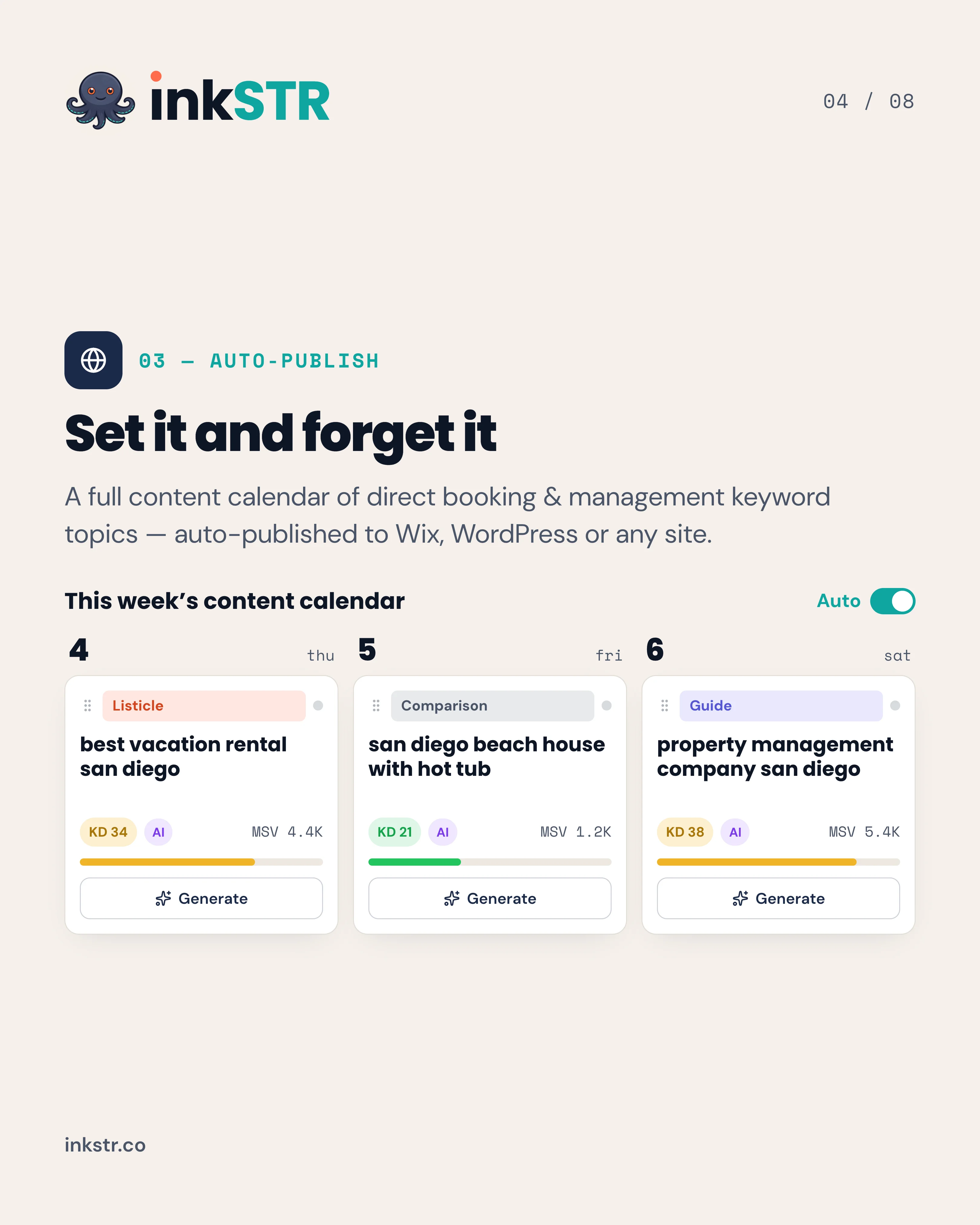
If your WP SEO plugin has been sitting on a clean audit score with nothing new published in months, that's the gap worth closing first. Get started with inkSTR and let the content calendar handle the research, drafting, and scheduling your plugin has been waiting for.
Content powered by inkSTR.co
Enjoyed this article? Share it:
Get more of inkSTR in Google Search
Add inkstr.co as a preferred source and our articles show up more in Top Stories, AI Overviews, and AI Mode — with a “Preferred” badge.
Get more guides like this
New SEO and AI-search guides, straight to your inbox. No spam, unsubscribe anytime.