Is Blogging Worth It for Vacation Rental Owners in 2026?
Is blogging worth it for vacation rental owners? Yes, when the goal is direct bookings, because one local article can keep sending searchers to your own booking page for years. At inkSTR, we see blogs fail only when posts are generic or never link to a booking page.
Key Takeaways
- Blogging pays off when you own a website with a booking path and can publish steadily for months. It does not help if you need bookings in the next few weeks.
- A single direct booking is typically worth $1,000 to $4,000 in revenue, so one booking traced to one post can outweigh the cost of several posts.
- Writing one quality post by hand takes 3 to 5 hours, and a freelance travel writer charges $300 to $700 per post.
- Expect months before steady traffic arrives. A ranking article can then drive organic search traffic for 2 to 5 years.
- Local-intent topics such as town guides, seasonal trip planning, and property-specific answers match what guests search before they choose a rental.
- inkSTR automates keyword research, drafting, scheduling, and publishing to WordPress or Wix for $99 per month, so the blog keeps running while you manage guests.
You have strong reviews, a clean website, and a booking page almost nobody visits.
A blog is the slow, owned alternative. In 2026 it also feeds AI search tools such as Google AI Overviews and ChatGPT, which pull answers from well-structured local content. Perplexity does the same. This guide gives you a verdict with math: what a blog costs in hours and dollars, how long it takes, which topics earn bookings, and when you should skip it.
We wrote it from what we see running content pipelines for short-term rental operators, so expect opinions and numbers rather than a list of generic benefits.
Is Blogging Worth It for Vacation Rental Owners, or Should You Skip It?
Blogging is worth it for vacation rental owners when three conditions hold. You need your own website with a booking path. You also need to publish steadily for several months, and your guests must search Google before they pick a platform. If one is missing, fix that first.
Ignore the conditions and the blog becomes a hobby. You spend evenings writing posts that send readers to a dead end, see nothing in month two, and quit just before search traffic would have started to build. Most owners who stall here had the writing skill; what they lacked was a system that kept publishing through busy weeks.
We built inkSTR to remove the consistency problem. The AI Content Writer drafts keyword-targeted articles, and the schedule publishes them, so the blog keeps moving during the weeks you are busy with turnovers.
| Your situation | Blogging verdict |
|---|---|
| You have a website with a booking engine or inquiry form | Worth it |
| Guests in your market search for things to do or places to stay near a specific attraction | Worth it |
| You manage several properties or markets | Worth it, and easiest when automated |
| You own one property and have no website yet | Build a booking page first, then blog |
| You need reservations within a few weeks | Skip for now; use listing optimization and past-guest email |
| You will publish a few posts and stop | Skip; blogging rewards consistency |
What Is the Most Popular Vacation Rental Website, and Why Do Guests Choose Vrbo Over Airbnb?
Airbnb is the best-known vacation rental website, and Vrbo is its main whole-home alternative, which is why many families and groups start their search there.
The trouble is ownership. On either platform you rent space in someone else's marketplace and pay a fee on every stay. You also have no claim on the traffic. A guest who loved your cabin last summer has to find you again through the same fee-bearing listing.
A blog catches guests earlier, when they type a question into Google before they choose a platform. We built inkSTR's Keyword Research to find those searches, so your articles answer them and lead readers to your own site. Our guide to a direct bookings strategy shows where that traffic should land.
How Much Does a Vacation Rental Blog Cost in Time and Money?
A vacation rental blog costs 3 to 5 hours of research and writing per post if you write it yourself. It costs $300 to $700 per post if you hire a freelance travel writer. With inkSTR it starts at $99 per month, and the platform generates, schedules, and publishes articles automatically.
| Approach | Time per post | Cash cost | Best fit |
|---|---|---|---|
| Write it yourself | 3 to 5 hours | None | Owners with spare evenings and a strong voice |
| Hire a freelance travel writer | Briefing and review time | $300 to $700 per post | Owners with budget who want a human byline |
| inkSTR | Review and light editing | $99 per month | Owners who want a steady cadence |
The math gets painful at a real cadence. Four posts a month by hand is 12 to 20 hours of writing, which is roughly two full working days every month. Four posts from a freelancer is $1,200 to $2,800 every month, before you add a single revision.
inkSTR handles the pipeline with Auto-Publishing, which sends finished articles to WordPress or Wix without manual formatting. You still review each draft and add details only you know, such as the trailhead you send guests to. See the pricing page for plan details.

How Long Does It Take for a Vacation Rental Blog to Get Traffic?
A vacation rental blog typically takes months, not weeks, to earn steady search traffic, because Google must find and index new pages. It also has to test them before ranking them. Judging a blog after a few weeks is the most common reason owners quit early.
The discouraging stretch is the middle. You publish four posts and check Search Console, and you see almost nothing. Most owners stop there, which means they paid the cost of the first posts and never collected the return.
Our own customer data shows what steady publishing looks like. A Smoky Mountains cabin rental brand grew monthly Google Search clicks from 788 to 5,195 over 11 months on a continuous inkSTR pipeline. A five-market mountain rental brand published 114 articles in four months and moved from 26 to 1,924 monthly Google search visits, measured in Wix Analytics and Google Search Console. Results vary by market, and nothing here guarantees rankings.
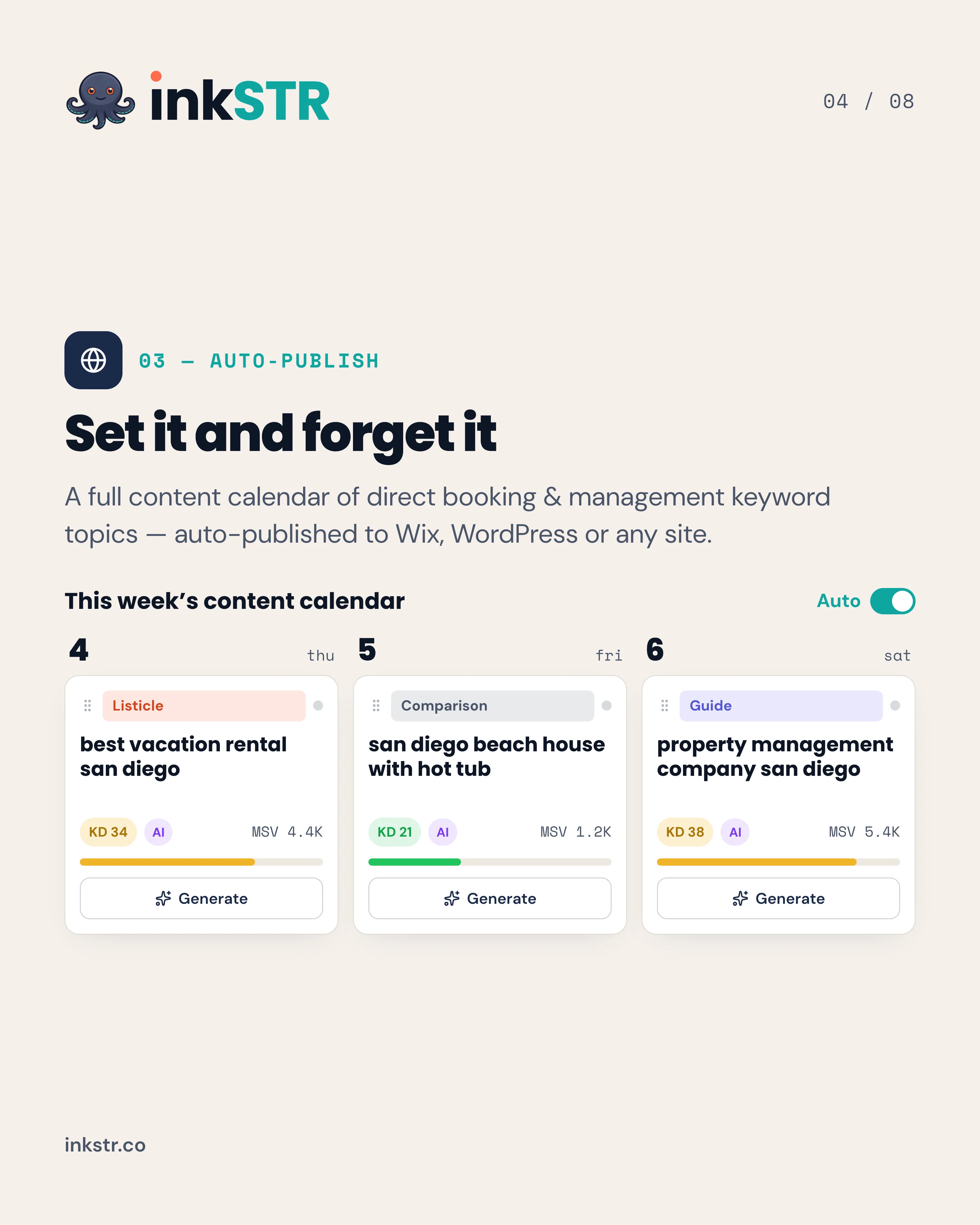
The Content Calendar keeps that cadence alive: drag an article to Tuesday and it publishes on schedule. For the technical side of ranking, read how to rank your vacation rental website on Google.
What Should a Vacation Rental Owner Blog About to Get Direct Bookings?
A vacation rental owner should blog about the questions guests ask before they book, such as what to do near the property and when to visit. Posts on what each season feels like help too. Local-intent posts sit close to a booking decision, while generic travel tips attract readers who never rent.
| Content type | What it captures | Example angle | Honest caveat |
|---|---|---|---|
| Town or neighborhood guide | Searches for things to do near your area | A morning-to-night plan for a weekend in your town | Needs refreshing when businesses close |
| Seasonal trip planning | Shoulder-season and holiday searches | Why a lake house works for a fall weekend getaway | Only useful if you update it yearly |
| Property-specific answers | Questions about parking, pets, amenities | Is the cabin dog-friendly, and where to walk the dog | Small search volume, high booking intent |
| Event and activity content | Searches around festivals and sports | Where to stay for a regional festival weekend | Confirm dates with the organizer each year |
Write like a regular. Name what to order and when to arrive, then say what to skip. Add one downside, such as a trailhead lot that fills by mid-morning on summer weekends. Guests trust a post that admits a crowd problem. Our roundup of vacation rental blog topics and our piece on local area guides that sell go deeper.
That is the part that eats your weekends, so inkSTR's PMS integration with Hospitable and OwnerRez pulls real reviews and photos into drafts, which keeps each article tied to your actual property.
Is Blogging Better Than Airbnb Listing Optimization, Google Business Profile, Ads, or Email?
Blogging beats the other channels on durability and loses on speed. Listing optimization and Google Business Profile work within days, email brings back past guests, and paid ads buy a bookings spike for as long as you keep paying. A blog builds a search asset you own.
| Channel | Speed to results | Ongoing cost | You own the audience? |
|---|---|---|---|
| Blog | Months | Low once running | Yes |
| Google Business Profile | Days to weeks | Low | Partly |
| Paid ads | Immediate | Continuous | No |
| Email list | Weeks | Low | Yes |
Our opinion: if you own one property and have no site, start with listing optimization and a complete Google Business Profile. Both pay faster than a blog. A blog only converts if the booking page behind it is solid, so fix that with our guide to booking page conversion optimization.
Once the booking page works, inkSTR's internal link management routes every article to it, so blog readers have a clear next click.
Ready to automate your content marketing?
inkSTR handles keyword research, content strategy, article writing, and publishing, all on autopilot.
Does Airbnb Allow Hosts to Promote Their Own Website?
Hosts can generally run their own website and blog. Platform rules target moving a guest with an existing reservation off the platform to book or pay. Wording matters.
Fear of this rule keeps some owners from blogging at all, and others blur the line by messaging booked guests about direct rebooking. Both mistakes cost you: the first leaves traffic on the table, and the second risks your listing.
The safer practice is to aim your blog at people who have not booked anywhere yet, and to keep all conversations with platform guests on the platform. Search visitors who read your town guide and click through to your site are a different audience from a guest in your Airbnb inbox. We design inkSTR articles for that first audience: searchers who find you on Google or in AI search answers.
Can Vacation Rentals Be Profitable, and Can a Blog Add Direct Booking Revenue?
Vacation rentals can be profitable, and a blog improves the margin by replacing platform fees on bookings you win directly.
Here is an illustrative example, not a customer result. On a $2,000 stay, 17-19% in platform fees is $340 to $380. One freelance post costs $300 to $700, so a single direct booking can cover a post several times over. Starting at $99 per month, one $1,000 booking pays for more than ten months of inkSTR. The figures come from the ranges above, so swap in your own nightly rate and average stay to see your break-even point.
Real data points the same direction. The Smoky Mountains cabin brand mentioned above attributed $309,775 in direct booking revenue in its first 14 months on inkSTR, measured in Google Search Console and Google Analytics. A different five-market brand closed its first $2,500 or more in commission-free direct bookings within four months.
If you manage homes for other owners, the same blog also attracts owner leads. Our page on content for property managers explains how.

How Do You Track Whether Your Blog Is Generating Bookings?
Tracking blog-driven bookings means connecting three data points: organic visits in Google Search Console and Google Analytics, the path from a post to your booking page, and the booking source recorded by your booking engine or asked at checkout.
Without tracking, you cannot tell a blog-assisted booking from one that merely coincided with traffic. Owners then judge the blog by gut feeling and either quit too early or keep funding posts that go nowhere.
- Connect your site to Google Search Console to see which queries bring impressions and clicks.
- In Google Analytics 4, mark your booking confirmation or inquiry submission as a key event.
- Add UTM parameters to blog links that you share in email and on social media.
- Add a "how did you find us?" field to your booking form or checkout.
- Review monthly: direct bookings, direct share of revenue, and visitor-to-booking conversion.
Check assisted conversions too, since a guest may read a post and leave, then return later through a branded search. inkSTR's Google Search Console integration tracks keywords and flags opportunities, and the How inkSTR Works page shows the full path from keyword to published post. For AI search visibility, see our guide to ranking in AI search.
Frequently Asked Questions
Create a host account on Vrbo, add your property details, photos, and rates, set your calendar, and complete the payment setup. Then confirm current requirements for your area with local authorities. Once the listing is live, build your own website and blog so you are not relying on one marketplace for all your traffic.
How often should a vacation rental blog publish new posts?
Pick a cadence you can hold for at least six months, because consistency matters more than volume. Many owners do well with one to two posts a week. inkSTR's Content Calendar schedules posts in advance, so the cadence survives busy seasons.
Which platform should you use to host a vacation rental blog?
Use the site where your booking page already lives, which is usually WordPress or Wix. Keeping the blog on your own domain means traffic and rankings build toward the pages that take direct reservations. inkSTR publishes to both with one click.
What are the best niche rental platforms for a lake or cabin property?
Niche and regional listing sites can add exposure, but they remain third-party channels with their own fees and rules. Before you commit, check how much traffic the site claims, what commission it takes per booking, and whether it lets you keep guest contact details. A blog on your own site complements any of them by capturing searchers before they pick a marketplace.
What booking solution is worth the investment for strengthening direct channels?
A booking engine connected to your property management system is worth having, but it only converts visitors you already have. Pair it with content that brings those visitors in. Start with our guide to direct bookings, then get started with inkSTR to automate the traffic side.
Can AI-written blog posts rank on Google?
They can, when you edit and optimize them, target real searches, and add details only you know about the property and area. Thin, generic posts rank poorly whoever writes them. inkSTR drafts 2,500 to 3,500 word articles and runs quality scoring before publishing.
What mistakes make vacation rental blogs fail?
The common ones are thin posts, skipping keyword research, no link to a booking page, and quitting after a few weeks. Outdated local information hurts too, so refresh seasonal posts each year. Posts that never mention a way to book give readers no next step.
So, Is Blogging Worth It for Vacation Rental Owners in 2026?
For most owners with a website and a booking path, yes. Blogging is worth it for vacation rental owners who want direct bookings, because a single booking worth $1,000 to $4,000 outweighs the cost of publishing for months. Skip it if you need reservations within weeks, and start with listing optimization and Google Business Profile instead.
Pick local topics, link every post to your booking page, track bookings by source, and give the blog months before judging it. As AI search keeps growing through 2026 and beyond, well-structured local articles earn visibility in both Google and AI answers.
If you want a blog that publishes without eating your evenings, Start Free Trial with inkSTR. The Content Calendar lets you schedule weeks of keyword-targeted articles in one sitting, and Auto-Publishing sends them to WordPress or Wix.
Content powered by inkSTR.co
Enjoyed this article? Share it:
Get more of inkSTR in Google Search
Add inkstr.co as a preferred source and our articles show up more in Top Stories, AI Overviews, and AI Mode, with a “Preferred” badge.
Get more guides like this
New SEO and AI-search guides, straight to your inbox. No spam, unsubscribe anytime.