Vacation Rental SEO vs Paid Ads for Bookings: Which Wins?
For most vacation rental operators, SEO delivers cheaper direct bookings over time, while paid ads deliver bookings faster. In the vacation rental seo vs paid ads for bookings debate, paid ads suit a new site or an empty shoulder season. SEO suits anyone who wants traffic that keeps working after the budget stops. Most operators should use both, in sequence.
Key Takeaways
- SEO builds traffic you own; paid ads rent traffic that stops the moment you stop paying.
- A single direct booking is typically worth $1,000 to $4,000, so even a modest number of organic bookings changes your margins.
- Writing one quality blog post manually takes 3-5 hours, and a freelance travel writer charges $300-$700 per post.
- A ranking article can drive organic traffic for 2-5 years, while ad clicks end when the budget does.
- inkSTR automates keyword research, article writing, scheduling, and publishing for $99/month, which makes the SEO side of the comparison affordable for a small operator.
At inkSTR, we build AI content tools for short-term rental operators, and the question we hear most in 2026 is whether to spend on ads or on organic search. The honest answer depends on your cash, your timeline, and how many properties you run.
This guide compares the two channels on cost and speed. It also covers control and measurement. You will see a worked break-even method and a hybrid plan. A decision framework by portfolio size follows. Where a number is not in our own data or in the sources we cite, we describe it qualitatively rather than guess.
Is SEO or Paid Ads Better for Vacation Rental Bookings?
SEO is better for sustained, low-cost direct bookings, and paid ads are better for immediate demand. SEO means earning visibility in unpaid search results. Paid ads, usually Google Ads, charge you each time someone clicks. Neither channel is universally better; they solve different timing problems.
You feel the problem when your calendar has gaps next month and your website gets no traffic. Ads fill that gap, but only while the card keeps charging. SEO fills it for years, but not by next Friday. Operators who pick only one usually regret it within a season.
Meanwhile, the OTA alternative costs you 17-19% of every booking in combined host and guest fees. Any channel that beats that percentage is worth considering, and the question is how fast you need results.
We built inkSTR's AI Content Writer for the SEO side of this decision, because the biggest barrier to organic traffic is not strategy. It is the hours of writing. inkSTR generates SEO-optimized articles from keyword research, so the slow channel becomes a hands-off one.

How Does Each Channel Actually Make You Money?
SEO produces compounding traffic, while paid ads produce rented traffic. An article you publish once can keep ranking and sending guests to your booking page for 2-5 years. An ad click costs the same on day 400 as on day one, and nothing accumulates.
The agitating part is the labor. Without automation, one quality blog post takes 3-5 hours of research and writing, or $300-$700 from a freelance travel writer. Publish twice a month for a year and you have either given up a full work week or written a sizable check.
What SEO is, in plain terms
SEO for vacation rentals is the work of getting your own website to appear when travelers search phrases like "pet friendly cabin near the lake." It covers keyword research, useful content, local signals, reviews, and a fast mobile site. Guests who arrive this way book on your site with no commission.
What paid ads are, in plain terms
Paid ads place your listing or website above organic results for targeted searches. Common formats include Google Search campaigns and Google Vacation Rentals. Meta or Instagram retargeting is another. You control timing and budget precisely, which is their real strength.
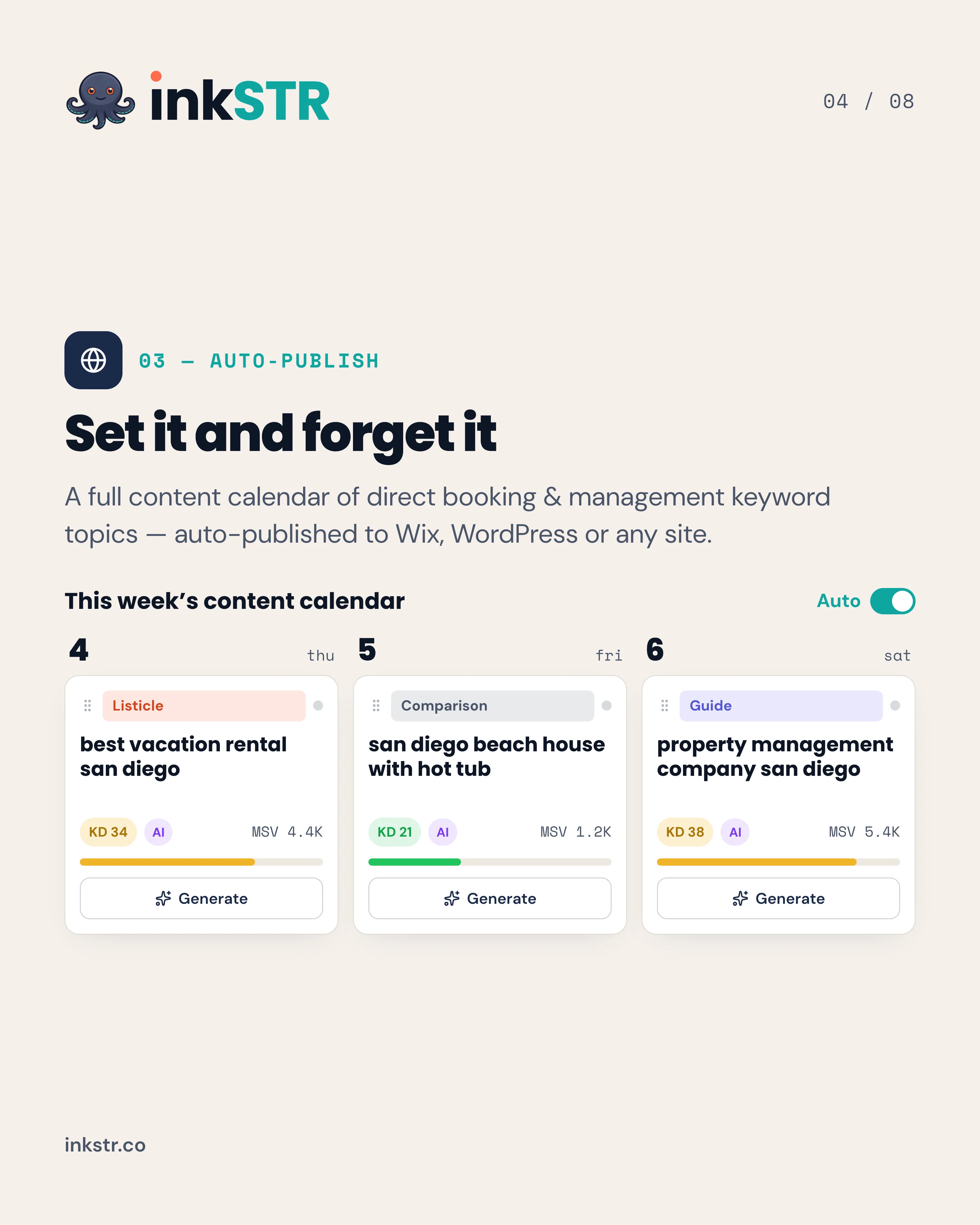
That is why inkSTR's Content Calendar matters: you drag articles onto dates and the scheduler publishes them, so compounding traffic grows without you sitting down to write.
What Does a Booking Cost From SEO vs Google Ads?
Treat that as a best-case range, since results vary by destination and season. Booking value matters too.
| Factor | SEO | Paid Ads |
|---|---|---|
| Time to first results | Months | Days |
| Cost behavior | Mostly upfront and monthly effort; traffic compounds | Pay per click; stops when you stop |
| Control over timing | Low | High |
| Lifespan of a single asset | A ranking article can last 2-5 years | Ends with the budget |
| Best fit | Evergreen direct bookings | Gap dates, launches, seasonal pushes |
| Ongoing labor | High if manual; low with inkSTR at $99/month | Campaign monitoring and tuning |
The manual SEO route is where the cost hides. An agency or freelancer can run well past a $99/month tool once you count multiple posts per month. We priced inkSTR at $99/month so the SEO side stops being the expensive channel.
When Do Paid Ads Beat SEO, and When Do They Lose?
Paid ads beat SEO when you need bookings inside weeks and your allowable cost per booking is higher than your ad cost. They lose when your margin per booking is thin, your landing page converts poorly, or you cannot sustain the budget.
Here is the break-even method we recommend, with no invented numbers. Start with the net revenue from a booking after cleaning and payment processing. Then subtract operating costs and any commission. That figure is your ceiling for what you can pay to acquire it. If a direct booking is worth $1,000 to $4,000 in revenue, your net after costs is lower, and your ad cost per booking must sit comfortably under it.
- Calculate net booking revenue after all per-stay costs.
- Set your maximum acceptable acquisition cost as a share of that net.
- Divide ad spend by direct bookings tracked to the ads to get your real cost per booking.
- Compare that against the 17-19% OTA fee on the same stay.
The trap is the landing page. Ads cannot rescue a page that fails to convert.
This is also where we steer operators toward inkSTR's Keyword Research. Before you pay for a single click, it shows which phrases guests actually search, so you avoid bidding on terms that cost a lot and convert rarely.
How Long Does Vacation Rental SEO Take to Work?
Vacation rental SEO typically takes months, not days, to produce steady booking traffic. We cannot promise a date, because timing depends on your market, domain history, and publishing consistency. Consistency is the variable you control.
The pain is the silent stretch. You publish and nothing moves, so most operators quit before the curve bends. Paying freelancers $300-$700 per post during that stretch makes quitting more likely.
Our own customer data shows what steady publishing can do. In one case, a Smoky Mountains cabin rental brand grew monthly Google Search clicks from 788 to 5,195 in 11 months. It did this on a continuous inkSTR content pipeline.
A second case moved faster from a near-zero base. Your results will differ, and neither is a guarantee.
inkSTR removes the quitting risk by publishing on a set schedule through Auto-Publishing to Wix or WordPress. The silent months pass whether you are watching or not.

Which Keywords Favor SEO and Which Favor Paid Ads?
Informational and long-tail searches favor SEO, while high-intent date-specific searches favor paid ads. A phrase like "things to do near a lake house in October" suits an article. A phrase like "pet friendly vacation home" can suit a paid ad pointed at a booking page.
The problem is that big property management companies and OTAs dominate broad terms such as "vacation rental [town]." Competing there with a young site wastes budget in both channels.
Where small operators can win
Long-tail terms tied to your specific property type and amenities carry less competition. Terms about nearby attractions do too. Local area guides and seasonal planning posts both fit. So do pet or family angles. We covered how to turn local knowledge into bookings in our guide to local area guides that sell.
Where ads earn their keep
Branded and high-intent phrases, plus shoulder-season windows, are where targeted ads pay back. Lodgify recommends campaigns in the weeks before and after peak periods because competition is lower and demand continues.
That keyword split is what inkSTR's research workflow handles for you. It maps the phrases guests use to articles, so informational terms become content and you reserve ad dollars for the moments they pay off. Our vacation rental blog topics post shows what that looks like in practice.
Ready to automate your content marketing?
inkSTR handles keyword research, content strategy, article writing, and publishing, all on autopilot.
Can You Run SEO and Paid Ads Together?
Yes, and the hybrid plan usually outperforms either channel alone. Use paid ads first for immediate bookings and keyword data, then shift budget toward SEO as articles begin to rank. The ads teach you which searches convert; the content captures those searches for free later.
Skipping the hybrid costs you in both directions. All-SEO leaves you with empty dates while you wait. All-ads leaves you with no asset when the budget ends.
- Months 1 to 2: Start a small Google Search campaign on a few high-intent phrases and set up tracking. Begin publishing articles at the same time.
- Months 3 to 6: Review which ad keywords produced actual bookings. Write articles around the winners and their long-tail variants.
- Months 6 onward: Cut ad spend on terms where organic rankings now appear. Keep ads for gap dates and shoulder seasons.
Watch for brand search cannibalization. If you pay for clicks on your own property name while you already rank first for it, you may be buying bookings you would have received free. Test by pausing branded ads briefly and watching direct bookings.
The article side of that plan is where inkSTR fits, since it generates, schedules, and publishes automatically. Our How inkSTR Works page walks through the workflow from keyword to published post.
How Do You Track Which Bookings Came From SEO vs Ads?
Attribution means tagging every booking with the channel that sent the guest, so you can compare cost per booking honestly. Without it, you are guessing which dollars produced which reservations.
Most operators skip this and then argue with themselves about whether ads work. They also mix in OTA bookings and returning guests. Brand searches that would have happened anyway get counted too.
A practical tracking setup
- Install Google Analytics and record booking confirmations as conversions.
- Tag every ad link with campaign parameters so paid traffic is separated from organic.
- Ask guests at checkout or in the confirmation email how they found you.
Run any ad test for a set period with a fixed budget cap, then judge it on booking quality, not clicks. For organic, connect Google Search Console to see which queries and pages earn impressions and clicks.
inkSTR connects to Google Search Console, so keyword tracking sits next to the content that produced it. Opportunity detection lives there as well. You see which articles earn traffic before you decide where to push budget. Our guide on ranking on Google covers the signals worth tracking.
Which Channel Fits One Property vs a Large Portfolio?
A single-property host usually benefits most from low-cost SEO plus small, targeted ads, while a 10+ unit manager can justify larger paid budgets and a content cluster per market. Portfolio size changes how many bookings each click or article can fill.
A single property can only host so many guests, so heavy ad spend hits a ceiling fast. But a one-property host still benefits from SEO, since a few well-aimed local articles can keep the calendar fuller across seasons.
| Portfolio | Lead with | Use as support | Main risk |
|---|---|---|---|
| 1 property | SEO with local and seasonal articles | Small ads for gap dates | Quitting before SEO matures |
| 2 to 9 units | SEO plus a steady calendar | Ads on high-intent and shoulder terms | Untracked ad spend |
| 10+ units | Per-market content clusters | Larger paid tests with attribution | Content workload across markets |
For managers, the bottleneck is content volume across markets and properties. inkSTR's multi-project support gives each property or brand its own pipeline, and inkSTR stays the content engine at every tier. Property managers can read more on our property management page, and operators focused on reducing OTA fees can see our direct bookings page.

Does Your Website Convert the Traffic You Pay For?
A booking page converts traffic when it loads fast on mobile, shows clear pricing and availability, and makes booking direct feel as safe as booking on an OTA. Traffic from either channel is wasted if the page leaks visitors.
The frustrating pattern we see is high page views and no reservations. You paid for the click or spent hours on the article, and the visitor left at the booking step.
Check page speed, photo quality, a visible price, a short booking path, and trust signals such as reviews. Rank Harvest also stresses mobile performance and intuitive navigation, and we agree. Our post on booking page conversion optimization goes deeper on the fixes.
Blog content helps conversion too, since each article can link readers directly to your booking page. inkSTR's internal link management routes readers to the pages you choose, so informational traffic has a path to a reservation. For deeper context, see why blog content fails to convert visitors into guests.
Frequently Asked Questions
Cost per booking depends on your conversion rate and destination. Season matters as well. Calculate your own by dividing ad spend by tracked direct bookings.
How long does it take for vacation rental SEO to show results?
Expect months rather than days, and treat consistency as the variable you control. Timing varies by market and site history. A scheduled pipeline through inkSTR's Content Calendar keeps publishing steady while the rankings build.
Is it worth doing SEO for a single vacation rental property?
Yes, if you can publish consistently at low cost. One direct booking is typically worth $1,000 to $4,000, so a few organic bookings can offset the effort. A full cluster strategy is optional at one property; a handful of local, seasonal articles is a sound start.
When should you stop paying for ads and rely on SEO?
Reduce ad spend on a keyword once your organic page ranks well for it and your tracking shows bookings holding steady. Keep ads for gap dates and launches. Shoulder seasons fit too. Pause branded ads briefly to test whether they were buying bookings you already had.
Can you run SEO and paid ads together?
Yes, and a phased hybrid is usually the strongest approach. Use ads for early bookings and keyword data, then write articles around the terms that convert. Our ranking in AI search guide shows how that content also earns AI citations.
What are the best SEO tools for vacation rental managers?
You need keyword research and content production. Scheduling and Search Console tracking are also required. inkSTR combines these for short-term rentals at $99/month. Free options like Ubersuggest can supplement keyword research.
What metrics measure direct booking marketing performance?
Track direct-booking share and website conversion rate, along with cost per acquisition. Organic clicks and booking revenue by channel belong on the list too. Google Analytics and Google Search Console cover most of these for free.
How do you list a vacation rental property?
Start with your direct-booking website and add OTA listings as a supplement. Write clear descriptions and upload strong photos. Then publish content that helps your site rank. Our guide on how to rank your vacation rental website on Google covers the next steps.
What Is the Verdict on Vacation Rental SEO vs Paid Ads for Bookings?
In the vacation rental seo vs paid ads for bookings comparison, SEO wins on long-term cost and ownership, and paid ads win on speed and control. Use paid ads to fill near-term gaps and gather keyword data, then move budget toward content that compounds. Track every booking by channel so the decision rests on your own numbers.
Anything that beats the 17-19% OTA fee is worth testing, but only a tracked test tells you which side of that line you are on. In 2026, with AI search sending more discovery through cited content, owned articles carry extra weight, and ads cannot replace them.
If you want the SEO half of this plan without the writing hours, Start Free Trial with inkSTR. Its Content Calendar and Auto-Publishing schedule and publish keyword-targeted articles to Wix or WordPress on autopilot, so your direct bookings keep growing while you run your properties. Connect Google Search Console and see which keywords your site can win next.
Content powered by inkSTR.co
Enjoyed this article? Share it:
Get more of inkSTR in Google Search
Add inkstr.co as a preferred source and our articles show up more in Top Stories, AI Overviews, and AI Mode, with a “Preferred” badge.
Get more guides like this
New SEO and AI-search guides, straight to your inbox. No spam, unsubscribe anytime.