What Is SE Ranking? How Vacation Rental Sites Climb Google
SE ranking, short for search engine ranking, is the position a web page holds in Google's results for a specific search query. For a vacation rental website, it decides whether a guest searching for a stay finds your direct booking page or an OTA listing first, and that gap shows up directly in booking revenue.
Key Takeaways
- SE ranking is the position your page holds in search results for one query. It is measured per keyword and per page, not as a single score for your whole site.
- Third-party authority scores such as Domain Authority run on a 1 to 100 scale (Duda Blog, February 13, 2026), but they estimate your strength and do not set where you rank.
- You can check your rankings for free with Google Search Console. Paid rank trackers vary by plan and usually scale with projects, tracked keywords, and seats.
- A single direct vacation rental booking is typically worth $1,000 to $4,000 in revenue, while Airbnb host and guest fees combined take 17 to 19% of every booking.
- A ranking blog article can drive organic search traffic for 2 to 5 years, which is why consistent publishing beats occasional bursts.
- inkSTR automates keyword research, article drafting, scheduling, and publishing, so your SE ranking improves through steady content you never have to write by hand.
SE ranking decides whether your direct booking site gets seen at all in 2026. A polished photo gallery and a clean booking page do nothing if your site sits on page five while OTA listings hold the first results. Demand for short-term stays keeps growing, and so does the number of listings competing for the same guests.
At inkSTR, we build AI content tools for short-term rental operators, and the question we hear most is why a good-looking website earns views from almost nobody. The answer usually traces back to rankings, and rankings usually trace back to content volume and intent match, plus consistency.
This guide defines the term and explains how Google decides positions. It also shows free and paid ways to check them and walks through a repeatable process for climbing. You will also see how the work changes for beach, mountain, urban, and lake rentals.
What Is SE Ranking and Why Does It Decide Who Gets Direct Bookings?
SE ranking is the numbered position a page holds on a search engine results page for one query, with position 1 as the top organic result. A vacation rental site can sit in position 3 for one phrase and position 40 for another, so ranking is always measured per keyword and per page.
You feel this problem when a guest types a phrase like cabin rental near a national park into Google and your site never appears. An OTA listing takes the click, the guest books there, and you pay the 17 to 19% that Airbnb host and guest fees combined take from the booking. Since one direct booking is typically worth $1,000 to $4,000 in revenue, every lost click has a price.
OTAs also hold a structural advantage in these results. In a 2019 analysis of vacation rental search markets, BuildUp Bookings found that VRBO took the first organic slot 24% of the time in the markets it studied. Each platform runs its own internal ranking too: Airbnb explains the factors behind its search results and Vrbo publishes a guide to influencing search position. Both only help you inside their own walls. Your Google ranking is the one you own.
We built inkSTR's Keyword Research feature for exactly this gap. It finds the phrases your target guests type, so you stop guessing which pages to build first. Connect that to your direct booking strategy and each ranking page becomes a path to your own booking page.
How Does Google Decide Which Vacation Rental Pages Rank Higher?
Google ranks vacation rental pages by how closely each page matches the searcher's intent and how trustworthy the surrounding site looks. Page speed and mobile usability act as gatekeepers. Google does not publish an exact formula, so every claim about ranking factors is an informed reading of the evidence.
Relevance and intent
Intent is the reason behind a search. Someone typing things to do near a lake town in October wants a planning guide, not a booking form. A page that answers the planning question earns the click and the trust, and then sends the reader to your booking page.
Authority
Third-party tools summarize site strength in scores. According to the Duda Blog, Domain Authority runs from 1 to 100, and a study from Ahrefs covering 218,713 domains found that its Domain Rating correlates well with keyword rankings. These numbers are estimates built by SEO software companies, and Google publishes no equivalent. Most of them lean heavily on links, which is why we wrote a guide on what a backlink is in SEO.
Technical and local signals
Slow pages and broken mobile layouts hold rankings back. So does thin location detail. For some very local searches, a well-kept Google Business Profile outperforms any blog post, and we would rather say so than pretend content does everything. Our breakdown of the local signals Google cares about in 2026 covers where to start.
The painful part is production. One quality post takes 3 to 5 hours of research and writing by hand, or $300 to $700 from a freelance travel writer, and rankings need dozens of posts. inkSTR's AI Content Writer drafts 2,500 to 3,500 word articles from your keyword plan, then scores them before publishing so weak drafts get caught early.

What Is Keyword Position, and What Counts as a Good One?
Keyword position is the rank a specific page holds in search results for one exact phrase, such as position 4 for lake house rental weekend. In Google Search Console it appears as average position, which blends every impression the page earned across devices and locations, so treat it as a trend line rather than a precise rank.
| Position range | What it usually signals | Practical move |
|---|---|---|
| Positions 1 to 3 | The page earns most of the clicks for that phrase | Protect it with yearly refreshes and fresh internal links |
| Positions 4 to 10 | Visible on page one but competing | Sharpen the opening answer and add depth the top results lack |
| Positions 11 to 20 | Google sees relevance but wants more authority | Add cluster articles that link back to this page |
| Beyond position 20 | Searchers rarely reach this far | Rewrite for intent or target an easier long-tail phrase |
Page boundaries shift slightly by device and search feature, so read the ranges as rough guides. The most useful row is the third one. Pages sitting on page two are your cheapest wins, because Google already considers them relevant.
Checking all this by hand is miserable. You open a private window, search five phrases, screenshot the results, and discover the next day that they moved. It takes an afternoon and tells you nothing about trend. inkSTR connects to Google Search Console to track keyword rankings and flag exactly these page-two opportunities, and our How InkSTR Works page shows where that data feeds the content plan.
How Do You Check Your SE Ranking, and What Does It Cost?
You can check SE ranking for free with Google Search Console, which reports average position per query and per page for your own site, plus private browser searches for quick spot checks. Dedicated rank-tracking subscriptions add daily monitoring across many keywords. Prices vary by plan and billing term, as well as limits on projects and tracked keywords.
| Method | Typical cost | Best for | Main limit |
|---|---|---|---|
| Private browser search | Free | Spot-checking one phrase | Results shift with location and search history |
| Dedicated rank-tracking subscription | Varies by plan; usually scaled by projects, keywords, and seats | Agencies and teams watching many sites and competitors | Reports data but does not write or publish content |
| inkSTR | $99/month | Operators who want keyword research, Search Console tracking, drafting, scheduling, and publishing in one workflow | Focused on short-term rental and hospitality content |
Is a full SEO platform worth it for a small rental business? Our opinion: a one-property host rarely needs a multi-seat suite with agency reporting. Search Console answers most where-do-I-rank questions at no cost. The paid question is who creates the content that moves those numbers.
That is where operators stall. Many end up with several subscriptions that report problems and nobody with time to fix them. We priced inkSTR at $99/month on our Pricing page because the tracking, keyword plan, drafting, and publishing live together, and you can start with a free trial to see your own Search Console data before paying anything.
Why Is Your Vacation Rental Site Stuck on Page Two or Lower?
A vacation rental site stuck on page two or lower usually has a publishing-consistency problem or an intent-mismatch problem. Often it has both. Google rewards sites that keep answering related questions over time. Most rental sites publish a handful of posts and stop, then wonder why nothing moved.
- Publishing in bursts. Six posts in one weekend, then silence for four months, tells Google very little about your site's depth.
- Chasing head terms first. Going straight after vacation rental plus a big destination name pits you against OTAs and large management firms. Start with specific long-tail phrases and work upward.
- Skipping the booking link. A ranking article with no path to your booking page earns readers and zero reservations.
- Writing for everyone. Generic travel copy matches no particular search, which is why many vacation rental websites never rank on Google.
- Never refreshing. A seasonal guide that still mentions last year's events loses ground to fresher pages.
Picture the usual version of this. You write three posts in January, a guest message interrupts you, the content calendar falls apart in week two, and by spring the blog is a ghost town. SEO is slow, and expecting results in days sets you up to quit before it works.
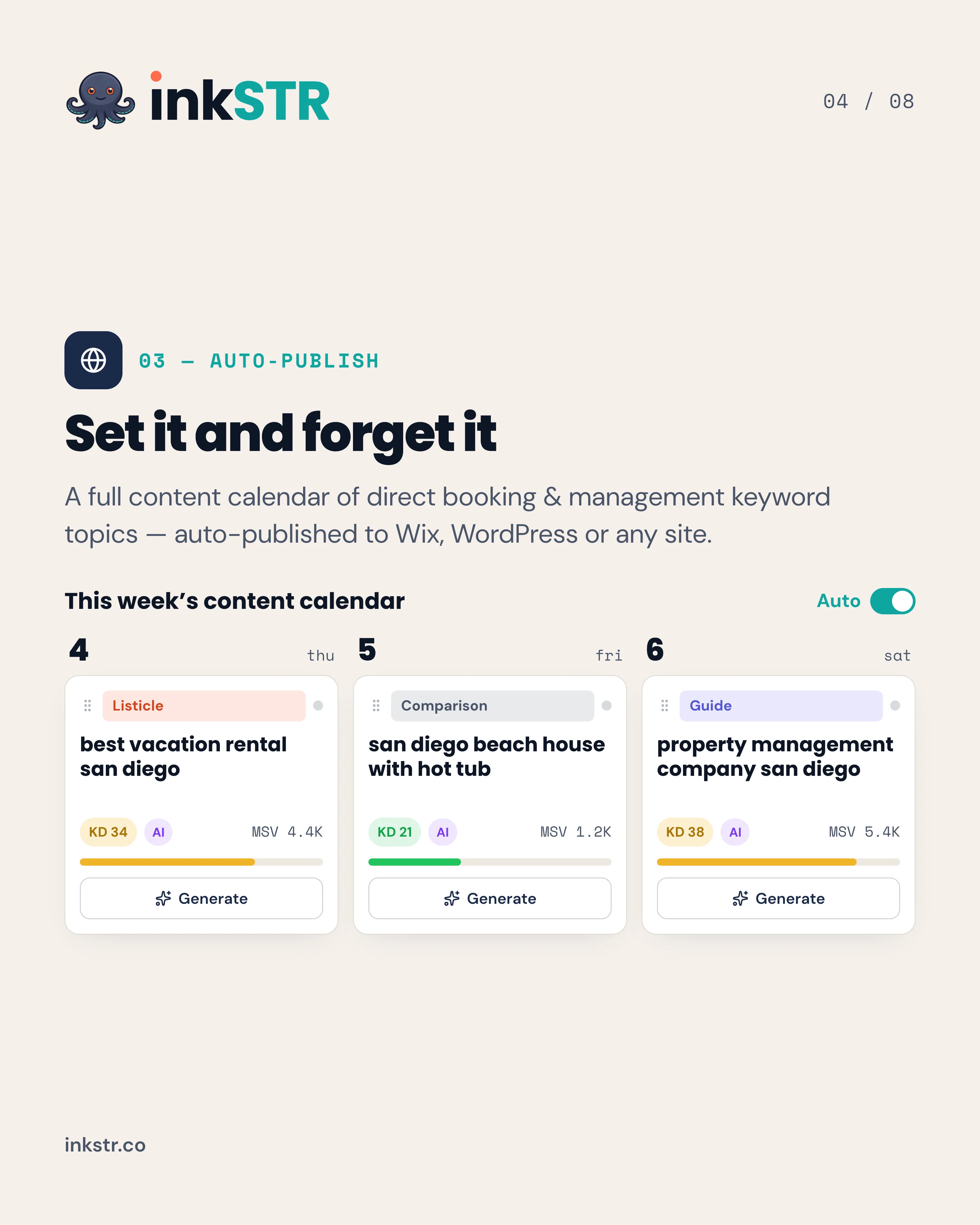
We designed the Content Calendar around that failure. You drag an article to Tuesday, and the scheduler handles the rest. Pair it with Auto-Publishing, which sends finished posts straight to Wix or WordPress, and consistency stops depending on your motivation.
How Do You Improve Your SE Ranking Step by Step?
Improving SE ranking for a vacation rental site means measuring where you stand, choosing keywords by guest intent, publishing answer-first articles on a schedule, and linking every article to your booking page. The process is repeatable, and most of it can be automated.
- Record a baseline. Connect Google Search Console and Google Analytics and note your current clicks, impressions, and top queries. inkSTR's Search Console integration pulls this in so you start with real numbers.
- Build a keyword list by intent. Group phrases into planning searches, comparison searches, and ready-to-book searches. inkSTR's keyword research and brand audit surface competitor keyword gaps so you see what rivals rank for and you do not.
- Organize pillar and cluster topics. One broad pillar page per market, with narrower cluster articles linking up to it. The content strategy wizard in inkSTR maps this architecture for you.
- Write answer-first articles with real property detail. Open each section with a direct answer, then add specifics only you know. inkSTR can ground drafts in reviews and photos pulled from Hospitable or OwnerRez.
- Schedule and publish on a cadence. Open the content calendar, place articles on weekly slots, and let the scheduler publish to WordPress or Wix without manual formatting.
- Link each article to your booking page. Use internal link management to route readers to a primary inquiry or booking page, not an OTA.
- Review monthly and refresh. Find pages sitting on page two, strengthen them, and repeat.
Doing all seven by hand is why operators stall around step three. Our Start page walks you into the workflow, and our guide to ranking your vacation rental website on Google goes deeper on each step.

Ready to automate your content marketing?
inkSTR handles keyword research, content strategy, article writing, and publishing, all on autopilot.
How Does SE Ranking Work Differently for Beach, Mountain, Urban, and Lake Rentals?
SE ranking works differently by market type because each kind of destination has its own search seasons and competitors. Its guests also ask their own questions. A cabin owner and a city apartment host both want page one, but the phrases and timing that get them there rarely match.
Beach towns
Searches cluster around summer weeks and are dominated by large OTA and management listings. Target specific beach and parking questions rather than the town name alone. Family-trip questions deserve their own pages too. Caveat: publish weeks ahead, because a post that goes live in July misses the planning window.
Mountain retreats
Many mountain markets have two demand seasons, such as winter sport and summer hiking, depending on the region. Write seasonal guides and publish them well before each peak. Large regional management companies crowd the broad terms, so long-tail searches about cabins and trails are the realistic opening.
Urban apartments
City searches revolve around neighborhoods and transit. Short business or event stays matter too. Neighborhood-level pages work because they match specific searches. Caveat: local short-term rental rules change, so link readers to the city's own official source rather than summarizing rules from memory.
Lake houses
Shoulder season is the opportunity. A lake house in the off-season needs content for the weekend-getaway search, not the July family reunion search, which larger listings already own. Autumn and spring pages often face the least competition.
Managing several markets multiplies the workload, since each one needs its own cluster. For property management companies, inkSTR's multi-project support gives every market or brand an independent pipeline, so a mountain portfolio and a lake portfolio never share a content queue.
How Do AI Search Engines Change the Way Rankings Work?
AI search visibility is the likelihood that Google AI Overviews or ChatGPT will cite your page when answering a traveler's or operator's question. Perplexity counts as well. It sits alongside classic SE ranking: a page can hold a strong Google position and still never appear in an AI-generated answer if its content is hard to extract.
The problem shows up quietly. Your rank tracker says position 4, yet a guest asks an AI assistant about your area and your site is absent from the answer. AI systems favor pages that open each section with a direct answer and name specific entities. They also favor pages that stand alone when quoted. Pages built around long, wandering introductions get skipped.
This is also why a GEO audit has become a useful habit. It checks whether AI assistants can find and understand your pages, not just rank them. It also checks whether they can cite them. Read our practical guide to ranking in AI search for the full checklist.
We build inkSTR articles for this from the first sentence. Each draft carries an answer-first opening and self-contained sections, written for citation by AI Overviews and ChatGPT. As of October 2026, we have secured more than 1,500 verified AI-search citations for customer content across the platform.
What Results Can Better Rankings Produce for a Rental Business?
Better rankings produce more organic clicks, more impressions for related searches, and eventually direct bookings that skip OTA fees. The pattern shows in the three inkSTR customer results below, each measured in Google Search Console, Google Analytics, or Wix Analytics rather than estimated by third-party tools.
| Customer type | Timeframe | Measured result |
|---|---|---|
| Smoky Mountains cabin rental brand | 11 months | Monthly Google Search clicks rose from 788 to 5,195; impressions rose from 130,000 to 450,000 |
| Five-market luxury mountain rental brand | 4 months | Monthly Google search visits rose from 26 to 1,924 after 114 published articles |
| Charlotte and Lake Norman management company | First month | Four property-owner leads arrived from AI search |
The cabin brand also attributed $309,775 in direct booking revenue to its first fourteen months on inkSTR. The five-market brand had closed more than $2,500 in commission-free direct bookings within its first four months. Neither figure is a promise, and nobody can guarantee them. Rankings depend on your market and your competition, along with your consistency.
Compare the economics. One freelance post costs $300 to $700, so a full month of inkSTR at $99 costs less than a single outsourced article. For a deeper look at why generic copy underperforms, read what STR operators need to know about ranking on Google.
Frequently Asked Questions
SE ranking is the position a web page holds in a search engine's results for a particular search phrase. Position 1 is the top organic result. For vacation rental operators, higher positions mean more guests reach your own booking page instead of an OTA listing.
What is the difference between a content refresh and a rewrite?
A content refresh updates an existing article's facts and headings while keeping its URL and core structure. Links and examples get updated too. A rewrite replaces most of the text because the article no longer matches what searchers want. Refresh pages that rank but are slipping or dated; rewrite pages that never gained traction or whose search intent changed.
What is a GEO audit?
A GEO audit, short for generative engine optimization audit, reviews whether AI assistants such as ChatGPT and Google AI Overviews can find, understand, and cite your pages. It checks for direct-answer openings and self-contained sections. It also looks at named entities and whether pages are crawlable. inkSTR writes articles with these elements built in.
Rank-tracking and SEO platform pricing varies widely by plan, billing term, and limits on projects, tracked keywords, and users. Plan names and prices also change, so confirm current figures on each vendor's own site. See our pricing page for current plans.
Google Search Console shows the queries your site appears for, along with clicks, impressions, and average position. A private browser window works for quick spot checks, though results vary with location and history. inkSTR connects to Search Console so the same data feeds your keyword plan.
Expect months, not days. New blogs usually need consistent publishing before Google trusts the site, and results vary by market and competition. Steady cadence is the lever you control, which is why we built the Content Calendar to keep publishing running on schedule.
What tools automate an AI content pipeline from keyword research to WordPress publishing and reporting?
inkSTR automates the full pipeline for short-term rental operators: keyword research and competitor analysis, AI article drafting, a drag-and-drop content calendar, one-click publishing to WordPress and Wix, and Google Search Console tracking for reporting. Learn the workflow on the How InkSTR Works page.
Is a dedicated SEO platform worth it for a small rental business?
For a single property, usually not as a first purchase. Google Search Console covers basic tracking at no cost, and the harder problem is producing enough quality content. A tool that handles keyword research and drafting together delivers more for a small operator than a dashboard that only reports positions. Publishing is part of the package.
What Should You Do Next to Improve Your SE Ranking?
SE ranking is the position your page holds in Google for each search. For a vacation rental site, that position decides whether a guest books direct or pays an OTA 17 to 19% on the way through. Start with free Search Console data, target page-two phrases first, and publish on a steady schedule that links readers to your own booking page.
You do not need to write every article yourself to get there. inkSTR's Content Calendar and Auto-Publishing handle the scheduling and posting, and its keyword research builds a plan around your market and your competitors. Start your free trial of inkSTR and see your first keyword opportunities from your own Search Console data. As AI search keeps reshaping how guests find rentals in 2026 and beyond, owned traffic is the asset worth building.
Content powered by inkSTR.co
Enjoyed this article? Share it:
Get more of inkSTR in Google Search
Add inkstr.co as a preferred source and our articles show up more in Top Stories, AI Overviews, and AI Mode, with a “Preferred” badge.
Get more guides like this
New SEO and AI-search guides, straight to your inbox. No spam, unsubscribe anytime.