How to Reduce Airbnb Dependence and Grow Direct Bookings

Reducing Airbnb dependence means deliberately shifting a share of your bookings away from Airbnb's marketplace and toward channels you own, primarily your direct booking website, email list, and other OTAs like VRBO or Expedia. It is not about abandoning Airbnb. It is about making sure one platform doesn't control your entire revenue stream.
Key Takeaways
- Airbnb and guest fees combined typically run 17-19% of every booking, meaning a $2,000 stay can lose $340 or more before you see a dollar.
- Industry guidance recommends a phased channel-mix shift, often moving from roughly 70% Airbnb dependence toward a 50/50 split over 12 months, then continuing toward a majority-direct mix over 18 months.
- Airbnb appears on the first page of Google for 79% of top vacation rental markets, but lands in the top 3 results in only 5% of those markets, according to 2019 research from BuildUp Bookings, which means there's real room for your own site to rank.
- A single direct booking is typically worth $1,000 to $4,000 in revenue, and every one you convert away from Airbnb keeps that full amount instead of losing a chunk to platform fees.
- Writing consistent, SEO-targeted blog content is one of the most repeatable ways to reduce Airbnb dependence, but manual blogging takes 3-5 hours per post and freelance writers charge $300-$700 per article.
- inkSTR automates the research, drafting, and publishing of that content on a set schedule, so you can build the direct booking traffic this article describes without adding hours to your week.
If you manage a single cabin or a portfolio of 40 units, the math on Airbnb dependence is the same: the more revenue that flows through one platform, the more exposure you have to that platform's fee structure, policy changes, and search algorithm. In 2026, with the vacation rental management software market growing at an estimated 11.1% CAGR as more operators professionalize their marketing, the operators pulling ahead are the ones treating their own website as a real revenue channel, not an afterthought.
At inkSTR, we work with hosts and property management companies who are tired of watching a third party take a cut of every reservation while doing nothing to build their brand. This article walks through exactly why hosts are rethinking their reliance on Airbnb, what the actual math looks like, and the specific steps that move bookings toward channels you control. We'll also cover the parts most guides skip: how to structure a direct booking offer, how to talk to your team about the transition, and how to steer OTA guests toward your own site without breaking platform rules.
By the end, you'll have a realistic, phased plan for reducing Airbnb dependence rather than a vague directive to "diversify."
Why Are People No Longer Relying Solely on Airbnb?
Hosts are moving away from full reliance on Airbnb because combined host and guest fees now eat into 17-19% of every booking, and that percentage compounds across hundreds of reservations a year. For a property management company running 20 units, that fee structure can represent tens of thousands of dollars annually that never reaches the owner or the operator.
Without a direct channel, you're stuck absorbing whatever fee changes Airbnb rolls out, with no leverage and no alternative revenue path. Search visibility inside Airbnb also depends entirely on an algorithm you don't control, meaning a strong booking month can be followed by a quiet one for reasons you can't fully diagnose. Meanwhile, your competitors who built a direct booking presence keep collecting repeat guests and referral traffic that Airbnb never sees.
This is exactly the gap inkSTR was built to close. Our AI Content Writer generates the SEO-optimized blog content that drives traffic to your own booking page instead of routing every guest through a platform taking a cut. Instead of hoping Airbnb's algorithm favors you this month, you build search visibility that belongs to you permanently.
What Is the 80/20 Rule for Airbnb Bookings?
The 80/20 rule, as applied to vacation rental channel strategy, refers to the idea that roughly 80% of your revenue often comes from 20% of your booking sources or repeat guests, and it's used as a planning framework for where to focus retention and marketing effort. Applied to Airbnb dependence specifically, many operators use it to identify which channel actually drives their most profitable, repeat business, then double down there.
If you pull your own booking data and 80% of your annual revenue traces back to first-time Airbnb guests who never return, you have a retention problem, not just a distribution problem. Most hosts never run this analysis because it requires pulling guest history across multiple platforms, something a busy independent host or a property manager juggling 15 properties rarely has time for.
Once you identify your highest-value guest segment, whether that's repeat vacationers, corporate travelers, or local weekend guests, you can build content specifically for them. inkSTR's Keyword Research tool finds the exact search terms that segment uses, so your content targets the guests most likely to book directly and return.
What Is the 75-55 Rule for Airbnb?
The 75-55 rule, in the context of channel diversification, describes a target shift where a host moves from roughly 75% dependence on a single platform down to around 55% over a defined period, typically the first phase of a multi-phase reduction plan. It functions as an early milestone, not the finish line, giving operators a realistic first target instead of an all-or-nothing switch.
Trying to jump from 75% Airbnb dependence to 30% overnight almost always fails. You don't have the direct traffic, email list, or reviews built up yet, and abruptly pulling inventory off Airbnb tanks your existing search ranking on the platform you're trying to reduce reliance on. Hosts who attempt this cold often see total bookings drop before their direct channel has matured enough to fill the gap.
A phased target like 75-55 gives you room to build. Over roughly six months, you keep enough Airbnb inventory to maintain your ranking there while simultaneously launching a direct booking website, collecting guest emails, and publishing the SEO content that will eventually replace that dependence. inkSTR's Content Calendar schedules that publishing automatically, so your direct channel keeps growing in the background while you run day-to-day operations.

What Is the 90 Day Rule for Airbnb?
The 90 day rule generally refers to local short-term rental regulations in certain cities that cap the number of nights a non-primary-residence property can be rented per year, often set around 90 days annually, though the exact limit varies significantly by jurisdiction. It is a zoning and licensing matter, not an Airbnb platform policy, so the specific number and rules depend entirely on your city or county.
Operators who don't check their local regulations sometimes assume Airbnb enforces this cap, when in reality it's a municipal ordinance that Airbnb simply reflects in your listing settings. If you're unsure whether your market has a night cap, permit requirement, or primary-residence rule, verify the current figure directly with your city's planning or short-term rental licensing office rather than relying on secondhand summaries, since these rules change periodically.
Here's where regulatory caps actually strengthen the case for reducing Airbnb dependence: if your city limits how many nights you can list on any platform, a direct booking channel doesn't add extra regulatory exposure, it just changes where those permitted nights get booked. inkSTR helps you build the content that captures those bookings directly, whether you're operating in a beach town with strict short-term rental caps or a mountain market with fewer restrictions.
How Do You Actually Build a Direct Booking Channel, Month by Month?
Building a direct booking channel from zero requires a sequenced plan covering your website, email list, and content, not a single tactic launched all at once. Most guides tell you to "build a website and collect emails" without explaining the order of operations, which is where most independent hosts get stuck.
Months 1-2: Infrastructure
- Launch a direct booking website with a real-time availability calendar, secure payments, and instant confirmation, ideally as fast and easy to use as booking through an OTA.
- Set up a Google Business Profile for each property or your management brand to build local search presence.
- Export guest emails from your property management system covering the last two years to seed your email list.
Months 3-4: Content and Offers
- Publish 2-4 local SEO articles per month covering restaurants, activities, and area guides that answer what your guests are actually searching for.
- Launch a direct booking incentive, commonly a 10% discount for returning guests who book directly instead of through an OTA.
- Add Google and Meta tracking pixels to your site so you can retarget visitors who didn't book on their first visit.
Months 5-6: Retention
- Build a simple loyalty structure, such as 5% off a second stay and 10% off a third, to reward repeat direct bookings.
- Review your channel mix weekly and track occupancy, average nightly rate, top guest complaints, and review score.
Writing four local guides a month manually costs the equivalent of two full workdays, or $300-$700 per article if you outsource it to a freelancer. inkSTR's full content workflow takes you from keyword to published post automatically, at a fraction of that cost, which is exactly why this phased plan is actually achievable for a host without a marketing team.

How Do You Structure an Actual Direct Booking Discount Offer?
A direct booking discount offer works best when it's specific, time-bound, and delivered at the right moment in the guest journey, not just a generic banner on your homepage. Most articles on this topic tell you to "offer a discount" without explaining the mechanics that make it convert.
The most common structure is a 10% discount code emailed to guests within 48 hours of checkout, when their experience is freshest and they're most likely to plan a return trip. Sending it too early, during their stay, feels transactional. Sending it months later gets buried in an inbox they've stopped checking.
For loyalty, a two-tier structure works better than a flat discount: 5% off a second direct stay, 10% off a third. This rewards escalating loyalty rather than treating every returning guest the same, and it gives you a natural reason to keep emailing without looking repetitive.
None of this works if guests never see your direct booking page in the first place. That's the traffic problem, and it's the one inkSTR's Auto-Publishing feature solves by pushing your content live to Wix or WordPress automatically the moment it's ready, so your offers reach guests who found you organically, not just past bookers.
How Do You Handle the Psychological Resistance to Reducing OTA Reliance?
The resistance to reducing OTA reliance is real and rarely discussed: hosts fear that pulling inventory off Airbnb, even partially, will tank their existing search ranking on that platform and cause an immediate revenue dip. This fear is often justified in the short term, which is why the transition has to be gradual, not a switch you flip overnight.
If you manage properties for owners, this resistance compounds. An owner who sees steady Airbnb income for three years will resist any strategy that looks like it reduces bookings on a platform that's "working," even if the long-term math favors diversification. You need a way to show progress without asking them to take it on faith.
The fix is transparent reporting, not persuasion. Track your channel mix weekly, show the percentage shift month over month, and frame Airbnb as a top-of-funnel lead source rather than the whole business. When owners or team members see direct bookings climbing steadily rather than replacing Airbnb bookings overnight, resistance fades because the data does the convincing.
Consistent content publishing is part of that data story. inkSTR's Content Calendar keeps your local guides and blog posts going out on schedule even during the months you're focused on operations, so the direct traffic numbers you're reporting to owners or partners keep climbing steadily instead of stalling whenever you get busy.
Ready to automate your content marketing?
inkSTR handles keyword research, content strategy, article writing, and publishing, all on autopilot.
How Should You Redesign Your OTA Listing to Steer Guests Toward Direct Booking, Without Breaking the Rules?
Redesigning an OTA listing to encourage future direct bookings means focusing on post-stay touchpoints rather than in-listing solicitation, since platforms like Airbnb and VRBO restrict directing guests off-platform during an active booking. The safest and most effective window is after checkout, not before or during the stay.
Inside your welcome materials, digital or printed, you can include your property's name and a note inviting guests to check your website for future stays, since this isn't a booking solicitation, it's general information. A branded welcome guide with a link to local recommendations naturally introduces guests to your direct site without violating any platform terms.
Your OTA listing photos, description, and branding should also match your direct site exactly. Guests who book through Airbnb and later search your property name should recognize it immediately and land on a site that feels like the same brand, not a disconnected experience.
The compliance line matters here: never mention pricing, discounts, or direct booking incentives inside your active Airbnb or VRBO messaging thread. Save that outreach for your post-stay email, sent after the reservation is fully complete. inkSTR's blog content library gives you a steady stream of local guide articles, ideal material to reference in that post-stay welcome sequence without any platform risk.
What Should You Track to Know If Your Airbnb Dependence Is Actually Decreasing?
Reducing Airbnb dependence is measurable only if you track specific numbers weekly, not just a general sense that "direct bookings feel busier." The four metrics that matter most are occupancy rate, average nightly rate (ADR), top guest complaints, and review score, tracked by channel so you can see the mix shift over time.
The table below shows a realistic phased target based on common industry guidance for channel-mix transitions.
| Phase | Timeframe | Airbnb Share Target | Direct + Other Channels Target |
|---|---|---|---|
| Phase 1 | Months 1-6 | ~60% | ~40% |
| Phase 2 | Months 7-12 | ~50% | ~50% |
| Phase 3 | Months 13-18+ | ~30% or lower | ~70% or higher |
These targets assume you started around 70% Airbnb dependence and are actively working every phase, not passively waiting for organic shift. Property management companies overseeing multiple units should track this per property, since a beach condo and a mountain cabin will shift at different rates depending on local search competition.
Tracking channel mix by hand across a growing portfolio becomes its own job. inkSTR's multi-project support gives each property its own content pipeline, so a manager running 15 units can watch each one's direct traffic climb independently instead of guessing at a blended average.
What Mistakes Slow Down Airbnb Dependence Reduction?
The most common mistake is pulling too much inventory off Airbnb before your direct channel has enough traffic to fill the gap, which causes a revenue dip that scares operators into abandoning the strategy entirely. This is a sequencing error, not a strategy error.
A second mistake: publishing content sporadically. A burst of five blog posts in January followed by silence until June signals inconsistency to search engines, and rankings that started climbing quietly fall back down. Search engines reward publishing cadence almost as much as content quality.
A third mistake is treating every OTA the same. Diversifying only into VRBO or Expedia without building an owned channel just trades one platform's fees for another's. The goal is direct booking growth, with other OTAs as secondary lead sources, not a replacement dependence on a different marketplace.
Consistency is the piece most independent hosts underestimate, mainly because writing takes real time. A quality blog post takes 3-5 hours of research and writing manually, and that math doesn't work when you're also cleaning turnovers and answering guest messages. This is precisely why inkSTR runs on a fixed schedule starting at $99/month, generating and publishing articles automatically so your cadence never breaks just because your week got busy.
Is Content Marketing Actually Worth the Investment for Reducing Airbnb Dependence?
Content marketing is worth the investment for reducing Airbnb dependence because a single ranking blog article can drive organic search traffic for 2 to 5 years, while a single direct booking it generates is typically worth $1,000 to $4,000 in revenue with none of the 17-19% fee taken off the top. Compare that to paid ads, which stop producing traffic the moment you stop paying.
Skeptics point out that a freelance writer costs $300-$700 per post and takes days to turn around a draft. That's a fair criticism of manual content production, but it's an argument against doing it manually, not against content marketing itself. If you also check our guide on ranking on Google for STR-specific factors, you'll see why generic SEO advice often underperforms for vacation rentals specifically.
The math changes entirely once production is automated. Starting at $99/month, inkSTR costs less than a third of a single freelance blog post, and it generates, schedules, and publishes articles automatically rather than requiring you to manage a writer's turnaround time. Over a year, that's the equivalent of dozens of articles compounding into search traffic, for less than the cost of two manually written posts.
Frequently Asked Questions
How long does it take to reduce Airbnb dependence noticeably?
Most hosts following a phased plan see a measurable shift within 6 months, moving from roughly 70% Airbnb dependence toward a more balanced 50/50 or 60/40 mix, with the biggest gains typically arriving in months 7 through 18 as SEO content and repeat bookings compound.
Does reducing Airbnb dependence mean leaving Airbnb entirely?
No. Reducing dependence means treating Airbnb as one lead source among several, not eliminating it. Most successful hosts keep a meaningful share of inventory on Airbnb even after their direct channel matures, because it still generates first-time guest discovery.
Can I mention my direct booking website inside my Airbnb listing?
Airbnb and VRBO restrict directing guests off-platform during an active booking or in-app messaging. The safer approach is post-stay outreach through email after checkout, where you're free to reference your own site and any direct booking incentives.
What's the fastest way to start building an email list from past Airbnb guests?
Export guest contact information from your property management system covering the last two years, where local rules allow it, and use that as your seed list. From there, every new confirmed booking, regardless of channel, becomes a new email list entry.
Do I need existing SEO knowledge to start publishing content that reduces Airbnb dependence?
No. Tools like inkSTR's Keyword Research feature identify the exact terms your target guests search for, removing the guesswork that normally requires prior SEO training to figure out on your own.
How many blog articles do I need before I see search traffic to my direct booking site?
There's no fixed number, but publishing 2-4 local SEO articles per month consistently for several months is the pattern most operators see working, since search engines favor steady publishing cadence over sporadic bursts of content.
Can a property management company use this strategy across multiple properties at once?
Yes, and it actually works better at scale since content and email retention compound across a larger guest base. inkSTR's multi-project support runs an independent content pipeline for each property, so a portfolio manager isn't managing 15 separate manual workflows.
Reducing Airbnb Dependence Is a Phased Process, Not a Switch
Reducing Airbnb dependence works best as an 18-month, phased shift built on a direct booking website, a growing email list, and consistent local SEO content, not an overnight platform exit. The operators who pull this off track their channel mix weekly, structure real discount offers for returning guests, and keep publishing even during their busiest operational months.
The math favors this shift clearly: a direct booking keeps its full $1,000 to $4,000 value instead of losing 17-19% to combined host and guest fees, and a single ranking article can keep generating that traffic for years. In 2026, with vacation rental management software adoption accelerating industry-wide, waiting on this transition just means falling further behind operators who already started.
inkSTR handles the research, drafting, and publishing side of that plan automatically, so the content keeps going out whether or not you have a free afternoon to write it yourself.
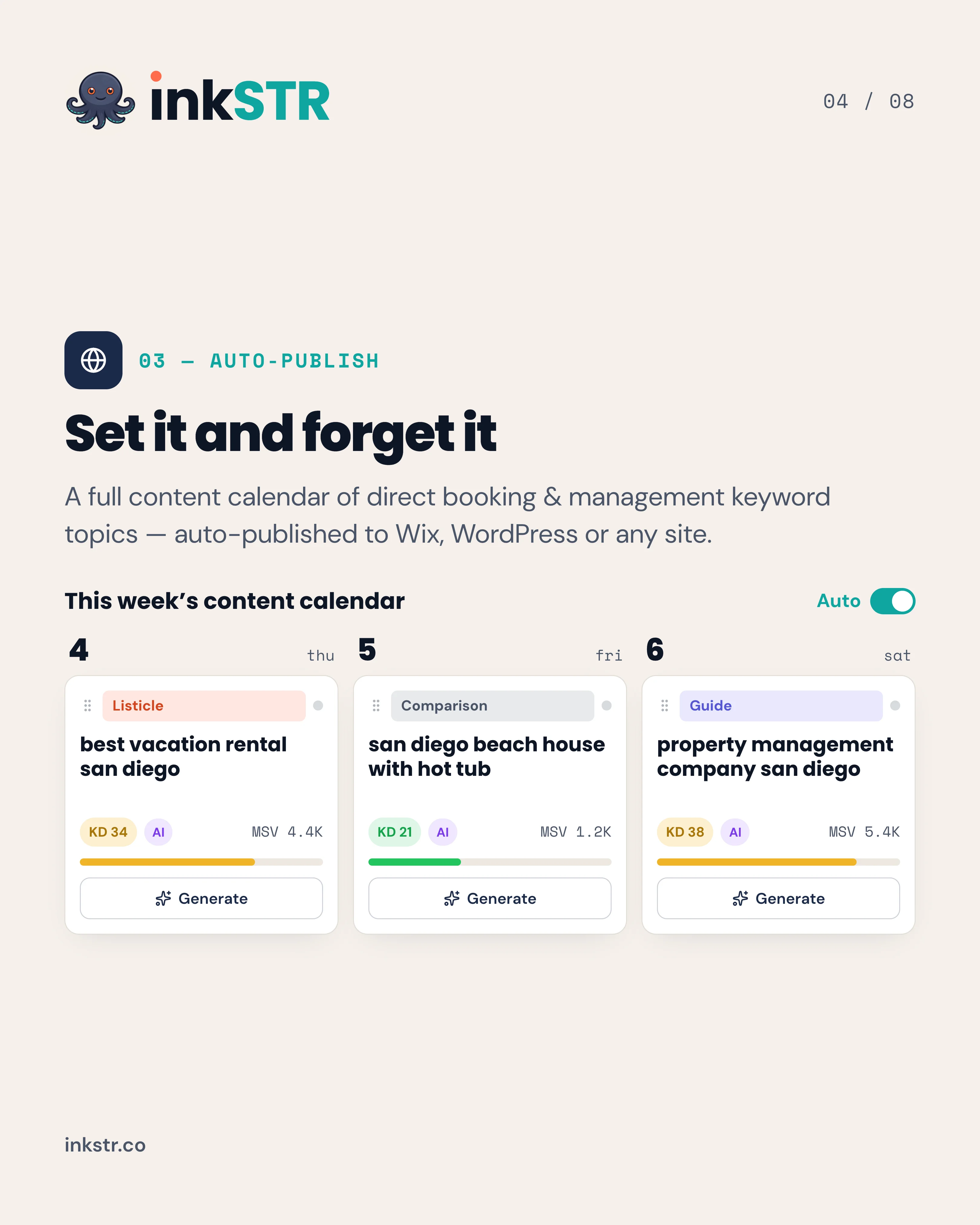
If building this content calendar manually sounds like a full-time job stacked on top of your actual job, inkSTR's Content Calendar generates and schedules your articles automatically, so your direct booking traffic keeps growing even during your busiest booking season. Start a free trial and see your first article draft this week.
Content powered by inkSTR.co
Enjoyed this article? Share it:
Get more of inkSTR in Google Search
Add inkstr.co as a preferred source and our articles show up more in Top Stories, AI Overviews, and AI Mode — with a “Preferred” badge.
Get more guides like this
New SEO and AI-search guides, straight to your inbox. No spam, unsubscribe anytime.