How to Attract Guests Without Airbnb: A Direct Booking Guide

You attract guests without Airbnb by building a direct booking website that ranks on Google, capturing guest emails for repeat stays, and publishing keyword-targeted content that answers the exact questions travelers are searching in your market. It takes longer than posting a listing, but it stops the 17-19% fee bleed on every reservation.
- Airbnb appears on page one of Google in 79% of top vacation rental markets, but lands in the top 3 results only 5% of the time, according to BuildUp Bookings, which means your own website has a real shot at outranking the platform for specific searches.
- Combined Airbnb host and guest fees run 17-19% of every booking, money that disappears the moment a guest books direct instead.
- A single direct booking is typically worth $1,000 to $4,000 in revenue, and a well-placed blog article can drive that traffic for 2-5 years after it's published.
- Writing one quality blog post manually takes 3-5 hours, and a freelance travel writer charges $300-$700 per post, costs that scale badly across a growing content calendar.
- The global vacation rental market is projected to hit $109.4 billion in 2026, per Mordor Intelligence, meaning more competition and more urgency to own your own traffic.
- inkSTR generates, schedules, and publishes SEO-optimized articles automatically, so you can build the content engine that attracts direct guests without spending your week writing blog posts.
If you're reading this, you've probably already felt the sting of an Airbnb payout that's smaller than it should be. You did the work: cleaned the property, answered the messages, kept the reviews high. Airbnb still took its cut off the top.
In 2026, more operators are treating OTA platforms as one channel among several, not the whole strategy. That shift isn't about abandoning Airbnb entirely. It's about building a second, more profitable path to guests: one you own, that doesn't charge a toll on every transaction.
At inkSTR, we've worked with hosts and property managers who spent months building a direct booking website only to watch it sit empty of traffic. The site wasn't the problem. The content strategy was missing. This guide walks through exactly how to fix that, step by step, with the specific tactics that actually move the needle.
What Is the 75-55 Rule for Airbnb and What Does It Mean for Attracting Guests Without It?
The 75-55 rule refers to Airbnb search ranking behavior where hosts who respond to inquiries within an hour and maintain strong response rates tend to appear higher in Airbnb's internal search results, though Airbnb has never published an official formula under this exact name. For operators trying to attract guests without Airbnb, the rule matters mostly as a contrast: it shows how much of your visibility is controlled by a platform's opaque algorithm rather than your own marketing.
Here's the problem with depending on any version of this rule: you're optimizing for Airbnb's internal ranking signals instead of Google's, and those signals can change overnight without notice. Airbnb has adjusted its search algorithm multiple times over the years, and hosts who built their entire strategy around gaming internal metrics found their bookings disappear when the rules shifted.
Compare that to a direct booking website you control. When you publish content optimized around actual traveler search intent, that content keeps ranking on Google regardless of what Airbnb changes internally. A blog post targeting "pet friendly cabin near Gatlinburg" doesn't care about Airbnb's response-rate thresholds. It cares about matching what a real traveler typed into Google.
This is exactly why we built inkSTR around Keyword Research that maps to guest search behavior, not platform algorithms. Instead of guessing which internal metrics might boost your Airbnb ranking this month, you're building durable visibility on a search engine whose ranking factors are far more transparent and far less prone to sudden internal policy shifts.
What Else Can You Use Instead of Airbnb to Attract Guests?
The main alternatives to Airbnb for attracting guests are a direct booking website optimized for local search, an email list of past guests, niche booking platforms specific to your property type, and local business partnerships that generate referral traffic. None of these replace Airbnb overnight, but together they build a guest acquisition system that doesn't depend on OTA commission structures.
Most hosts try one alternative, see slow results after a few weeks, and give up. That's the trap. A direct booking site with no content behind it gets zero organic traffic. An email list with three names in it doesn't drive repeat bookings. Building alternatives to Airbnb requires running several channels simultaneously, and doing that manually is where most operators burn out.
Consider the actual time cost: setting up a direct booking website, researching keywords for your market, writing blog content, managing an email newsletter, and building local partnerships. Each of those is a part-time job on its own. Layer them together without a system, and content becomes the first thing that gets skipped, usually right when it would start paying off.
Here's what actually works when we've seen it implemented well:
| Channel | Time to Results | Ongoing Effort | Best For |
|---|---|---|---|
| Direct booking website + SEO content | 4-6 months | Ongoing publishing cadence | Compounding, long-term traffic |
| Guest email list | Immediate for past guests | Monthly or seasonal sends | Repeat bookings and referrals |
| Local business partnerships | 1-3 months | Occasional relationship upkeep | Niche destination markets |
| Niche or regional booking platforms | Weeks | Listing maintenance | Supplemental visibility, lower fees than Airbnb |
Content is the piece that ties the others together. Your direct booking site needs blog articles to rank, your email list needs content worth opening, and your local partnerships get stronger when you're publishing guides that mention them. inkSTR's AI Content Writer handles the writing side of that equation so you can run all four channels without hiring a content team.
What Is the 80/20 Rule for Airbnb and How Should You Apply It to Direct Bookings?
The 80/20 rule applied to vacation rentals suggests that roughly 80% of your repeat revenue and referrals come from about 20% of your past guests, the ones who had an exceptional stay and are likely to book again or recommend you. Applied to attracting guests without Airbnb, this means your highest-leverage move isn't chasing new traffic first. It's re-engaging the guests who already loved staying with you.
Most hosts let this 20% slip through their fingers. A guest checks out, leaves a five-star review, and never hears from the property again. No email capture, no follow-up, no reason to think of your rental the next time they plan a trip. That's a direct booking opportunity evaporating for free, while Airbnb keeps that guest's contact information and relationship.
Building an email list from past guests solves this, but only if you're consistently giving them a reason to open your emails. A generic "book again" blast twice a year doesn't cut it. What works is sending seasonal content: a guide to fall foliage timing near your cabin, an update on a new local restaurant, a heads-up about a regional event. This is content marketing applied to retention, not just acquisition.
Our guide to local area guides that sell breaks down exactly how to structure this kind of content so it reads as genuinely useful rather than promotional. And because inkSTR's Content Calendar schedules and publishes on a set cadence, you can maintain that repeat-guest content pipeline without personally remembering to sit down and write it every month.
What Is the 25 Percent Rule on Airbnb and Why Does It Matter for Direct Booking Strategy?
The 25 percent rule generally refers to guidance that hosts shouldn't rely on any single traffic source, including Airbnb, for more than roughly a quarter of their total booking volume once they're established, to avoid catastrophic exposure if that channel changes its policies or fees. For operators building a direct booking strategy, this framing is a useful diversification benchmark, even though it's more of an industry heuristic than an official Airbnb policy.
The risk this rule addresses is real. Airbnb has raised fees, changed search visibility rules, and adjusted cancellation policies multiple times over the years, often with limited notice to hosts. An operator who built 100% of their booking volume through Airbnb has zero leverage when those changes hit. An operator with a diversified mix, direct bookings, a returning guest base, and a couple of supplemental channels, absorbs the change and keeps operating.
Getting to that diversified mix requires your direct booking website to actually generate meaningful traffic on its own, not just exist as a backup option nobody finds. That's where most DIY attempts stall. Building the site is the easy part. Filling it with content that ranks for the searches your future guests are actually typing is the part that eats time and money.
A freelance travel writer charges $300 to $700 per quality post, and writing one yourself takes 3-5 hours of research and drafting. Multiply that across the 12 to 20 articles most sites need before showing meaningful organic movement, and you're looking at either thousands of dollars or a part-time job you didn't sign up for. This is precisely the gap inkSTR was built to close: full articles generated, scheduled, and published on autopilot, at a fraction of the freelance cost, starting at $99 per month.

How Do You Build a Direct Booking Website That Actually Attracts Guests?
A direct booking website attracts guests when it's built around specific, keyword-targeted content rather than just a property description and a booking widget. The build itself takes days; the content that drives traffic to it takes months of consistent publishing to compound.
Step 1: Set Up the Booking Infrastructure
Get a booking engine connected to your website, whether through your property management system or a standalone widget. This is a one-time technical setup, usually completed in a few days with existing PMS integrations.
Step 2: Research the Keywords Your Guests Actually Search
Before writing a single blog post, identify what travelers type into Google when researching your destination. This is where most DIY efforts go wrong: hosts write about what they think is interesting rather than what guests are searching. inkSTR's Keyword Research tool surfaces the actual search terms and volume for your specific market, whether that's a beach town, a mountain retreat, or an urban apartment corridor.
Step 3: Publish Consistently, Not Sporadically
Google rewards consistency more than volume spikes. Two to four articles per month, published on schedule, builds more authority than ten posts in one month followed by six months of silence. The Content Calendar automates that scheduling so the cadence never breaks, even during your busiest booking season.
Step 4: Publish Without Manual Copy-Pasting
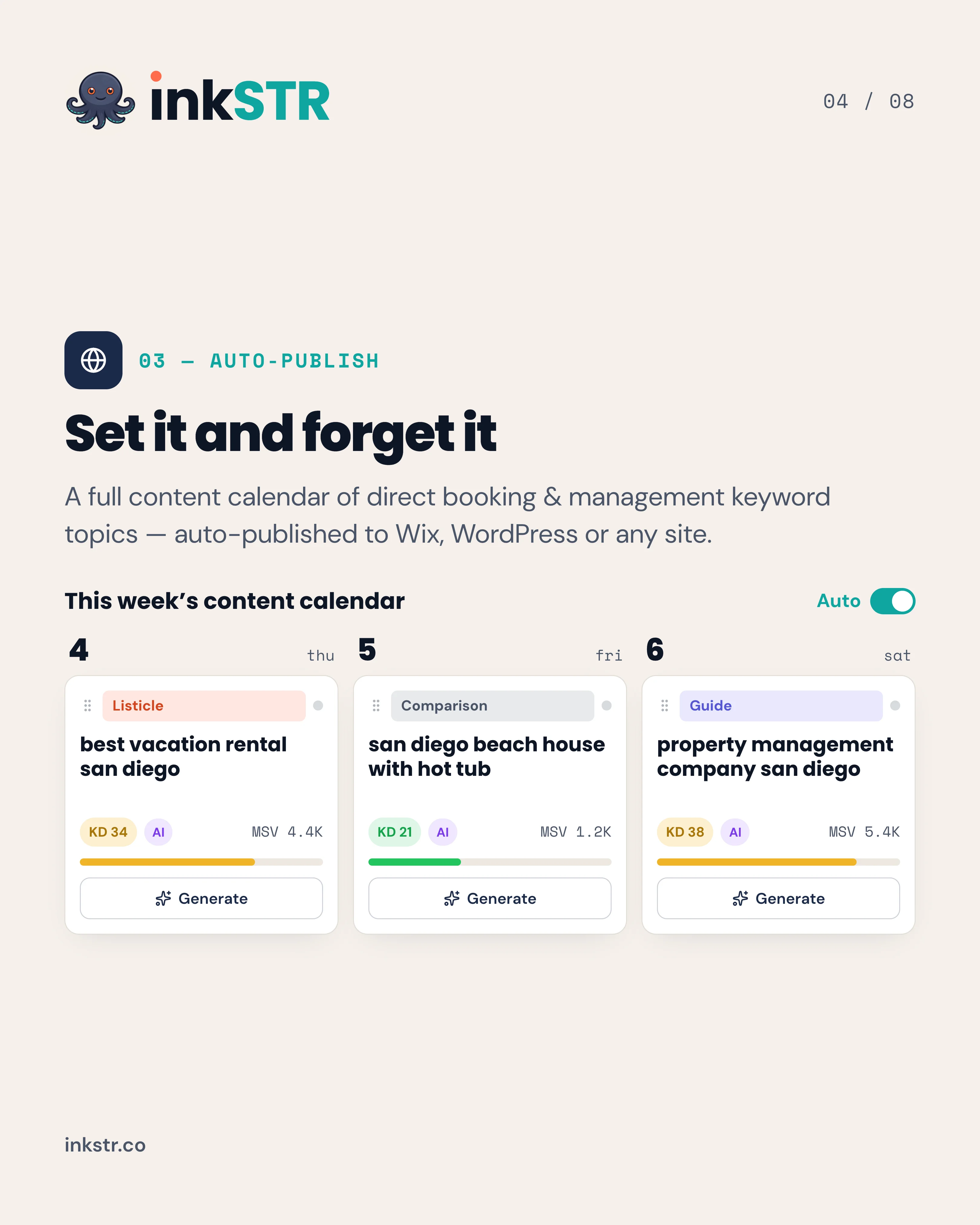
Manually uploading and formatting articles to WordPress or Wix every time is where content calendars quietly die. inkSTR's Auto-Publishing pushes finished articles directly to your site, removing the last manual step in the pipeline.
For a deeper look at the technical side of getting your site indexed correctly, our piece on how to rank your vacation rental website on Google covers the on-page fundamentals this strategy depends on.
Why Isn't Your Vacation Rental Website Getting Bookings Even With Good Content?
A vacation rental website fails to convert traffic into bookings when the content ranks but doesn't lead the reader toward a clear next action, or when the booking page itself creates friction. Traffic without conversion is often a structural problem, not a content quality problem.
We see this constantly: an operator publishes solid articles, starts getting real visitors, and still sees no inquiries. The article answered the reader's question completely, then left them with nowhere obvious to go. No internal link to the booking page. No clear call to check availability. The reader closes the tab satisfied but never converts.
Every article you publish needs a natural bridge from information to action, not a hard sales pitch, but a logical next step. A blog post about the best time to visit for fall foliage should link naturally to your availability calendar for those exact weeks. Our article on booking page conversion optimization covers the specific friction points that block conversion even when traffic is strong.
inkSTR's content includes internal link suggestions built into every generated article, so the path from "informative blog post" to "check availability" is never left to chance. That structural detail is easy to overlook when you're writing manually, and it's exactly the kind of thing that separates content that ranks from content that also converts.
How Do You Compete With Property Management Companies for the Same Searches?
You compete with larger property management companies by publishing more specific, locally detailed content than they can produce at scale, since big management companies often rely on generic, templated pages across dozens of properties. Specificity beats scale when the searcher wants a genuine answer, not a corporate summary.
Property management companies handling 20, 40, or 100-plus units typically can't write a genuinely detailed guide for every single property's neighborhood. Their content, if they publish any at all, tends toward generic descriptions that could apply to any cabin or any beach condo. That's a real content gap, and it's the one independent hosts and boutique operators can exploit.
A single-property host who writes with real, specific local knowledge, the actual trailhead distance, the specific restaurant that's walkable, the exact week fall colors typically peak, produces content that ranks better because it answers the query more precisely. Google's algorithm increasingly rewards this kind of specificity over generic breadth.
The challenge is sustaining that specificity across enough articles to build real authority. inkSTR's content engine is built specifically for short-term rental terminology and destination-level detail, meaning the articles it generates understand the difference between "beach town" and "mountain retreat" search intent rather than producing the same generic travel copy a general-purpose AI writer would output. For a broader look at this competitive dynamic, see our piece on why your vacation rental website is not ranking on Google.
Ready to automate your content marketing?
inkSTR handles keyword research, content strategy, article writing, and publishing, all on autopilot.
What Should You Blog About to Attract Guests Without Airbnb?
The blog topics that attract guests without Airbnb fall into four categories: local area guides, seasonal and event-driven content, property-specific detail pages, and comparison content that answers "why book direct" questions. Each category targets a different stage of the traveler's search journey, from initial destination research to final booking decision.
Local area guides work because they capture broad, top-of-funnel searches like "things to do near [destination]" where travelers haven't picked a property yet. Seasonal content captures narrower, time-sensitive searches tied to specific events or weather windows. Property-specific pages capture bottom-of-funnel searches from travelers who've already narrowed down what they want.
Here's a mistake we see constantly: hosts write only property description content and skip the local guides entirely. That leaves the top of the funnel completely uncontested, ceding that traffic to Airbnb's own destination pages or to bigger competitors. A balanced content mix needs all four categories running simultaneously.
Our full breakdown in vacation rental blog topics that actually drive bookings maps out specific topic ideas for each category. If generating that volume of varied content sounds like more than you have bandwidth for, that volume and variety is exactly what inkSTR's content strategy engine is designed to produce on a recurring schedule.
How Long Does It Actually Take to Build Direct Booking Traffic Without Airbnb?
Building meaningful direct booking traffic without Airbnb typically takes four to six months of consistent content publishing before you see reliable organic search movement, based on the general timeline Google's indexing and ranking process follows for new or growing sites. This isn't a 30-day fix, and any strategy promising instant results should raise a flag.
The timeline breaks into phases. In the first one to two months, your new content gets indexed and starts appearing for very long-tail, low-competition searches. Months three and four typically bring movement on moderately competitive local terms. By months five and six, consistent publishers usually see their pillar content start ranking for the terms that actually drive bookings.
This timeline assumes consistent publishing, not sporadic bursts. A host who publishes six articles in January and then nothing until June resets much of that momentum. Google's algorithm favors sites that demonstrate ongoing authority-building, not one-time content dumps.
Given that consistency matters more than volume, the practical question becomes whether you can sustain a publishing cadence for six months straight while also running your property. Most hosts can't, which is precisely the operational gap inkSTR closes with automated scheduling and publishing that doesn't depend on your personal bandwidth each month.
Data and Evidence: Why the Direct Booking Opportunity Is Real in 2026
The data supporting a direct booking strategy in 2026 centers on two facts: Airbnb's own search visibility on Google is weaker than most hosts assume, and the vacation rental market overall is large enough that even a modest share of direct traffic represents meaningful revenue. Both facts argue against treating Airbnb as your only viable channel.
According to BuildUp Bookings, Airbnb appears on the first page of Google in 79% of top vacation rental markets analyzed, but lands in the top 3 results in only 5% of those markets. That gap between "present" and "prominent" is exactly where a well-optimized direct booking site can compete. You don't need to outrank Airbnb everywhere; you need to outrank it for the specific, longer-tail searches your property actually matches.
| Metric | Value | Source |
|---|---|---|
| Airbnb page-one presence in top markets | 79% | BuildUp Bookings, 2019 |
| Airbnb top-3 organic presence in top markets | 5% | BuildUp Bookings, 2019 |
| Global vacation rental market size, 2026 | $109.4 billion | Mordor Intelligence |
| Combined Airbnb host and guest fees | 17-19% of booking value | Business Identity |
| Typical revenue per direct booking | $1,000-$4,000 | Business Identity |
Put those numbers together and the math is straightforward. If your property generates even a handful of direct bookings a year at $1,000 to $4,000 each, while avoiding a 17-19% platform fee on those specific transactions, the content investment required to capture that traffic pays for itself many times over across the 2-5 years a ranking article typically keeps driving visitors.
Practical Guidance: How to Prioritize Your First 90 Days Without Airbnb Dependence
Prioritizing your first 90 days of direct booking strategy means sequencing three things in order: technical setup, keyword-targeted content foundation, and guest retention infrastructure. Skipping the sequence, jumping straight to content without keyword research, for example, wastes the entire 90-day window on articles nobody searches for.
- Weeks 1-2: Confirm your direct booking website and booking engine are functional. Fix any broken booking flow before investing in traffic.
- Weeks 2-4: Complete keyword research for your specific market. Identify 15-20 target terms across destination guides, seasonal content, and property-specific pages.
- Weeks 4-10: Publish your first wave of content, aiming for two to four articles per week if using an automated system, or two to four per month if writing manually.
- Weeks 8-12: Set up email capture for past and current guests. Send your first seasonal or local-update content piece to that list.
Common mistakes in this window include publishing inconsistent content, targeting keywords with no real search volume, and neglecting the booking page itself while focused entirely on blog traffic. Trade-offs to understand: manual content creation gives you full control over voice but costs significant time; automated content generation trades some hands-on control for consistency and speed. For most operators managing a property alongside everything else involved in hosting, the speed advantage wins.
Frequently Asked Questions
How do I start attracting guests without Airbnb if I have no existing website traffic?
Start with keyword research to identify what travelers actually search for in your destination, then publish content targeting those specific terms consistently for at least four to six months. A direct booking website with zero content will not generate traffic regardless of design quality; the content is what search engines index and rank.
Is it possible to fully replace Airbnb bookings with direct bookings?
Most established operators aim for a diversified mix rather than fully replacing Airbnb, since maintaining some presence on multiple channels reduces risk from any single platform's policy changes. That said, a mature direct booking content strategy can meaningfully reduce your dependence on Airbnb and the 17-19% combined fees that come with it.
How many blog posts do I need before I see organic traffic without Airbnb?
Most vacation rental websites begin showing meaningful ranking movement after 12 to 20 published articles targeting a mix of destination keywords and long-tail booking intent queries. inkSTR's Content Calendar automates the scheduling of that volume so you reach that milestone without manually tracking every publish date.
Can AI-generated content actually rank on Google for vacation rental searches?
Yes, when the content is specific, well-structured, and targets real search intent rather than generic travel language. inkSTR's articles are built around STR-specific keyword research and quality scoring before publication, which is different from generic AI writing tools with no niche context.
What is the fastest way to build an email list for direct bookings without Airbnb?
Capture guest emails at booking confirmation and checkout, then follow up with genuinely useful seasonal or local content rather than only promotional messages. This turns past guests, your highest-conversion audience, into a repeat booking channel that costs nothing per transaction.
Do I need a separate blog for each property if I manage multiple rentals?
You can publish everything from one website if your properties are in the same market, but separate content pipelines make more sense once you're managing properties across multiple distinct destinations. inkSTR's multi-project architecture supports independent content pipelines per property or brand for exactly this situation.
What's the difference between optimizing an Airbnb listing and building direct booking SEO?
Optimizing an Airbnb listing means improving your ranking within Airbnb's internal, largely opaque algorithm. Direct booking SEO means building content and site authority that ranks on Google itself, which is a channel you control and one that doesn't disappear if Airbnb changes its internal ranking rules.
Is content marketing worth it if my destination already has heavy tourist competition?
Heavy competition usually means more search volume, not less opportunity, especially for specific long-tail searches that bigger operators and generic OTA pages ignore. Detailed, locally accurate content tends to outperform generic competitor pages precisely because it answers the traveler's question more completely.
Conclusion: Attracting Guests Without Airbnb Is a System, Not a Single Tactic
Attracting guests without Airbnb comes down to building a direct booking website with keyword-targeted content, capturing past guest emails, and diversifying beyond a single OTA channel, sustained over months rather than treated as a one-time project. The operators who succeed at this aren't the ones with the best property; they're the ones who kept publishing consistently while everyone else gave up after month two.
Start with one concrete action this week: run keyword research for your specific market and identify the five terms you're missing content for entirely. That gap is where your next direct booking is hiding. If you want that entire pipeline, research, writing, scheduling, and publishing, running without eating every evening you have left after guest turnovers, inkSTR handles the content pipeline so you can focus on the property itself.

If getting your property showing up in searches like these feels like the missing piece, start your free trial with inkSTR and see the keyword and content plan it builds for your specific market.
Content powered by inkSTR.co
Enjoyed this article? Share it:
Get more of inkSTR in Google Search
Add inkstr.co as a preferred source and our articles show up more in Top Stories, AI Overviews, and AI Mode — with a “Preferred” badge.
Get more guides like this
New SEO and AI-search guides, straight to your inbox. No spam, unsubscribe anytime.