How to Grow Your Vacation Rental Business Past Airbnb

Growing a vacation rental business means reducing your dependence on any single platform, specifically Airbnb and VRBO, by building direct booking channels: your own SEO-optimized website, an email list, and a content strategy that ranks in Google and AI search. The operators who scale past one or two units almost always do this before they add inventory.
- OTA fees compound fast: Airbnb host and guest fees combined typically run 17-19% of every booking, meaning a $2,000 stay quietly loses $340 to $380 before you ever see it.
- Direct bookings are worth more per stay: a single direct vacation rental booking is typically worth $1,000 to $4,000 in revenue, and none of it gets split with a platform.
- Organic search already drives a huge share of this industry: in the vacation rental industry, 38% of traffic comes from organic search, more than direct or paid search combined, according to CUFinder's 2026 data.
- Professional operators are winning the distribution game: professional property managers now control roughly 69% of U.S. short-term rental listings, according to AirDNA and Rentals United 2026 data, which means solo hosts need a real strategy to compete.
- Content compounds instead of decaying: a ranking blog article can drive organic search traffic for 2-5 years, unlike a paid ad that stops the moment you stop paying.
- inkSTR removes the production bottleneck by generating, scheduling, and publishing SEO-optimized blog content automatically, so growing past the platforms you started on doesn't require you to become a full-time content writer.
If you launched your vacation rental on Airbnb or VRBO, you built your business on someone else's real estate. That's not a criticism, it's how almost every operator starts. But in 2026, the operators pulling ahead of the pack are the ones who treated the OTA as a launchpad, not a permanent home. This guide covers the exact rules and questions vacation rental operators ask most, from the 2% rule to whether owning a rental is still profitable, and shows you the growth path that gets you off platform dependence for good.
We wrote this from the perspective of people who've spent years building organic content systems specifically for short-term rental operators. At inkSTR, we've watched hundreds of operators try to grow through OTA optimization alone and hit a ceiling. The ones who broke through added a direct booking content engine. That's the difference this article is built around.
What Is the 2% Rule for Rentals?
The 2% rule is a quick screening test for rental property investments: it states that a property's monthly rental income should equal at least 2% of its purchase price for the investment to be considered strongly cash-flow positive. For a $300,000 property, that means targeting at least $6,000 in monthly rental income before expenses.
The 2% rule is a blunt instrument. It was built for long-term rentals with predictable, flat monthly income, not short-term rentals where revenue swings by season, event calendar, and even day of week. A mountain cabin near a ski resort might blow past the 2% rule during peak winter weeks and fall well short in the off-season shoulder months.
Where this rule actually helps you is in the early screening phase, before you buy. If a property can't come close to 2% even during peak season projections, it's probably not going to cash flow as a short-term rental either. Most experienced operators use it as a first filter, then layer in occupancy rate research, seasonal demand data, and local regulatory limits before committing.
The problem is that most new buyers stop at the 2% rule and never build the marketing engine that actually gets them close to those projected numbers. Passing the screening test doesn't guarantee the income. That income depends on visibility, and visibility is the piece most operators underinvest in. This is exactly where a lot of operators discover, months into ownership, that their vacation rental website is not ranking on Google at all, which means every dollar of that 2% projection has to come from the OTA and its commission structure. inkSTR's Keyword Research tool exists to close that gap early, mapping out exactly which searches your target market is actually running before you publish a single page.
What Is the 75-55 Rule for Airbnb?
The 75-55 rule is a budgeting guideline some short-term rental operators use to sanity-check profitability: it suggests that operating expenses should stay near 75% of gross revenue at most, with roughly 55% of gross revenue remaining available after mortgage or debt service specifically. In practice, it's a way to stress-test whether a property still cash flows after financing.
Notably, this rule isn't as widely codified as the 2% rule, and different operators apply slightly different thresholds. What matters more than the exact percentages is the discipline behind it: tracking cleaning costs, platform fees, utilities, insurance, and maintenance reserves against revenue, then checking what's left after debt service.
Here's where the rule breaks down for most operators: it assumes gross revenue is fixed and the only lever you can pull is expense control. But revenue is the bigger lever, and it's the one most hosts ignore. If 17-19% of every Airbnb booking disappears into host and guest fees, that's not an "expense line," it's a structural tax on every transaction that never touches your books as an editable cost.
The fix isn't just tighter expense management, it's diversifying revenue so a larger share of your bookings come direct, at full margin. That's the entire premise behind building a content-driven direct booking channel. inkSTR's AI Content Writer generates the destination guides, amenity pages, and seasonal content that turn a static direct booking site into an actual traffic source, so more of your gross revenue shows up on the "keep" side of the 75-55 math instead of leaking out through platform commissions.
What Is the 80/20 Rule for Airbnb?
The 80/20 rule, or Pareto principle, applied to Airbnb means roughly 80% of your bookings and revenue typically come from about 20% of your efforts, whether that's your top listing photos, your best-performing amenities, or your highest-converting search keywords. For vacation rental operators, this usually shows up as a small number of high-intent search terms or a handful of standout property features driving most of the demand.
In our experience working with operators across beach towns, mountain retreats, and lake house markets, the 80/20 pattern shows up constantly in content performance too. A handful of blog posts, usually the ones targeting specific, high-intent local searches like "pet-friendly cabin near [trailhead name]" rather than generic terms like "cabin rental," end up driving most of a site's organic traffic. The mistake we see constantly: operators write ten generic posts about their region instead of finding the two or three specific, high-intent angles that actually convert. Generic content spreads effort thin across low-value topics. Specific content concentrates effort where the 80/20 curve rewards it.
Identifying which 20% actually matters requires real keyword and competitor research, not guesswork. That's precisely the workflow inkSTR's Keyword Research tool automates: it surfaces the specific search terms your market is actually using, so you can concentrate your content calendar on the handful of topics likely to drive most of your bookings instead of spreading effort across dozens of low-value blog posts. Once you know your 20%, the Content Calendar keeps that priority content publishing on schedule instead of falling to the bottom of your to-do list.

Is Owning a Vacation Rental Profitable?
Owning a vacation rental can be profitable, and the market data backs that up: the U.S. vacation rental segment alone is projected to generate $76.46 billion in revenue in 2026, up from $72.00 billion in 2026, a 7.3% compound annual growth rate through 2033. But profitability depends heavily on how much of that revenue you keep versus how much you hand over in platform fees, and that's where most new owners get blindsided.
The math changes fast once you factor in OTA commissions. Airbnb host and guest fees combined run 17-19% of every booking. On a $250,000 property generating solid seasonal revenue, that's tens of thousands of dollars a year flowing to a platform instead of your bank account, before cleaning costs, mortgage, insurance, and maintenance reserves even enter the picture. Additionally, as of 2026, professional property managers now control roughly 69% of U.S. short-term rental listings, according to AirDNA and Rentals United data, which means solo owners are increasingly competing against operators with dedicated marketing budgets and teams. That competitive pressure makes distribution strategy, not just property quality, a real profitability lever.
Here's our honest take: owning one property and relying entirely on Airbnb search visibility is a fragile business model. It's profitable until an algorithm change, a new competing listing two blocks away, or a slow season hits, and then your entire revenue stream is exposed. Owners who build a second channel, specifically a direct booking website supported by consistent SEO content, insulate themselves from that fragility. This is the single biggest lever inkSTR was built around: a content system that lets a solo owner compete on visibility the way a 50-property management company would, without hiring a marketing team. If you want the deeper mechanics of why sites stall out on Google, our piece on how to rank your vacation rental website on Google walks through the technical and content-side reasons most direct booking sites never get found.
Why Is My Vacation Rental Not Getting Bookings?
A vacation rental usually isn't getting bookings because it's invisible outside the OTA it's listed on, meaning the property has no independent search presence, no email list, and no content pulling in travelers who haven't already opened Airbnb or VRBO. Low visibility, not property quality, is the most common cause we see.
Think about how most travelers actually search. According to ShortTermRentalz's 2023 research, 42% of U.S. leisure travelers said Google Search impacted their travel provider decision on their last trip, and 40% of Google users making regional hotel queries are actually considering vacation rentals. That's a massive pool of demand happening entirely outside the Airbnb app, and if your only presence is your OTA listing, you're invisible to all of it.
The frustrating part is that fixing this manually is genuinely time-consuming. Writing one quality blog post takes 3-5 hours of research and writing, and a freelance travel writer charges $300-$700 per post if you outsource it. Multiply that across the dozen or more posts most sites need to gain real traction, and you're looking at either a huge time sink or a real cash outlay before you see a single extra booking.
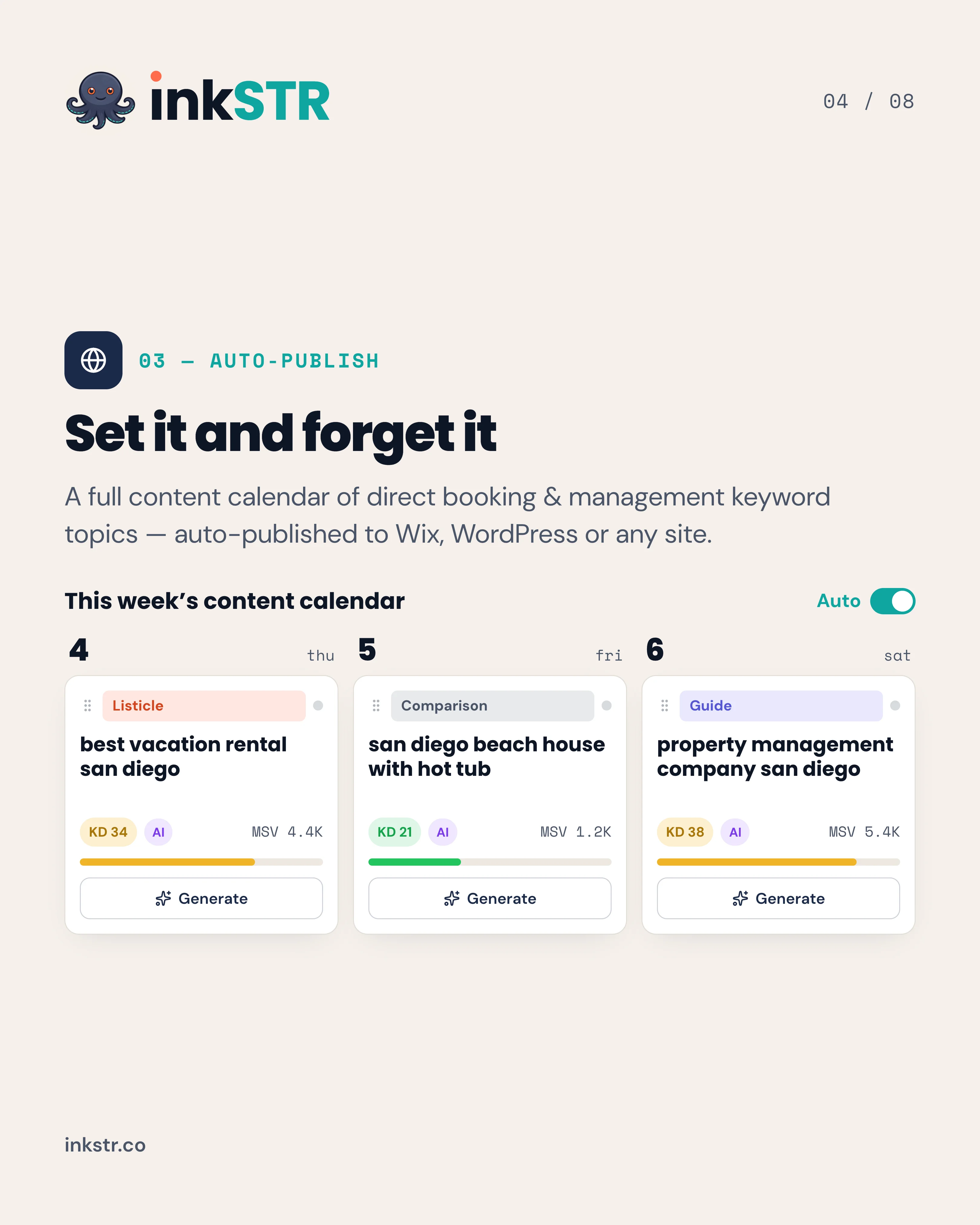
This is the exact production bottleneck inkSTR was designed to remove. Instead of blocking out an entire weekend to draft one post, inkSTR's AI Content Writer generates a complete, SEO-optimized article built around your market's actual search terms in minutes, then the Auto-Publishing feature pushes it live to your WordPress or Wix site without you touching a single plugin. Visibility stops being the thing you never get around to and becomes something that happens on autopilot.
How Do I Get Direct Bookings Without Paying Platform Fees?
Getting direct bookings without paying OTA platform fees requires three things working together: a website built to convert, consistent SEO content that ranks for the searches your ideal guest actually runs, and a way to capture repeat guests through email so they book with you again without ever opening Airbnb. Skipping any one of the three usually stalls the whole system.
Here's the part most hosts get wrong: they build the website, list a few amenities, add a booking widget, and wait. But a direct booking site with no organic content has nothing pulling new visitors in. Mobile traffic represents 68.5% of all traffic for vacation rental websites, according to CUFinder's 2026 data, and mobile searchers are typically running specific, local, intent-driven queries, not just browsing your homepage cold.
Building an email list matters just as much. A guest who stayed with you last summer and loved the property is your cheapest possible future booking, if you have a way to reach them again. Our guide on why your blog content isn't converting visitors into guests covers the conversion side of this in more depth, including where most sites lose the visitor before they ever reach the booking form.
This is precisely the workflow inkSTR automates end to end. The Keyword Research tool identifies exactly what your target guests are searching, the AI Content Writer drafts the articles targeting those terms, and the Content Calendar keeps them publishing on a consistent schedule so your organic traffic compounds month over month instead of spiking once and fading. A single direct booking is typically worth $1,000 to $4,000, at full margin, with none of the 17-19% OTA fee coming off the top.

How Do I Compete With Big Property Management Companies in Search?
Competing with large property management companies in search means out-specifying them, not out-spending them: targeting narrow, local, high-intent keywords that a 50-property management brand's generic corporate blog rarely bothers to cover. Big management companies optimize for scale, and scale usually means shallow, broad content instead of deep, specific local coverage.
Professional managers already control roughly 69% of U.S. short-term rental listings, according to AirDNA and Rentals United 2026 data, so if you're a solo host or a small management company, you're not going to out-list them. But you can out-rank them on specific local searches they haven't bothered to target: a particular trailhead, a specific neighborhood pocket, a niche amenity combination like a hot tub plus ski-in access.
We consistently see smaller operators win the long-tail search game by publishing content that's genuinely useful to a narrow slice of travelers, the kind of hyper-specific local area guide a corporate content team has no incentive to write for a single property. Our article on local area guides that sell covers the exact structure that turns this local knowledge into bookings, not just page views.
What makes this achievable without hiring a full content team is automation. inkSTR's multi-project architecture lets you run separate content pipelines per property, each targeting its own hyper-local keyword set, without one property's content strategy bleeding into another's brand voice. That's a level of specificity most large management companies simply can't replicate at scale, because their systems are built for volume, not local nuance.
What Should I Blog About for My Vacation Rental Website?
The blog topics that actually drive bookings for a vacation rental website fall into three categories: destination-specific guides tied to your exact location, amenity and experience content that showcases what makes your property different, and seasonal or event-driven posts timed to when travelers are actually searching. Generic "top 10 things to do in [state]" posts almost never convert.
The reason generic content underperforms is intent mismatch. A traveler searching "best hiking trails near [specific trailhead]" is closer to booking than one searching "things to do in [state]," because their search is already narrowed to your exact micro-market. Specific intent converts. Broad intent browses.
We recommend a mix: one pillar guide per major nearby attraction cluster, several cluster posts answering specific traveler questions (pet policies, parking, best time of year to visit), and a handful of conversion-focused posts that directly address why a guest should book your property over a competing listing. Our roundup of vacation rental blog topics that actually drive bookings breaks this structure down topic by topic.
Building that pillar and cluster architecture manually, then keeping it updated as seasons change, is a real content strategy job, not a side project. This is exactly the gap inkSTR's content strategy wizard closes: it maps out a pillar and cluster plan automatically based on your property type and market, then the AI Content Writer fills in each piece, so you get a coherent content architecture instead of a random pile of disconnected posts.
Ready to automate your content marketing?
inkSTR handles keyword research, content strategy, article writing, and publishing, all on autopilot.
Is It Worth Paying a Content Writer for My Short-Term Rental?
Paying a freelance content writer for your short-term rental blog is worth it if you need occasional, highly specialized pieces, but it becomes expensive fast at the volume most sites actually need to rank. A freelance travel writer charges $300-$700 per quality blog post, and most vacation rental sites need a dozen or more articles before they see meaningful organic movement.
Do the math on a full content calendar. If you're publishing two posts a month at $500 each, that's $12,000 a year, before you've paid for editing, SEO optimization, or scheduling tools. And that number assumes every single post lands, with no wasted spend on pieces that never rank.
Compare that to inkSTR's pricing, which starts at $99/month for the full pipeline: keyword research, AI-generated articles, a scheduling calendar, and one-click publishing to your existing website. That's a fraction of a single freelance post's cost, covering an entire month of content production instead of one article.
To be fair, there's a real trade-off worth naming. A specialized freelance writer with firsthand knowledge of your exact property can add texture inkSTR's AI can't fully replicate on its own. But for the bulk of your content calendar, the destination guides, the FAQ posts, the seasonal updates, the volume and consistency inkSTR provides is what actually moves the needle on search visibility. Most operators we work with use inkSTR for the volume and reserve freelance writing, if at all, for a handful of flagship pieces.
Can AI Write Content for My Vacation Rental Business?
AI can write blog content for a vacation rental business, and when the AI is trained specifically on hospitality and short-term rental terminology, it can produce publish-ready articles rather than generic filler. The key differentiator is specificity: general-purpose AI tools don't understand traveler search intent or STR-specific vocabulary the way a niche-built platform does.
Skepticism about AI content quality is fair. A lot of early AI-generated content read as vague, repetitive, and generic, the kind of writing that could describe any business in any industry. That reputation still lingers, and it's a legitimate concern if you're evaluating tools.
But the technology and the training data have moved considerably since those early complaints. inkSTR's AI understands vacation rental terminology specifically: occupancy rates, ADR, direct booking funnels, OTA fee structures, and location-based search patterns relevant to beach towns, mountain retreats, urban apartments, and lake house markets. That specificity is what separates content that ranks from content that reads as filler.
Every article also passes through quality scoring before it publishes, so you're not blindly trusting raw AI output. If you want the deeper breakdown of what actually determines whether AI content ranks, including the structural and specificity factors Google's helpful content systems reward, our piece on why generic travel content kills conversions covers exactly where AI content goes wrong and how to avoid it.
What Is the ROI of Content Marketing for Short-Term Rentals?
The ROI of content marketing for short-term rentals comes from the compounding value of ranking articles: a single blog post that ranks well can drive organic search traffic for 2-5 years, unlike paid ads that stop producing the moment you stop spending. Over that lifespan, one article can generate far more in direct bookings than it cost to produce.
Run the numbers on a single post. If it starts at $99/month through inkSTR (covering your entire content pipeline, not just one article) and it eventually helps convert even one direct booking worth $1,000 to $4,000 over its multi-year lifespan, the math works decisively in your favor. And a functioning content engine produces multiple ranking articles, not just one.
Compare that to OTA dependence, where every booking permanently loses 17-19% to host and guest fees, no matter how many bookings you've already generated. Content marketing has an upfront time or cost investment followed by a long payoff tail. OTA fees are a permanent tax with no payoff curve at all.
The honest caveat: content marketing takes three to six months to show meaningful results in most cases. If you need bookings in the next 30 days, paid ads are the faster path. But if you're building a business you plan to run for years, not months, content is the channel that compounds instead of resetting to zero every time your ad budget runs out. inkSTR's Google Search Console integration tracks that ranking progress automatically, so you can see the compounding effect happening in real numbers instead of guessing.
Direct Bookings vs. OTA Bookings: A Side-by-Side Look
| Factor | OTA Booking (Airbnb/VRBO) | Direct Booking |
|---|---|---|
| Platform fees | 17-19% combined host and guest fees | None, guest pays platform-free rate |
| Typical revenue per booking | Same nightly rate minus fees | $1,000 to $4,000 typically retained in full |
| Traffic source | OTA search algorithm, out of your control | Organic search and email, under your control |
| Content investment needed | Listing photos and description only | Ongoing SEO content and keyword targeting |
| Longevity of investment | Resets with every algorithm change | A ranking article can drive traffic for 2-5 years |
| Guest relationship | Owned by the platform | Owned by you, enabling repeat bookings |
How Do I Build an Email List for My Vacation Rental?
Building an email list for a vacation rental starts at the point of booking and continues through the guest stay, using booking confirmations, pre-arrival messages, and post-stay follow-ups as natural, non-intrusive opt-in moments. The list itself becomes a direct booking channel that costs nothing per send and bypasses OTA fees entirely.
Most hosts skip this step entirely because it feels like an extra task layered onto an already full guest communication workflow. But a guest who already stayed with you and enjoyed it is dramatically easier to convert into a repeat direct booking than a cold visitor discovering your property for the first time.
The content side matters here too. An email list with nothing worth sending goes stale fast. Seasonal availability updates, a new local guide, or a returning-guest discount tied to a blog post about an upcoming local event all give you a legitimate reason to email without feeling like spam.
This is where your content calendar and your email strategy should work together, not sit in separate silos. inkSTR's Content Calendar keeps your blog publishing on a predictable schedule, giving you fresh, relevant material to feed into your email list every month instead of scrambling for something to say. The two channels reinforce each other: content drives new subscribers in through search, and email turns past guests into repeat direct bookings.
Practical Guidance: Choosing Where to Focus First
If you're deciding where to put your limited time this quarter, prioritize in this order:
- Audit your current visibility. Check whether your direct booking site ranks for any searches at all. If it doesn't rank for your own property name plus location, that's your starting point.
- Run keyword research before writing anything. Guessing at topics wastes the 3-5 hours per post you'd otherwise spend writing. inkSTR's Keyword Research tool surfaces the actual searches your market runs.
- Publish consistently, not sporadically. A single burst of five posts followed by six months of silence underperforms a steady drip of one to two posts monthly.
- Layer email capture into your booking flow. Don't wait until you have a huge list to start; start capturing addresses from your very next guest.
- Track what's actually working. Use Google Search Console data to see which posts are gaining traction and double down on those topics.
Common mistakes to avoid: writing generic regional content instead of hyper-local posts, publishing once and abandoning the blog, and underestimating how long organic growth takes. Three to six months is a realistic timeline for meaningful movement, not three weeks.
Frequently Asked Questions
How long does it take for vacation rental blog content to rank on Google?
Most vacation rental sites begin seeing meaningful ranking movement after roughly three to six months of consistent publishing, though highly specific long-tail keywords can rank faster. Publishing consistency matters more than posting volume in a single burst. inkSTR's content calendar keeps that publishing cadence steady without requiring manual scheduling every week.
Do I need a separate blog for each property I manage?
If you manage multiple properties in different markets, separate content pipelines generally perform better than one shared blog, since each property's keywords and traveler intent differ by location. inkSTR's multi-project architecture supports independent pipelines per property, keeping each market's SEO strategy and brand voice distinct.
What's the difference between optimizing a direct booking website and optimizing an Airbnb listing?
Optimizing an Airbnb listing means improving photos, description, and pricing within Airbnb's own search algorithm, which you don't control and which changes without notice. Optimizing a direct booking website means building your own SEO presence on Google, which you do control and which compounds over years rather than resetting with every platform update.
How many blog posts do I need before I see organic traffic?
Most vacation rental websites start showing meaningful ranking movement after roughly 12 to 20 published articles targeting a mix of destination keywords and long-tail booking intent queries. inkSTR's content calendar automates the scheduling needed to reach that volume without manually tracking every publish date yourself.
Can AI-generated blog content actually rank on Google for vacation rental keywords?
Yes, AI-generated content can rank when it's built around real keyword research, specific local detail, and structured for both traditional search and AI search citation. Generic AI content that reads as vague filler underperforms, which is why inkSTR trains its content generation specifically on hospitality terminology and STR search intent rather than general business copy.
How do I find out which keywords my vacation rental competitors are ranking for?
Competitor keyword gaps can be uncovered through dedicated keyword research and competitor analysis tools that show which search terms are driving traffic to similar listings in your market. inkSTR's Keyword Research feature runs this analysis automatically, surfacing gaps you can target before a larger management company does.
Is it worth publishing local area guides if my property is in a heavily trafficked tourist market?
Yes, even in saturated tourist markets, hyper-specific local guides targeting narrow traveler questions (parking near a specific attraction, pet policies, best season for a specific activity) consistently outperform broad "things to do" content, because they match higher-intent searches closer to a booking decision.
What is the fastest way to reduce reliance on Airbnb and VRBO?
The fastest sustainable path is building a direct booking website supported by consistent SEO content and an email list of past guests, rather than trying to negotiate better OTA placement. This combination captures search traffic Airbnb never sees and converts repeat guests without any platform fee at all.
Conclusion: Growing Past the Platform You Started On
Growing a vacation rental business in 2026 means treating your OTA listing as one channel among several, not the entire strategy. The 2% rule, the 75-55 rule, and the 80/20 principle all point to the same underlying truth: revenue and expense discipline only get you so far if 17-19% of every booking disappears into platform fees before you even see it. The operators pulling ahead are building direct booking websites backed by real SEO content and an email list that turns past guests into repeat direct bookings.
None of that requires you to become a full-time content writer or hire an agency you can't afford. Start with keyword research so you know exactly what your market searches, publish consistently instead of in bursts, and give it the three to six months organic growth actually takes. Get started with inkSTR if you want that entire pipeline, from keyword research to published article, running on autopilot instead of sitting on your to-do list.

If you're ready to stop losing 17-19% of every booking to platform fees, the content strategy behind that shift doesn't have to eat your weekends. inkSTR's AI Content Writer and Content Calendar handle the research, writing, and publishing schedule so your direct booking site starts pulling its own weight. See pricing starting at $99/month and start your free trial today.
Content powered by inkSTR.co
Enjoyed this article? Share it:
Get more of inkSTR in Google Search
Add inkstr.co as a preferred source and our articles show up more in Top Stories, AI Overviews, and AI Mode — with a “Preferred” badge.
Get more guides like this
New SEO and AI-search guides, straight to your inbox. No spam, unsubscribe anytime.