Drive Direct Bookings: What Your Vacation Rental Site Needs

A vacation rental website drives direct bookings when it combines search-visible content, a frictionless booking path, and enough trust signals to make a guest skip Airbnb entirely. Most operators get the design right and the content wrong, which is why a beautifully built direct booking site can still sit at zero organic traffic a year after launch. If you built a site and heard nothing but crickets, the problem almost certainly isn't your booking engine. It's that Google has no reason to send anyone to it.
- Organic search accounts for 38% of vacation rental traffic, more than direct (32%) or paid search (16%), according to CUFinder's 2026 industry data, meaning content and SEO carry more weight than any other channel.
- Direct traffic converts at 3 to 5% for vacation rentals, per hostAI's 2026 research, typically from returning guests or word-of-mouth referrals with high booking intent.
- Airbnb and VRBO combined host and guest fees run 17 to 19% of every booking, meaning a single direct booking worth $1,000 to $4,000 saves hundreds of dollars in commission per stay.
- A single ranking blog article can drive organic traffic for 2 to 5 years once it earns a position on page one, unlike paid ads that stop the moment you stop paying.
- 37.5% of short-term rental operators reported generating more direct bookings in 2026 than the prior year, according to Maverick Strategies, signaling the shift away from OTA dependency is real and measurable.
- inkSTR automates the keyword research, article generation, and publishing schedule that turns a direct booking website from a static brochure into an actual traffic engine.
In 2026, the vacation rental market is projected to reach $101 to $109 billion globally, according to estimates from The Business Research Company and Mordor Intelligence, and the U.S. share alone is forecast at $76.46 billion this year per Grand View Research. That growth means more competition for the same searches: "cabin rental Gatlinburg," "beachfront condo Gulf Shores," "pet friendly Airbnb Asheville." Your website isn't competing with three other hosts anymore. It's competing with property management companies running content at scale.
We built inkSTR because we watched hundreds of operators make the same mistake: they'd spend thousands on a gorgeous direct booking website, publish a single "About Us" page, and wonder why nobody found it. This guide covers what actually moves the needle, from the platforms guests already trust to the specific content structure that gets a vacation rental site ranking and converting in 2026.
What Is the Most Used Vacation Rental Website?
Among booking platforms, Airbnb and VRBO remain the two most used vacation rental websites in the United States, handling the overwhelming majority of guest search and booking volume. Both platforms dominate not because they're the cheapest option for hosts, but because guests trust the review systems and payment protection baked into each marketplace.
That dominance is exactly why a direct booking site can't just copy the OTA playbook. Notably, Airbnb's own ranking factors and VRBO's search positioning guide reward completeness, response time, and review velocity, none of which transfer to your own website's Google ranking. Your site starts from zero domain authority every time.
This is the gap most hosts never close. They assume that because their Airbnb listing ranks well, their standalone website will too. It won't, because Google evaluates your domain independently, based on content depth, backlinks, and topical relevance, not booking history.
That's where a structured content strategy matters more than design polish. We've watched operators spend $8,000 on a custom site and $0 on content, then wonder why their vacation rental website isn't ranking on Google at all. inkSTR's Keyword Research tool identifies the exact searches your target guests use, so your content targets demand that actually exists instead of guessing.
What Is a Direct Booking Website?
A direct booking website is a property's own site, separate from Airbnb or VRBO, where guests can browse availability and reserve a stay without paying platform commission. It typically includes a booking engine, property photos, pricing, and enough content to earn organic search visibility on its own.
Building the site is the easy part. Making it findable is where most hosts stall. A direct booking website with no blog, no local area content, and no keyword strategy behaves like an unlisted phone number: technically reachable, practically invisible.
Here's the painful version most hosts live through: they launch the site, write one property description, then spend four to five hours trying to write a single blog post about "things to do near my cabin." A freelance travel writer charges $300 to $700 per quality post, and even then, most freelancers don't understand vacation rental search intent or how to structure content for booking conversion, not just page views.
We designed inkSTR's AI Content Writer specifically for this problem. It generates SEO-optimized articles built around the exact keywords your guests search, whether that's "dog friendly cabin near Gatlinburg" or "beach house with private pool Destin." Instead of four hours per post, you get a published article in minutes, and the Content Calendar schedules the next one automatically so your site never goes quiet.
What Is the 75-55 Rule for Airbnb?
The 75-55 rule is a pricing and occupancy heuristic some hosts use to balance rate against booking volume, generally suggesting a host aim for roughly 75% occupancy at a rate that captures at least 55% of peak season pricing during shoulder periods. It's a rough guideline, not an Airbnb-published policy, and it varies significantly by market.
Here's the honest take: rules like this get repeated across host forums without much nuance for the specific market. A mountain cabin in a ski corridor behaves nothing like a beach condo in a summer-only market. Applying a blanket occupancy target without understanding your local demand curve is a common mistake that leaves revenue on the table in both directions, either underpricing peak weeks or leaving units empty in shoulder season because the discount wasn't deep enough to move bookings.
The bigger issue is that pricing strategy alone doesn't drive direct bookings, it only affects what happens once a guest is already looking at your listing. If nobody finds your direct booking website in the first place, occupancy math is irrelevant. You need demand flowing to your own domain before pricing rules even matter.
This is why we think about direct booking strategy as two separate problems: getting found, and converting once found. inkSTR focuses entirely on the first half. Our Keyword Research tool surfaces exactly what guests are searching in your specific market and season, so your content calendar targets demand before you ever have to worry about occupancy math. For the conversion side, our piece on vacation rental booking strategies covers what happens after a guest lands on your site.
Is Owner Direct Vacation Rentals Legit?
Yes, owner direct vacation rentals are a legitimate and growing booking channel, provided the operator maintains transparent pricing, clear cancellation policies, and secure payment processing. Guests are increasingly comfortable booking direct when the site looks professional and reviews are visible or linkable back to Airbnb or VRBO history.
Legitimacy concerns exist for a reason. A direct booking site with no reviews, no clear refund policy, and a sketchy-looking payment form will lose guest trust immediately, no matter how nice the property photos are. Guests who are used to Airbnb's built-in protections need to see equivalent trust signals on your own domain, or they'll book through the OTA instead, even after finding your site through search.
Here's what most hosts underestimate: trust isn't just a policy page. It's built through content that demonstrates local expertise, honest property descriptions, and a blog that answers the questions a hesitant guest actually has, like parking, check-in logistics, or what's within walking distance. A guide like A Local's Take on Jasper shows how specific, honest local content builds the kind of trust generic travel copy never will.
We built inkSTR to write that specific type of content automatically. The AI Content Writer understands STR terminology and traveler search intent, so articles read like they were written by someone who actually knows the property and the area, not a generic travel blog template. That specificity is what makes owner direct booking legitimate in a guest's eyes, not just legal on paper.
Why Is My Vacation Rental Not Getting Direct Bookings?
Most vacation rental websites fail to generate direct bookings because they have traffic problems, conversion problems, or both, and operators rarely diagnose which one they're actually facing. A site with zero visitors has a visibility problem. A site with visitors but no bookings has a trust or conversion problem.
The visibility problem is by far the more common one. According to CUFinder's 2026 data, organic search drives 38% of vacation rental industry traffic, more than any other channel. If your site has no blog, no destination content, and no keyword targeting, you're not competing for that 38%, you're invisible to it entirely.
The conversion problem shows up differently. Traffic arrives, but bounces. This usually traces back to unclear pricing, no booking calendar visibility, or content that reads like a template instead of an actual property description. Our piece on booking page conversion optimization covers the single mistake that costs operators the most in this category.
Diagnosing which problem you have requires actually tracking search performance, not guessing. That's exactly why inkSTR's Keyword Research tool ties into ranking data, so you can see whether you're missing traffic or missing conversion, instead of rewriting your homepage for the third time without evidence.
How Do I Get Direct Bookings Without Paying Platform Fees?
Getting direct bookings without OTA commission requires building organic search visibility for your own domain, since paid ads stop working the moment your budget does. Airbnb and VRBO combined charge 17 to 19% in host and guest fees per booking, meaning a $2,500 weekly rental costs guests, and you, hundreds of dollars in fees that a direct booking avoids entirely.
The manual path here is brutal. Writing one quality blog post takes 3 to 5 hours of research and writing, and most hosts manage one property alone while also handling guest messages, cleaning turnover, and maintenance. Competitors who publish twice a month for a year build a 20-plus article library. Solo hosts who write "when they get time" build two or three articles and stall.
That gap compounds. According to CUFinder, 38% of vacation rental industry traffic already comes from organic search, and Booking.com Partner Hub data cited by Maverick Strategies shows properties with fully complete listing pages get up to 18% more bookings than incomplete ones. Consistency and completeness aren't optional extras, they're the baseline competitors are already meeting.
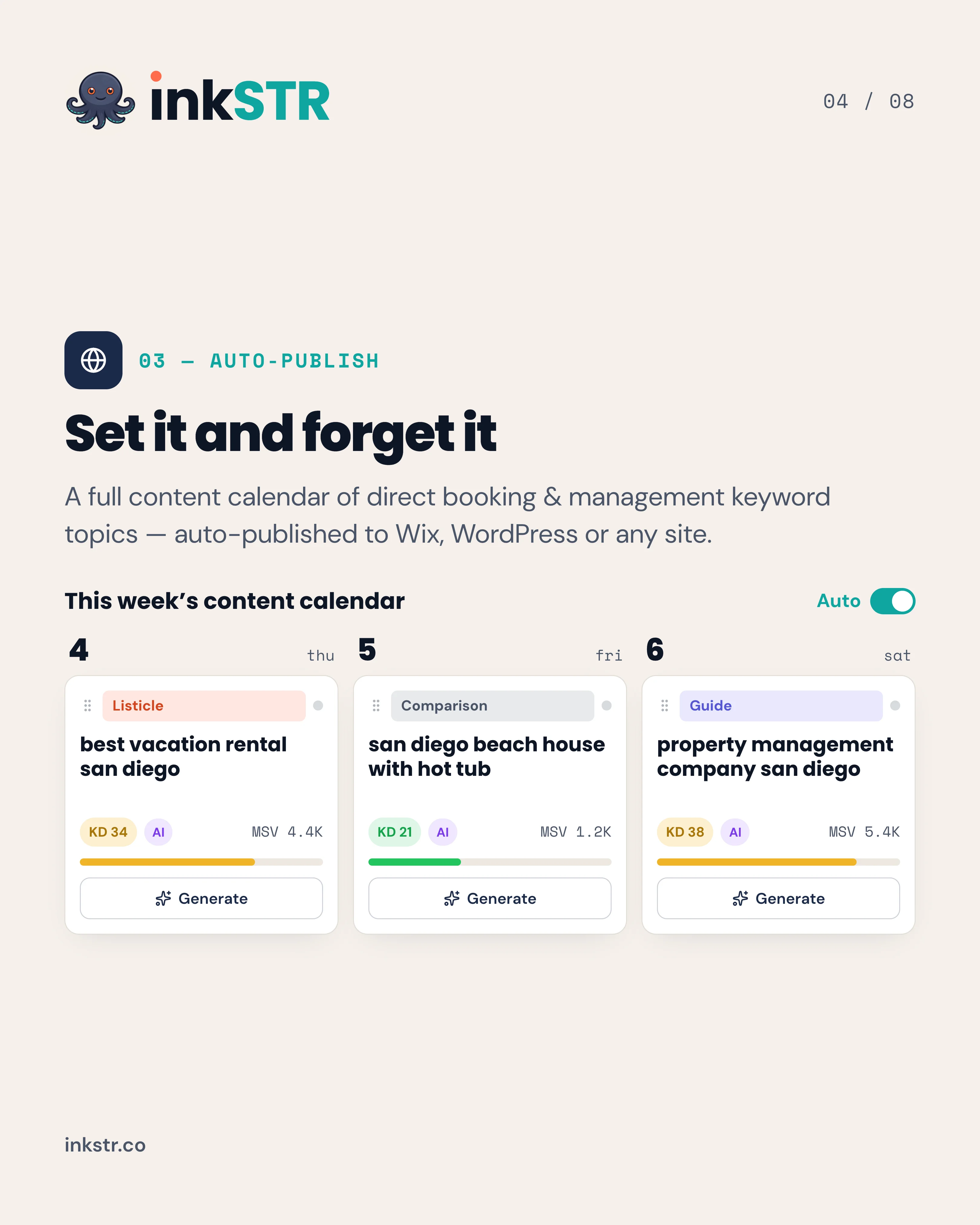
inkSTR removes the time cost entirely. The platform generates, schedules, and publishes articles automatically on a set cadence through Auto-Publishing, which pushes content directly to Wix, WordPress, or your custom site without you touching a single manual step. Starting at $99 a month, inkSTR costs less than a third of one freelance blog post, and it produces a consistent publishing schedule no solo host can match writing alone.
Ready to automate your content marketing?
inkSTR handles keyword research, content strategy, article writing, and publishing, all on autopilot.
What Should I Blog About for My Vacation Rental Website?
Effective vacation rental blog content falls into three categories: destination guides that target "things to do near [property]" searches, property-specific content answering booking hesitations, and seasonal posts that capture time-sensitive search demand like "best time to visit [destination]." Each category serves a different stage of the guest's search journey.
Most hosts default to generic travel writing, listicles of "top 10 restaurants" that could describe any city in America. That kind of content doesn't rank, because it competes against travel media sites with far more domain authority, and it doesn't convert, because it reads like it was written by someone who's never actually stayed in the area.
Specificity is what separates content that books guests from content that just fills a blog tab. Compare a generic "best hikes nearby" post to something with actual trail names, mileage, and seasonal notes specific to your property's location. For a full framework on this, see our guide on vacation rental blog topics that actually drive bookings and local area guides that sell.
This is precisely the content type inkSTR's AI Content Writer was built to produce. Because the platform is trained on STR terminology and traveler search intent rather than generic travel writing, it generates destination guides, seasonal posts, and property-specific FAQs that read with the local specificity guests and Google both reward.
Data and Evidence: What Drives Direct Booking Traffic in 2026
Concrete traffic data tells a consistent story: organic search and direct traffic together account for 70% of vacation rental industry visits, while paid search trails at just 16%, according to CUFinder's 2026 breakdown. That means most of the visibility battle happens through content and SEO, not ad spend.
| Traffic Channel | Share of Industry Traffic | What Drives It |
|---|---|---|
| Organic Search | 38% | Blog content, destination guides, keyword targeting |
| Direct Traffic | 32% | Returning guests, word of mouth, brand recall |
| Paid Search | 16% | Google Ads, social media ads |
Direct traffic converts at 3 to 5%, per hostAI's 2026 research, notably higher than typical cold organic traffic, because it's largely returning visitors with existing trust in the property. But you can't build a direct traffic base without first earning the organic visibility that introduces new guests to your brand.
Search behavior data reinforces this further. According to ShortTermRentalz, 42% of U.S. leisure travelers said Google Search impacted their travel provider decision on their last trip, and 40% of Google users making regional hotel queries are actually considering vacation rentals. Google Search is not a secondary channel for this industry, it's a primary decision point.
One more data point worth internalizing: ranking a vacation rental website on Google can move a site from position five to position two through structured SEO work, according to research published in ScienceDirect. That's the difference between page-one visibility and guests never scrolling far enough to find you.

Why Do My Competitors Rank First for Vacation Rental City Keywords?
Competitors rank first for city-specific vacation rental keywords, like "cabin rental Pigeon Forge" or "beach house Gulf Shores," because they've published consistent, keyword-targeted content over months or years, building the domain authority Google rewards over time. Ranking first is rarely about better property photos, it's about content volume and relevance.
Professional property management companies now control an estimated 42% of active short-term rental listings globally, and many run dedicated content teams publishing weekly. A solo host competing against that volume with sporadic blogging simply loses the search visibility battle, regardless of how good the property actually is.
The frustrating part is that this gap is entirely closeable with the right system, not a bigger budget. VRBO itself ranks on page one of Google for 94% of the vacation rental markets analyzed, according to BuildUp Bookings research, which means the search real estate is dominated by platforms and property managers who publish consistently, not necessarily the best properties.
inkSTR's Content Calendar and Auto-Publishing features exist to close exactly this gap for solo hosts and small portfolios. Instead of competing against a management company's content team with zero staff of your own, you get an automated pipeline producing keyword-targeted articles on the same cadence larger competitors run manually. Our guide on how to rank your vacation rental website on Google breaks down the specific tactics behind this.
Practical Guidance: How to Prioritize Your Direct Booking Content Strategy
Prioritizing content for a direct booking website means starting with high-intent, low-competition keywords before chasing broad destination terms that established sites already dominate. A new site targeting "vacation rentals [major city]" will lose to established competitors for years. Targeting "pet friendly cabin with hot tub near [specific landmark]" can rank within months.
Here's a practical sequence we recommend to operators starting from zero:
- Audit your current site for basic technical issues using a tool like Screaming Frog, checking for broken links, missing meta descriptions, and slow load times before investing in content.
- Research long-tail keywords specific to your property type and location rather than competing head-on for broad city terms.
- Publish consistently, aiming for two to four articles monthly rather than a single burst followed by silence.
- Build trust signals including transparent pricing, visible cancellation policy, and honest property descriptions that match your photos.
- Track ranking movement monthly and adjust keyword targets based on what's actually gaining traction.
Common mistakes to avoid: publishing generic travel content that could describe any property, writing one blog post and abandoning the strategy after a month with no results, and ignoring mobile page speed while most guest searches happen on phones. SEO also takes three to six months to show meaningful movement. If you need bookings in 30 days, paid ads move faster, but they stop the moment you stop paying, while content compounds over 2 to 5 years once it ranks.
This is the exact workflow inkSTR automates end to end. The How inkSTR Works page walks through the full pipeline from keyword identification to published article, so you're not rebuilding this process manually every month. Tools like Ubersuggest or SEMRush can supplement keyword discovery, but inkSTR handles research, writing, and scheduling in a single system built specifically for STR search intent.
Frequently Asked Questions
How long does it take for vacation rental blog content to rank on Google?
Most vacation rental blog content begins showing meaningful ranking movement within three to six months of consistent publishing, though highly specific long-tail keywords can rank faster. A ranking article typically keeps driving organic traffic for 2 to 5 years once it earns a page-one position, unlike paid ads that stop the moment spending stops.
Do I need a separate blog for each property I manage, or can I publish everything on one site?
A single blog can work for one or two properties in the same market, but portfolios spanning multiple destinations typically need separate content pipelines to keep keyword targeting and brand voice relevant to each location. inkSTR's multi-project architecture creates independent content pipelines per property, which prevents keyword and voice cross-contamination across a growing portfolio.
What is the difference between SEO content for a direct booking website and optimizing an Airbnb listing?
Airbnb listing optimization affects your ranking within Airbnb's internal search algorithm, based on factors like response time and reviews. SEO content for a direct booking website affects your ranking on Google, which requires an entirely separate strategy built on blog content, keyword targeting, and domain authority that Airbnb listings never build.
How many blog posts do I need to publish before I see organic traffic to my vacation rental site?
Most vacation rental websites see meaningful ranking movement after 12 to 20 published articles targeting a mix of destination keywords and long-tail booking intent queries. inkSTR's Content Calendar automates the scheduling needed to reach that volume without manually tracking every publish date.
Can AI-generated blog content actually rank on Google for vacation rental keywords?
Yes, AI-generated content can rank competitively when it's specific, well-structured, and targeted at real search intent rather than generic filler. The quality bar is the same as human-written content: specificity, keyword relevance, and genuine usefulness to the reader matter more than who or what wrote it.
What types of blog posts drive the most direct booking conversions?
Destination guides answering "things to do near [property]" and property-specific FAQ posts addressing booking hesitations, like parking or check-in logistics, tend to convert best because they meet guests at the exact moment they're deciding whether to book. Generic travel listicles rarely convert because they read the same on every competitor's site.
Is it worth paying a freelance content writer for my vacation rental instead of using AI tools?
A freelance travel writer typically charges $300 to $700 per quality blog post and takes days to turn around a single article, which makes consistent publishing expensive and slow for most solo hosts. inkSTR starts at $99 a month and generates, schedules, and publishes articles automatically, making it a fraction of the cost of freelance writing at scale.
Conclusion: Building a Direct Booking Website That Actually Gets Found
Driving direct bookings through your vacation rental website in 2026 comes down to one uncomfortable truth: the design and booking engine matter far less than the content strategy behind them. Organic search already accounts for 38% of industry traffic, and that share keeps growing as the vacation rental market itself expands toward a projected $101 to $109 billion this year alone.
The operators winning that traffic aren't the ones with the prettiest websites. They're the ones publishing consistent, keyword-targeted content month after month, building the domain authority that compounds for years instead of stopping the moment ad spend runs out. Start with long-tail keywords specific to your property, publish on a real schedule, and track what actually moves rankings.
If building and maintaining that pipeline manually sounds like another full-time job on top of running your properties, that's the exact gap Get started with inkSTR was built to close, from keyword research through published article, on autopilot.
If you're ready to stop guessing at your content schedule, inkSTR's content calendar shows exactly what's publishing and when, so your direct booking website keeps gaining ground every month instead of sitting idle between posts. See pricing plans starting at $99 a month.
Content powered by inkSTR.co
Enjoyed this article? Share it:
Get more of inkSTR in Google Search
Add inkstr.co as a preferred source and our articles show up more in Top Stories, AI Overviews, and AI Mode — with a “Preferred” badge.
Get more guides like this
New SEO and AI-search guides, straight to your inbox. No spam, unsubscribe anytime.