How to Create Content for Airbnb Hosts That Books Direct

The most effective way to create content as an Airbnb host is to publish keyword-targeted blog posts, local area guides, and seasonal travel articles on your own website, so that guests discover your property through Google search before they ever open the Airbnb app. This approach builds a compounding organic traffic engine that works independently of the platform's algorithm and reduces your dependence on OTA commissions over time.
- Creating content for your Airbnb hosting business means publishing keyword-targeted blog posts, local guides, and seasonal articles that rank on Google before guests ever open Airbnb.
- A single ranking article can drive organic search traffic for 2 to 5 years, making it one of the highest-ROI marketing investments available to STR operators.
- According to BuildUp Bookings (2019), Airbnb appeared on the first page of Google for vacation rental searches in 79% of top markets analyzed, but landed in the top 3 results only 5% of the time, leaving enormous organic opportunity for individual hosts who publish quality content.
- Writing one quality blog post manually takes 3 to 5 hours of research and writing, while a freelance travel writer typically charges $300 to $700 per post.
- The content types that attract guests earliest in the booking journey are local area guides, seasonal travel itineraries, and destination FAQ posts, not property description copy.
- inkSTR automates the full content pipeline for STR operators, from keyword research to scheduled publishing, so hosts can maintain a consistent blog cadence without writing a single post manually.
You built a direct booking website. Maybe you spent real money on the design, wrote your best property description, and waited for traffic that never came. That is the experience of most Airbnb hosts who try content marketing without a system behind it. The problem is rarely the property. The problem is that without consistently published, keyword-targeted blog content, your website is invisible to the search engines that your future guests use every day.
At inkSTR, we have worked with STR operators across beach towns, mountain retreat markets, and urban apartment corridors. The pattern is consistent: the hosts generating reliable direct booking traffic are not the ones with the most stunning photography. They are the ones publishing educational content that shows up when a traveler searches "best cabin with hot tub near Asheville" or "things to do in Gulf Shores with kids" three months before their trip.
In 2026, the vacation rental market is projected to exceed $100 billion globally according to The Business Research Company, and the competition for guest attention has never been sharper. This guide covers exactly how to create content that finds guests before they ever search a listing, and how to do it without burning 15 hours a week on your laptop.

What Does It Mean to Create Content as an Airbnb Host?
Creating content as an Airbnb host means producing written, visual, or video material that answers the questions your ideal guests are already searching online, and publishing it in a way that search engines can find, index, and rank. It is not the same as updating your Airbnb listing description or posting on Instagram. Content creation, in the SEO sense, refers to articles, guides, and destination posts published on your own website or blog that you own and control.
Most hosts never make this distinction. They spend time perfecting their Airbnb title (which Airbnb suggests keeping to four simple descriptive words), polishing their listing photos according to Airbnb's own photography guidelines, and writing guest-facing descriptions. All of that is important. But it lives entirely inside Airbnb's walled garden. The moment a potential guest leaves that app and types their destination into Google, your listing disappears unless you have external content waiting for them.
The guests most likely to book directly, pay full price without heavy discount shopping, and return for future stays are the ones who discovered you through a blog post or local guide you published months ago. They arrived with context, with trust already built, and with a strong preference for your property before they compared a single competitor listing.
That is the goal of STR content marketing: reach guests at the research stage, before intent has fully crystallized into a platform search. Executing it consistently is where most operators struggle, not because the strategy is wrong, but because the production process is genuinely time-consuming without the right system behind it.
What Is the 80/20 Rule for Airbnb Content?
The 80/20 rule for Airbnb content means that 80% of your published content should deliver genuine educational value to your target guest, covering destination guides, local experiences, travel itineraries, and seasonal tips, while only 20% should directly promote your property or push a booking call to action. This ratio builds trust with readers, signals topical authority to Google, and positions you as the local expert rather than just another listing.
Here is where most hosts get it backwards. They sit down to write their first blog post and immediately write about their property: the bedrooms, the amenities, the check-in process. That content has an audience of almost zero, because nobody is searching "tell me about this specific Airbnb." They are searching for information about the destination itself.
Writing 80% destination content and 20% property promotion feels counterintuitive when your goal is bookings. But the math works out because the destination content drives organic traffic, and the traffic converts when readers trust you enough to click through to your listing or direct booking page. The property content then closes the deal. Neither works without the other, but the educational 80% is what gets guests in the door.
In practical terms, for every promotional post you write about your property, plan four destination-focused pieces: a local restaurant guide, a hiking trail itinerary, a weekend getaway packing list, a seasonal events calendar. Citedy's 2026 research found that over 60% of high-ranking travel content now aligns with informational or navigational intent, not transactional. The algorithm rewards the 80/20 approach directly.
Step 1: Identify the Keywords Your Future Guests Are Already Searching
Keyword research for STR content is not about finding the highest-volume travel term you can target. It is about finding the specific informational queries your ideal guest types into Google while planning a trip to your destination, three to twelve weeks before they ever open a booking platform.
Start with your destination name plus a traveler intent modifier: "things to do in [city] with kids," "best weekend getaways near [city]," "where to stay in [city] for couples." These phrases have genuine monthly search volume and relatively low competition from major travel publishers, particularly when they include long-tail qualifiers. Tools like Ubersuggest can help you identify which variations in your market have the most accessible ranking potential.
Most hosts skip keyword research entirely and write whatever comes to mind. The result is content that gets zero search traffic because it targets no specific query. We built inkSTR's Keyword Research tool specifically for STR operators who want to skip the learning curve: it identifies which destination and property-type keywords your target guests are searching, maps them to content formats, and gives you a prioritized list to publish against. No SEO background required.
Step 2: Build a Content Calendar Around Seasonal Demand
Short-term rental markets run on seasonality, and your content calendar should mirror that pattern. Coastal markets need beach packing guides published in March, not July. Mountain cabin markets need fall foliage itineraries live by August. Urban markets need holiday event roundups six to eight weeks before the dates they cover.
The critical timing error most hosts make is publishing seasonal content after the demand peak has passed. Google needs four to twelve weeks to fully index and rank new content. A blog post about New Year's Eve in your city, published on December 28th, will rank just as the holiday ends. Publish it in October and you have a two-month window to capture planning traffic.
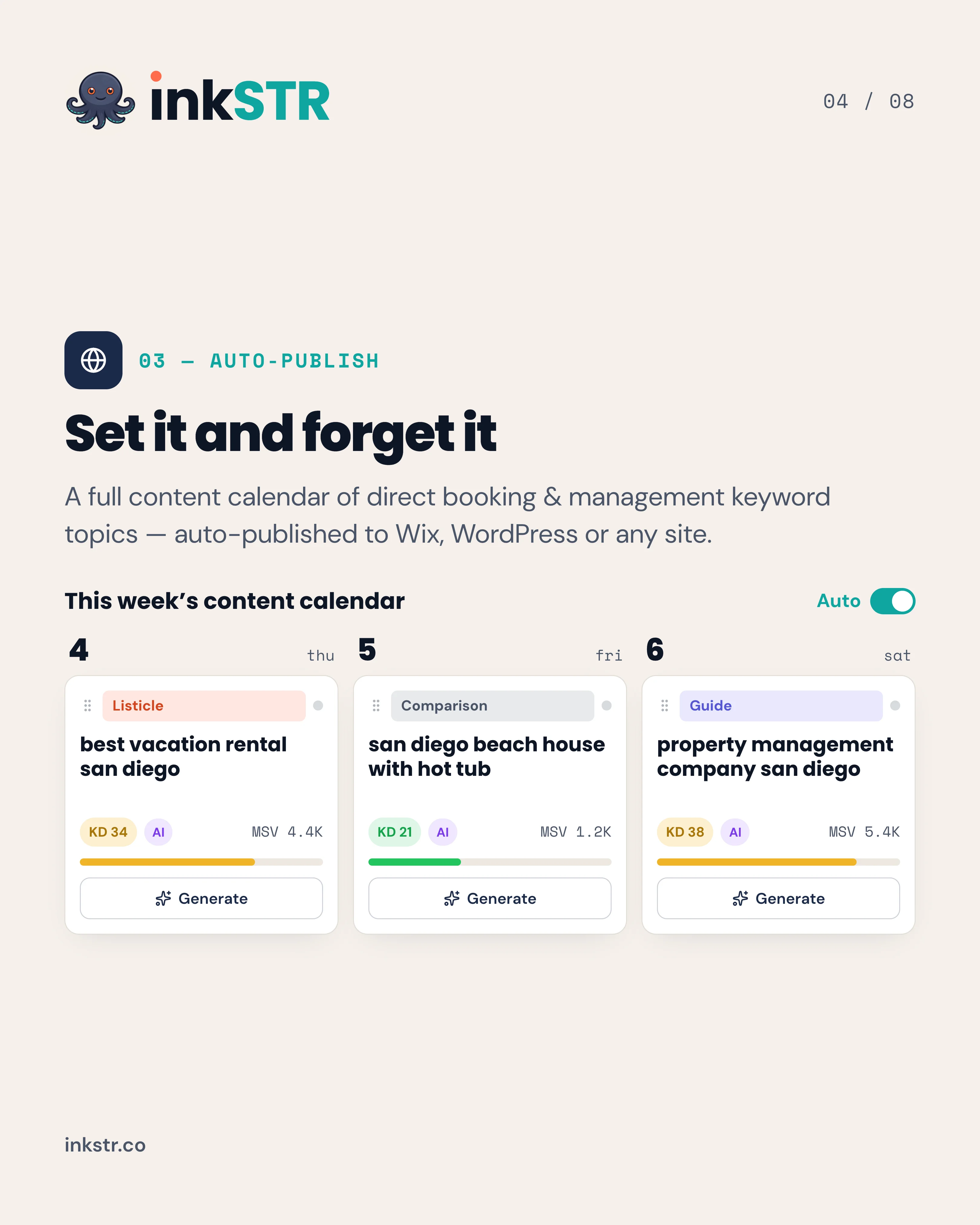
Planning and maintaining that kind of forward-looking calendar manually is genuinely difficult. inkSTR's Content Calendar automates the scheduling side, so articles are queued, written, and set to publish at the optimal timing window for each season without you tracking every deadline by hand.
What Is the 75-55 Rule in Airbnb, and Why Does It Apply to Content?
The 75-55 rule in Airbnb refers to the platform's search algorithm weighting, where listings that maintain at least a 75% acceptance rate and a minimum 55% booking completion rate receive favorable positioning in search results. For content strategy, this matters because the hosts who rank well inside Airbnb are not necessarily the same hosts who rank well on Google, and building content that captures external organic traffic gives you a second, entirely independent traffic channel that the platform's internal rules cannot touch.
Relying solely on Airbnb's internal algorithm puts your occupancy at the mercy of platform rule changes you have no control over. The operators who have stable, predictable booking calendars in 2026 are the ones who built an audience outside the OTA. A direct booking website backed by keyword-targeted content does exactly that.
There is also a revenue argument. Airbnb charges combined host and guest fees of 17 to 19% of every booking value. On a $2,000 booking, that is $340 to $380 leaving your pocket. A single direct booking from your blog at that value covers the cost of several months of content production. A library of ranking articles producing steady direct bookings over two to five years changes the unit economics of your entire operation.
This is not a theoretical benefit. It is a structural shift in how guests find you. The 75-55 rule governs what happens inside Airbnb's platform. Your blog content governs what happens everywhere else on the internet. Both matter, but only one you actually control. For a deeper look at how search signals translate to bookings, the post on ranking on Google for STR-specific factors covers the mechanics in detail.
How Do You Structure Blog Content That Actually Converts Readers Into Guests?
Blog content that converts readers into guests follows a specific structural logic: it starts by answering a genuine traveler question, builds trust through local expertise and useful detail, and ends with a natural, low-pressure invitation to view the property or book directly. Conversion happens when the reader finishes the article feeling that you understand their trip better than any other source they have consulted.
Generic travel content does not convert. A listicle of "10 things to do in Sedona" that reads identically to every other Sedona guide on the internet signals nothing about your property, your expertise, or your market. Guests click through from blog posts when the content is specific enough to feel authored by someone who genuinely lives in or near the destination.
The structural framework that works across STR markets is: answer the traveler question fully, add local detail that only an insider would know, weave in one organic mention of your property where it fits naturally, and close with a soft call to action. Citedy's 2026 data found that content based on real user intent has a 3x higher chance of ranking in the top 10 than content built around keyword tools alone. Intent-first structure and local specificity together produce the combination Google and your guests both reward. Our article on why generic travel content kills conversions covers this failure mode in more depth.

Step 3: Write Local Area Guides That Answer Real Traveler Questions
Local area guides are the single highest-converting content format for STR operators because they match the exact search intent of guests in the research phase of their booking journey. A guest searching "best restaurants near [your neighborhood]" or "what to do in [your city] for a long weekend" is actively planning a trip. They have not booked anything yet. Your guide is the first credibility signal they encounter.
An effective local area guide names specific places, explains what makes them worth visiting, and includes practical details like hours, parking, and best times to go. Vague endorsements ("there are many great dining options") add nothing. Specific recommendations ("the waterfront oyster bar two blocks from the main marina is worth the walk and tends to be quieter on Tuesday evenings") build the trust that turns a reader into a guest.
Structure each guide around a single traveler type or use case: families with young children, couples on a romantic weekend, adventure seekers, remote workers on a workcation. A guide tailored to one audience type will outrank a generic one for the specific long-tail queries that audience types into Google. It also signals to the reader that your property is the right fit for them specifically.
Our blog post on local area guides that sell has a detailed framework for building these guides from scratch, including how to structure them for both Google ranking and direct booking conversion.
Step 4: Create Seasonal and Event-Driven Content Before Demand Peaks
Seasonal and event-driven content captures guests at the exact moment their travel intent forms, which is almost always weeks or months before the event itself. An article covering a major local festival, a holiday weekend, or a seasonal attraction published eight to twelve weeks before the event has time to rank and reach planning guests when their decisions are still open.
Event hashtag strategy also extends this approach to social and discovery channels. Planning content around anchors like a regional music festival, a fall foliage season, or a marathon weekend gives you a natural publishing hook and connects your property to a high-intent search cluster your guests are already forming.
The planning discipline required to execute this consistently is where most solo hosts fall short. Life and property management get in the way. inkSTR's automated scheduling system handles the calendar logic: once you set the publishing cadence, articles go live at the right time without you tracking every date manually. That is the operational difference between content marketing that compounds and content marketing that stalls after three posts.
Is $100 a Night Expensive for Airbnb, and How Does Content Help Justify Your Rate?
Whether $100 a night is expensive for an Airbnb depends entirely on the destination, the property type, and the perceived value a guest forms before they ever see your listing. Content marketing directly shapes that perception. A host with a library of detailed local guides, guest experience posts, and property-specific articles arrives in the guest's mind as a credible, established local expert, and guests pay a premium for credible local experts.
Price sensitivity is largely a trust problem. When a guest finds your property by clicking through from a thoughtful guide you wrote about their destination, they arrive pre-sold. They already trust your recommendations. Your rate feels anchored to a local authority, not compared against the cheapest available option on a grid of similar listings.
The hosts who compete purely on OTA listings compete purely on price. The hosts who build an off-platform content presence compete on value and expertise. Both audiences exist, but the content-driven audience books at higher rates, leaves better reviews, and returns more often. According to our experience working with STR operators across the country, the direct booking guests who arrive through blog content are consistently the guests who treat the property well and generate the most repeat business.
Content that justifies premium pricing does not say "our property is worth $200 a night." It shows the guest why the experience is worth it through descriptions of the destination, the activities, and the quality of stay they should expect. The listing price feels like the natural conclusion of the value already demonstrated. For a broader look at how positioning affects revenue, see our post on STR market positioning strategies.
Ready to automate your content marketing?
inkSTR handles keyword research, content strategy, article writing, and publishing, all on autopilot.
What Are Red Flags for Airbnb Hosts When Building a Content Strategy?
The most common red flags for Airbnb hosts building a content strategy are publishing without keyword research, writing only about the property itself, inconsistent publishing cadence, and failing to build any content outside the Airbnb platform. Each of these mistakes produces the same result: content that gets no search traffic and converts nobody.
Publishing without keyword research is the most expensive mistake in terms of wasted time. Writing about a topic nobody searches, regardless of how well you write it, produces zero organic traffic. Every post needs to target a specific query with verifiable search volume before you invest hours producing it.
Writing only about the property is the second most common failure. Your guests are not searching "tell me about this Airbnb." They are searching about your destination. Content that focuses exclusively on the property's features has no audience at the research stage of the booking journey, which is when content marketing does its most important work.
Inconsistent publishing is the final deal-breaker. Google rewards sites that publish regularly and penalizes those that go dark for months at a time. A burst of five posts followed by six months of silence does almost nothing for domain authority. Two posts per month, published consistently, outperforms ten posts in a single month followed by nothing. That is why inkSTR's Auto-Publishing feature exists: it removes the manual execution barrier so your schedule stays intact even during your busiest hosting seasons.
Hosts should also watch for the trap of repurposing OTA content as blog content. Your Airbnb listing description is written for guests who are already on the platform. A blog post is written for guests who are still on Google. The intent, the format, and the length are entirely different. Copying one into the other wastes the opportunity both channels represent.
How Can Hosts Turn Blog Content Into a Direct Booking Engine?
Hosts turn blog content into a direct booking engine by combining consistent keyword-targeted publishing with a clear path from article to booking page. Specifically, this means embedding a direct booking call to action within each post, capturing email addresses from readers who are not yet ready to book, and building a content library large enough that organic traffic compounds month over month.
The mechanics work as follows. A guest searches a destination-specific query on Google. Your blog post appears in the results because it was built around that exact query. The guest reads the guide, trusts your local expertise, and clicks a link to your direct booking page at the bottom. If they are not ready to book immediately, they opt into your email list in exchange for a local guide or packing list PDF. You follow up with additional destination content and a booking link over the following weeks. That sequence converts at a higher rate than any OTA listing because the guest arrived with trust already established.
Building this engine requires three components: content that ranks, a direct booking page that converts, and an email capture mechanism that keeps non-converting visitors in your orbit. Most hosts have the booking page. Few have the content pipeline or the email sequence. The content piece is where the leverage is highest, because a ranking article continues working for two to five years after publication with no additional spend.
If you want to understand the full workflow behind turning blog readers into direct booking guests, our post on why your blog content is not converting visitors into guests diagnoses the most common structural gaps and how to fix them. inkSTR's AI Content Writer generates the keyword-targeted articles that fuel the top of this funnel, publishing complete, SEO-optimized posts without you spending 3 to 5 hours per piece writing them yourself.
Frequently Asked Questions
How long does it take for Airbnb host blog content to rank on Google?
Most new blog posts from a relatively new domain take four to twelve weeks to appear in search results and three to six months to reach meaningful ranking positions. Competitive destination keywords take longer. Long-tail queries, such as specific local guides or niche activity posts, often rank faster because fewer established sites are targeting them. Consistent monthly publishing accelerates this timeline by building domain authority progressively rather than in isolated bursts.
Do I need a separate website to publish content as an Airbnb host?
Yes. Content published on your own website is the only kind you actually own. Blog posts published inside the Airbnb platform do not exist. Your own site, whether built on WordPress, Wix, or another platform, is the only place where keyword-targeted articles can rank on Google and build domain authority over time. inkSTR's Auto-Publishing feature connects directly to both Wix and WordPress, so articles are published to your site automatically without manual uploads.
What blog topics drive the most direct bookings for vacation rental hosts?
The highest-converting blog topics for STR operators are local area guides, seasonal activity itineraries, destination FAQ posts, and "best [property type] in [destination]" roundups that position your property naturally within a curated list. These formats match the informational search intent of guests in the research phase of their booking journey. Promotional posts about the property itself convert fewer readers because they attract guests who are already committed to a specific listing search, not guests still exploring options.
How many blog posts does an Airbnb host need before seeing organic traffic?
Most vacation rental websites begin seeing measurable organic search traffic after 12 to 20 published articles that each target a distinct, researchable keyword. The exact number depends on domain age, niche competition, and content quality. Publishing fewer than ten posts rarely produces consistent traffic because Google has insufficient content to establish topical authority for your domain. inkSTR's Content Calendar automates the scheduling logic to help you reach that baseline without manually tracking every publish date.
Can AI-generated content actually rank on Google for vacation rental keywords?
Yes, when the content is structured around genuine search intent, uses STR-specific terminology correctly, and is published with proper SEO formatting. Generic AI content fails to rank not because it is AI-generated but because it is vague, poorly structured, and targets no specific query. inkSTR's AI Content Writer is trained specifically on vacation rental terminology, traveler search behavior, and location-based SEO patterns, which produces content that reads as authored by a genuine industry practitioner rather than a generic writing tool.
Is it worth creating content if I only have one Airbnb property?
Absolutely, and single-property hosts often have an advantage because their content can be tightly focused on one specific destination market and one specific guest persona. A focused content strategy covering 15 to 20 destination-specific articles can generate meaningful direct booking traffic for a single property within six to nine months. The revenue from even two or three direct bookings per month, each worth $1,000 to $4,000, more than justifies the content investment.
How do I repurpose my Airbnb guest reviews into content?
Guest reviews are a source of actual traveler language, which is exactly the language your future guests type into search engines. Pull recurring phrases from your reviews, such as "perfect for a girls' weekend" or "great base for exploring the national park," and build blog posts that target those exact search queries. You can also quote specific reviews within destination guides to add social proof and first-person credibility to content that would otherwise be entirely editorial.
What is the 80/20 rule for Airbnb content, and should I follow it?
The 80/20 rule means publishing 80% destination-focused educational content and 20% property-promotional content. Following this ratio is strongly recommended because it matches how Google rewards content (informational intent) and how guests build trust (through perceived local expertise rather than direct advertising). Hosts who publish only property promotional content attract almost no organic search traffic because those posts target no meaningful guest search query. The educational 80% is what gets guests to your site; the 20% is what closes the booking.
The Content Strategy That Compounds Over Time
Building organic traffic as an Airbnb host is not a single-post project. It is a system: the right keywords, the right content structure, and a publishing cadence that adds articles to your site every month without fail. The hosts who reduce their dependence on Airbnb are not the ones who got lucky with one viral post. They are the ones who built that system and let it compound.
The math is straightforward. A ranking blog article drives organic search traffic for two to five years after publication. A library of 20 well-targeted articles produces a compounding traffic effect that no single listing optimization, no matter how polished, can replicate. Each article is a permanent asset that works while you are managing guests, maintaining the property, and doing everything else that running a short-term rental demands.
In 2026, with the vacation rental market more competitive than at any point in its history, the hosts who will own their occupancy calendars are the ones who started building their content engines now. The operators still relying entirely on OTA algorithms will find that platform fee structures and search visibility rules continue shifting in ways they cannot control.
If you want the content system running without doing every piece manually, inkSTR handles the full pipeline: keyword research, article generation, scheduling, and publishing directly to your Wix or WordPress site on autopilot. Starting at $99 per month, a single direct booking worth $1,000 to $4,000 covers the cost many times over. Start building the content engine that works for you while you sleep. See how inkSTR works and start your free trial today.

Content powered by inkSTR.co
Enjoyed this article? Share it:
Get more of inkSTR in Google Search
Add inkstr.co as a preferred source and our articles show up more in Top Stories, AI Overviews, and AI Mode — with a “Preferred” badge.
Get more guides like this
New SEO and AI-search guides, straight to your inbox. No spam, unsubscribe anytime.