STR Market Positioning Strategies: Stand Out When Every Host Claims to Be Unique

Effective STR market positioning strategies are the difference between a listing that commands premium rates and one that competes on price alone. Positioning is not your amenity list or your star rating. It is the clear, specific reason a guest chooses your property over every other option at the exact moment they are deciding. In 2026, with vacation rental inventory growing and guests scrolling faster than ever, vague positioning is a booking killer.
TL;DR
- Most STR operators describe their properties using features (hot tub, mountain view, fast Wi-Fi) rather than communicating an emotional identity, which is the actual driver of booking decisions.
- The 4 core positioning types are: price-based, feature-based, niche/audience-based, and experience/identity-based. Identity-based positioning is the hardest to copy and the most durable.
- The 80/20 rule applied to Airbnb means roughly 20% of your listing elements drive 80% of your conversion results. Identifying those elements is the first practical step in repositioning.
- The 3 C's of brand positioning (Company, Customer, Competition) give you a simple audit framework for finding the gap where your property can credibly own a specific identity.
- Pricing is itself a positioning signal. The rate you set communicates quality, exclusivity, and target audience before a guest reads a single sentence of your description.
- At inkSTR, we help STR operators translate their positioning strategy into consistent, SEO-optimized content that reaches the right guests through organic search, so the work you put into differentiation actually gets found.
Table of Contents
- Why Every STR Listing Sounds Identical (And How to Fix It)
- What Are the 4 Types of Positioning Strategies?
- What Are the 3 C's of Brand Positioning?
- What Is the 80/20 Rule for Airbnb?
- What Is the 75-55 Rule for Airbnb?
- How to Conduct a Competitive Audit on OTA Platforms
- How Pricing Communicates Your Position Before Guests Read a Word
- Platform-Specific Positioning: Airbnb vs. VRBO vs. Direct Booking
- How to Write a Positioning Statement for Your STR
- Turning Your Positioning Into Content That Drives Organic Bookings
- FAQ: STR Market Positioning
- Conclusion
Why Every STR Listing Sounds Identical (And How to Fix It)
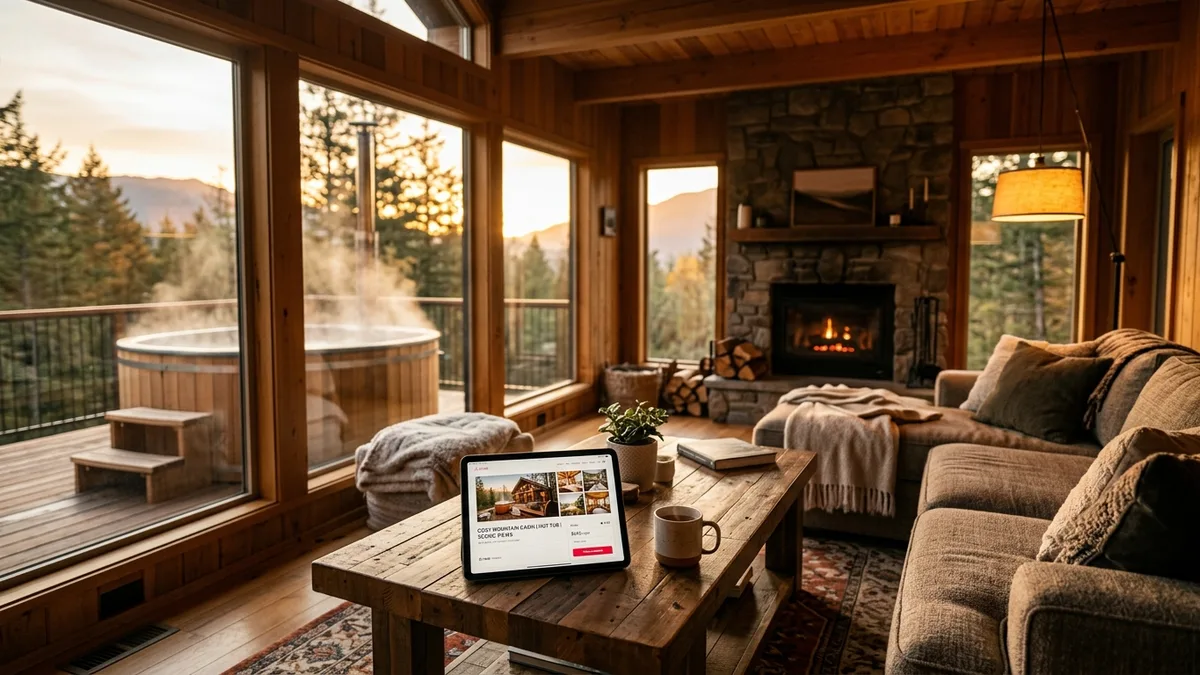
You already know your property has something worth talking about. The problem is that your current listing describes it the same way every other host does. "Cozy cabin with hot tub and mountain views." "Modern downtown apartment, steps from everything." "Spacious family home with fully equipped kitchen." These headlines describe features. They do not communicate an identity.
Guests do not book features. According to Fortune Business Insights, more than 35% of travelers now favor vacation rentals over hotels, and that preference is driven by a desire for experience and authenticity, not square footage. When a guest chooses your property, the emotional trigger is something closer to "this is the place where I will finally disconnect" or "this is where our family will make a real memory" than "this has four bedrooms and a grill."
The painful reality: most hosts spend hours photographing their property, writing bullet-pointed amenity lists, and optimizing their nightly rate while completely ignoring the one thing that separates bookings from browsing. That is emotional positioning. And without it, you are competing on price by default.
At inkSTR, we see this pattern consistently across the vacation rental websites we work with. Operators invest in the physical product but publish content that sounds generic because they have no framework for communicating what makes their property emotionally specific. The sections below give you that framework.
What Are the 4 Types of Positioning Strategies?
The 4 types of positioning strategies for short-term rentals are: price-based positioning, feature-based positioning, niche or audience-based positioning, and experience or identity-based positioning. Most STR operators default to the first two without realizing it, which is exactly why their listings get lost.
Price-Based Positioning
Price-based positioning means competing as the most affordable option in your market. It works, but only as a short-term strategy. When a new listing undercuts you, your occupancy drops overnight. Grand View Research estimates the global vacation rental market will grow at a CAGR of 3.7% through 2033, meaning more inventory is entering every market every year. Racing to the bottom is a race with no finish line.
Feature-Based Positioning
Feature-based positioning means leading with amenities: the hot tub, the pool table, the Tesla charger. This is better than competing on price, but it is fragile. Any competitor can add a hot tub next season. Properties featuring quality hot tubs typically achieve 25 to 35% higher nightly rates than comparable properties without them, according to KeyData Dashboard analysis, but that premium erodes once the amenity becomes standard in your competitive set.
Niche or Audience-Based Positioning
Niche positioning means targeting a specific guest type: remote workers needing a dedicated desk and fiber internet, multi-generational families needing two master suites, wellness travelers seeking a digital detox. This is where things get genuinely interesting. When your listing speaks directly to one type of guest, it resonates far more strongly with that person than a generic listing does with anyone. The downside is that you need to actually know who that guest is, which requires real research.
Experience or Identity-Based Positioning
Identity-based positioning is the most durable and the hardest to replicate. Instead of listing what your property has, you communicate what a stay there feels like and what kind of person chooses it. "Your Off-Grid Reset: A Modern Cabin for Reconnecting with What Matters" says nothing about the hot tub but communicates the exact emotional outcome a certain guest is searching for. That guest will scroll past twenty other listings to book yours.
We built inkSTR's AI Content Writer specifically to help operators move from feature lists to identity-driven content, generating blog posts and landing page copy that speak directly to the emotional triggers driving booking decisions in your market.
What Are the 3 C's of Brand Positioning?
The 3 C's of brand positioning are Company, Customer, and Competition. Applied to vacation rentals, this framework gives you a structured audit for finding the exact positioning territory your property can credibly own without fabricating an identity it cannot deliver.
Company: What Can You Actually Own?
Start with honest self-assessment. What is genuinely true about your property that you could defend in a guest review? Location, architecture, a specific view, the surrounding neighborhood, a unique design decision, proximity to a particular type of activity. Your positioning must be grounded in something real, because a guest who feels misled will say so publicly. According to academic research published in PubMed Central, online reviews are a central source of information in travel decision-making, which means overpromising your positioning gets punished fast.
Customer: Who Is Actually Booking You Right Now?
Pull your booking history and look for patterns. What is the average party size? Are bookings concentrated around weekends, holidays, or mid-week remote work stays? Are guests coming from cities two to four hours away or flying in from across the country? These patterns tell you who already self-selects your property, which is often a better signal than who you think you should be targeting. The normalization of remote and hybrid work has created sustained demand for STR properties with dedicated workspace areas, a trend that represents a viable niche for hosts in the right location.
Competition: Where Is the White Space?
The third C is where most operators stop short. They know their competitors exist but they never systematically analyze how those competitors are positioned. Spend thirty minutes searching your market on Airbnb and VRBO. Read the first ten listing titles and the first paragraph of each description. You will almost certainly find that everyone in your market is using the same three adjectives and describing the same five amenities. The gap between what everyone else is saying and what a specific guest type actually wants is your positioning opportunity.
In our experience working with STR operators at inkSTR, the 3 C's audit takes about two hours when done properly and surfaces at least one positioning angle that no competitor in the market is currently using. That angle becomes the foundation for every piece of content, from your listing headline to your direct booking website's blog posts.

What Is the 80/20 Rule for Airbnb?
The 80/20 rule for Airbnb holds that roughly 20% of your listing elements drive 80% of your conversion results. In practice, this means your cover photo, your listing title, and your first paragraph of description generate the overwhelming majority of clicks and inquiries, while the remaining content (your full amenity list, your house rules, your neighborhood section) plays a supporting role at best.
This matters enormously for positioning because it tells you where to invest your strategic energy. Hosts spend hours perfecting their amenity checklist while leaving their title generic. The title is the one element that appears in search results before a guest has seen a single photo. It is the first positioning signal you send.
Consider the practical implication. If your title currently reads "Charming 3BR Cottage Near Lake," you are competing with every other charming cottage near every other lake. Rewrite it to speak to a specific guest identity: "The Lake House for People Who Actually Want to Unplug" or "Modern Cottage for Families Who Hike, Paddle, and Cook Together." Neither title lies about your property. Both communicate something emotionally specific that a certain guest will immediately recognize as written for them.
Your cover photo operates under the same 80/20 logic. Most hosts choose the photo that makes their living room look largest. But the photo that converts best is usually the one that communicates the emotional experience most clearly: the view from the hot tub at dusk, the coffee mug on the porch railing with the forest in the background, the dining table set for six with the lake visible through the window. These images tell a story before a guest reads a word.
When we build content strategies for operators through inkSTR's Keyword Research tool, we apply the same 80/20 logic to organic search: identify the few high-intent search terms that drive the most qualified traffic and build content around those first, rather than trying to rank for everything simultaneously.
What Is the 75-55 Rule for Airbnb?
The 75-55 rule for Airbnb is a listing optimization benchmark, sometimes cited in host community forums, that suggests your listing should achieve at least 75% of the possible completeness score on the platform and maintain a response rate of at least 55% within a specified window to qualify for stronger algorithmic visibility. The specific thresholds vary by market and platform version, and Airbnb's official documentation on Airbnb ranking factors confirms that listing completeness and response behavior both influence search placement.
The practical takeaway is not the specific numbers. It is the underlying principle: platforms reward listings that demonstrate engagement signals and completeness. An incomplete listing, regardless of how well-positioned its headline is, will be suppressed in search results before a guest ever sees the copy you worked hard to craft.
Think of this as the technical baseline your positioning needs to sit on. You can have the most emotionally resonant listing identity in your market, but if your calendar is inconsistently updated, your response rate is low, or your listing is missing key fields, the algorithm will show your competitors first. Booking.com uses a similar system through their Property Page Score that directly correlates listing completeness to booking performance.
The 75-55 rule also has a content implication. A complete listing is not just one with all fields filled in. It is one where every field contributes to the same positioning narrative. Your description, your neighborhood section, your house rules, and even your host bio should all reinforce the same identity. Most listings are internally inconsistent: an identity-driven headline followed by a generic amenity dump followed by a defensive house rules section. That inconsistency erodes trust and undercuts the positioning signal you established in the title.
This is exactly the type of content problem inkSTR was built to solve. Our AI Content Writer generates listing copy and blog content that maintains consistent voice and positioning signals across every touchpoint, from your direct booking website to your organic search presence.
How to Conduct a Competitive Audit on OTA Platforms
Most guides on STR positioning tell you to "know your competition" without explaining how. Here is the actual process we recommend at inkSTR, and it takes under two hours.
Step 1: Run Your Market Search as a Guest Would
Open Airbnb or VRBO in a private browser window and search for your market using the dates, guest count, and filters a typical guest would use. Do not filter by price yet. Screenshot the first page of results, including titles and cover photos.
Step 2: Catalog the Positioning Language
Open a spreadsheet and record the first line of each listing title in the results. Note the adjectives used, the amenities mentioned, and whether any listing is trying to speak to a specific guest type. In most markets, you will find that 70 to 80% of listings use the same vocabulary: "cozy," "spacious," "modern," "perfect location," "fully equipped." These words have lost all meaning through overuse.
Step 3: Read the Top-Performing Listings Carefully
Sort by "Top Rated" or the platform's equivalent and read the first paragraphs of the top five listings. Note whether they describe features or communicate an experience. Note whether they address a specific guest type. Note any emotional language. These are the listings your positioning needs to stand apart from, not match.
Step 4: Identify the White Space
After cataloging what competitors are saying, map what they are not saying. Which guest personas are completely unaddressed? Which emotional outcomes are mentioned by nobody? Which design sensibilities, local experiences, or travel motivations are absent from every listing in the market? That absence is your opportunity.
For example, if every cabin listing in a mountain market emphasizes adventure and outdoor activity, a listing that speaks to recovery, rest, and slow mornings is positioning itself against zero direct competitors, while still attracting guests searching in the same market. The guest who wants to hike aggressively has many options. The guest who wants to do absolutely nothing has almost none.
Learning how to rank on Google for the searches these underserved guest types make is the next step after identifying the white space in your OTA market.
Ready to automate your content marketing?
inkSTR handles keyword research, content strategy, article writing, and publishing, all on autopilot.
How Pricing Communicates Your Position Before Guests Read a Word
Price is a positioning signal, not just a revenue lever. The rate you set communicates something to a potential guest before they have clicked your listing, before they have read your title, and certainly before they have seen your photos. Most hosts understand pricing as a supply and demand exercise. Fewer understand it as a branding decision.
When your property is priced at the bottom third of your competitive set, you are telling guests that your property is appropriate for budget-conscious travelers who are willing to trade quality for cost. That attracts a specific type of guest. When you are priced at a premium, you attract guests who expect and often demand a premium experience. The guests you attract through your price point shape your reviews, your repeat booking rate, and the long-term reputation of your listing.
According to KeyData Dashboard analysis, top-decile STR properties generate 40 to 60% higher revenue per square foot than market averages. And they maintain occupancy rates 15 to 25 percentage points above local norms. This is not because they have significantly better properties. It is because they have credibly positioned themselves as premium experiences and priced accordingly, which attracts guests who value what they offer.
Price anchoring works in your favor when done correctly. Listing your property at a rate visibly above the market average, then offering a clearly explained reason for that premium (specific amenity, location advantage, unique design), communicates quality to guests who are willing to pay for it. Discounting from a high baseline feels like a deal. Being the cheapest option feels like a risk.
The practical caution: premium pricing only holds if your positioning, your photos, your copy, and your guest experience actually deliver on the promise. Price above your current quality level and you will get bad reviews. Price at or slightly above your actual quality level and you attract the guests most likely to appreciate what you offer, leave good reviews, and return.

Platform-Specific Positioning: Airbnb vs. VRBO vs. Direct Booking
Your positioning strategy does not translate identically across platforms. The guest demographics, search behavior, and decision-making patterns on Airbnb differ meaningfully from those on VRBO and from the guests who find you through organic search and book directly. Treating all three channels as identical is a positioning mistake.
Airbnb: Younger, Urban, Experience-Driven
The Airbnb audience skews toward millennials and Gen Z travelers who are, according to current market data, actively prioritizing experiential and personalized stays over standardized accommodations. On this platform, identity-based positioning performs best. Your title and first paragraph need to communicate an emotional experience quickly, because the scrolling behavior is fast and the decision to click happens in seconds. The VRBO search positioning guide and Expedia positioning guide offer platform-specific algorithmic context worth reviewing alongside your content strategy.
VRBO: Family Groups, Longer Stays, Practical Priorities
VRBO attracts a higher proportion of family groups, multi-generational travel parties, and guests booking longer stays with specific practical requirements: enough beds, enough bathrooms, outdoor space, proximity to specific activities. On this platform, niche or audience-based positioning works well. Speak directly to the multi-generational family, the annual friend group reunion, or the extended stay remote worker. Feature-based positioning also performs better here than on Airbnb because the VRBO audience is more likely to be systematically evaluating whether a property meets functional requirements.
Direct Booking: Highest Value, Highest Intent
Guests who find your direct booking website through organic search are the most valuable guests you can acquire. They found you without a platform, which means they are not comparison shopping in the same way, and you keep 100% of the booking value rather than losing 17 to 19% to Airbnb's combined host and guest fees. But your direct booking site needs to work harder to earn trust, because you lack the social proof infrastructure of an established OTA. Your positioning needs to be explicit, your reviews need to be prominently displayed, and your content needs to pre-answer the questions a guest would normally resolve by reading platform reviews.
Building a direct booking presence that ranks in organic search is where content marketing intersects with positioning strategy. The psychology behind vacation rental booking decisions explains why guests who arrive through organic search convert at higher rates than OTA browsers. That is the audience inkSTR's content automation is built to help you reach and convert.
How to Write a Positioning Statement for Your STR
A positioning statement is a single sentence that defines who your property is for, what it delivers, and why it is the best choice for that specific person. Most hosts have never written one. Doing so forces clarity that transforms every piece of content you produce afterward.
Use this framework:
For [specific guest type] who want [specific outcome or experience], [your property name] is the [category] that [specific differentiator] because [credible reason].
A completed example: "For remote workers who need a genuine separation from city life, Ridgeline House is the mountain retreat that provides fiber-speed internet alongside complete disconnection from urban pressure, because it sits on twelve private acres with no neighbors in sight but full professional infrastructure inside."
Notice what this statement does not include: bedroom count, nightly rate, distance to the nearest town. Those details belong in your listing. The positioning statement belongs in your headline, your opening paragraph, and the emotional hook of every blog post you publish.
The Positioning Statement Audit Test
Once you have drafted your statement, apply this three-question test. First: could any other property in your market honestly use this exact statement? If yes, it is not specific enough. Second: is every claim in the statement something a guest could verify within thirty seconds of arriving? If any claim is misleading, revise it. Third: does this statement make a specific guest feel seen? Read it out loud imagining the guest you most want to attract. If their reaction is "that is exactly what I am looking for," you have it right.
Translating Your Statement Into Listing Copy
Your positioning statement is not your listing title verbatim. It is the strategic foundation that informs the title. From the example above, a listing title might be: "Work Deep. Rest Deeper. Private Mountain Office Retreat on 12 Acres." Every word serves the positioning statement without copying it directly.
This process, translating a positioning strategy into specific, conversion-oriented copy across multiple channels, is precisely what takes hours to do manually. Our full inkSTR content workflow is designed to take a positioning strategy like the one you develop here and generate consistent, SEO-optimized content that reinforces it across your blog, your direct booking pages, and your organic search presence.
Turning Your Positioning Into Content That Drives Organic Bookings
You have a positioning strategy. The problem most operators face next is that positioning only drives bookings when potential guests actually see it. If your positioning lives only on your OTA listing, you are still dependent on platform algorithms showing you to the right people. Translating your positioning into organic search content breaks that dependency.
A single direct vacation rental booking is typically worth $1,000 to $4,000 in revenue, and when that booking comes through your own site rather than an OTA, you keep every dollar. A ranking blog article can drive that kind of traffic for two to five years from a single publication. Compare that to a freelance travel writer who charges $300 to $700 per quality blog post and requires your input for research and direction, or to writing it yourself at three to five hours per post. The math shifts quickly when you see content as a long-term booking asset rather than a one-time marketing expense.
The content that performs best for STR operators is not generic travel content. It is positioning-specific content that speaks to the same guest persona your listing targets, answers the questions that guest types into Google, and converts that reader into a direct booking inquiry. A blog post titled "The Best Workation Retreats Near Asheville" serves your positioning directly if your property is a remote-work-optimized cabin near Asheville. It attracts exactly the right guest through organic search and pre-sells your positioning before they ever see your listing.
The challenge is that most operators understand this logic but have no time to execute it consistently. Writing one strong positioning-aligned blog post takes three to five hours of research and writing. Publishing one post a month is better than nothing, but it takes months to see traction, and months of consistent effort is exactly what most hosts cannot sustain alongside running their properties.
That is the specific gap inkSTR fills. Our platform generates SEO-optimized blog posts aligned to your positioning strategy and publishes them automatically on a set schedule through our Auto-Publishing feature, which connects directly to Wix and WordPress without manual steps. The Content Calendar manages the scheduling so your content pipeline runs without requiring your attention every week. For STR operators who have spent years building their positioning and then watched it go unread, this is the part of the system that makes positioning actually work.
Starting at $99/month, inkSTR costs a fraction of a single outsourced blog post per month while generating a consistent publishing cadence that compounds over time. For more on what consistent content does to your search visibility, our guide on direct booking SEO and local signals in 2026 covers the technical side in detail. And if you want to understand how AI search engines are changing what positioning content needs to accomplish, our piece on ranking in AI search for STR operators is worth your time.
FAQ: STR Market Positioning
What is the difference between STR positioning and branding?
Positioning is the strategic decision about where your property sits in the market relative to competitors and what specific guest type it serves. Branding is the execution of that position through visual identity, language, tone, and consistent experience. Positioning comes first. A property with clear positioning but inconsistent branding will still outperform one with strong branding and no strategic position, because positioning drives who finds you while branding determines whether they trust you once they do.
How often should I update my STR positioning strategy?
Review your positioning at minimum once per year, and immediately after any significant market shift, such as a major competitor entering your market, a new amenity category becoming standard, or a change in local regulations that affects your competitive set. In 2026, the rise of remote work stays and "workation" travel is actively reshaping what premium positioning looks like in many markets. What differentiated a property in 2023 may be table stakes today.
Can I use the same positioning across Airbnb, VRBO, and my direct booking website?
Your core positioning strategy should be consistent, but the execution should be adapted to each platform's audience. Airbnb guests respond to emotional identity language; VRBO guests often respond to functional specificity; direct booking guests need trust-building content that substitutes for the social proof OTAs provide automatically. The positioning statement stays the same. The headline, opening paragraph, and content emphasis change per channel. inkSTR's content tools help operators generate platform-appropriate variations from a single positioning strategy.
What are the most underserved guest niches in vacation rentals right now?
Based on current market trends, the most underserved niches in 2026 include extended-stay remote workers who need professional infrastructure, wellness and recovery travelers seeking properties designed around rest rather than activity, and multi-generational family groups who need functional space configurations that most listings never explicitly address. These segments are searching with high intent and finding few listings that speak directly to them, which means a well-positioned property targeting any of these groups faces minimal direct competition in most markets.
Does positioning affect my Airbnb search ranking?
Positioning affects your click-through rate and conversion rate, which are indirect ranking signals on OTA platforms. A listing with a compelling, specific title will earn more clicks from the same search position than a generic one, and a higher click-through rate signals to the platform that your listing is relevant to that search. Airbnb's algorithm, as detailed in their official ranking documentation, weighs booking conversion as a quality signal, meaning better positioning directly improves your algorithmic visibility over time.
Is it worth investing in a direct booking website if I already have strong OTA listings?
Yes, and the financial case is straightforward. Airbnb and guest fees combined represent 17 to 19% of every booking. On a $2,000 booking, that is $340 to $380 that stays on the platform. Over a full year of bookings, the fees from a single actively rented property can easily exceed the annual cost of building and maintaining a direct booking website. Direct booking also gives you your guest's contact information, enabling repeat bookings and email marketing that OTAs explicitly prevent. Our guide on booking page conversion optimization covers how to make a direct site actually convert.
What content types work best for driving direct bookings through organic search?
The content types that consistently perform well for STR operators are: local area guides targeting the specific activities your guest persona cares about, comparison content addressing the "vacation rental vs. hotel" question for your market, and positioning-specific content targeting the exact search terms your ideal guest uses when they have already decided on an experience but have not yet chosen a property. Generic travel content competes with professional travel publishers and rarely ranks. Positioning-specific content competes with almost nobody. Our piece on local area guides that drive bookings covers the format in practical detail.
Conclusion
STR market positioning strategies are not a branding exercise. They are the operational decision that determines whether you compete on price or on value, whether you attract repeat guests or one-time bargain hunters, and whether your direct booking website generates organic traffic or collects dust. In 2026, with vacation rental inventory growing globally and guests making booking decisions faster than ever, the operators who have done the work of defining their positioning clearly are the ones generating 40 to 60% higher revenue per square foot than their undifferentiated competitors.
The practical steps are clear: choose your positioning type, run the 3 C's audit to find credible white space, apply the 80/20 rule to your listing's most visible elements, align your pricing with the guest experience you are promising, and translate your positioning into consistent content that organic search can find. None of these steps requires a large budget. They require clarity and consistency.
The part that does require sustained effort is content. Publishing enough positioning-aligned blog content to rank in organic search and drive direct bookings is a long game, and most operators cannot play it manually alongside everything else they manage. That is the specific problem inkSTR was built to solve.
Ready to turn your positioning strategy into a consistent stream of SEO-optimized content that reaches the right guests automatically? Start your free inkSTR trial at inkSTR.co and publish your first positioning-aligned blog post this week.

If your positioning strategy is solid but your content pipeline is not, inkSTR's Content Calendar gives you the automated publishing system that makes consistent, positioning-aligned content possible without consuming hours you do not have. Your positioning is only as powerful as the audience that sees it.
Enjoyed this article? Share it:
Get more of inkSTR in Google Search
Add inkstr.co as a preferred source and our articles show up more in Top Stories, AI Overviews, and AI Mode — with a “Preferred” badge.
Get more guides like this
New SEO and AI-search guides, straight to your inbox. No spam, unsubscribe anytime.