inkSTR Explained: What It Does and Who Should Use It
inkSTR is an AI-driven SEO content platform built exclusively for short-term rental operators and property managers. It researches keywords, writes 2,500 to 3,500 word blog articles, schedules them on a content calendar, and publishes them to Wix or WordPress, so your direct booking website earns organic traffic without you writing every post.
Key Takeaways
- inkSTR is a fully digital software platform for short-term rental hosts and property managers, available to operators anywhere in the U.S. regardless of where their properties sit.
- The best fit is an operator with a bookable website who lacks the hours or budget to write consistently: independent hosts, property management companies, new STR owners, and portfolio investors.
- inkSTR automates keyword research, competitor analysis, article drafting, scheduling, publishing to Wix and WordPress, and Google Search Console tracking.
- Writing one quality post by hand takes 3-5 hours, and a freelance travel writer charges $300-$700 per post; inkSTR replaces both routes with a flat monthly subscription.
- A single direct vacation rental booking is typically worth $1,000 to $4,000 in revenue, and a ranking article can keep driving organic traffic for 2-5 years.
- inkSTR generates, schedules, and publishes SEO and AI-search-optimized articles automatically, so your direct booking site keeps growing while you run your rentals.
You built a direct booking website, and it gets almost no organic traffic. Meanwhile, Airbnb host and guest fees combined take 17-19% of every booking that comes through the platform. The gap between those two facts is a content problem, and most operators have neither the hours nor the budget to close it by hand.
According to Market Intelo, the global vacation rental market is valued at USD 115.0 billion in 2026, and buying-intent search terms are contested by operators who publish on a steady cadence. Google rewards sites that keep answering traveler questions, and AI search engines draw from pages that answer them clearly. At inkSTR, we have watched operators with excellent properties stay invisible for months because nobody had time to write.
This guide explains what inkSTR is, who benefits most, what it automates, what it costs, and how to set it up step by step. It also covers the setup mistakes we see most often, so you can skip them in your first week.
What Is inkSTR and How Does It Help Short-Term Rental Operators?
inkSTR is a fully digital software platform, available at inkSTR.co, that automates blog content for short-term rentals from keyword research through the published article. Because inkSTR runs entirely online, operators anywhere in the U.S. use it the same way, whether the properties are lake houses or city apartments.
Your direct booking site is a brochure until someone finds it. Getting found means publishing answers to the questions travelers type into Google, and writing one quality post manually takes 3-5 hours of research and writing. Hiring a freelance travel writer costs $300-$700 per quality post. Either route stalls during the first busy season, and every booking that goes through a marketplace instead carries platform fees.
We built inkSTR because that stall is predictable. The AI Content Writer drafts full articles from your keyword research, and the pipeline schedules and publishes them on a set cadence while you handle guests and turnovers.
How Does inkSTR Differ From a General-Purpose AI Writing Tool?
General-purpose AI writers know nothing about vacation rentals. inkSTR focuses on the short-term rental and hospitality niche, so it understands rental terminology, traveler search intent, and location-based SEO. It also integrates with the property management systems Hospitable and OwnerRez, so articles can draw on real reviews, photos, and guest data from your properties.

Who Should Use inkSTR, and Who Should Wait?
inkSTR fits short-term rental operators who own or manage a website that can take a direct booking and who need steady organic traffic without hiring a writer. The fit looks different depending on your situation, so here is how it breaks down.
| Who you are | Typical situation | inkSTR features you will lean on |
|---|---|---|
| Independent host with a handful of properties | You handle guests, cleaning, and marketing yourself and have no hours left for blogging | AI blog generation, content calendar, one-click publishing |
| Property management company | Your site ranks poorly for local searches and you also need owner leads | Multi-project support, keyword research, competitor gap analysis |
| New STR owner | You have a site but no organic traffic and no keyword knowledge | Content strategy wizard, research chat, keyword research |
| Portfolio investor | Several brands or markets that each need their own content | Independent project pipelines, backlink exchange marketplace |
| Cabin, cottage, boutique, or urban apartment operator | You compete against bigger or more polished listings | Brand audit, per-project writing style, image library |
If you run a large portfolio, updating content across every listing eats your week, and the site still ranks poorly for local vacation rental searches. inkSTR's multi-project support gives each property or brand an independent content pipeline, all managed from one dashboard. Management companies can see how this works in practice on our page for property management companies.
Hosts chasing bookings outside VRBO and Airbnb should start with intent-driven content. A single direct vacation rental booking is typically worth $1,000 to $4,000 in revenue, which puts the value of even one booking earned from a blog post in perspective. Our direct bookings page shows how the content plan is organized around that goal.
Wait if your site has no way to take a booking. Content sends visitors to a page, and that page has to convert them. A ranking article can drive traffic for 2-5 years, so it deserves a destination worth arriving at.
What Does inkSTR Automate for Short-Term Rental SEO?
Short-term rental SEO automation is the practice of handing the repeatable parts of content marketing to software so your site keeps compounding authority on a fixed cadence. inkSTR automates that whole chain for vacation rental websites and feeds it rental-specific inputs.
Doing this by hand means a keyword spreadsheet, a document editor, a calendar you forget to check, a folder of unlabeled property photos, and a CMS login you open twice a month. Every handoff is a place where the schedule slips. By the third week the blog goes quiet again, and competitors keep publishing.
Inside one dashboard, inkSTR handles these jobs:
- Keyword research and competitor analysis: the Keyword Research tool finds the terms your target guests search, and the research chat answers keyword and competitor questions on demand.
- Content strategy wizard: builds a pillar, cluster, and conversion architecture so each article has a defined job.
- AI blog post generation: writes 2,500 to 3,500 word articles optimized for Google and for AI citation.
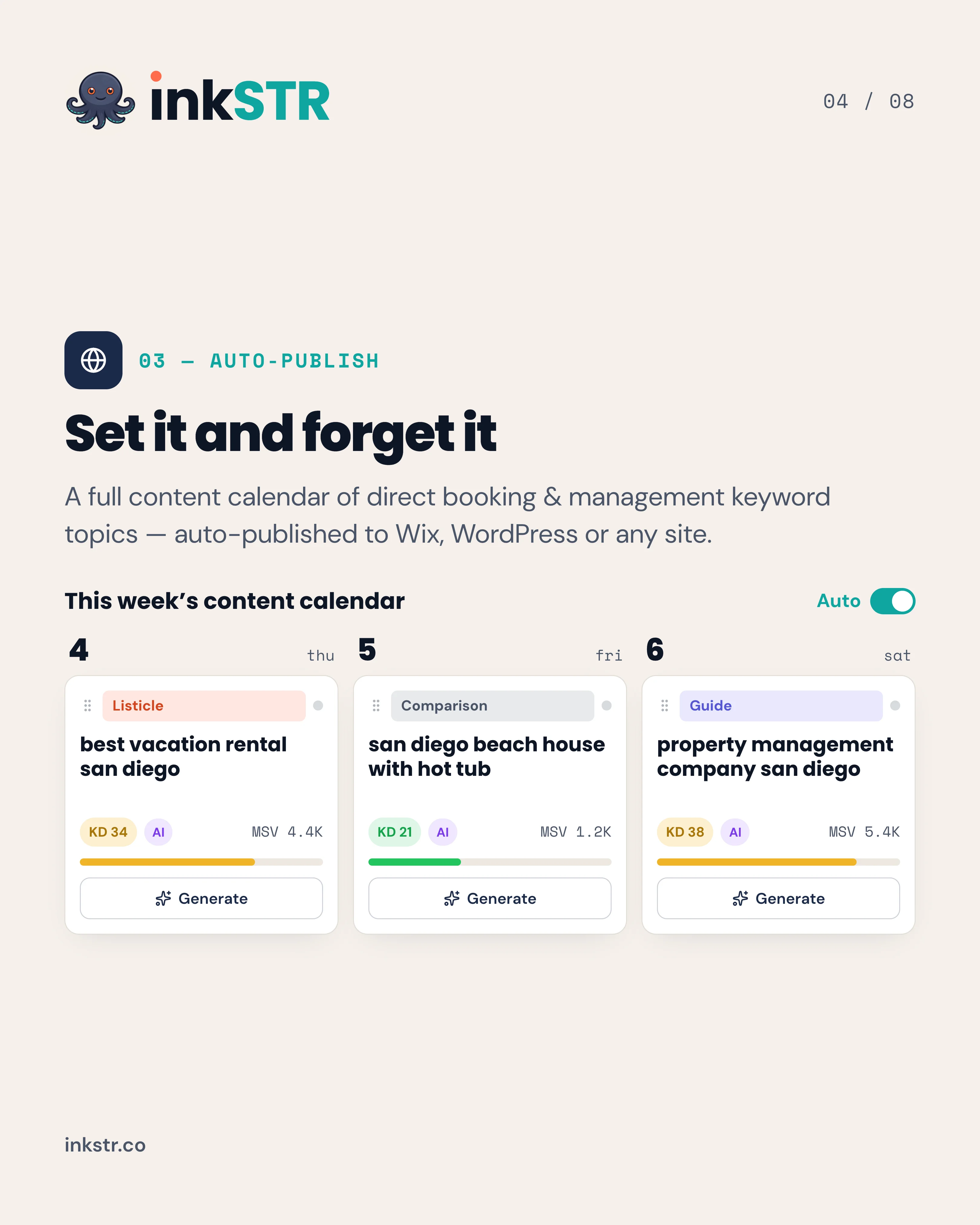
- Scheduling and publishing: a drag-and-drop Content Calendar queues posts, and Auto-Publishing sends them to Wix, WordPress, or a custom site.
- Image library: stores your property photos with AI-generated descriptions and SEO file naming.
- Internal link management and quality scoring: suggests links between posts and validates each article before it goes live.

The Google Search Console integration deserves special attention. The report shows queries where a page already ranks close to page one, and inkSTR surfaces those as opportunities. Your next article then targets a gap you can win instead of a term you guessed at.
How Much Does inkSTR Cost Compared With Writing Blog Posts Yourself?
inkSTR pricing is a flat monthly subscription that starts at $99 per month, which is less than the $300-$700 a freelance travel writer charges for a single quality blog post. The comparison below shows what each route costs in money and in hours.
| Approach | Cost | Time commitment | Consistency |
|---|---|---|---|
| Write posts yourself | No cash cost, all of your own time | 3-5 hours per post | Stalls whenever bookings get busy |
| Hire a freelance travel writer | $300-$700 per post | Briefing and editing every draft | Depends on the writer's availability and your budget |
| inkSTR | $99 per month | Review time only | Generates, schedules, and publishes on a set schedule |
The manual alternative is painful in a predictable way. You spend a Sunday afternoon on one post, or you approve a freelance invoice that exceeds a full month of software. Next month the same decision returns, and the blog only grows in the months you have energy for it.
With inkSTR, the cost stays flat while the pipeline runs on its own schedule. You can see current plans on the pricing page, and the free trial lets you check the output on your own property before you commit.
How Do You Get Started With inkSTR, Step by Step?
Getting started with inkSTR means connecting your website, your data sources, and your keyword plan, then letting the content calendar run. Plan one focused setup session; after that, your time goes to reviewing drafts rather than producing them.
Setting up an SEO program by hand is slow because every piece lives in a different tool. Keyword research sits in one app, drafts in another, photos in a folder, and publishing in your CMS. We designed the inkSTR workflow to put all of it in a single order of operations, described in full on the How inkSTR Works page.
- Start a free trial and create a project. Go to the start page and create one project per property or brand. Multi-property operators keep projects separate so each market gets its own keywords, writing style, and calendar.
- Connect your website. inkSTR publishes with one click to Wix and WordPress, and custom sites are supported through Auto-Publishing. Confirm that a test post reaches your blog before you queue anything.
- Connect Google Search Console and your PMS. Search Console powers keyword tracking and opportunity detection. If you use Hospitable or OwnerRez, connect it so articles can pull in reviews, photos, and guest data.
- Run the brand audit and keyword research. The brand audit compares your keywords against competitors and lists the gaps. Use the research chat to pick buying-intent phrases, such as a property type plus an amenity plus a market type.
- Build your plan with the content strategy wizard. The wizard maps pillar, cluster, and conversion articles. Start with the cluster that matches your best-performing property, and browse these vacation rental blog topics that drive bookings if you want ideas to feed it.
- Set your writing style and load the image library. Writing style is customized per project. Upload property photos so inkSTR can add AI descriptions and SEO file names, and read our guide to article automation without losing your brand voice before you finalize tone.
- Generate, review, and schedule. Check each draft against its quality score and pre-publish validation, then drag approved posts onto the calendar. A steady cadence matters more than a burst of ten posts followed by silence.
- Track results and adjust. Watch clicks, impressions, and query gaps in Search Console, then point the next batch of articles at the terms closest to page one.
Pro tip: review the first batch closely and add one detail only you know, such as the trail that starts behind the property. That single edit teaches you what to put into your writing style settings for every later draft.
Ready to automate your content marketing?
inkSTR handles keyword research, content strategy, article writing, and publishing, all on autopilot.
Why Does a Specialized Tool Produce Better Vacation Rental Content?
Niche specialization means the software understands the vocabulary, traveler intent, and location patterns of one industry instead of treating every topic the same. For vacation rentals, that difference shows up in what the article says and in which searches it can win.
Vacation rental search intent looks nothing like standard local SEO. A traveler searching for a pet-friendly cabin with a hot tub near a national park is deep in the decision funnel, and the page needs to match that specificity. A generic tool writes about a beautiful getaway; a rental-specific tool writes about the amenity, the property type, and the trip the guest is planning. Our analysis of why generic travel content kills conversions explains where generic copy loses guests.
Specialization also affects AI search. inkSTR structures articles answer-first, with definition-style openers and self-contained sections, because AI search engines extract passages rather than whole pages. As of September 2026, more than 1,200 verified AI-search citations have been secured for content published through inkSTR. For a practical view of the mechanics, read our guide to ranking in AI search for STR operators.
Here is a candid opinion: posting the same generic "top things to do" article across every property page is a waste of time for direct bookings. It attracts browsers, not buyers. The pillar, cluster, and conversion structure inside the content strategy wizard exists to send readers from broad questions toward a page that can take a reservation.
What Results Do Operators See From an Automated Content Pipeline?
Content pipeline results are measured in Google Search Console clicks, impressions, and attributed direct booking revenue over a defined period. The examples below come from operators running on inkSTR, and every figure was measured in Google Search Console, Google Analytics, or Wix Analytics rather than estimated by third-party tools.
| Operator | Market type | Result | Timeframe |
|---|---|---|---|
| Hemlock Hills | Cabin rental management company in the Smoky Mountains | Monthly Google Search clicks grew from 788 to 5,195, with $309,775 in attributed direct booking revenue | 11 months for clicks; first 14 months for revenue |
| The Peak Properties | Multi-market luxury mountain rentals across five markets | Monthly Google search visits grew from 26 to 1,924 after 114 articles, plus $2,500+ in commission-free direct booking revenue | 4 months |
| MyTripify | STR management company in the Charlotte and Lake Norman area | 4 property-owner leads from AI search; Google impressions at 4.6x the year-ago level | First month for leads; 3 months for impressions |
Without a system, the alternative looks like The Peak Properties before it started: five markets of luxury rentals averaging around 13 Google visits a month for fifteen straight months. Publishing 114 articles by hand in four months would have required a full writing team. inkSTR built the pillar-and-cluster plan across all five markets and auto-published to Wix.
Owner acquisition works the same way. MyTripify needed leads from property owners rather than guests, so the pipeline targeted management-hire intent from day one. Across inkSTR customer sites, we have published more than 4,400 articles as of September 2026.
Set realistic expectations. Most sites see meaningful traffic gains within 3 to 6 months of consistent publishing, and no platform can guarantee a ranking position. That timeline is exactly why automation matters: the operators who win are the ones still publishing in month five.

What Mistakes Should You Avoid When You Start With inkSTR?
The most common inkSTR setup mistakes are configuration and expectation errors rather than technical ones. Each one is easy to prevent if you know it in advance.
Most operators lose the first month to small decisions that seemed harmless, like a rushed setup or an early verdict. Because content compounds, an early mistake gets copied into every article that follows.
- Publishing to a site with no booking path. Traffic that lands on a page with no way to reserve is wasted. Confirm your booking flow works on mobile before the first post goes live.
- Skipping the writing style setup. Per-project style is what keeps a lakefront cottage from sounding like a downtown loft. Ten minutes here saves hours of edits.
- Ignoring the quality score. The pre-publish validation flags thin sections and structure problems. Treat a low score as a task, not a suggestion.
- Mixing unrelated properties in one project. A beach house and a mountain cabin target different guests and different keywords. Give each its own project.
- Judging results after a few weeks. Search rankings move on a months-long clock. Check Search Console monthly and watch impressions before clicks.
- Leaving out your local knowledge. inkSTR automates drafting, not your hospitality expertise. Add the details only you know, such as the best sunset spot or the trailhead that fills by 9 a.m.
One trade-off deserves a plain statement: automation reduces your writing time but does not remove your review time. Budget a little of each week for approving drafts, and the pipeline stays trustworthy.
Quick Reference: The Setup at a Glance
| Step | inkSTR feature | What you get |
|---|---|---|
| Create a project | Multi-project support | An independent pipeline per property or brand |
| Connect your site | One-click publishing | Direct posting to Wix, WordPress, or a custom site |
| Connect data sources | Search Console and PMS integration | Performance tracking plus real property details |
| Audit and research | Brand audit and keyword research | Competitor gaps and buying-intent keywords |
| Plan the content | Content strategy wizard | Pillar, cluster, and conversion architecture |
| Set style and images | Writing style and image library | On-brand tone and SEO-named property photos |
| Generate and schedule | AI content writer and calendar | Reviewed, scored articles on a publishing schedule |
| Track and adjust | Search Console integration | Opportunity detection for the next batch |
Frequently Asked Questions
What is inkSTR and who is it for?
inkSTR is an AI-driven SEO content platform for short-term rental operators, Airbnb hosts, VRBO operators, and property managers. It generates, schedules, and publishes keyword-targeted blog articles to help your direct booking website rank on Google and attract guests without platform fees. It works for operators anywhere in the U.S.
How much does inkSTR cost for short-term rental businesses?
inkSTR plans start at $99 per month. That compares with $300-$700 for a single freelance-written blog post. You can review current plans on the inkSTR pricing page.
How do I start an inkSTR free trial?
Go to the inkSTR start page, create your account, and set up a project for your first property or brand. Then connect your Wix or WordPress site and Google Search Console, and run the brand audit. Check the start page for the current trial terms.
What does inkSTR automate for short-term rental SEO?
inkSTR automates keyword research, competitor analysis, article generation, internal link suggestions, quality scoring, scheduling, and one-click publishing to Wix and WordPress. It also tracks performance through Google Search Console and can pull reviews, photos, and guest data from Hospitable and OwnerRez. The How inkSTR Works page shows the full workflow.
What are the best SEO tools for vacation rental operators?
Most operators need four things: a way to measure search performance, a way to understand site behavior, keyword and competitor research, and a publishing engine that keeps content flowing. Google Search Console and Google Analytics cover the first two. inkSTR covers research, article generation, scheduling, and Search Console tracking in one rental-specific platform.
Can AI-generated content rank on Google and get cited by AI search engines?
Yes, when the content is specific, structured, and grounded in real property details rather than generic filler. inkSTR writes answer-first sections with definition-style openers that AI engines can extract, and it validates quality before publishing. Rankings still depend on your market, competition, and consistency.
How long does it take to see results from vacation rental blogging?
Most sites see meaningful traffic gains within 3 to 6 months of consistent publishing, though timing varies by market and competition. Our guide on how to rank your vacation rental website on Google explains what to expect at each stage.
Is inkSTR Worth Using for Your Rental Business in 2026?
inkSTR is worth using when you have a bookable website, limited hours, and a goal of moving bookings away from marketplace fees. Ranking on Google and turning traffic into direct bookings depends on publishing the right content consistently, and consistency is the part most operators cannot sustain by hand. The manual routes cost 3-5 hours per post or $300-$700 per post; the platform route runs on a flat subscription and a schedule.
Your next step is small: create one project, connect your site, and let the strategy wizard build your first cluster. As AI search grows through 2026 and beyond, the operators who publish structured, property-grounded articles now will hold the citation history that later arrivals lack.

If keeping up with keyword research and blog publishing across your properties feels impossible right now, inkSTR was built to automate exactly this. It generates, schedules, and publishes SEO content on autopilot through the content calendar. Start a free trial and see your first content plan today.
Content powered by inkSTR.co
Enjoyed this article? Share it:
Get more of inkSTR in Google Search
Add inkstr.co as a preferred source and our articles show up more in Top Stories, AI Overviews, and AI Mode — with a “Preferred” badge.
Get more guides like this
New SEO and AI-search guides, straight to your inbox. No spam, unsubscribe anytime.