STR Marketing in 2026: 5 Strategies That Drive Bookings
STR marketing is the set of activities that make a short-term rental visible, trusted, and bookable, from OTA listing optimization to a direct booking website, search content, and email to past guests. The goal is bookings you own, measured by revenue per channel instead of likes or follower counts.
Key Takeaways
- STR marketing covers every effort that makes a short-term rental visible and bookable: OTA listings, a direct booking website, search content, email, and small paid tests.
- Five strategies carry most results: OTA listing optimization, a property-specific direct booking site, SEO blog content, email to past guests, and small retargeting tests.
- Writing one quality blog post by hand takes 3-5 hours, and a ranking article can drive organic traffic for 2-5 years.
- Measure STR marketing by direct booking revenue and assisted conversions, and collect guest emails only with consent.
- inkSTR researches keywords, writes, schedules, and publishes SEO articles on autopilot for $99/month, so the content channel runs without weekly effort from you.
At inkSTR, we build AI content tools for short-term rental operators, and the question we hear most is how to make marketing produce reservations. In 2026 a polished Instagram grid still has a place, but it sits at the weakest end of the system.
This guide defines the term, ranks five strategies by what they do for your direct booking revenue, and covers the measurement, consent, and software questions most guides skip. You can apply every tactic without buying anything. We point out where inkSTR removes manual work.
Table of Contents
- What Is an STR in Marketing?
- What Are 5 Marketing Strategies That Work for STRs?
- Which STR Marketing Strategy Should You Start With?
- How Do You Know If Your Marketing Is Working?
- What Does STR Marketing Software Do for Your Rentals?
- What Does a Content-Led Direct Booking Funnel Look Like?
- How Do You Start in the Next 30 Days?
- Frequently Asked Questions
- Where Should Your STR Marketing Go From Here?
What Is an STR in Marketing?
In marketing, an STR is a short-term rental: a furnished home, cabin, or apartment rented by the night or week through Airbnb, VRBO, or your own website. STR marketing is everything you do to earn those reservations, from listing photos to search content to email.
You probably started with a listing and a calendar. It filled some weeks, so you assumed marketing meant posting nicer photos.
That setup rents your guests from someone else. When the algorithm shifts, your calendar goes quiet and you have no channel of your own to fix it. One direct booking is typically worth $1,000 to $4,000, so each one you win back changes your month. On a $2,000 stay, an 18% fee is $360 you keep when the guest books direct.
We built inkSTR around that gap. It generates and publishes keyword-targeted blog articles that rank on Google, which gives you a traffic source you own. Our direct bookings page shows how that fits into the larger picture.
What Are 5 Marketing Strategies That Work for STRs?
Five strategies carry most STR marketing results: OTA listing optimization, a property-specific direct booking website, SEO blog content, email to past guests, and small retargeting tests. They work as a sequence, because each one feeds the next.
Most operators either try all five at once or stick to whichever feels creative. Posting on social media for hours each week while the booking page sits half built is the usual version.
The expensive part is content. A freelance travel writer charges $300-$700 per quality post, and writing one yourself takes 3-5 hours. Twelve posts a year from a freelancer costs $3,600 to $8,400, and the same twelve by hand take 36 to 60 hours. So the blog gets skipped, and competitors take the search results.
1. Optimize your OTA listings
Your Airbnb and VRBO listings are the top of the funnel, so treat them that way. Lead with your five best photos, write a title that names the signature feature (the hot tub, the lake view, the walkable block), and answer every review. Use repeat stays to introduce guests to your own site, within each platform's rules.
2. Build a property-specific direct booking website
Send traffic to a page built for one property, with live availability and pricing synced to your PMS, a full photo gallery, and a mobile-first layout. A generic homepage loses the visitor who came for one specific cabin. Our guide to booking page conversion optimization covers the mistakes that cost the most reservations.
3. Publish SEO blog content
Travelers who search for a cabin near a national park or winter activities in a lake town are planning before they pick a platform. An article that answers those searches can drive organic traffic for 2-5 years. That payoff is why we rank this strategy above social media for most operators.
inkSTR handles the pipeline. Keyword Research finds the searches your target guests use, and the AI Content Writer drafts a 2,500 to 3,500 word article from them. Quality scoring checks it before it goes live. If you need topic ideas first, start with these vacation rental blog topics that drive bookings.
4. Email past guests, with consent
Past guests are your cheapest bookings. Ask for email consent at booking, send a thank-you and review request within a day or two of checkout, then a seasonal offer ahead of your peak dates. Your PMS or any email platform can send these. The list itself is the asset.
5. Test retargeting in small budgets
Retargeting shows ads to people who browsed your site without booking. Start with a small daily budget a couple of months before peak season, and judge it on direct booking revenue, not clicks. It only works when your site already gets visitors, which is why content comes first.

Which STR Marketing Strategy Should You Start With?
The right starting point depends on your property's maturity, your budget, and how much time you have each week. A new listing needs OTA fundamentals first; an established property needs owned channels; a portfolio needs content that scales across markets.
Generic checklists skip this question, so operators spread thin. You buy ads for a booking page that converts poorly, or write blog posts for a site with no booking engine. Both waste money.
Use the table below as a priority order. In every row, inkSTR carries the content work, so your effort goes into the parts only you can do.
| Your situation | Do first | Add next | Where inkSTR fits |
|---|---|---|---|
| New listing, small budget | OTA listing photos, title, and reviews | A simple direct booking page | Starts the keyword plan and weekly articles from day one |
| Established single property | Direct booking page with live availability | Guest email list and seasonal offers | Publishes search content on a schedule so traffic compounds |
| Multi-property portfolio | One page per property and per market | Retargeting and attribution tracking | Runs a separate content pipeline per property or brand |
We designed multi-project support for that last row. Each property gets its own pipeline, so a portfolio manager can plan weeks of posts in one sitting instead of juggling logins. See how it works for property management.
How Do You Know If Your Marketing Is Working?
Marketing is working when it produces direct booking revenue you would not have earned otherwise. Likes, follower counts, and impressions are supporting signals. Track website sessions, direct booking conversions, and assisted conversions, where a channel helped before another one closed the sale.
Most operators credit the last click. A guest reads your blog in March, sees a retargeting ad in April, and books from a branded search in May. The branded search gets the credit, and you cut the blog.
That mistake kills the channel with the longest payoff. We connect Google Search Console in inkSTR so you can see which keywords and articles earn impressions and clicks before bookings show up. Pair it with Google Analytics to see which pages sit in the path to a reservation.

How do you avoid crediting bookings that would have happened anyway?
Ask every direct guest how they found you, and compare it with your analytics paths. Branded searches and returning visitors often reflect earlier work. Treat a channel as profitable only after subtracting its cost from the direct booking revenue it touched, and keep the OTA fee you avoided in the math. For example, a $400 ad spend that touched two $2,500 direct stays returned $5,000 in revenue, plus roughly $900 in avoided fees at 18%.
How do you test social and paid before committing budget?
Run one change at a time for a fixed window. Change a listing title, a landing page, or an ad audience, then compare qualified outcomes: booking page visits, inquiry forms, and completed reservations. A post with many likes and no site visits failed the test. Keep the spend small until a test earns direct bookings twice.
What do consent and privacy rules mean for guest data?
Collect guest emails with clear consent, state how you will use them, and honor unsubscribes. Retargeting and email platforms have their own rules too. Privacy laws such as GDPR and CCPA can apply when you store guest data, so confirm what applies to you with a qualified advisor and the platform's current terms.
What Does STR Marketing Software Do for Your Rentals?
STR marketing software automates a specific marketing job: writing and publishing search content, sending guest emails, scheduling social posts, or powering the booking engine. No single tool does all four well, so the best setup for hosts matches software to the job that costs you the most time.
The trap is buying by feature list. You end up with a social scheduler you open twice a month and an email tool with no list. Hostfully's 2026 Vacation Rental Tech Stack Report (June 2026) found marketing and analytics tool adoption rising from 23% among operators with 1-5 properties to 67% among those with 100 or more. Small operators run on manual effort for longer than they should.
| Marketing job | What the software does | What to look for |
|---|---|---|
| Search content | Researches keywords, drafts, schedules, and publishes articles (inkSTR) | STR-specific writing, one-click publishing to Wix or WordPress |
| Email to past guests | Sends review requests, seasonal offers, and anniversary notes | Consent tracking and PMS sync |
| Social media | Schedules posts across Instagram and Facebook | Reusing content you already have |
| Booking engine and PMS | Shows live availability and takes direct payments | Mobile-first checkout |
In our experience, search content is the first purchase worth making, because it feeds every other row. inkSTR costs $99/month and publishes through Auto-Publishing to Wix, WordPress, or a custom site, with no copy-and-paste step. At $99/month, a year costs $1,188, less than the $3,600 a freelancer would charge for twelve posts at the low end. See the plans on our pricing page. As of October 2026, we have published more than 5,100 articles across inkSTR customer sites.
Ready to automate your content marketing?
inkSTR handles keyword research, content strategy, article writing, and publishing, all on autopilot.
What Does a Content-Led Direct Booking Funnel Look Like?
A content-led direct booking funnel is a chain of owned pages: a blog article answers a travel search, links to a property or area page, and that page leads to your booking engine. Each step has one job, and the reader never has to return to an OTA to finish.
The usual break is the link between article and booking page. Readers enjoy a post about a lake town's farmers market and leave, because nothing pointed them to your cabin.
We build inkSTR's content strategy around pillar, cluster, and conversion articles, and its internal link management routes readers to your booking or inquiry pages. The results can be large. A Smoky Mountains cabin rental brand on inkSTR grew monthly Google Search clicks from 788 to 5,195 in 11 months and attributed $309,775 in direct booking revenue to the first fourteen months, measured in Google Search Console and Google Analytics. That is about $22,100 per month on average. A five-market mountain rental brand went from 26 to 1,924 monthly Google search visits in four months.
Results depend on your market, site, and consistency, and SEO takes months, not days. For the ranking side, read our guide to ranking on Google as an STR operator. For turning local knowledge into pages that sell, see local area guides that sell.

How Do You Start in the Next 30 Days?
You can start STR marketing in 30 days with six steps: fix your listing, prepare a booking page, build a keyword plan, schedule content, collect guest emails, and set up tracking. The order matters because later steps depend on earlier ones.
The painful alternative is a vague plan that stalls in week two, with a half-written draft and no calendar. Voice matters too. Our guide to article automation without losing your brand voice shows how to keep posts sounding like you.
- Rewrite your OTA title and reorder your first five photos around your signature feature.
- Check that your direct booking page shows live availability, one page per property, and loads well on a phone.
- Generate a keyword plan in inkSTR's Keyword Research, built around your market and your competitors.
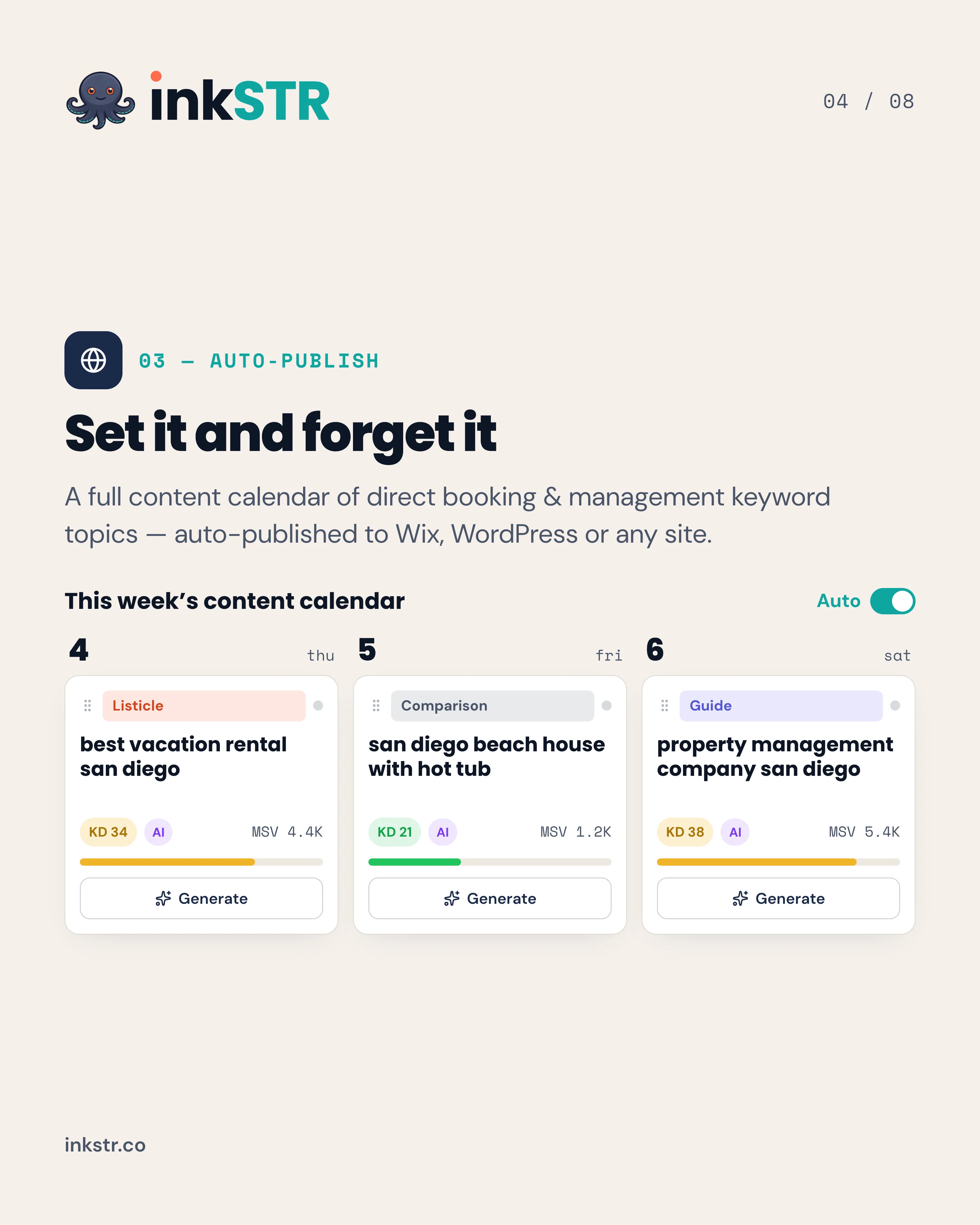
- Drag the first articles into the Content Calendar, which schedules and publishes on autopilot.
- Add a consent checkbox for guest emails and write your post-checkout message.
- Connect Google Search Console and Google Analytics, then record your starting numbers.
Want the full workflow from keyword to published post? See how inkSTR works, or use our start page to begin.
Frequently Asked Questions
What is STR marketing?
STR marketing is the work of attracting and converting guests for a short-term rental. It spans OTA listing optimization, a direct booking website, SEO content, email to past guests, and paid tests. The strongest programs shift bookings from platforms toward channels you own.
How can STR operators get more direct bookings?
Build a booking page for each property, publish search content that answers traveler questions, and email past guests with consent. Content brings new visitors and email brings repeat ones. inkSTR automates the content half by publishing SEO articles on a set schedule.
What is the best STR marketing software for hosts?
No single tool covers search content, email, social, and booking. Match software to your biggest time cost. For most hosts that is blog content, which inkSTR handles with AI content generation and automatic publishing.
What are the best vacation rental email marketing tools?
Look for consent tracking, PMS sync, and automated sequences for review requests and seasonal offers. Your PMS may already include basic sending. The list matters more than the platform, and it grows when your site earns traffic.
Which software helps short-term rentals manage social media?
Social schedulers can queue posts across Instagram and Facebook from one calendar. Measure them by site visits and direct bookings, not likes. In our experience, articles from your blog give a scheduler plenty of material to post.
How long does STR marketing take to work?
Listing fixes can help within weeks, while SEO content typically takes months to earn steady traffic. A ranking article can then bring visitors for 2-5 years. Consistent publishing is the part you control, and our content marketing guide explains what to publish.
Where Should Your STR Marketing Go From Here?
Good STR marketing in 2026 starts with owned channels: a booking page that converts, search content that earns visitors, and a guest list you collected with consent. Fix your listing, build the direct path, then measure by direct booking revenue. The 17-19% you lose to platform fees is the budget this work recovers.
Over the coming years, as more travelers ask AI tools for recommendations, sites with clear, well-structured content will be cited more often. Starting now builds that base. If you would rather not write every post, start your free trial of inkSTR and let the Content Calendar schedule and publish SEO articles to your site.
Content powered by inkSTR.co
Enjoyed this article? Share it:
Get more of inkSTR in Google Search
Add inkstr.co as a preferred source and our articles show up more in Top Stories, AI Overviews, and AI Mode — with a “Preferred” badge.
Get more guides like this
New SEO and AI-search guides, straight to your inbox. No spam, unsubscribe anytime.