How to Get More Traffic to Your Vacation Rental Website

Getting more traffic to your vacation rental website means combining local SEO, consistent blog content, and a direct booking funnel that doesn't rely on Airbnb's algorithm. Most operators try one tactic at a time and quit before it compounds. The ones who win treat traffic growth as a system, not a single project.
- Organic search drives 38% of vacation rental traffic, more than direct (32%) or paid search combined, according to CUFinder's 2026 industry data.
- Mobile traffic accounts for 68.5% of vacation rental website visits, so mobile page speed and design directly affect your visitor count.
- 67% of all search traffic goes to the top 5 Google results, meaning ranking on page two is functionally invisible, per LiveRez research.
- Direct traffic converts at 3 to 5% for vacation rentals, far higher than the sub 1% conversion rate typical of social media discovery traffic.
- Airbnb and VRBO combined host and guest fees run 17 to 19% per booking, which is the cost you eliminate every time a guest books through your own site instead.
- inkSTR automates the keyword research, writing, and publishing schedule behind this entire traffic strategy, so you're not doing it manually every week.
If your direct booking website gets a trickle of visitors a month, you're not alone, and it's rarely a design problem. In 2026, most vacation rental sites lose the traffic battle before a single guest ever lands on the homepage, because the content that actually drives search visibility was never published.
This guide walks through the specific tactics that move the needle: local SEO fundamentals, content strategy, email capture, and the no-ads traffic funnel that most guides gloss over. We'll also answer the exact questions people type into Google right before they land on an article like this one, including the 80/20 and 75-55 rules Airbnb hosts ask about constantly.
At inkSTR, we've reviewed the content strategies behind hundreds of short-term rental websites, and the pattern holds up every time: the sites getting consistent organic traffic are publishing keyword-targeted content on a fixed schedule. The ones stuck at a few dozen visitors a month usually published five blog posts once, two years ago, and stopped.
What Is the 75-55 Rule for Airbnb, and Does It Affect My Website Traffic?
The 75-55 rule is an informal Airbnb hosting guideline suggesting hosts aim for at least a 75% response rate and respond within roughly an hour to stay competitive in Airbnb's own search ranking. It has nothing to do with your independent website traffic, but the confusion between OTA visibility and website SEO trips up a lot of hosts.
Here's the disconnect: optimizing your Airbnb response rate improves your position inside Airbnb's marketplace. It does nothing for your Google rankings or your direct booking site's visibility. Yet many hosts spend all their marketing energy chasing internal platform metrics like this one while their own website sits untouched for months.
That's the trap. You can hit every Airbnb internal benchmark and still generate zero traffic to your own domain, because Airbnb has no incentive to send guests off-platform. Every guest who books through Airbnb pays that 17 to 19% combined fee, and Airbnb keeps that guest inside its ecosystem for future trips too.
This is exactly why we built inkSTR around the idea that website traffic and OTA optimization are two separate skill sets. Response rate rules live inside Airbnb's black box. Google traffic growth lives inside your content strategy, and it's the one channel you fully control. The Keyword Research tool inside inkSTR identifies exactly which search terms your target guests use before they ever open Airbnb, so you can capture that intent on your own site first.
How Do You Increase Traffic to Your Airbnb Business Website?
Increasing traffic to a short-term rental website in 2026 comes down to three compounding channels: search engine optimization, consistent content publishing, and owned audience building through email. Guests who find you organically through Google convert at a much higher rate than those who stumble in through social discovery.
Start with technical basics. A fast-loading, mobile-first site matters because mobile traffic makes up 68.5% of all vacation rental website visits, according to CUFinder's 2026 data. If your site takes more than a few seconds to load on a phone, you're losing visitors before they see a single photo.
Next, build a local content hub. Instead of one static "About the Area" page, publish individual articles: a neighborhood guide, a seasonal events calendar, a packing list specific to your climate, and a guide to nearby restaurants and attractions. Each one targets a different search query, and together they build topical authority Google rewards. Finally, capture emails from every visitor, even the ones who don't book. A branded WiFi splash page or a simple newsletter signup on your blog turns one-time visitors into a repeat traffic source, since returning visitors convert at 3 to 5% compared to under 1% for social discovery traffic.
Manually producing that local content hub is where most operators stall out. Writing one solid, well-researched blog post takes 3 to 5 hours if you do it yourself, and a freelance travel writer typically charges $300 to $700 per article. Multiply that across a dozen local guide topics and you're looking at either a full week of unpaid work or a few thousand dollars before you've published a single post. This is precisely the bottleneck inkSTR's AI Content Writer was built to remove, generating SEO-optimized local content in the time it takes you to review a draft instead of write one from scratch.
How Do You Get 1000 Visitors a Day to a Vacation Rental Website?
Reaching 1,000 daily visitors requires a large, ranking content library, not a single viral post or ad campaign. For most independent vacation rental sites, that volume comes from dozens of keyword-targeted articles compounding in Google's index over months, not from any one traffic spike.
Realistically, a single-property site will rarely need or reach 1,000 visitors a day, and that's fine. The goal isn't raw traffic volume, it's qualified traffic that converts into direct bookings. A portfolio site managing 15 or more properties across a region, however, can realistically build toward that scale by publishing property comparison pages, destination guides, and seasonal content across every market it serves.
The math behind high-traffic vacation rental content sites is simple but unforgiving: 67% of search traffic goes to the top 5 results for any given keyword, per LiveRez research. That means ranking on page one for 40 or 50 different search terms, not just your brand name, is what compounds into meaningful daily traffic.
Each article you publish has a long shelf life too. A well-optimized blog post can drive organic search traffic for 2 to 5 years before it needs a refresh, which means every article you publish this year keeps working long after you've stopped thinking about it.
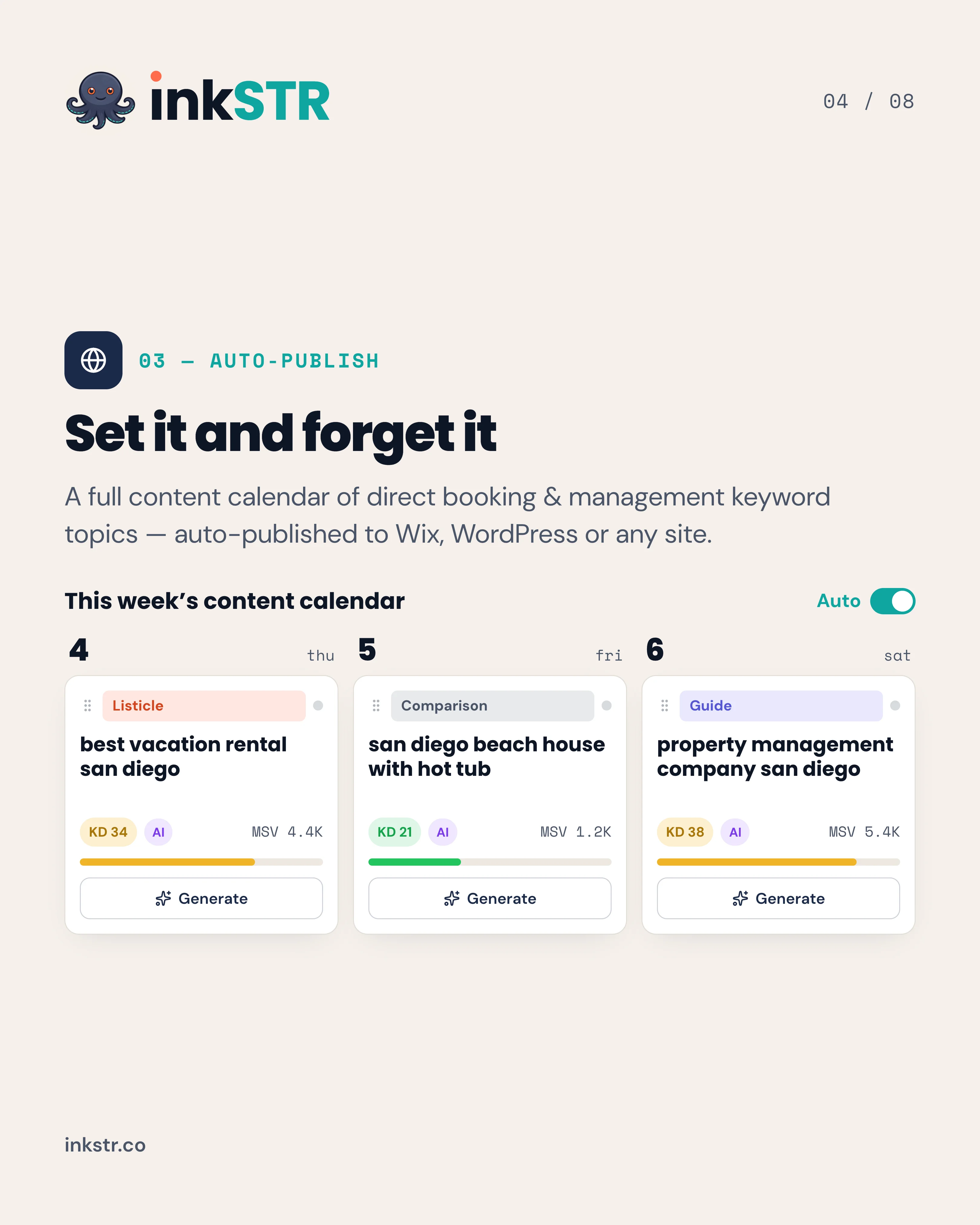
Building and maintaining that volume of content manually is a full-time job most operators don't have room for, especially across a growing portfolio. inkSTR's Content Calendar schedules and publishes articles automatically on a set cadence, so the content library keeps growing in the background while you handle guest communication, turnovers, and everything else that actually needs your attention today.

What Is the 80/20 Rule for Airbnb Hosts Trying to Grow Traffic?
The 80/20 rule, applied to Airbnb hosting, generally suggests that 80% of your bookings or revenue come from 20% of your efforts, listings, or marketing channels. Applied to website traffic specifically, it means a small number of your content pieces or keywords will drive the majority of your organic visitors.
In practice, this shows up clearly once you've published enough content to analyze. A handful of location-specific pages, maybe your "things to do near [property]" guide or a specific neighborhood comparison, will typically outperform generic content by a wide margin. Guests searching "cabin rental with hot tub near [specific trail]" convert differently than guests searching "cheap cabin rental," even though both are technically the same keyword category. Most hosts never identify which 20% is working because they're not tracking performance at the article level. They publish a few posts, see modest results, and assume content marketing doesn't work for their market. In reality, they just haven't published enough volume to find their winning content patterns yet.
This is where a lot of DIY content strategies fall apart quietly. Without consistent publishing and tracking, you can't identify your 20%, and without identifying it, you can't double down on what's actually working. inkSTR's Google Search Console integration surfaces which published articles are gaining traction and which keyword opportunities are still open, so you're not guessing which content deserves more investment. If you want a deeper breakdown of the specific ranking factors Google weighs for short-term rental sites, our guide on ranking on Google covers the STR-specific signals that matter most.
Why Isn't Your Vacation Rental Getting Any Bookings Despite Having a Website?
A vacation rental website with no bookings almost always has a traffic problem, a conversion problem, or both, and the two require different fixes. Traffic problems mean nobody is finding your site. Conversion problems mean people are finding it but not booking once they arrive.
Diagnosing which one you have is straightforward. If your Google Analytics shows near-zero organic sessions, you have a traffic problem: your site simply isn't ranking for the searches your target guests are typing. If you're getting decent traffic but a low booking rate, the issue is usually incomplete listing information or a weak call to action, since properties with a fully complete listing page receive up to 18% more bookings than incomplete ones, based on Booking.com Partner Hub data cited by Maverick Strategies. Many operators assume it's a pricing or design issue when it's actually neither. A beautifully designed site with zero blog content and thin location pages simply has nothing for Google to rank. You could have the best photography in your market and still sit on page four of search results because Google has no reason to trust your site as an authority on your destination.
Fixing this requires publishing content Google actually wants to index: local guides, seasonal content, and property comparison pages, published consistently rather than in a single burst. This is the exact gap inkSTR's full content workflow was designed to close, taking you from a keyword gap to a published, indexed article without the multi-week production cycle a freelance writer or in-house effort usually requires. For a deeper diagnostic on this exact problem, see our guide on why your vacation rental website is not ranking on Google.
What Should You Actually Blog About to Drive Direct Booking Traffic?
The highest-performing vacation rental blog content covers hyper-specific local topics: neighborhood guides, seasonal event calendars, packing lists tied to your climate, and comparison content between nearby attractions or property types. Generic travel content that could apply to any destination rarely ranks or converts. Specificity is the differentiator most operators miss. "Things to do near our cabin" is too broad. "A weekend itinerary for families staying near [specific trailhead] in October" targets an actual search query with real intent behind it. The second version also naturally attracts guests already planning the type of trip your property is built for.
Beyond destination content, publish operational trust-builders: your cancellation policy explained plainly, what's included versus what guests need to bring, and honest answers to the questions you get asked most in guest messages. This content converts well because it removes friction at exactly the moment a hesitant visitor is deciding whether to book. A content mix that works across most markets includes: one neighborhood or area guide per quarter, a seasonal update timed to your peak booking window, at least one comparison piece (your property versus nearby alternatives, or one room configuration versus another), and evergreen FAQ-style posts that answer real guest questions before they're asked.
Figuring out this content mix from scratch, especially across a portfolio with different markets and guest profiles, eats a huge amount of planning time before you've even written a word. inkSTR's content strategy wizard maps a pillar and cluster architecture specific to each property or market, so you're publishing a coordinated content plan instead of disconnected one-off posts. Our post on vacation rental blog topics that actually drive bookings goes deeper into this exact content mix if you want a longer topic list to start from.
How Do You Build an Email List From Vacation Rental Website Traffic?
Building an email list from a vacation rental website means capturing visitor contact information before they leave, typically through a blog subscription form, a branded in-property WiFi splash page, or a lead magnet like a local guide download. Email is the only traffic channel you fully own, immune to algorithm changes on Google or Airbnb. This matters because direct traffic, much of which comes from returning visitors and email subscribers, converts at 3 to 5%, a rate several times higher than the sub-1% conversion typical of social media discovery traffic. An email list turns first-time blog readers into a repeat audience you can market to for years, not just a single session.
The simplest capture point is your blog itself. Every article you publish should include a subscribe prompt, ideally tied to something specific, like "get our full [destination] events calendar emailed to you every season" rather than a generic "join our newsletter" ask. Specific offers convert better than vague ones. A branded WiFi splash page inside the property is another underused tactic. Guests already staying with you are the most likely people to book again or refer friends, and capturing their email at check-in gives you a direct line to them for future promotions, all without spending a dollar on ads.
None of this works, though, if there's no content pipeline feeding new subscribers into that list consistently. An email list built once and never nurtured with fresh content goes stale fast. That's the ongoing publishing rhythm inkSTR's Content Calendar keeps running in the background, feeding your list new local content on autopilot so your email channel doesn't depend on you remembering to write something every month.
Ready to automate your content marketing?
inkSTR handles keyword research, content strategy, article writing, and publishing, all on autopilot.
How Do You Compete With Big Property Management Companies in Search Results?
Independent hosts and small property managers compete with larger management companies in search by targeting hyper-local, long-tail keywords that big companies rarely bother optimizing for individually. A large portfolio operator manages content at the brand level; you can win at the property or neighborhood level. Big management companies typically build one strong domain with broad location pages covering entire regions. That approach ranks well for competitive city-level searches but rarely dominates hyper-specific queries like "pet-friendly cabin with lake access near [small town name]." That specificity gap is exactly where independent operators and boutique managers can win.
Focus your content on what only you can credibly claim: the exact walk time to a specific trailhead, the real noise level at night, which local restaurant delivers, what the neighborhood actually feels like in the off-season. Large competitors write generic regional content because it has to serve dozens of properties at once. You can write content that's true for exactly one property, and that authenticity shows up in both rankings and conversion.
The challenge for smaller operators isn't strategy, it's execution capacity. A management company might have a marketing coordinator or agency retainer; a solo host or two-property owner has neither the time nor budget to match that output. This is the exact gap inkSTR closes: giving individual hosts and boutique managers the same consistent publishing cadence larger competitors pay a marketing team for, at a fraction of that cost. Plans start at $99 a month, which is less than the cost of a single freelance blog post in most markets.
Data and Evidence: Traffic Sources Compared for Vacation Rental Websites
Understanding which traffic channel actually converts matters more than chasing raw visitor counts. The table below breaks down conversion behavior across the main channels available to vacation rental operators in 2026, based on published industry data.
| Traffic Source | Typical Conversion Rate | Booking Intent | Cost to Acquire |
|---|---|---|---|
| Organic search (blog/SEO) | Varies by keyword intent | High for long-tail, specific queries | No ad spend, requires content investment |
| Direct traffic (returning visitors) | 3 to 5% | Very high, often repeat guests | Free once audience is built |
| Referral traffic (partner sites, local links) | 1 to 2% | Varies by source quality | Free, requires relationship building |
| Social media traffic | Less than 1% | Low, mostly discovery-stage | Free organically, or paid for reach |
| OTA listings (Airbnb, VRBO) | Platform-dependent | High, but 17 to 19% fee per booking | Commission-based, no upfront cost |
Organic search alone accounts for 38% of all vacation rental website traffic, more than direct or paid search individually, according to CUFinder's 2026 data. That single fact should reorient how most operators allocate their marketing time. If you're spending hours on social media posts and zero hours on your blog, you're investing in the channel with the lowest conversion rate and neglecting the one with the highest volume potential. The uncomfortable math for OTA-dependent hosts: every booking through Airbnb or VRBO costs 17 to 19% in combined fees. A single direct booking, by contrast, is typically worth $1,000 to $4,000 in total revenue with none of that fee taken off the top. Redirecting even a portion of your bookings from OTA to direct traffic through content marketing pays for a content strategy many times over.
The No-Ads Traffic Funnel Most Guides Never Explain
A no-ads traffic funnel for vacation rentals is a structured path that moves a stranger from a Google search result to a direct booking without any paid advertising spend, built entirely on organic content and owned channels. Most guides mention SEO and social media as separate tactics without ever connecting them into an actual sequence. Here's the sequence that works: a visitor searches a specific, local query and lands on a blog article, not your homepage. That article answers their question completely, then offers a specific next step, usually an email signup tied to a related resource, like a seasonal packing list or an events calendar. That email nurtures them with additional local content over the following weeks, and when they're ready to book, they come to your site directly rather than searching "vacation rentals near me" and landing on an OTA.
The step most operators skip is repurposing. One well-researched neighborhood guide shouldn't live only as a blog post. Turn it into a few social posts highlighting individual sections, an email drip series over three or four sends, and even a printed QR-code card in the rental linking guests back to the full digital guide. One piece of core content, distributed across five or six formats, multiplies its traffic-generating reach without any additional research time.
Low-cost partnerships extend this further. Reaching out to a local tourism office or a nearby restaurant with a straightforward offer, a mutual link exchange or a joint seasonal guide, costs nothing but time and often earns you a referral link from a site with existing local authority. That kind of backlink strengthens your own domain's search visibility over time. If backlinks are new territory for you, our explainer on what a backlink is in SEO breaks down exactly why they matter for direct booking sites.
Executing this full funnel by hand, research, writing, repurposing, and outreach, easily consumes a full week per content cycle. That's the exact workload inkSTR compresses. The Auto-Publishing feature pushes finished articles directly to Wix, WordPress, or your custom site the moment they're ready, so the publishing step that used to take you an afternoon of copy-pasting and formatting happens automatically.

Practical Guidance: How Do You Prioritize Your First 90 Days of Traffic-Building Work?
Prioritizing your first 90 days of vacation rental traffic work means sequencing quick technical fixes before long-term content investment, since technical issues can block even great content from ranking. Fix the foundation first, then build the content library on top of it.
Weeks 1 to 2: Technical quick wins.
- Confirm your site loads quickly on mobile, since mobile traffic makes up 68.5% of vacation rental site visits.
- Fix meta titles and descriptions on every page; test them with a tool like the Google SERP Simulator to see how they'll actually appear in search results.
- Make sure your name, address, and property details are consistent everywhere they appear online.
Weeks 3 to 8: Content foundation.
- Run keyword research to find the specific, long-tail search terms your ideal guest actually types, using a tool like Ubersuggest or a platform built specifically for STR content strategy.
- Publish your first local content hub: a neighborhood guide, a seasonal events piece, and an FAQ-style post addressing your most common guest questions.
- Add an email capture form to every published article, tied to a specific, relevant offer.
Weeks 9 to 12: Distribution and compounding.
- Repurpose your best-performing article into social posts and an email sequence.
- Reach out to one or two local partners for a link exchange or joint content piece.
- Review early Google Search Console data to identify which articles are gaining traction, and double down there.
The common mistake at every stage is inconsistency, publishing three articles in a burst and then going quiet for four months. Google rewards sustained publishing patterns, not sporadic bursts, and your 20% winning content only becomes visible once you have enough published volume to compare. This 90-day cadence is essentially the same framework built into inkSTR's content strategy wizard, just automated so you're not manually tracking each phase yourself.
Frequently Asked Questions
How long does it take for vacation rental blog content to start ranking on Google?
Most vacation rental websites see meaningful organic traffic movement after 12 to 20 published articles targeting a mix of local, seasonal, and long-tail booking-intent keywords. A single article can take anywhere from a few weeks to several months to rank, depending on competition in your market, but a well-optimized post typically keeps driving traffic for 2 to 5 years once it does.
Do I need a separate blog for each property I manage, or can I use one website?
You can generally run one blog for multiple properties as long as you organize content clearly by location or property type, though operators managing distinct brands across different markets often benefit from separate content pipelines. inkSTR's multi-project support creates independent content plans per property or brand so keyword strategies and voice don't blend together across a portfolio.
Can AI-generated blog content actually rank on Google for vacation rental keywords?
Yes, AI-generated content ranks when it's specific, well-structured, and built around real keyword research rather than generic filler. What determines ranking success is content quality and topical relevance, not whether a human or an AI system typed the first draft. inkSTR's AI Content Writer is built specifically around STR terminology and traveler search intent, which is what separates ranking content from generic AI output.
What types of blog posts drive the most direct booking conversions?
Hyper-local content, neighborhood guides, seasonal itineraries, and specific comparison pieces, tends to convert better than generic travel advice because it matches searchers who already have concrete travel plans. FAQ-style posts addressing real guest hesitations, like cancellation policies or what's included, also convert well by removing friction at the decision point.
How do I find out which keywords my vacation rental competitors are ranking for?
Tools like SEMRush or Moz let you enter a competitor's domain and see which keywords are driving their organic traffic. inkSTR's keyword research tool automates this analysis specifically for the STR niche, surfacing destination and property-type keywords a generic SEO tool might miss entirely.
Is it worth publishing local area guides if my market is already a heavily trafficked tourist destination?
Yes, and arguably it matters more in competitive markets, because generic destination content is exactly what's already saturating search results there. Your advantage is specificity, writing about the exact experience from your property rather than the whole town, which is a gap most competitors in busy markets never fill.
What is the difference between optimizing an Airbnb listing and building SEO for my own website?
Optimizing an Airbnb listing improves your visibility inside Airbnb's internal marketplace search, which Airbnb fully controls and can change at any time. Building SEO for your own website grows visibility on Google, a channel you own indefinitely, and every article you publish keeps compounding value long after it's written.
How many blog posts should I publish per month to see consistent traffic growth?
Most operators who see steady organic growth publish two to four articles per month on a consistent schedule rather than in occasional bursts. Consistency matters more than volume in the short term, since Google rewards sites that demonstrate ongoing topical authority, which is why inkSTR's Content Calendar automates that publishing rhythm so it never lapses.
Conclusion: Building Real Traffic Takes a System, Not a Single Fix
Learning how to get more traffic to your vacation rental website comes down to three things working together: technical SEO fundamentals, a consistent local content library, and an owned email audience that doesn't depend on any platform's algorithm. Organic search already drives 38% of vacation rental traffic industry-wide, and that share keeps growing as OTA fees push more travelers to search directly for the destinations they're visiting. The operators who succeed at this aren't necessarily better writers or SEO experts. They're the ones who built a publishing system and stuck with it past the first quiet month. If you take one action from this guide, make it this: pick one hyper-specific local topic your competitors haven't covered and publish it this week, then commit to a second one next month. If you'd rather not manage that publishing cadence manually, Get started with inkSTR to see how the full research-to-published-article workflow runs on autopilot for vacation rental operators across the country.

Watching your organic traffic climb month over month is the clearest sign your content strategy is working, and that visibility is exactly what a consistent publishing schedule builds over time. See how inkSTR's full content workflow takes you from keyword research to a published, indexed article without the manual grind in between.
Content powered by inkSTR.co
Enjoyed this article? Share it:
Get more of inkSTR in Google Search
Add inkstr.co as a preferred source and our articles show up more in Top Stories, AI Overviews, and AI Mode — with a “Preferred” badge.
Get more guides like this
New SEO and AI-search guides, straight to your inbox. No spam, unsubscribe anytime.