How to Generate Property Management Leads in 2026

Generating property management leads means building a consistent pipeline of property owners who want you to manage their short-term rental, using a mix of referrals, paid ads, outbound prospecting, and organic search content, rather than relying on any single unpredictable source.
Key Takeaways
- Most durable lead generation for property management companies comes from a blend of four channels: referrals, paid platforms, outbound prospecting, and SEO/content, each with different cost and speed tradeoffs.
- Industry benchmarks put real estate paid search around $2.53 per click with a cost-per-lead near $100, meaning a single converted client from paid ads can cost well over $400 once conversion rates are factored in.
- A qualified property management lead typically meets four criteria: the contact is the decision maker, their property sits inside your service area, the asset type matches your portfolio, and they plan to hire within 30 to 60 days.
- A single freelance blog post costs $300 to $700 and takes 3 to 5 hours to write manually, while a ranking article can keep generating inbound owner inquiries for 2 to 5 years.
- Organic search leads close at a notably higher rate than most paid channels, per industry close-rate data, making content and local SEO one of the lowest-cost, highest-durability lead sources available to property managers in 2026.
- inkSTR automates the SEO content pipeline, keyword research, drafting, scheduling, and publishing, so property management companies can build owner-facing organic lead flow without hiring a writer or blocking out hours every week.
If you manage short-term rental properties in 2026, you already know the leads are out there. Owners frustrated with self-managing, investors buying their third or fourth unit, families inheriting a cabin they don't have time to run themselves. The problem isn't demand. It's that most property management companies are still chasing leads the same way they did five years ago: referrals when they come, a pay-per-lead subscription that eats margin, and a website that hasn't been updated since it launched.
At inkSTR, we work with property management companies and independent hosts every day who are stuck in exactly this position. They have good service, decent reviews, and almost no repeatable way to bring in new owner clients without paying for every single one. This guide breaks down where property management leads actually come from, what they cost, and how to build a channel that keeps producing without a growing ad budget.
We'll cover paid lead services, referral systems, outbound prospecting, and the SEO and content approach that most property managers underuse, plus a practical lead qualification framework and a real look at what channels cost compared to what they return. This is written for operators managing anywhere from a handful of doors to 100-plus units across one or more markets.
What Does the 80/20 Rule Mean in Property Management?
The 80/20 rule in property management, borrowed from the broader Pareto principle, means roughly 80% of your new business and revenue tends to come from about 20% of your lead sources, clients, or referral relationships. For most property management companies, that 20% is a small handful of repeat referral partners or one or two organic channels that quietly outperform everything else.
The pain here is obvious once you see it: most companies spread marketing budget evenly across five or six channels, hoping one sticks. Meanwhile, they're often already sitting on a top-performing channel they haven't identified, because nobody's tracking which lead source actually closes versus which one just generates form-fills. Without tracking, you can't tell your best 20% from your worst 80%, so budget gets wasted renewing the wrong subscriptions.
Applying the 80/20 rule practically means auditing where your last 10 to 15 signed management contracts actually originated, not where the initial inquiry came from, but where the relationship started. Often it traces back to a specific referral partner, a specific blog post that ranked for an owner-intent search, or a specific real estate agent relationship. Once you know that, double down there instead of maintaining five mediocre channels.
This is exactly where content and SEO tend to become the hidden 20% for property managers willing to invest in it. A ranking article targeting a search like "self-manage vs hire property manager cost breakdown" keeps working in the background, month after month, without new spend. That's the channel most companies underweight because it takes longer to show results than a paid campaign. We built inkSTR's keyword research tool specifically to identify which owner-intent searches are worth targeting first, so you're not guessing which content might become your 20%.
Can ChatGPT Generate Leads?
ChatGPT and other AI assistants can influence property management lead generation indirectly, by helping owners research questions like local management fees or self-management costs, but ChatGPT itself does not generate or capture leads the way a form or phone call does. What matters is whether your content gets cited when someone asks an AI assistant these questions.
The agitating reality: property owners are increasingly asking ChatGPT, Perplexity, and Google's AI Overviews questions like "how much does a property manager cost in my area" or "should I self-manage my rental" before they ever visit a website. If your company has no published content answering those exact questions, you're invisible in that research phase entirely, regardless of how good your actual service is. Competitors with even mediocre service win the client simply because their content got cited first.
Getting cited by AI search tools requires the same underlying discipline as ranking on Google: clear, specific, well-structured answers to real owner questions, published consistently. Generic pages about "our services" rarely get pulled into an AI answer. Pages that directly answer "what's included in a property management fee" or "how to switch property management companies" do. That specificity is what AI citation systems are built to reward.
This is a core reason we designed inkSTR around ranking in AI search as a first-class goal, not an afterthought. Every article inkSTR generates through the AI Content Writer is structured with direct-answer openings and named entities specifically because that structure is what gets extracted and cited by AI assistants. Property managers who publish this way consistently show up in the research phase, not just the search results page.

What Are the 5 P's of Property Management?
The 5 P's of property management, a framework used across the industry, typically refer to People, Property, Process, Profit, and Promotion, the five operational pillars a management company needs to run efficiently and market itself effectively. Promotion, the piece most companies neglect, is where lead generation actually lives.
Most property management companies invest heavily in People (staffing and training) and Process (software, workflows, PMS integrations) but treat Promotion as an afterthought, something handled with a static website and an occasional Facebook post. That imbalance shows up directly in lead flow: a company can run flawless operations and still starve for new owner clients because nobody owns the marketing function full time.
Promotion, done properly, means a consistent content calendar targeting owner-intent keywords, an active referral program, a presence in local search results, and outbound follow-up that doesn't rely on one person remembering to send emails. Without a system, promotion becomes whatever gets squeezed in during a slow week, which is exactly when it's needed least.
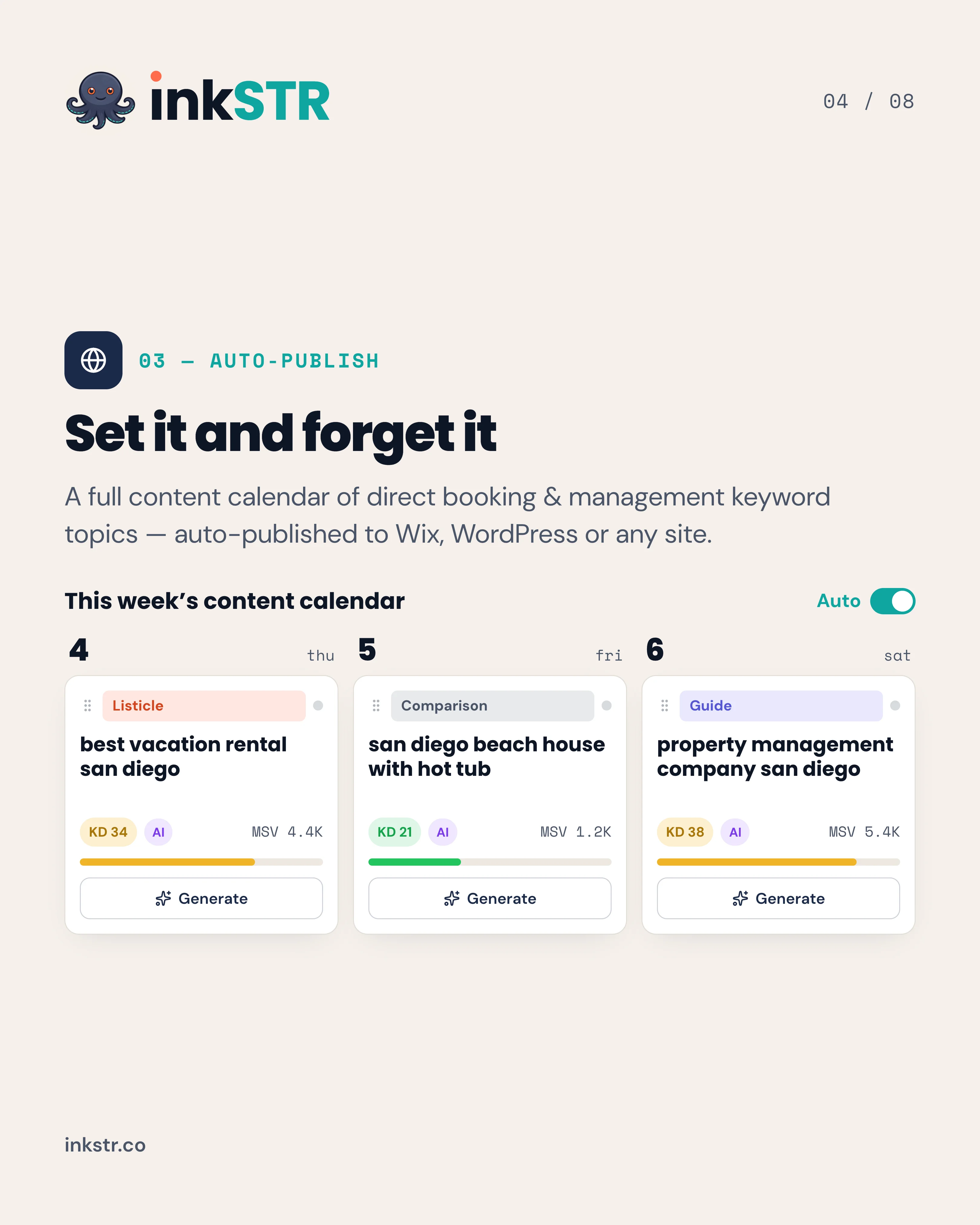
We built inkSTR's Content Calendar to solve the Promotion gap specifically. It schedules and publishes SEO-optimized articles automatically, so the marketing pillar of your business runs on the same schedule every week regardless of how busy operations get. For companies managing content across 15 or more properties or multiple brand sites, that consistency is the difference between a marketing function and a marketing hobby.
How Much Do Property Leads Cost?
Property management leads cost anywhere from roughly $40 to over $400 per converted client depending on the channel, with paid search averaging around $2.53 per click and a cost-per-lead near $100 in the real estate industry, according to 2026 Google Ads benchmark data. Referrals cost the least in direct spend but the most in relationship-building time; SEO and content sit in between, higher upfront effort, near-zero marginal cost per lead once published.
| Lead Channel | Typical Cost Pattern | Speed to Lead | Durability |
|---|---|---|---|
| Pay-per-lead platforms | High and recurring, cost per lead often $50 to $150+ | Fast, often same day | Stops the moment you stop paying |
| Paid search (Google/Meta ads) | Roughly $2.53 CPC / ~$100 CPL industry average | Fast, days to weeks | Stops when budget stops |
| Referrals (clients, agents) | Low direct cost, high relationship investment | Slow, unpredictable timing | High trust, but low volume and hard to scale |
| Outbound prospecting | Low cost, high labor (cold calling, direct mail) | Slow, requires volume | Durable if systematized, but labor-intensive |
| SEO and content marketing | Content cost only, $300 to $700 per manual post or $99/month with automation | Slow to build, 2 to 5 years of ongoing traffic once ranking | Highest, an article keeps working for years without new spend |
The pain most property managers feel here is a cash flow squeeze: paid leads convert fast but never stop costing money, while the cheaper long-term channel, content, takes months to show results. That gap causes a lot of companies to abandon SEO before it has a chance to work, then re-invest in the expensive paid channel indefinitely.
The math changes once you account for close rates. Organic search leads carry an average close rate around 14.6%, notably higher than most cold, paid traffic, according to close-rate data from SharkPlatform. That means fewer total leads from SEO can still produce more signed contracts than a larger volume of colder paid leads, once you factor in who actually closes.
Manually producing that content is the bottleneck. Writing one quality blog post takes 3 to 5 hours of research and writing, and hiring a freelance writer runs $300 to $700 per post, costs that add up fast if you're trying to publish weekly across multiple markets. This is precisely the gap inkSTR was built to close. Starting at $99 a month, inkSTR generates, schedules, and publishes owner-intent articles automatically, turning a five-figure annual content budget into a fraction of that cost while keeping the publishing cadence consistent.
What Counts as a Qualified Property Management Lead?
A qualified property management lead is a prospective owner client who meets four specific criteria: they are the decision maker on the property (owner or someone with power of attorney), the property sits within your defined service area, the asset type matches what your portfolio manages, and they intend to hire within roughly 30 to 60 days.
Without this filter, most companies waste time on inquiries that never convert: a tenant asking questions instead of the owner, a property two hours outside your service radius, or someone just browsing prices a year before they'd actually switch management companies. Chasing unqualified leads burns hours that should go toward the 20% of prospects who are actually ready to sign.
Speed to lead matters as much as qualification. Response-time research shows contacting a lead within 5 minutes dramatically increases the odds of conversion compared to waiting even an hour, a pattern confirmed across sales research broadly and directly relevant to property management inquiries that come in through a website form. If your qualification and routing process is manual, that response window slips constantly, especially outside business hours.
This is where the gap between content generation and lead capture becomes obvious. Publishing great articles that rank is only half the job; the other half is converting that traffic into a qualified form-fill and routing it fast. inkSTR's Auto-Publishing feature gets your owner-intent content live on your Wix or WordPress site the moment it's ready, without the delay of manual copy-paste, so the traffic-to-lead pipeline starts working sooner rather than sitting in a drafts folder.

Why Do Referrals Alone Not Scale for Property Management Companies?
Referrals do not scale for property management companies because they depend entirely on the goodwill and memory of a small number of people, real estate agents, existing clients, friends, who have no obligation to send you business on any predictable timeline. Referrals close at a high rate, but volume stays capped by how many relationships you can personally maintain.
The frustration compounds as a portfolio grows. A company managing 10 units can survive on referrals from two or three loyal agents. A company scaling toward 50 or 100 units needs a lead volume that a handful of relationships simply cannot produce, no matter how strong those relationships are. Waiting on referrals while competitors run active SEO and paid campaigns means losing new-construction and new-owner business to companies who show up first in search.
Real estate agent partnerships remain valuable and worth cultivating, but they should sit alongside a scalable channel, not substitute for one. Owners searching "self-manage vs hire property manager cost breakdown" or "[city] property management fees 2026" are actively comparing options right now, and a referral relationship can't reach them if they haven't asked anyone for a recommendation yet.
This is exactly the gap organic content fills. Owner-intent blog content captures the prospects who are actively researching but haven't asked their network for a referral yet, expanding your total addressable pool beyond who you personally know. We built inkSTR's multi-project support so a company running content across several markets or brand sites can run each pipeline independently, scaling content production alongside referral relationships instead of instead of them.
How Should You Budget Across Lead Generation Channels?
A reasonable property management lead generation budget splits spend across at least three channels: a smaller, sustained investment in SEO and content that compounds over time, a flexible paid budget for immediate volume, and near-zero-cost relationship investment in referrals and outbound. No single channel should carry 100% of your lead flow.
Most companies get this backward. They pour the entire marketing budget into pay-per-lead platforms because the results feel immediate, then panic when that spend has to increase every quarter just to maintain the same lead volume. Meanwhile the SEO investment that could have compounded for years never gets started because it doesn't show results in month one.
A workable framework: dedicate roughly a third of budget to paid channels for speed, a third to consistent content and SEO for long-term durability, and reserve the rest for outbound prospecting and referral program incentives (small gifts, commission-style bonuses for agent referrals). Track every closed deal back to its source so you can rebalance quarterly, the practical application of the 80/20 principle covered earlier.
The content third of that budget is where most companies stall out, not from lack of budget but from lack of time to execute consistently. That's the specific problem tools built for short-term rental managers exist to solve, and it's the exact gap inkSTR fills. Instead of a $99-a-month subscription replacing a $2,000-a-month freelance writing retainer, it replaces the inconsistency that kills most content efforts before they compound.
Ready to automate your content marketing?
inkSTR handles keyword research, content strategy, article writing, and publishing, all on autopilot.
What Should Property Management Owner-Intent Content Actually Cover?
Owner-intent content for property management lead generation means blog articles written specifically for property owners researching whether and how to hire a manager, not for the guests who stay in the properties. Topics like "[city] property management fees 2026," "do I need a property manager for one rental," and "how to switch property management companies" target this exact research phase.
Most property management websites make the same mistake: their blog, if they have one, is written for guests, local restaurant guides, things to do nearby, packing tips, none of which an owner searching for a management company will ever read. That content might help with guest SEO, but it does nothing for owner lead generation, and companies often don't realize the mismatch until they audit their traffic sources.
Effective owner-intent content answers the specific financial and operational questions an owner has before signing: what fees look like, how revenue reporting works, what the switching process involves if they're leaving another manager, and how self-managing compares on cost versus time. This content works because it mirrors the exact research an owner does before calling anyone.
This distinction, guest content versus owner content, is something we see property managers get wrong constantly at inkSTR. If your goal is to create content for Airbnb hosts that actually books direct or attracts new management clients, the keyword targeting has to match which audience you're trying to reach. inkSTR's content strategy wizard builds separate pillar and cluster structures for owner-facing pages versus guest-facing pages, so the two don't get muddled into a single generic blog.
Data and Evidence: What Actually Drives Property Management Leads in 2026
The data on property management lead generation in 2026 shows a clear divide between channels that scale fast but cost more per lead and channels that cost less but take longer to build. Ecommerce and service-business SEO can generate roughly 5.2x ROI over a 36-month period, according to SEO industry research, a return timeline that rewards patience over quick wins.
The global vacation rental software market, valued at roughly $20.14 billion in 2026 and projected to reach nearly $49.78 billion by 2035 at an 8.57% CAGR according to Market Research Future, reflects how much operational infrastructure is being built around this industry. That growth signals more competition for owner attention, not less, making differentiated content more valuable, not optional.
Companies that adopt structured marketing tools see measurable gains elsewhere in the funnel too. HubSpot customers report acquiring 129% more leads after just one year of consistent inbound marketing execution, a pattern that tracks with what we see among property managers who commit to a real content calendar instead of sporadic posting.
The takeaway: SEO and content aren't a replacement for paid leads or referrals, they're the channel that keeps compounding after the others plateau. A ranking article published in 2026 can still be driving inquiries in 2029, something no pay-per-lead subscription can claim once you stop the payment.
Deep Dive: The Lead Nurture and Tracking Gap Most Companies Miss
The lead nurture and tracking gap is the single biggest reason property management companies underperform on lead generation, even when their channels are working. Capturing a form-fill or a call is only step one; without a system to score, route, and follow up on leads over the 30 to 60 day window most owners take to decide, a large share of qualified inquiries simply go cold.
Most companies have no CRM workflow for what happens after a lead comes in. The inquiry sits in an inbox, gets a single follow-up email, and then nothing. Meanwhile the owner is comparing three or four management companies simultaneously, and the one that stays in touch consistently over that window is usually the one that wins the contract, regardless of who had the better initial pitch.
A basic nurture sequence for property management leads should include an immediate acknowledgment (ideally within minutes, not hours), a follow-up with specific fee and service information within 24 hours, a case-study or testimonial email a few days later, and a check-in call around the two-week mark if there's been no response. Long-timeline leads, the ones planning to switch in 60 days rather than immediately, need at least one more touchpoint spaced out over that window rather than being written off after the first non-response.
Tracking matters just as much. Without UTM tagging on every campaign link, a call-tracking number on paid ads, and consistent CRM notes on lead source, you cannot actually apply the 80/20 rule from earlier in this guide, because you won't know which channel is producing your closed deals versus just raw form-fill volume. Most property management companies are flying blind on this exact metric, renewing paid subscriptions based on lead count instead of closed-deal count.
None of this replaces the need for content that ranks in the first place, though. A perfect nurture sequence applied to zero organic traffic still produces zero leads. That's why we think about content and nurture as two halves of the same system: inkSTR handles the traffic-generation half through ranking on Google for owner-intent searches, and the tracking discipline described here handles what happens once that traffic converts into a form-fill.
Practical Guidance: How to Prioritize Your Lead Generation Channels
Prioritizing property management lead generation channels means matching the channel to your company's current stage: newer companies need faster, if costlier, paid volume, while established companies with the bandwidth to invest in content should shift budget toward SEO for long-term durability. Trying to run every channel at full intensity from day one spreads resources too thin to see meaningful results anywhere.
- Audit your last 10 to 15 signed contracts and trace each back to its true origin channel, not the last touchpoint, but where the relationship actually started.
- Define your qualified lead criteria explicitly: decision maker, service-area location, matching asset type, and a realistic hiring timeline, so your team stops chasing inquiries that were never going to convert.
- Set up basic tracking before spending another dollar on paid ads: UTM parameters on every link, a dedicated tracking phone number, and a CRM field for lead source on every new contact.
- Commit to a content cadence you can actually sustain, whether that's one article a week or one every two weeks, consistency matters more than volume in the first six months.
- Build a simple nurture sequence covering the first 60 days after a lead comes in, with at least four touchpoints spaced across that window.
- Rebalance budget quarterly based on which channel is producing closed deals, not just raw lead counts, applying the 80/20 principle with real data instead of guesswork.
The most common mistake we see is abandoning content and SEO after two or three months because it hasn't produced leads yet, then reinvesting that budget into a paid channel that costs more every quarter. Content is the channel with the steepest patience requirement and the highest long-term payoff, exactly the tradeoff that generic content marketing approaches get wrong when they publish thin, one-off posts instead of a structured, ongoing calendar.
Frequently Asked Questions
How long does it take to see results from property management SEO content?
Most property management companies start seeing measurable organic traffic within 3 to 6 months of consistent publishing, with meaningful lead volume typically building by month 6 to 12. A ranking article can then continue producing inquiries for 2 to 5 years without additional spend, which is why patience with this channel pays off longer than any paid alternative.
How many blog articles do I need to start generating property management leads?
There's no fixed number, but most companies need at least 15 to 20 owner-intent articles covering fees, self-management comparisons, and location-specific service pages before search engines start treating the site as a credible authority on the topic. inkSTR's content calendar automates this pace so you're not manually tracking publishing gaps.
Can I use inkSTR if I manage properties across multiple markets?
Yes. inkSTR supports multiple independent content pipelines, so a company managing properties in several markets or under multiple brand names can run separate keyword strategies and publishing schedules for each without duplicating manual work.
Do referrals or SEO produce better property management leads?
Referrals typically close at a higher rate per lead but cannot scale beyond the size of your personal and professional network. SEO and content produce a lower per-lead close rate on average but far higher total volume over time, and organic leads still close at a strong rate, around 14.6% on average according to industry close-rate data.
What's the difference between writing property management content myself and using an automation platform?
Writing manually takes 3 to 5 hours per post and requires ongoing keyword research, formatting, and publishing steps that most operators don't have time to sustain weekly. inkSTR's AI Content Writer and Content Calendar automate that full pipeline at $99 a month, replacing what would otherwise cost $300 to $700 per freelance post.
Does content marketing actually reduce dependence on pay-per-lead platforms?
Over time, yes. Pay-per-lead platforms require continuous spend to maintain volume, while a growing library of ranking articles keeps generating inbound inquiries without new payment. Most companies that commit to SEO for 12 months or more report being able to reduce, though rarely eliminate, their paid lead spend.
What's a realistic monthly budget for property management lead generation?
Budgets vary widely by portfolio size, but a reasonable starting split allocates roughly a third to paid channels, a third to content and SEO, and the remainder to referral incentives and outbound prospecting. Content costs can be minimized significantly with automation tools like inkSTR compared to hiring a dedicated writer or agency.
Conclusion: Building a Property Management Lead Pipeline That Doesn't Depend on Constant Spend
Generating property management leads consistently in 2026 means treating your channels as a portfolio, not a single bet: referrals for trust, paid ads for speed, outbound for control, and SEO content for durability. The companies that win aren't the ones spending the most, they're the ones tracking which channel actually closes and doubling down there, the 80/20 principle applied with real data instead of guesswork.
Content remains the most underused channel in this mix, not because it doesn't work, but because it takes discipline most companies can't sustain manually. That's the exact gap we built inkSTR to close, automating the research, drafting, and publishing work that keeps a property management content calendar running whether or not anyone on your team has time to sit down and write this week.
If building and publishing owner-focused content every week feels like a job on top of your actual job, start a free trial with inkSTR and see your first automated article draft this week.
Content powered by inkSTR.co
Enjoyed this article? Share it:
Get more of inkSTR in Google Search
Add inkstr.co as a preferred source and our articles show up more in Top Stories, AI Overviews, and AI Mode — with a “Preferred” badge.
Get more guides like this
New SEO and AI-search guides, straight to your inbox. No spam, unsubscribe anytime.