Best Search Engine 2026: What STR Operators Should Use

The best search engine 2026 for a vacation rental operator is a mix: Google for volume and Google Business Profile visibility, an AI answer engine like Perplexity or ChatGPT Search for the growing share of trip research that starts as a conversation instead of a query, and Microsoft Bing because it feeds Copilot's answers. If your direct booking site only optimizes for classic Google results, you're missing a growing slice of how travelers find a place to stay.
Key Takeaways
- No single engine wins in 2026. Google still drives the most volume, but AI answer engines like Perplexity and ChatGPT Search are increasingly where trip research starts.
- Over 40% of product discovery now begins on AI-powered search engines like ChatGPT, Gemini, and Perplexity, which directly affects how travelers find vacation rentals.
- Over 92% of marketers already optimize for both traditional and AI-powered search engines as of 2026, meaning treating them separately is now the outdated approach.
- Organic search generates leads at a fraction of the cost of paid search, which is why content built for search has better long-run ROI for STR sites than ad spend.
- Across inkSTR customer sites, we've secured over 1,100 verified AI-search citations for customer content as of September 2026, proof that vacation rental content can earn placement in AI answers.
- inkSTR builds content for citability across Google, Google AI Overviews, and AI answer engines at once, so you don't have to run separate strategies for each.
Every year the "best search engine" question gets asked with a slightly different meaning behind it. In 2026, the honest answer for a short-term rental operator is about which engines your guests are actually using to plan a trip, and whether your content shows up in any of them.
We write this from inside the vacation rental content world at inkSTR, where we watch Google Search Console and AI citation data across dozens of live customer projects every day. The search landscape guests use to find a cabin, beach house, or lake property has fractured. Classic Google results, Google AI Overviews, Bing-powered Copilot answers, and standalone AI answer engines like Perplexity now compete for the same query, and each one surfaces different content.
This guide covers what "best" means for STR operators in 2026, walks through the practical differences between the leading options, and shows you what to prioritize if your goal is direct bookings, not just traffic for traffic's sake.
What to Use Instead of Google in 2026?
For STR operators, the honest answer to "what to use instead of Google in 2026" is: nothing replaces it outright, but you supplement it. Google remains the dominant starting point for local and transactional searches like "pet-friendly cabin near [destination] with hot tub," while AI answer engines increasingly handle the earlier, broader research phase of a trip.
The practical shift we see across our customer base is that guests now often start planning with a conversational query in an AI answer engine, narrow down a destination and property type, then move to Google for the final search that leads to a booking. If your site only ranks for that last-mile Google query, you're invisible during the phase where the guest chose a region, a property style, or a budget range.
This is exactly the gap that made our multi-market case study interesting. A five-market vacation rental brand we work with went from averaging 26 monthly Google search visits to 1,924 in four months, once its content covered the earlier research-stage questions travelers ask, not just the bottom-funnel "book now" terms. That growth happened because the content answered questions guests were asking before they'd picked a specific listing.
We built inkSTR's Keyword Research tool to surface these earlier-funnel questions, the ones that show up in AI answer engines and Google alike, so your content shows up at every stage of the search.

Which Search Engine Is Better Than Google for Travel Research?
No single search engine is universally "better than Google" for travel research in 2026, the right choice depends on the type of question a traveler is asking. Google still wins for local, map-based, and comparison-shopping queries. AI answer engines like Perplexity win when a traveler wants a synthesized recommendation instead of ten blue links to sort through.
Perplexity AI, for example, functions as an AI-powered answer engine that aggregates sources rather than running its own independent web index. It's built for research-style questions, "what's the best area to stay near [destination] for a family of five," and it returns a direct written answer with citations instead of a results page. Bing plays a different role: it's the index that powers Microsoft Copilot, so content that ranks reasonably well on Bing has a real chance of surfacing inside Copilot's AI answers too.
For an independent host or a 10-property manager, chasing all of these separately isn't realistic on a manual schedule. That's the operational problem we designed inkSTR to solve: our AI Content Writer structures every article for classic search ranking and AI-answer citability at the same time, using the answer-first, source-backed format that these engines pull from.
We've seen this play out directly. A Charlotte and Lake Norman property management company on inkSTR picked up four property-owner leads from AI search in its first month on the platform, with Google impressions running at 4.6 times the year-ago level within three months. That's not a Google win or an AI-engine win specifically, it's both, because the content was built to work across both.
What Is the Number One Search Engine in the World Right Now?
Google remains the number one search engine in the world by usage share as of 2026, and for STR operators that means Google Search and Google Business Profile still deserve the largest share of your optimization effort. But "number one by volume" is a different question than "number one for a specific guest's trip-planning moment," and that distinction matters more for booking conversions than raw traffic share.
A 2026 court finding determined that Google had created an illegal monopoly in part by paying partners to make Google the default search engine on phones and mobile browsers. That ruling is part of why 2026 has seen faster growth in alternative search products: default settings are no longer guaranteed to favor one engine indefinitely, and travelers are more willing to try alternatives than they were a few years ago.
For a vacation rental site, Google dominance shouldn't be treated as permanent or as the only channel worth building for. We tell every operator we work with the same thing: build content that would rank well on Google today and still get cited if a guest asks an AI engine the same question tomorrow. That's the design goal behind inkSTR's Content Calendar, publishing consistently on a schedule so your site keeps compounding authority regardless of which engine happens to be dominant in a given year.
One data point that illustrates the scale of this shift: ranking in AI search is becoming a standard part of how content gets discovered, and treating it as an afterthought means losing ground to competitors who don't.

What's a Good Replacement for Google for Local, Direct-Booking Searches?
There is no full replacement for Google when it comes to local, map-based, direct-booking searches in 2026, but privacy-focused and independent-index engines like Brave Search fill a specific niche worth understanding. Brave Search runs an independent web index rather than relying entirely on another provider's results, and it scores well on privacy, which appeals to travelers who actively avoid ad-heavy, tracking-dependent search products.
For most STR operators, this segment is smaller than the mainstream Google and AI-answer-engine audience, but it's not zero. It skews toward travelers who also value direct booking over OTA convenience, since they're already choosing tools based on control and transparency. If your content earns organic visibility through solid on-page SEO and clean site structure rather than paid placement, you're naturally more visible on these independent-index engines too.
The bigger opportunity for most operators isn't chasing niche engines, it's making sure the content that already works on Google also earns direct booking revenue instead of routing every guest back through Airbnb or VRBO. That's a different problem than search engine choice, but it's the one that actually affects your bottom line. Our guide on how to rank your vacation rental website on Google covers the mechanics in more depth.
We built inkSTR's Auto-Publishing feature so that once content is written and scheduled, it goes live on Wix or WordPress without you touching a single setting, which matters regardless of which engine ends up sending the click.
How Do Search Engines Actually Differ in 2026? A Practical Comparison
The core difference between search engines in 2026 comes down to whether the engine runs an independent index or aggregates another provider's results, and how much weight it gives to AI-generated summaries versus traditional result links. These factors determine what kind of content each engine surfaces and rewards.
Here's how the categories most relevant to STR content strategy break down:
| Engine Type | Index Model | Best For | What Ranks Well |
|---|---|---|---|
| Mainstream search (Google, Bing) | Independent index | Local search, maps, comparison shopping | Fast pages, structured local signals, strong on-page SEO |
| AI answer engines (Perplexity, ChatGPT Search) | Aggregates sources, cites answers | Trip research, "what's the best area for" questions | Answer-first, source-backed, clearly structured content |
| Independent-index privacy engines (Brave Search) | Independent index | Privacy-conscious travelers | Organic ranking signals, minimal reliance on paid placement |
| Metasearch / aggregator engines | Aggregates another provider's index | Users who want familiar results without tracking | Same signals as the underlying provider they pull from |
Some travelers are now willing to pay directly for an ad-free search experience without AI Overviews at all. That's a small but telling signal: not every traveler wants an AI answer, and your content needs to work as a standalone, well-structured page too, not just as an AI citation source.
The practical takeaway for operators managing content across a portfolio: don't build separate strategies for "Google content" and "AI content." Build one strategy that satisfies both, because clear structure and real data work across every row in that table.
How Should You Choose Which Engines to Prioritize for Your STR Content?
Choosing which search engines to prioritize starts with understanding your specific guest profile, not chasing every engine equally. A boutique cabin operator targeting families researching a first mountain trip should prioritize AI answer engines and Google's informational content, while a repeat-guest lake house brand competing on availability and pricing should prioritize Google's transactional and local results.
Here's a practical decision framework we walk operators through:
- Identify whether your guests are typically first-time destination researchers (prioritize AI-answer-friendly, question-based content) or repeat visitors comparing specific properties (prioritize Google local and comparison content).
- Audit your current content for answer-first structure. If a human has to scroll past three paragraphs of introduction to find the actual answer, an AI engine won't cite it either.
- Check whether your property pages and blog content include specific, named details, actual amenities and distances, since generic content underperforms across every engine type equally.
- Publish consistently rather than in bursts. A ranking blog article can drive organic search traffic for years, but only if there's enough published depth on your site for Google and AI engines to recognize topical authority.
- Track both Google Search Console clicks and any AI citation tools available to you, since the two metrics tell different stories about where your traffic is coming from.
A common mistake we see: operators write one blog post, check rankings a week later, and give up when nothing changed. Most sites see meaningful traffic gains within three to six months of consistent publishing, not days, and that pattern holds regardless of which engine you're optimizing for. This is why we built inkSTR's content workflow around a sustained schedule instead of one-off article generation.

Ready to automate your content marketing?
inkSTR handles keyword research, content strategy, article writing, and publishing, all on autopilot.
What Do Competing "Best Search Engine" Guides Miss?
Most existing "best search engine 2026" roundups compare privacy scores, index models, and pricing, but they rarely address the practical migration and infrastructure questions that matter to someone deciding where to invest content effort. Two gaps stand out for STR operators specifically.
First, most guides don't separate search-result quality from AI-answer quality, meaning they treat a citation-accurate, low-hallucination AI answer the same as a fast, low-quality summary. For a vacation rental site, getting cited accurately in an AI answer, with your correct amenities and location details, matters more than getting cited at all. Inaccurate AI citations can send guests the wrong information about your property before they even reach your site.
Second, almost none of them explain which engines still rely partly on another provider's index behind the scenes. If an engine you're optimizing for actually pulls its results from a larger provider's index, your effort compounds across both, you're not choosing between them, you're building for one underlying system that serves several front-end products.
The 92% marketer adoption of SEO for AI-powered search engines that we cite above confirms this is now mainstream practice, not an experimental one. Our own view, based on managing content across dozens of live customer projects: treating "SEO" and "AI search optimization" as two different disciplines is the single biggest strategic mistake we see operators make. Content structured with clear answers, real data, and named specifics performs across both, and content that lacks those things underperforms across both too.
Data Snapshot: Search Behavior and Content ROI for STR Operators
The numbers behind this shift are worth sitting with. As of 2026, over 40% of product discovery begins on AI-powered search engines like ChatGPT, Gemini, and Perplexity. For a travel purchase like a vacation rental stay, that means a meaningful share of trip research never touches a traditional Google results page at all.
| Metric | Figure | Source |
|---|---|---|
| Product discovery starting on AI search engines | Over 40% (2026) | Moonrank |
| Marketers optimizing for AI-powered search | Over 92% | HubSpot, 2026 |
| inkSTR customer AI-search citations (all-time) | Over 1,100 as of September 2026 | inkSTR internal data |
The lead-cost gap between organic and paid search is the number operators most consistently underestimate. Organic content, built once and maintained, keeps generating leads at a fraction of the cost of paid placement, which is why sustained content investment beats sporadic ad spend for direct booking growth over a full year.
What Practical Steps Should You Take This Quarter?
The most useful next step for most STR operators isn't picking a single "best" search engine, it's auditing whether your current content would satisfy a human reader and an AI answer engine at the same time. Start with your five highest-traffic pages and check each one against a short list.
- Does the page answer its core question in the first two sentences, without requiring the reader to scroll?
- Does it include specific, named details, actual property features and distances, rather than generic descriptions?
- Is it structured with clear subheadings that match how someone would actually phrase a search or a question to an AI engine?
- Does it link internally to related content on your site, building topical depth rather than isolated pages?
- Has it been updated in the last twelve months, since freshness signals matter more for AI citation than for classic Google ranking?
If most of your pages fail two or more of these checks, that's your actual priority, not choosing between Google and an alternative engine. We see this pattern constantly across new customer audits: sites with decent traffic but almost no direct booking conversion, because the content technically ranks but doesn't answer anything specific enough to convert. Our piece on why your vacation rental website isn't ranking walks through the most common causes in more detail.
Writing this kind of answer-first, specific content by hand, for every property and every market you manage, is realistically a multi-hour task per article, before you even get to formatting and publishing. That's the bottleneck inkSTR's AI Content Writer removes, generating full-length, structured articles built to satisfy classic search and AI answer engines from the first draft.
Frequently Asked Questions
What is the best vacation rental SEO tool?
The best vacation rental SEO tool is one built specifically for short-term rental terminology, traveler search intent, and location-based hospitality SEO, rather than a general-purpose content tool applied to a niche it wasn't designed for. inkSTR was built specifically for this niche, combining keyword research, content generation, and scheduled publishing in one workflow rather than requiring you to stitch together separate tools.
Is Google still the best search engine for vacation rental searches in 2026?
Google remains the largest single search engine by volume in 2026 and is essential for local and map-based vacation rental searches. However, a meaningful share of trip research now starts in AI answer engines, so relying on Google alone means missing an increasingly important early-research phase of guest decision-making.
What to use instead of Google in 2026?
There's no single one-to-one replacement for Google, but AI answer engines like Perplexity and ChatGPT Search increasingly handle the research-heavy, question-based part of trip planning that used to happen entirely through Google searches. Most operators get better results treating these as additions to a Google strategy, not substitutes for it.
Which search engine is better than Google for local, direct-booking travel searches?
No engine is universally better than Google for local direct-booking searches, but independent-index privacy engines like Brave Search appeal to privacy-conscious travelers who also tend to favor direct booking over OTA convenience. For most operators, this remains a smaller supplementary audience rather than a primary channel.
How long does it take for vacation rental content to rank across multiple search engines?
Most sites see meaningful traffic gains within three to six months of consistent publishing, though this varies by market competitiveness and publishing frequency. AI answer engine citation can happen faster for well-structured, answer-first content since these engines prioritize clarity and source credibility over long-term domain authority alone.
Can AI-generated content actually rank on Google and get cited in AI search results?
Yes, when the content is built with an answer-first structure, specific named details, and topical depth rather than generic filler. Across inkSTR customer sites, we've secured over 1,100 verified AI-search citations for customer content as of September 2026, which confirms that well-structured AI-assisted content performs in both traditional and AI-powered search.
What's a good replacement for Google for finding vacation rentals directly?
There isn't a full replacement, but travelers increasingly combine Google with AI answer engines during trip research before landing on a specific property through a direct search. You capture guests at every stage of that journey when your content answers both the early research questions and the final comparison questions.
Conclusion
The best search engine 2026 has to offer for a vacation rental operator isn't a single winner: it's Google for volume and local visibility, AI answer engines for the growing share of early-stage trip research, and Bing for its role feeding Copilot. The operators who win in 2026 build content that satisfies all three at once, rather than picking a favorite and hoping it stays dominant.
That means answer-first structure, specific named details, and a publishing schedule consistent enough to build real topical authority, whether the engine reading it is a person or an algorithm summarizing an answer. As search behavior keeps splitting across more products through 2026 and beyond, that foundation is what keeps a vacation rental site visible no matter which engine a guest happens to open first.
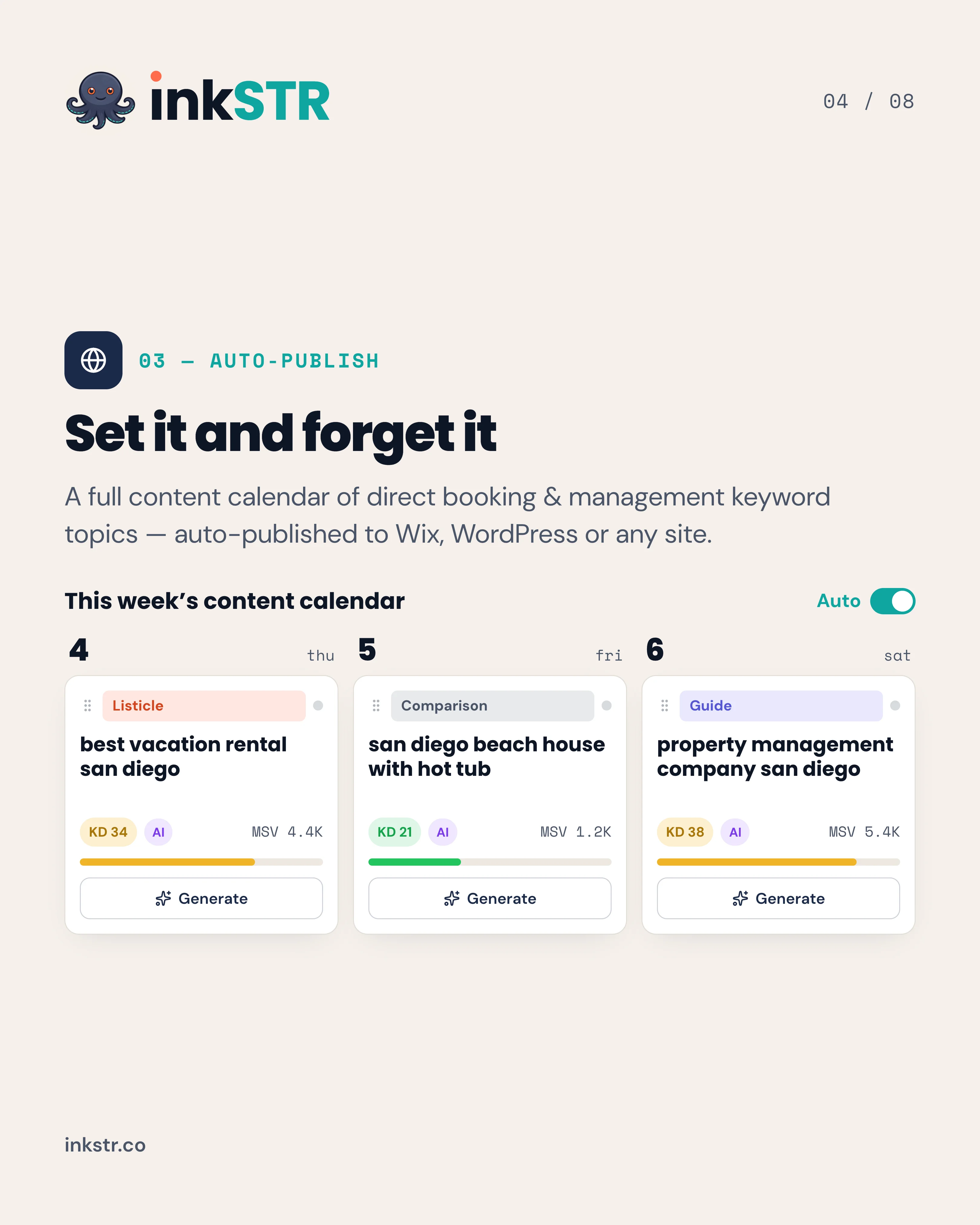
If keeping content structured for both Google and AI answer engines feels like more than you can manage on top of running your properties, Get started with inkSTR and see how our content calendar handles the research, writing, and publishing on a set schedule, built specifically for short-term rental operators.
Content powered by inkSTR.co
Enjoyed this article? Share it:
Get more of inkSTR in Google Search
Add inkstr.co as a preferred source and our articles show up more in Top Stories, AI Overviews, and AI Mode — with a “Preferred” badge.
Get more guides like this
New SEO and AI-search guides, straight to your inbox. No spam, unsubscribe anytime.