How Long Does It Take for SEO to Start Working?
Most vacation rental websites start seeing measurable SEO movement, meaning indexed pages and rising impressions, within three to six months of consistent publishing. Full results, meaning steady direct booking traffic and revenue, typically take six to 12 months, longer for brand-new domains or highly competitive markets.
Key Takeaways
- The implementation-to-benefit window runs roughly four months to a year for most sites.
- Indexing (Google finding and crawling your pages) can happen within days to a few weeks, but indexing is not the same as ranking or getting clicks.
- A survey of SEO professionals found 82 percent said it takes six months on average to see a traffic increase, with full results sometimes taking 12 to 24 months.
- Established domains with no prior SEO history often see first rankings in six to 10 weeks; brand-new domains with no content history commonly need four to six months.
- One vacation rental brand we worked with grew from 788 to 5,195 monthly Google Search clicks in 11 months and attributed $309,775 in direct booking revenue in its first 14 months. The timeline is real, but so is the payoff.
- inkSTR shortens the practical timeline by removing the bottleneck that stalls most STR content plans: publishing consistently, on schedule, without burning out the operator writing it.
If you run a short-term rental website, you have probably typed some version of "how long does it take for SEO to start working" into Google after watching your traffic sit flat for weeks. It is the single most common question we hear from hosts and property managers before they commit to any content strategy, and it deserves a straight answer instead of a vague "it depends."
In 2026, the timeline hasn't fundamentally changed from what SEO practitioners have reported for years, but the stakes have. Airbnb and VRBO fees now eat 17 to 19 percent of every booking, so every month your own site sits unranked is a month you're paying platform commissions you didn't have to pay. We built inkSTR specifically because most STR operators don't have the bandwidth to sustain the publishing cadence SEO actually requires, and inconsistent publishing is the number one reason SEO timelines stretch longer than they should.
This guide breaks the SEO timeline into its real components, indexing, ranking movement, traffic, leads, and revenue, so you know exactly what to expect at each stage and how to tell if your vacation rental content strategy is on track or stalled.
What Does "SEO Starting to Work" Actually Mean?
"SEO starting to work" is not one single milestone. It is a sequence of five distinct events: indexing, impressions, ranking movement, clicks, and conversions. Confusing these stages is the number one reason STR operators give up on content marketing too early, right around the point it was about to pay off.
First, Google has to crawl and index your page, meaning it exists in Google's database at all. Next come impressions, your page showing up in search results even if nobody clicks. Then ranking movement, your position climbing for target keywords like "pet-friendly cabin rental near the Smokies." Only after that do clicks and bookings follow.
Most vacation rental sites see indexing within days, impressions within a few weeks, and ranking movement starting around month three or four. Clicks and bookings lag behind rankings by another month or two, because guests still need to find and trust your page before they convert.
This is exactly why we built inkSTR's content workflow around continuous publishing rather than one-off blog posts. A single article might rank in eight weeks, but a site with 20 to 30 interlinked articles builds topical authority that compounds, which is what actually shortens the path from indexing to booking revenue.

Is SEO Still Worth It in 2026?
Yes, SEO is still worth it in 2026, and it's more valuable for short-term rental operators than it was five years ago, because organic traffic is the only channel that doesn't charge a commission on every booking. A single direct booking is typically worth $1,000 to $4,000 in revenue, and a ranking blog article can keep driving that traffic for two to five years after it's published.
The pain most operators feel isn't whether SEO works, it's that manual content creation doesn't scale. Writing one quality blog post takes three to five hours of research and writing, and hiring a freelance travel writer runs $300 to $700 per article. At that pace, publishing the volume of content needed to build topical authority across a multi-property portfolio becomes a part-time job nobody signed up for.
Meanwhile, competitors who do publish consistently pull further ahead every month you don't. We've seen this play out directly: a five-market vacation rental brand went from averaging 26 monthly Google search visits to 1,924 in just four months after publishing 114 articles across its portfolio. A solo writer would have needed well over a year to produce that volume manually.
That gap between what SEO requires and what a busy operator can realistically produce is the entire reason inkSTR exists. Our AI Content Writer generates SEO-optimized, 2,500 to 3,500 word articles automatically, so the volume problem that used to make SEO impractical for independent hosts stops being a barrier.
Is SEO Very Difficult for a Vacation Rental Website?
SEO is not conceptually difficult, but it is operationally difficult to sustain, which is why most vacation rental sites fail at execution rather than strategy. The mechanics, keyword targeting, on-page optimization, internal linking, are well documented. What's hard is doing them consistently for six to 12 months without a team.
Consider what "difficult" actually looks like in practice. You need keyword research that reflects how guests actually search, phrases like "oceanfront condo with balcony" rather than generic terms. You need a publishing schedule you can maintain even during your busiest booking season, plus internal linking between your blog and booking pages, something most hosts never set up correctly.
Property management companies juggling 10 or more listings feel this most acutely. Manually researching keywords, drafting posts, and publishing across multiple property sites eats an entire workweek that could go toward guest communication or revenue management instead.
That is why inkSTR's Keyword Research tool automates the part operators consistently skip or do poorly: finding the specific terms your target guests search, then feeding those directly into article generation. Time, not difficulty, is the real obstacle, and that's the piece inkSTR removes.
What Is the 80/20 Pattern in SEO for Short-Term Rentals?
In practice, a small share of your content, typically your pillar pages and highest-intent blog posts, tends to drive the majority of your organic traffic and bookings. For vacation rental sites, that usually means location-specific guides and direct-booking comparison pages outperform generic "things to do" posts by a wide margin.
In practice, this means a listing page optimized for "3 bedroom lake house rental with dock" combined with two or three supporting blog posts on nearby activities and seasonal booking timing will often outperform 20 unfocused posts about general travel tips. Focus matters more than volume, but volume still matters once you know where to focus.
The mistake we see constantly: operators publish whatever comes to mind instead of building around search intent. A generic "top 10 restaurants" post rarely converts a reader into a booking. A post titled "is this cabin walkable to downtown" tied directly to your property's actual location does.
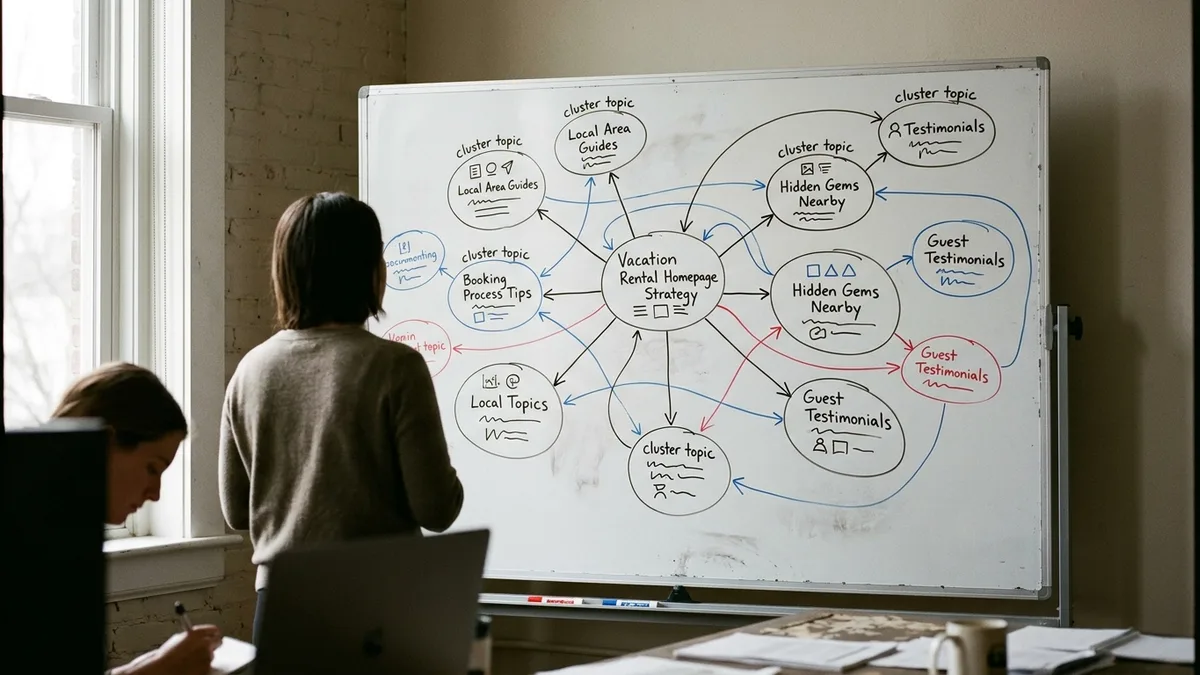
Our content strategy tools build pillar-and-cluster architecture specifically around direct-booking search intent, so the handful of articles that matter most get built first, not buried in a queue behind filler content. That structural discipline is what separates sites that rank from sites that just publish.
Is SEO Dead Now With AI?
No, SEO is not dead because of AI. It has expanded into a parallel discipline: ranking in AI-generated answers from tools like ChatGPT, Perplexity, and Google's AI Overviews, on top of traditional search rankings. Traffic is increasingly split between classic blue-link search and AI-summarized answers, which means content now needs to satisfy both systems.
AI Overviews and chat-based assistants pull from the same well-structured, authoritative content that ranks well in traditional search, meaning the fundamentals haven't changed as much as the distribution channel has. What has changed is how quickly AI systems can surface a well-written answer, sometimes citing a source within weeks of publication if the content is useful and well-structured.
We've seen this firsthand. One STR management company we work with started publishing owner-facing content in late April 2026 and had four property-owner leads arrive directly from AI search within the first month, with Google impressions running 4.6 times higher than the year prior within three months.
inkSTR builds every article with what we call AI-search citability from the start, meaning answer-first structure, clear definitions, and named entities that AI systems can extract and cite. SEO is evolving, not dying, and the operators who adapt their content structure now are the ones who show up in both Google's results and ChatGPT's answers later this year.
How Long Does SEO Take Based on Your Site's Starting Condition?
SEO timelines vary significantly depending on domain age, existing authority, and technical health, not just keyword competition. An established domain older than two years with no prior SEO history can see first rankings in as little as six to 10 weeks, while a brand-new domain with no content history commonly takes four to six months to show similar movement.
This distinction matters enormously for STR operators deciding whether to build a new site or optimize an existing one. Crawling and indexing speed depends partly on site authority signals Google has already established, which is why an older domain with dormant content often outperforms a brand-new site in the first few months, even with less new content.
| Starting Condition | Typical Time to First Ranking Movement | Typical Time to Meaningful Traffic |
|---|---|---|
| Established domain (2+ years), no prior SEO | 6 to 10 weeks | 3 to 6 months |
| Brand-new domain, no content history | 4 to 6 months | 6 to 12 months |
| Existing site with technical issues | Delayed until fixes are indexed, add 4 to 8 weeks | 4 to 8 months |
| National competitive keyword targeting | 6+ months | 12+ months |
| Local, low-competition STR market | 6 to 10 weeks | 3 to 6 months |
Local vacation rental markets, a specific mountain town or lake destination, tend to move faster than national competitive terms because fewer sites compete for that exact search intent. This is also where local SEO signals matter more than raw domain authority.
Whichever category your site falls into, the fix for a slow start is rarely "wait longer." It's usually "publish more consistently while fixing technical issues in parallel." That's the exact workflow inkSTR's Content Calendar was built to run on autopilot, so your publishing cadence doesn't stall while you're busy managing guest turnovers.
What Should You Expect Month by Month?
A realistic SEO timeline for a short-term rental website follows a predictable arc: foundational work and indexing in months one and two, early ranking movement and rising impressions in months three and four, then measurable clicks and bookings from month five onward. Highly competitive markets extend this arc to 12 months or more.
- Month 1: Foundation and technical setup. Submit your sitemap, fix crawl errors, and set up Google Search Console. Indexing of individual pages can happen within days to a few weeks once submitted, though full-site indexing takes longer.
- Month 2: Initial content publishing. Publish your first wave of pillar and cluster articles targeting direct-booking search intent. Expect impressions to appear in Search Console with minimal clicks.
- Month 3 to 4: Early ranking movement. Keywords begin appearing on pages two and three of Google. This is the stage where most operators mistakenly assume SEO "isn't working," when in fact it's tracking to typical patterns.
- Month 5 to 6: First measurable clicks. A meaningful share of your target keywords should be climbing toward page one. Industry surveys of SEO professionals report this as the point where most sites see a traffic increase.
- Month 7 to 12: Compounding traffic and bookings. Older articles continue climbing while new ones enter the index, creating compounding organic growth. This is where direct booking revenue typically becomes measurable against your content investment.
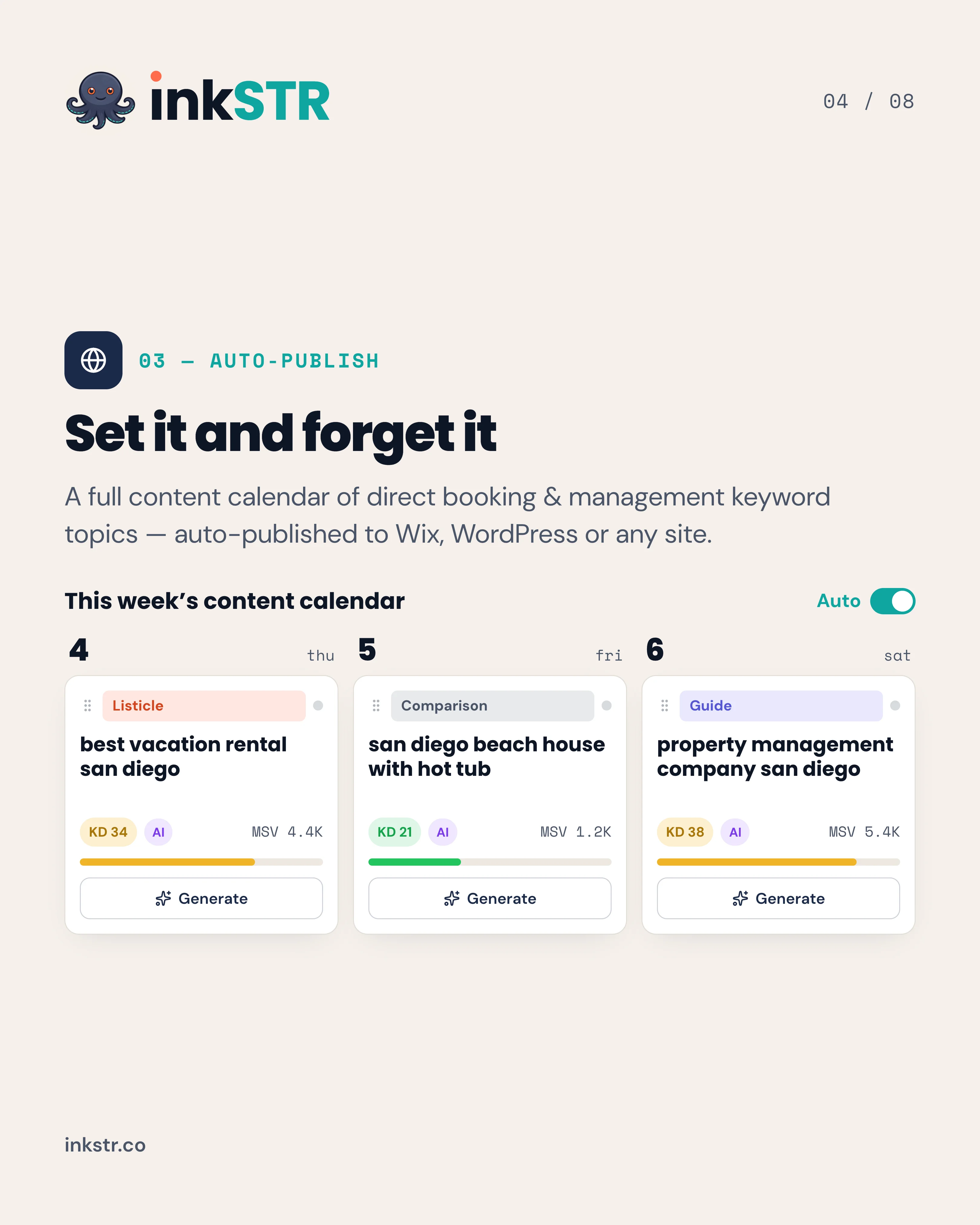
Notice the sequence: technical work compounds into content, content compounds into rankings, rankings compound into traffic. Skipping steps, publishing content before fixing crawl errors, for example, delays everything downstream. inkSTR's Auto-Publishing feature keeps this sequence moving without manual bottlenecks, publishing directly to Wix or WordPress on the schedule you set.
Ready to automate your content marketing?
inkSTR handles keyword research, content strategy, article writing, and publishing, all on autopilot.
How Do You Measure Early SEO Progress in Month Three?
Healthy month-three SEO progress looks like rising impressions and indexed pages in Google Search Console, even before clicks or rankings fully materialize. A stalled campaign, by contrast, shows flat or declining impressions, unindexed pages, or zero keyword movement across an entire quarter.
Use this diagnostic checklist to separate a slow-but-healthy campaign from one that's genuinely stuck:
- Indexed pages: Check your Search Console Pages report. If fewer than 80 percent of your published articles are indexed by month three, you likely have a technical or content-quality issue.
- Impressions trend: Impressions should be rising month over month, even if clicks stay low. Flat impressions signal your content isn't matching real search queries.
- Average position: Keywords sitting consistently on page four or five with no movement toward page two or three by month three suggest weak topical relevance or thin content.
- Click-through rate: If you're getting impressions but near-zero clicks, your titles and meta descriptions likely aren't answering the searcher's question directly.
- Conversion tracking: Set up goal tracking in analytics for booking inquiries originating from blog content, not just homepage traffic.
Across inkSTR customer sites, we've published more than 4,100 articles as of September 2026, generating over 2.7 million Google Search impressions and more than 22,000 clicks in the trailing 90 days alone. That scale gives us a clear pattern: sites that publish consistently through month three, even without dramatic early results, are the ones that break through by month six.
If your numbers don't match this pattern, the fix usually isn't waiting longer, it's revisiting search intent, technical health, or publishing consistency. That's a diagnostic conversation we have constantly with new inkSTR users, and it's exactly why the platform pairs keyword research with a brand audit that flags competitor gaps before you waste months publishing content nobody's searching for.
What Mistakes Slow Down Your SEO Timeline?
The most common mistake that delays SEO results is inconsistent publishing, stopping for weeks during busy booking season, then restarting with no strategy continuity. Google's crawlers reward consistent signals of an active, maintained site, and gaps in publishing reset the momentum you've built.
Second most common: writing generic content instead of direct-booking-focused content. A post about "best hiking trails nearby" with no connection to your specific property rarely converts, no matter how well it ranks. Guests need a clear next step from your blog to your booking page.
Third: ignoring technical health while focusing only on content volume. Broken internal links and slow page speed can quietly cap your ranking potential no matter how much you publish.
Fourth: expecting linear growth. SEO growth is rarely a straight line, it's closer to a hockey stick, flat for months, then compounding once you cross a topical authority threshold. Giving up in month four, right before that inflection point, is the single most expensive mistake we see STR operators make.
Avoiding these mistakes is largely a matter of consistency and structure, which is precisely the operational gap inkSTR's Content Calendar closes. It schedules and publishes automatically, so a slow August with back-to-back guest turnovers doesn't quietly derail your entire content strategy.

How Do You Know if Your SEO Strategy Is Actually Working?
SEO is working if you see a consistent upward trend across indexed pages, impressions, and average keyword position over a rolling 90-day window, even if absolute traffic numbers still feel small. Look at trend direction, not single-month snapshots, since natural fluctuation is normal even in a healthy campaign.
Set up a simple reporting cadence: check Google Search Console weekly for impressions and indexing, monthly for keyword position trends, and quarterly for conversion tracking tied to actual booking inquiries. Leading indicators, impressions and indexing, should move first. Lagging indicators, clicks and bookings, follow weeks or months later.
If you're three months in and impressions are flat, that's your signal to revisit keyword targeting or content quality, not to wait longer. If impressions are climbing but clicks aren't, the fix is usually your titles and meta descriptions, not your content strategy.
This measurement discipline is where most independent hosts fall short, not because they lack the data, but because they lack the time to review it consistently alongside everything else running a rental business demands. inkSTR's dashboard surfaces this progress automatically, connecting directly to your Google Search Console data so you're not manually cross-referencing spreadsheets every month.
Practical Guidance: How to Set Realistic SEO Expectations
Setting realistic SEO expectations starts with separating what you control from what you don't. You control content quality, publishing consistency, and technical health. You don't control how fast Google recrawls your site or how competitive your specific market is.
- Audit your starting condition first. Know whether you're working with an established domain or starting fresh, since that alone shifts your timeline by months.
- Commit to a minimum six-month runway before judging results. Anything shorter isn't a fair test of whether your strategy works.
- Publish consistently, not in bursts. A steady cadence of articles beats ten posts in one week followed by three months of silence.
- Track leading indicators weekly, impressions and indexed pages, so you catch problems in month two instead of month six.
- Prioritize direct-booking search intent over generic travel content. A post that ranks but doesn't convert isn't doing its job.
- Fix technical issues before scaling content volume. More articles won't fix a crawl error or broken sitemap.
Here's the trade-off worth naming honestly: faster timelines usually mean targeting less competitive, more specific keywords, "dog-friendly cabin near Pigeon Forge with a fenced yard" instead of "vacation rentals." Specific keywords rank faster but each one drives less volume, so you need more of them, which again comes back to publishing consistency.
This is the exact operational problem inkSTR was designed around. Our pricing starts at $99 per month, built for operators who need consistent output without hiring a full content team or freelance writer at $300 to $700 per post.
Frequently Asked Questions
How long does it take for SEO to start working for a new vacation rental website?
A brand-new domain with no content history typically needs four to six months before first rankings appear, and six to 12 months before traffic becomes meaningful. An established domain with existing authority can see first rankings in six to 10 weeks instead.
Do I need a blog if I already have a direct booking website?
Yes. A booking page alone rarely ranks for the informational searches guests make before deciding where to stay. A blog captures that earlier-stage search intent, then funnels readers to your booking page through internal links, which is exactly the architecture inkSTR's content strategy tools are built to construct.
What's the difference between SEO for a single listing and SEO for a property management company?
A single listing typically targets a handful of highly specific, local keywords tied to one property. A property management company needs SEO across many properties and markets simultaneously, which multiplies the content workload, exactly the problem inkSTR's multi-project support addresses by running independent content pipelines per property from one dashboard.
How often should I publish new blog content for my vacation rental site?
Most sites benefit from a steady, sustained cadence rather than sporadic bursts, since Google's crawlers respond to consistent signals of an active site. The exact frequency matters less than consistency over a six to 12 month window.
Can AI-generated content actually rank on Google and get cited in AI search results like ChatGPT?
Yes, when it's well-structured, answer-first, and grounded in real search intent. We've seen this directly: one STR management company had four property-owner leads arrive from AI search within its first month of publishing with inkSTR, and the platform has secured over 1,185 verified AI-search citations for customer content as of September 2026.
How do I get more direct bookings without relying on Airbnb or VRBO traffic?
Build content around the specific searches guests make before booking, then link that content directly to your booking page. This is slower than paying for OTA placement but avoids the 17 to 19 percent combined host and guest fees those platforms charge on every reservation.
Is SEO still worth it in 2026 given how much AI has changed search?
Yes. AI Overviews and chat-based assistants still pull from well-structured, authoritative content, meaning the core SEO fundamentals, quality content and technical health, remain the foundation for visibility in both traditional search and AI-generated answers.
What mistakes make SEO take longer than it should?
Inconsistent publishing, generic content with no connection to direct bookings, unresolved technical issues, and giving up before month four are the most common reasons a healthy SEO timeline stretches unnecessarily long.
Conclusion: Setting a Realistic SEO Timeline for 2026
SEO for a short-term rental website typically starts showing early movement, indexing and rising impressions, within three to six months, with meaningful traffic and bookings following in the six to 12 month range. The exact timeline depends heavily on domain age, technical health, and how consistently you publish.
The operators who see results fastest aren't the ones with the biggest budgets, they're the ones who publish consistently through the flat months instead of stopping right before the inflection point. That consistency is the entire premise behind inkSTR: automated keyword research, article generation, and scheduled publishing so your content strategy keeps running even during your busiest booking season.
If keeping up a consistent publishing schedule across your properties feels impossible with everything else on your plate, Get started with inkSTR and see your first content plan generated automatically, no freelance invoices, no missed weeks, just a schedule that runs itself.
Content powered by inkSTR.co
Enjoyed this article? Share it:
Get more of inkSTR in Google Search
Add inkstr.co as a preferred source and our articles show up more in Top Stories, AI Overviews, and AI Mode — with a “Preferred” badge.
Get more guides like this
New SEO and AI-search guides, straight to your inbox. No spam, unsubscribe anytime.