Portfolio Marketing Strategy for 10+ Rental Managers
A portfolio marketing strategy for 10+ rentals sorts your units into segments, assigns each segment its own search-targeted content, and measures results across the whole portfolio. At inkSTR, we build content automation for short-term rental managers, and this is the system we see hold up as unit counts grow.
Key Takeaways
- A portfolio marketing strategy manages 10+ rentals as one system: a shared brand and content engine, with segment-level targeting for each group of units.
- Segment by market, property type, guest profile, and price band before you write anything, because each group searches differently.
- Track direct booking share, cost per direct booking, inquiry-to-booking conversion, and vacant nights by segment instead of raw page views.
- A single direct booking is typically worth $1,000 to $4,000 in revenue, while Airbnb host and guest fees combined take 17-19% of every booking.
- Governance (one owner per segment, fact checks, and a refresh cadence) keeps 10+ listings from contradicting each other.
- inkSTR automates keyword research, drafting, scheduling, and publishing, with a separate pipeline for each property or brand, so one person can run content for the whole portfolio.
Picture managing fourteen units across three neighborhoods. Every property has a listing page, the blog went quiet in spring, and the keyword spreadsheet nobody has opened since March sits in a shared drive. Traffic still arrives, but it lands on the OTAs, and the booking fee goes with it.
In 2026, scale changes who wins that search. According to Hostfully's 2026 Vacation Rental Tech Stack Report (June 2026), marketing and analytics software adoption rises from 23% among operators with 1-5 properties to 67% among operators with 100 or more. Bigger portfolios treat marketing as infrastructure, and the gap shows up in search results.
This guide walks through seven steps, from segmenting your units to turning traffic into direct bookings and owner leads. As of October 2026, we have published more than 5,400 articles across inkSTR customer sites, so the workflow below comes from running it, not theorizing about it.
Step 1: What Does a Portfolio Marketing Strategy Look Like for 10+ Rentals?
A portfolio marketing strategy for vacation rentals is one plan that spreads content, channels, and effort across every unit you manage, instead of promoting each listing alone. Product marketing sells a single offer. Portfolio marketing decides which units and markets get attention first. It also decides which guest types come first and how every page leads to a booking path.
Without that plan, the same pattern repeats. You write a post for one cabin, paste similar copy onto six other listings, and wait for rankings that never come. Updating content across 15 or more properties eats whole days, and freelancers at $300-$700 per post turn every extra unit into a budget argument.
We built inkSTR's content strategy wizard for exactly this situation. It maps pillar, cluster, and conversion articles to your markets, and multi-project support gives each property or brand its own independent pipeline. The how inkSTR works page shows the full flow from keyword to published post.
Pro tip: before touching any tool, list every unit on one sheet with its market, property type, and booking page URL. That sheet is your portfolio map, and it takes an afternoon.
Step 2: How Do You Segment Your Rentals Into Marketing Groups?
Segmenting a rental portfolio means sorting units into groups that share a market and property type, along with a guest profile and price band. Each group then gets its own keywords and messaging. A lakefront house for multigenerational families and a downtown studio for business travelers answer different searches, even when one brand owns both.
The common mistake is segmenting by owner or by the order units joined your roster. Guests search by place and trip type, and group size matters too, so your content has to follow those lines or it reaches nobody.
| Segment | What guests search for | Content focus | Lead metric |
|---|---|---|---|
| Lake or beach house | Weekend getaway and family reunion queries by town | Seasonal guides, shoulder-season stays | Direct booking share |
| Mountain cabin | Cabins near a specific trail or attraction area | Local attractions, group size guides | Organic clicks by market |
| Urban apartment | Neighborhood and business-trip queries | Neighborhood guides, mobile booking speed | Inquiry-to-booking conversion |
| Large group home | Reunion, retreat, and wedding-weekend queries | Capacity details, event-ready amenities | Average nightly rate achieved |
| Owner-acquisition (management companies) | Property manager searches by town | Owner-facing guides and service pages | Owner leads |
Keep the number of segments to what you can staff. A handful gives each group enough content to build authority.
This is where inkSTR's keyword research and brand audit earn their place. Instead of building a spreadsheet per segment, you get a keyword plan around your market plus a competitor keyword gap analysis in one workflow. We apply the same approach to owner-facing searches. A Charlotte and Lake Norman STR management company started on inkSTR at the end of April 2026. In its first month, it had four property-owner leads arrive from AI search.

Step 3: How Do You Write Buyer-Centric Messaging Across Many Units?
Buyer-centric messaging for a rental portfolio means building each page around the decision a specific guest segment is trying to make, such as which town or which house. Which weekend matters too, and the page should center on that rather than on your amenity list. Your portfolio brand carries trust. Unit and market pages carry the details that answer a real search.
Copy-pasted descriptions are the usual casualty of scale. When ten listings share one paragraph about "stunning views and modern comforts," search engines see duplicates and guests see nothing that explains why this house fits their trip. We cover the conversion damage in our post on why generic travel content kills conversions.
Writing every page by hand is the other trap, since one quality post takes 3-5 hours. inkSTR pulls real property detail from your connected property management system, including reviews, photos, and guest data, and the AI Content Writer drafts 2,500 to 3,500 word articles for each segment.
That is how The Peak Properties, a five-market mountain rental brand, published 114 articles in four months and moved from 26 to 1,924 monthly Google search visits. Those figures were measured in Wix Analytics and Google Search Console, not estimated by a third-party tool.
Step 4: How Do You Build a Portfolio Marketing Roadmap?
A portfolio marketing roadmap is a dated plan that sequences which segments and markets you publish over the next quarter or two. It also covers content types. It matters because 10+ units generate more topics than one person can cover at once, so the order you publish in decides which pages start earning traffic first.
Without a roadmap, publishing follows whatever feels urgent. Three posts about one cabin appear in week one, nothing in week two, and the schedule collapses by week three. A workable sequence has four phases:
- Foundation: one pillar page per market and one per segment.
- Cluster: supporting articles for specific searches such as trip types, seasons, and local attractions.
- Conversion: pages that route readers to booking or owner inquiry forms.
- Refresh: a scheduled pass over older posts as units change.
| Approach | Cost | Effort per post | Fit for 10+ units |
|---|---|---|---|
| Write it yourself | Your time | 3-5 hours of research and writing | Stalls once the day fills with guest messages |
| Freelance travel writer | $300-$700 per post | Briefing and editing on your side | Cost multiplies with every unit and market |
| inkSTR | $99/month | Articles generated, scheduled, and published automatically | One pipeline per property or brand |
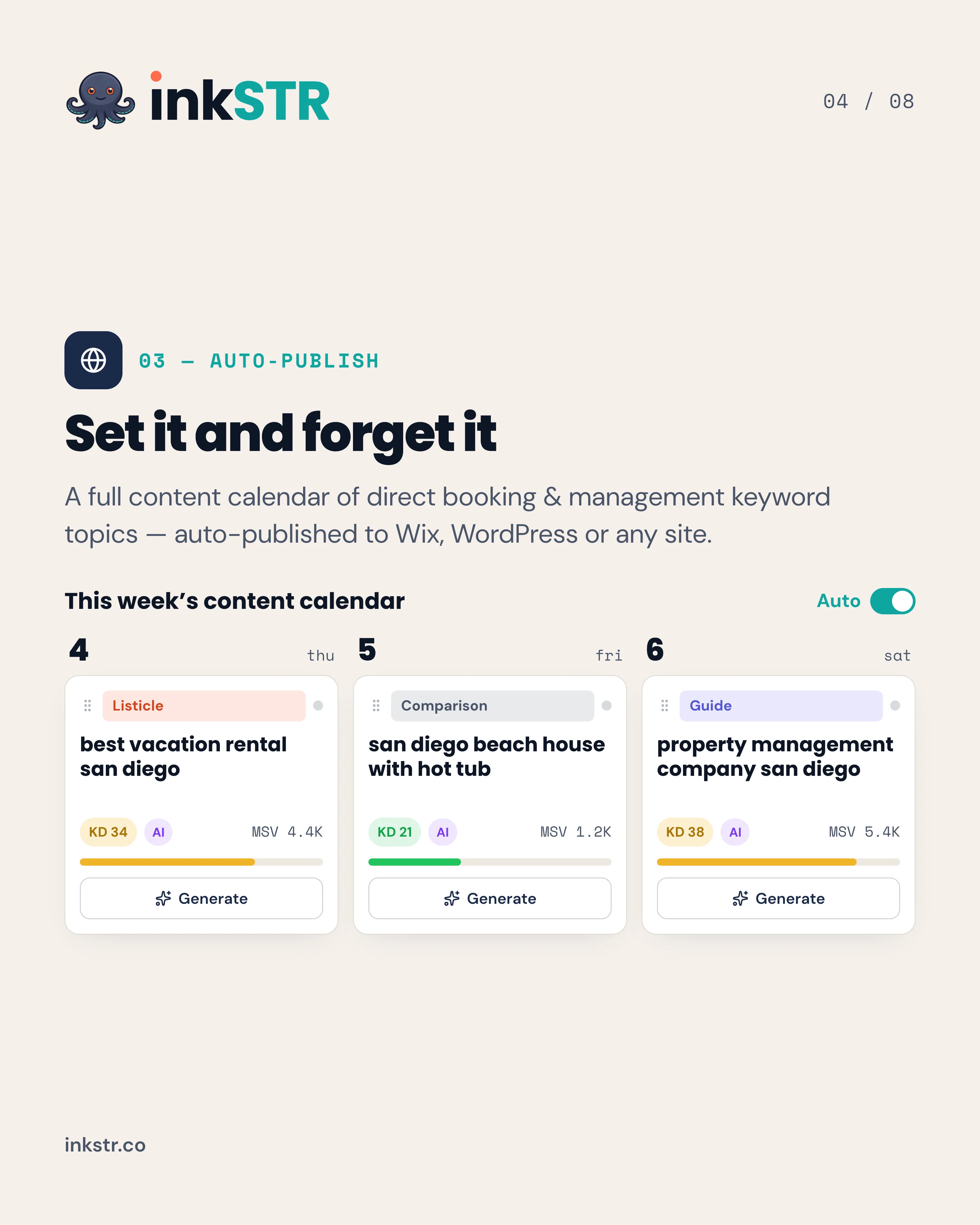
Open the content calendar, drag an article to Tuesday, and the scheduler publishes it to your WordPress or Wix site through auto-publishing. We designed it so you can plan weeks of posts in one sitting. A ranking article can drive organic traffic for 2-5 years, which is why early consistency pays off, and our list of vacation rental blog topics gives you a starting backlog. When you are ready, start a free trial and load your first segment.

Step 5: Which Metrics Show Whether the Portfolio Is Working?
Portfolio marketing KPIs are the few numbers that let you compare segments against each other: direct booking share and cost per direct booking, plus inquiry-to-booking conversion and vacant nights by group. Page views alone cannot tell you whether a lake house segment outearns a city apartment segment.
Many managers track traffic and stop there. Booking pages collect plenty of views and few reservations, and nobody can say which segment is leaking. Meanwhile every OTA booking still carries 17-19% in combined host and guest fees, so traffic you cannot measure is expensive traffic. Our guide to booking page conversion optimization covers the fixes once you find the leak.
| Metric | What it tells you | Where to read it |
|---|---|---|
| Direct booking share by segment | Which groups earn bookings you own | PMS booking source report |
| Cost per direct booking | Whether content spend beats OTA fees | Content cost divided by direct bookings |
| Organic clicks and impressions by market | Which markets gain search visibility | Google Search Console |
| Vacant nights by segment | Where demand is soft | PMS calendar |
| Nightly rate achieved versus listed | Whether discounting hides weak positioning | PMS revenue report |
inkSTR's Google Search Console integration tracks keyword rankings and flags opportunities, so you see which markets are moving without exporting a single report. Hemlock Hills, a Smoky Mountains cabin brand, grew monthly Google Search clicks from 788 to 5,195 in 11 months on a continuous inkSTR pipeline. It attributed $309,775 in direct booking revenue over its first 14 months. All of it was measured in Search Console and Google Analytics.
Ready to automate your content marketing?
inkSTR handles keyword research, content strategy, article writing, and publishing, all on autopilot.
Step 6: How Do You Govern Marketing Across Many Listings and Team Members?
Portfolio marketing governance is the set of ownership and approval rules that keeps 10+ listings accurate and consistent while several people edit them. Refresh rules are part of it too. It decides who can publish and who checks facts. It also sets how often old pages get revisited.
The cost of skipping it shows up quietly. A renovated cabin still advertises a hot tub it no longer has, a review quote includes a guest's full name, and a post goes live at 11 p.m. that nobody approved. Performance comparisons that flatter one unit at another's expense also mislead the owners reading them.
Start with ownership: name one person per segment, so every question has an address. That person verifies amenities, capacity, and distances before anything publishes, and keeps guest names and identifying details out of reviews and photos. They also confirm local short-term rental rules with the relevant local office, including any fair-housing requirements for units you market for longer stays. Finally, they set a fixed refresh schedule for every page, and a renovation triggers an immediate update.
That is why we added quality scoring and pre-publish validation to inkSTR: weak or risky content gets flagged before it goes live. The image library with AI descriptions and SEO file naming keeps photo use consistent across units, and separate project pipelines mean one segment's approvals never block another's.

Step 7: How Do You Turn Portfolio Traffic Into Direct Bookings and Owner Leads?
Turning portfolio traffic into revenue means sending each reader to the page that matches their intent, whether that is a unit booking page or a market hub. Owners go to an inquiry form. A single direct booking is typically worth $1,000 to $4,000 in revenue, so every closed path matters.
Without those paths, blog traffic leaks. Readers enjoy a post, close the tab, and book later on Airbnb or VRBO, where the fees come out of your margin. Guest email is the second leak: past guests are your cheapest audience, yet most portfolios never ask for an address.
Capture emails on blog and booking pages, then run automated campaigns from your PMS or email platform: a booking confirmation and a pre-arrival message. Add a post-stay thank-you and an off-season return offer after that. inkSTR does not send email. It builds the search traffic and routes it, which is the part most portfolios lack.
inkSTR's internal link management sends readers from each article to your primary booking or inquiry page, so informational searches end somewhere that converts. Our direct bookings content approach shows the full funnel, and property management companies can point the same structure at owner inquiry pages.
Frequently Asked Questions About Portfolio Marketing for Rentals
What is portfolio marketing for vacation rentals?
Portfolio marketing for vacation rentals is the practice of planning content and channels across all of your units as one system. Metrics get planned the same way. You group units into segments, publish search-targeted content for each, and compare results at the portfolio level. It suits managers with 10 or more units because per-listing marketing stops scaling at that size.
What is the difference between portfolio marketing and product marketing?
Product marketing promotes one offer to one audience. Portfolio marketing allocates effort across many offers, so you decide which units and markets come first. You also choose which guest types lead and how their pages connect. In rentals, that means choosing which cabins or apartments get content attention this quarter.
How do short-term rental managers market multiple properties?
They build a shared brand site with market and segment hubs, then publish unique content for each group instead of repeating one description. A content calendar, one owner per segment, and segment-level metrics keep the work manageable. inkSTR gives each property or brand its own pipeline and schedules posts to Wix or WordPress, which removes much of the daily juggling.
What is the best marketing software for vacation rentals?
No single tool covers everything. Most portfolios combine a PMS, a channel manager, an email platform, analytics, and a content engine; our list of must-have tools for short-term rental managers scaling up covers the stack. inkSTR handles the content and SEO layer, from keyword research to publishing, with plans starting at $99/month on the pricing page.
How do I set up automated guest email campaigns?
Start in your PMS or email platform, since inkSTR focuses on blog content and publishing. Build sequences for booking confirmation and pre-arrival details, then add post-stay thanks and a return-stay offer. Finish by adding a signup form to blog and booking pages. Tie each message to the unit and segment the guest stayed in.
How can rental operators increase direct bookings?
Publish content that answers the searches your guests use, route every post to the matching booking page, and measure direct booking share by segment. Consistency matters more than volume in any single week. Our guide to ranking in AI search shows how to structure that content so AI engines can cite it.
How long does a portfolio marketing strategy take to show results?
SEO is slow, so expect months, not days, before a new blog earns steady traffic. A ranking article can keep driving organic traffic for 2-5 years, which rewards early consistency. The Peak Properties went from 26 to 1,924 monthly search visits in four months with 114 articles, but results vary by market and competition.
Conclusion: Where Should You Start With Your Portfolio Marketing Strategy in 2026?
A portfolio marketing strategy for 10+ rentals comes down to sorting units into segments, writing for each segment's real searches, and measuring direct bookings by group. Use this quick reference to work through it:
- Define the plan and map every unit on one sheet.
- Segment units by market, property type, guest profile, and price band.
- Write buyer-centric messaging for each segment, grounded in real property details.
- Build a dated roadmap with foundation, cluster, conversion, and refresh phases.
- Track segment-level KPIs such as direct booking share and cost per direct booking.
- Assign owners, fact checks, and a refresh cadence.
- Route every reader to a matching booking or owner inquiry page.
As AI search keeps reshaping how guests find rentals in 2026 and beyond, portfolios with organized, answer-first content across every segment give AI engines something to cite. As of October 2026, we have secured more than 1,500 verified AI-search citations for inkSTR customer content.
Want to run every property's blog from one dashboard? Start Free Trial with inkSTR and schedule weeks of segment-specific articles in a single sitting. The content calendar and keyword research handle the pipeline, and so does one-click Wix and WordPress publishing. That lets you stay focused on your guests and your owners.
Content powered by inkSTR.co
Enjoyed this article? Share it:
Get more of inkSTR in Google Search
Add inkstr.co as a preferred source and our articles show up more in Top Stories, AI Overviews, and AI Mode, with a “Preferred” badge.
Get more guides like this
New SEO and AI-search guides, straight to your inbox. No spam, unsubscribe anytime.