What Is a SEO Writer? A Guide for STR Content Marketing

A SEO writer is a content creator who writes blog posts, web pages, and articles specifically structured to rank on Google and attract organic traffic, while still being genuinely useful to the person reading it. For a short-term rental business, that means someone (or something) producing keyword-targeted content about your property, your market, and the travelers searching for both.
- A SEO writer blends keyword research, search intent analysis, and readable prose into content built to rank and convert, not just fill a page.
- Experienced SEO content writers typically charge $300 to $700 per quality blog post based on freelance market rates, with some specialized writers charging more for long-form or strategic pieces.
- Writing one quality, well-researched blog post manually takes 3 to 5 hours of keyword research, drafting, and on-page optimization work.
- The global SEO services market is estimated at USD 83.98 billion in 2026, reflecting how central this skill set has become to online visibility.
- A single ranking blog article can drive organic search traffic for 2 to 5 years once it earns a position on page one.
- inkSTR automates the entire SEO writer function for vacation rental operators, generating, scheduling, and publishing keyword-targeted articles without hiring a freelancer or blocking off your own week.
If you run a vacation rental business, you've probably searched some version of "what is a SEO writer" while trying to figure out whether you need to hire one. Maybe you're staring at a direct booking website that gets almost no traffic, or you've priced out a freelancer and the number made you close the tab. Either way, you're in the right place.
In 2026, the SEO writing profession sits at the intersection of two forces reshaping how travelers find vacation rentals: traditional Google search and AI-driven search tools like ChatGPT and Perplexity. Understanding what a SEO writer actually does, and what one costs versus what one delivers, is the first step toward deciding whether you write this content yourself, hire it out, or automate it entirely.
This guide breaks down the SEO writer role in plain terms: what they do day to day, how much they typically charge, whether the skill is worth learning yourself, and where the manual approach breaks down for busy STR operators managing one property or fifty. At inkSTR, we've built our entire platform around solving the exact production bottleneck that makes hiring or becoming a SEO writer so painful for vacation rental businesses.
What Does an SEO Writer Actually Do for a Vacation Rental Business?
A SEO writer for a vacation rental business researches the keywords travelers use to find properties like yours, then writes blog content and web pages structured around those exact search terms. Specifically, this means articles about your destination, your amenities, and the questions guests ask before booking, all written to rank on Google while still reading naturally.
The day-to-day tasks are more mechanical than people expect. A SEO writer identifies target keywords (say, "pet friendly cabin rental Gatlinburg"), researches what's already ranking for that term, then drafts an article with a specific structure: an answer-first opening, subheadings that match how people search, internal links to other pages on your site, and meta titles and descriptions built for click-through. They also handle the technical layer most hosts never think about: alt text on images, URL slugs, schema markup, and internal link placement. None of that is optional if you want the content to actually rank, not just exist.
For STR operators specifically, the job also requires understanding traveler search intent by property type and destination. A writer covering a beach town rental needs different keyword instincts than one covering a mountain cabin, and generic content writers without hospitality context usually miss this entirely. That's the specific gap inkSTR's AI Content Writer was built to close: it understands vacation rental terminology and location-based search intent instead of producing generic travel copy that could describe any destination.
Without a SEO writer, or a system that replaces one, your website content ends up written for you, not for search engines or the traveler actually deciding between your listing and five others. That's the difference between a blog that exists and a blog that drives bookings.
How Do I Become a SEO Writer for My Own Rental Business?
Becoming a SEO writer, at least well enough to handle your own property's content, requires learning three overlapping skills: keyword research, on-page optimization, and clear writing that matches what travelers are actually searching for. Most STR operators can learn the basics in a weekend, but sustaining the output is where it falls apart.
Start with keyword research. Tools like Ubersuggest or SEMRush show you search volume and competition for terms like "vacation rental [your city]" or "things to do near [your property]." From there, you map those keywords to specific article topics, ideally organized into a pillar and cluster structure so your site builds topical authority instead of one-off posts that go nowhere.
Next comes on-page structure: answer-first openings, question-based subheadings, short paragraphs, and internal links between your own pages. A technical crawler like Screaming Frog can flag structural problems once your site has enough pages to audit.
Here's the honest part most guides skip: learning to write one good SEO post is achievable in a weekend. Sustaining that output, one to four posts a month, every month, for a year, is where almost every solo operator quits. We've watched this pattern repeat across hundreds of STR businesses: the content stops not because the strategy failed, but because nobody had four hours a week to spare after guest turnover, pricing, and maintenance calls.
This is exactly the production gap inkSTR was designed to solve. Instead of you learning and executing every step of the SEO writer skill set yourself, inkSTR's Keyword Research tool finds the terms your target guests actually search, and the AI Content Writer handles the drafting, so you keep the strategic control without the weekly time cost.
How Much Do SEO Writers Make (or Cost You to Hire)?
Experienced freelance SEO content writers typically charge $300 to $700 per quality blog post, with rates climbing higher for long-form, technical, or strategic content. For a vacation rental business publishing consistently, that adds up fast: even a modest schedule of two posts a month runs $600 to $1,400 monthly before you've built enough content volume to move the needle on rankings.
Rates vary by experience and market. Newer writers or generalists may charge on the lower end, while specialists with hospitality or travel niche expertise, exactly the writers who understand STR search intent, command premium pricing precisely because that expertise is rare. Some experienced SEO content writers charge upward of $175 per hour for strategic work beyond simple drafting, according to industry freelance pricing data. The math gets worse when you factor in inconsistency. Freelancers get busy, take on other clients, or disappear mid-project. Property management companies running content across 15-plus properties often end up managing multiple freelancers just to maintain a publishing schedule, which adds coordination overhead on top of the per-post cost.
Compare that to what a single direct booking actually returns. A direct vacation rental booking is typically worth $1,000 to $4,000 in revenue, meaning even a few converted bookings a year from organic content can outweigh months of freelance writer costs, assuming the content is consistent enough to rank in the first place. That consistency is the real cost driver most hosts underestimate: it's not the per-post price, it's the compounding cost of gaps in your publishing schedule. inkSTR runs at $99 a month, generating, scheduling, and publishing articles automatically on a set cadence, which is a fraction of what even one freelance writer costs for the same volume.
| Content Production Method | Typical Cost | Time Investment | Consistency Risk |
|---|---|---|---|
| Freelance SEO writer | $300 to $700 per post | You manage briefs, edits, revisions | High (availability varies) |
| Writing it yourself | $0 direct cost | 3 to 5 hours per post | Very high (time competes with operations) |
| inkSTR automated pipeline | from $99/month | Minutes to review and approve | Low (set schedule, auto-publish) |
Is SEO a High Paying Skill Worth Learning for Your Rental Website?
SEO is a genuinely high-value skill, and the market reflects that: the global SEO services market is projected to reach USD 148.86 billion by 2031, growing at roughly 12.12% annually from an estimated $83.98 billion in 2026. But "high paying" for a freelancer or agency doesn't automatically mean "worth learning yourself" if you're running a rental portfolio, not a writing career.
On-page SEO specifically accounts for about 41.8% of total SEO services revenue, the largest single segment in the industry, which tells you where the money and the demand concentrate: structured, keyword-targeted content that ranks. That's precisely the layer STR operators need most and have the least time to execute.
Here's our honest take: learning SEO fundamentals is worth it for anyone running a business online, because it helps you evaluate whether content is working and what to prioritize. But becoming a full-time, skilled SEO writer, capable of producing publish-ready content at volume, is a different investment than most rental operators should make. You didn't get into short-term rentals to become a content strategist. Your time is worth more spent on pricing, guest experience, and property upkeep.
That's the exact trade-off inkSTR was built around. You get the strategic value of SEO, keyword targeting, ranking-ready structure, consistent publishing, without personally becoming the SEO writer. The platform's full content workflow takes you from keyword to published post without you doing the manual production work that eats the time of even skilled writers.
Is SEO Writing Easy, or Does It Just Look That Way?
SEO writing looks simple from the outside, string keywords into a paragraph, but it is not easy in practice. It requires balancing search engine requirements (keyword placement, structure, meta data) with genuine readability, and most people either over-optimize into robotic-sounding copy or under-optimize into content that never ranks.
The difficulty compounds for STR content specifically. A generic content writer without vacation rental experience will write "our beautiful property offers stunning views," which says nothing a search engine or a traveler can act on. A skilled SEO writer instead writes toward specific search intent: is the traveler comparing properties, researching the destination, or ready to book? Each intent needs different content.
Add in the technical side, meta titles, internal linking, schema, image alt text, and the "easy" reputation falls apart fast. Writing one quality post manually takes 3 to 5 hours of research and drafting, and that's before formatting for publishing platforms or checking it against what's already ranking. For property management companies juggling content across dozens of listings, that time multiplies in ways that make manual SEO writing genuinely unsustainable, not just difficult. If your content sounds generic and reads like it could describe any rental anywhere, that's usually the tell that it wasn't written with real search intent or destination specificity in mind, a problem we cover in more depth in why generic travel content kills conversions.
This is precisely why inkSTR pairs AI efficiency with hospitality-specific training data. Instead of you learning to balance keyword density against readability by trial and error, the AI Content Writer produces STR-specific content that's pre-structured for both, and the built-in quality scoring flags issues before anything goes live.

How Do SEO Writers Work With SEO Specialists and Content Strategists?
A SEO writer typically executes content within a strategy someone else, or something else, has already mapped out. Specifically, a SEO specialist or strategist identifies which keywords matter, how content should be structured across a site (pillar pages versus supporting cluster articles), and what the competitive gaps are. The writer then produces the actual article within those parameters. For solo hosts and small property management teams, this division of labor rarely exists as separate people. You end up needing to be strategist, researcher, and writer simultaneously, which is exactly where most manual content efforts stall.
In agency and enterprise settings, this workflow is usually sequential: a strategist runs competitor keyword gap analysis, hands a content brief to a writer, and an editor reviews the draft against SEO checklists before publishing. Larger vacation rental portfolio managers sometimes try to replicate this internally, assigning a part-time marketing coordinator to play all three roles. That rarely works well because each function requires different skills and different time commitments.
inkSTR collapses this entire pipeline into one system rather than three separate roles. The Keyword Research feature handles the strategist's competitor gap analysis, the AI Content Writer handles drafting, and built-in quality scoring functions as the editorial review step, all before the Auto-Publishing feature pushes it live on your schedule. That's the strategist, writer, and editor functions running as one automated workflow instead of three hires or three hats you wear yourself.
Ready to automate your content marketing?
inkSTR handles keyword research, content strategy, article writing, and publishing, all on autopilot.
What Does It Cost to Hire a SEO Writer, and How Do Rates Vary by Region?
SEO writer rates vary significantly by region, experience level, and niche specialization, generally ranging from $300 to $700 per post in competitive English-language markets like the United States. Writers working in other regions or languages often price differently, and niche expertise (like hospitality or travel) commands a premium over generalist content writing.
The regional variation matters more than most hosts realize if they're sourcing freelance talent globally to save money. A lower rate from an unfamiliar market often comes with a tradeoff: less familiarity with U.S. traveler search behavior, regional STR terminology, or platform-specific nuances like Airbnb versus VRBO listing language. For a beach town rental in Gulf Shores or a mountain cabin outside Asheville, that local and cultural fluency is not optional; it's the difference between content that converts and content that reads like it was translated.
Specialization also drives cost. A writer who understands occupancy trends, seasonal booking windows, and destination-specific traveler intent charges more than a general blogger, and for good reason: that expertise directly affects whether the content ranks for the right search terms. Generic content writers without STR context frequently target the wrong keywords entirely, chasing broad travel terms instead of the specific, high-intent phrases that convert.
inkSTR removes the regional and specialization guesswork by building hospitality and traveler search intent directly into the platform, at a flat $99 a month regardless of how many articles you publish within your plan. You're not negotiating rates, vetting portfolios, or gambling on whether a writer understands vacation rental terminology; that specificity is built in from the start.
Can an SEO Writer Deliver Measurable Traffic or Ranking Results?
A skilled SEO writer can absolutely move rankings and traffic, but the timeline is longer than most people expect, and results depend heavily on consistency rather than any single post. As a general benchmark, a ranking blog article can drive organic search traffic for 2 to 5 years once it earns a page-one position, which is what makes content marketing fundamentally different from paid ads: the return compounds instead of stopping the moment you stop spending.
The honest caveat here: no legitimate SEO writer, human or automated, can promise a specific ranking position or traffic number within a fixed timeframe. Google's algorithm weighs dozens of signals, including domain authority, backlink profile, and how AI search systems like ChatGPT and Perplexity now cite sources, a topic we cover in detail in ranking in AI search for STR operators. What a writer, or a system, controls is consistency and structural quality, not the algorithm itself. For STR-specific measurement, tools like Ubersuggest or Google Search Console are the standard ways to track whether content is gaining traction over months, not days.
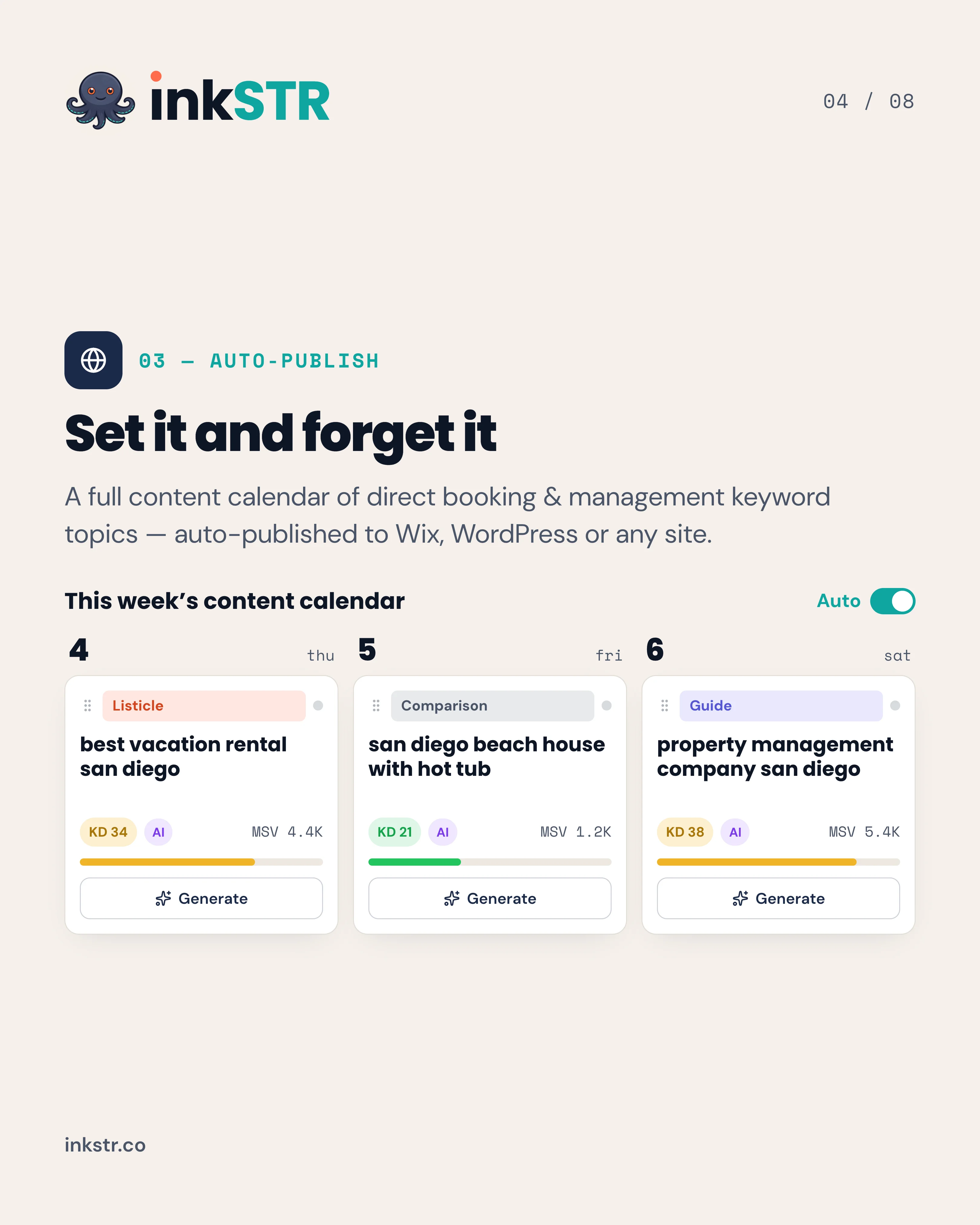
Where most manual efforts fail isn't quality, it's volume and consistency. One great post rarely moves rankings. A library of 12 to 20 well-structured articles targeting a mix of destination and long-tail booking keywords is closer to what actually shifts organic traffic, and that volume is nearly impossible to sustain manually alongside running a property. That's the specific gap inkSTR's Content Calendar closes: it schedules and publishes consistently without you tracking a single deadline yourself, which is the actual driver behind measurable, compounding results.
Practical Guidance: Choosing Between Hiring, Learning, or Automating SEO Writing
Choosing the right path for your rental business content depends on your time budget, portfolio size, and how quickly you need results. There's no universally correct answer, but there is a clear decision framework based on what we've seen work, and fail, across hundreds of STR operators.
- If you manage one property and have genuine spare time: learning basic SEO writing yourself can work, but budget 3 to 5 hours per post and expect to publish consistently for months before seeing meaningful traffic.
- If you're hiring freelancers: vet for hospitality-specific experience, not just general writing skill. A generalist writer without STR context often targets the wrong keywords entirely.
- If you manage multiple properties or a portfolio: manual and freelance approaches both break down at scale. Coordinating content across 10-plus listings manually consumes entire workweeks that should go toward operations.
- Avoid the common mistake of publishing inconsistently. A single post rarely ranks; it's the compounding library of content, published on a steady cadence, that builds the domain authority Google rewards.
- Track what's working. Whether you hire, write, or automate, use Google Search Console or a keyword tool like SEMRush to confirm your content is gaining position over time, not just publishing into the void.
For most vacation rental operators and property management companies we work with, the trade-off comes down to this: manual and freelance SEO writing both demand either your time or a recurring bill that scales with volume. inkSTR's approach removes both constraints. The Content Calendar and Auto-Publishing features run your content on a schedule you set once, so consistency stops depending on whether you had a free afternoon this week.

Frequently Asked Questions
What is the difference between an SEO writer and a regular content writer?
A regular content writer focuses on clear, engaging prose without necessarily targeting specific search terms. A SEO writer deliberately researches keywords, structures content around search intent, and optimizes on-page elements like meta titles and internal links so the piece has a real chance of ranking on Google, not just reading well.
Do I need a SEO writer if I already have a direct booking website?
Yes, in most cases. A website without consistent, keyword-targeted content rarely ranks for the terms travelers actually search, even if the design and booking engine are solid. Content is usually the missing piece, which is exactly why inkSTR focuses on the publishing side rather than website design itself.
Can AI-generated content actually work as SEO writing?
Yes, when the AI is trained on relevant industry context and the output passes through quality checks before publishing. Generic AI content without hospitality specificity tends to underperform, but niche-trained tools like inkSTR's AI Content Writer are built specifically to avoid the vague, could-be-anywhere language that hurts rankings.
How long does it take for SEO writing to show results for a vacation rental site?
Most vacation rental websites begin showing meaningful ranking movement after roughly 12 to 20 published articles targeting a mix of destination and long-tail booking keywords, typically over several months of consistent publishing. Results build gradually rather than appearing after a single post.
Is it worth paying a freelance SEO writer for a single vacation rental property?
It depends on your time and budget. At $300 to $700 per post, a freelancer can be worthwhile if you need occasional high-quality pieces, but sustaining a full content calendar this way gets expensive fast for a solo operator, especially compared to a flat monthly platform cost.
What skills does a good SEO writer need for vacation rental content specifically?
Beyond general writing ability, a strong SEO writer for STR content needs keyword research skills, understanding of traveler search intent by destination and property type, and familiarity with platforms like Airbnb and VRBO. Generic writing experience without this context usually produces content that misses the actual search terms guests use.
Can one SEO writer handle content for multiple vacation rental properties?
Yes, but managing distinct brand voices and keyword strategies across multiple properties manually gets complicated quickly. This is where multi-property content systems, like inkSTR's multi-project architecture, become more practical than relying on one person juggling separate briefs for each listing.
The Bottom Line on SEO Writers for Vacation Rental Marketing
A SEO writer creates search-optimized content built to rank on Google while remaining genuinely useful to the traveler reading it, and for vacation rental businesses in 2026, that content is often the difference between a booking site nobody finds and one that generates steady direct booking inquiries. Whether you hire a freelancer at $300 to $700 per post, learn the skill yourself, or automate the pipeline, the core requirement stays the same: consistent, keyword-targeted publishing over months, not a single post.
The math tends to favor automation for most operators we work with. A direct booking is worth $1,000 to $4,000 in revenue, freelance writers cost hundreds per post with inconsistent availability, and writing manually eats 3 to 5 hours you likely don't have. inkSTR was built to close that gap specifically for short-term rental operators, generating, scheduling, and publishing SEO content automatically so you get the output of a skilled SEO writer without hiring or becoming one.
If the SEO writer function has been the missing piece in your direct booking strategy, start your free trial with inkSTR and let the platform's content calendar, keyword research, and auto-publishing handle the work a full-time SEO writer would otherwise charge you hundreds per post to do.
Content powered by inkSTR.co
Enjoyed this article? Share it:
Get more of inkSTR in Google Search
Add inkstr.co as a preferred source and our articles show up more in Top Stories, AI Overviews, and AI Mode — with a “Preferred” badge.
Get more guides like this
New SEO and AI-search guides, straight to your inbox. No spam, unsubscribe anytime.