Automated SEO Tool Guide: What Actually Works in 2026

An automated SEO tool is software that handles keyword research, content creation, or on-page optimization with minimal manual input, ranging from tools that just monitor rankings to platforms that write and publish articles on a schedule. For short-term rental operators, the useful category is the second one: tools that actually execute, not just report.
Key Takeaways
- Automated SEO tools split into two categories: monitoring tools that flag problems for a human to fix, and execution tools that draft content, apply on-page changes, or publish directly to a website.
- The global SEO tools market is valued at $87.80 billion in 2026 and is projected to reach $195.99 billion by 2034, according to Resourcera, showing how fast automation is replacing manual SEO labor.
- Writing one quality blog post manually takes 3 to 5 hours of research and writing, and a freelance travel writer typically charges $300 to $700 per post, costs that compound fast across a multi-property portfolio.
- AI-driven SEO tools are expected to account for over 60% of SEO activities by 2030 in a high-adoption scenario, according to LinkedIn analysis of industry trends.
- A Smoky Mountains cabin rental brand using inkSTR grew monthly Google Search clicks from 788 to 5,195 in 11 months and drove $309,775 in direct booking revenue in its first fourteen months, measured in Google Search Console.
- inkSTR automates the full pipeline for short-term rental content, keyword research, drafting, scheduling, and publishing to Wix or WordPress, so property managers get execution-level automation built specifically for vacation rental search intent.
If you manage a vacation rental website, you've probably typed some version of "automated SEO tool" into Google after realizing you can't keep up with blogging, keyword tracking, and technical fixes on top of running your property. That search brings back dozens of platforms, most built for e-commerce stores or SaaS companies with no idea what a "cabin rental in Gatlinburg" search actually looks like.
This guide breaks down what automated SEO tools actually do in 2026, where most of them fall short for short-term rental operators, and how to tell a tool that genuinely executes work from one that just tells you what's wrong. At inkSTR, we built our platform specifically because generic SEO automation tools don't understand traveler search intent, location-based hospitality terms, or the difference between a beach condo listing and a mountain cabin listing.
By the end of this, you'll know the real categories of SEO automation, what separates a monitoring dashboard from a tool that actually publishes content, and how to evaluate whether a given platform is worth the monthly cost for your specific property portfolio.
What Is the Best Automated SEO Tool?
The best automated SEO tool for a short-term rental operator is one that executes the full content pipeline, keyword research, writing, and publishing, rather than one that only monitors rankings and flags problems for you to fix manually. Most tools marketed as "automated SEO" stop at reporting.
Industry research shows that the tools most commonly labeled "automated" actually just automate reporting: keyword tracking, audit scans, and backlink alerts. Someone still has to read the report, decide what to change, write the content, and publish it. That's not automation. That's a dashboard with an alert system.
For a property manager running 15 units across two markets, a tool that tells you "your Gatlinburg cabin page needs 800 more words about local hiking trails" is not solving your problem. You still have to write those 800 words, source photos, and get them published on WordPress or Wix. That's the exact gap we built inkSTR to close with our AI Content Writer, which drafts full articles built around real property and market data, not generic templates.
Without execution-level automation, most operators end up paying for a monitoring tool and then hiring a freelance writer separately, or writing the content themselves at 3 to 5 hours per post. That's two subscriptions and hours of manual labor to do what one properly built tool should handle end to end.
Can SEO Be Automated?
Yes, most recurring SEO tasks can be automated as of 2026, including keyword research, content drafting, internal linking, image optimization, and scheduled publishing. What cannot be fully automated is strategic judgment, deciding which markets to target and how to position a property against competitors.
Almost every step of recurring SEO work can now run without a human touching each individual task. Rank tracking updates automatically. Technical audits run on a schedule. Content briefs get generated from keyword clusters. But no single tool covers every part of that chain equally well, and vacation rental operators specifically need automation tuned to hospitality search behavior, not generic retail or B2B keyword patterns.
Consider a property manager in Charlotte overseeing a 50-plus unit portfolio. Manually researching keywords for each market, drafting blog posts, and publishing them across multiple sites would eat an entire workweek every month. That's exactly the workflow MyTripify, a Charlotte and Lake Norman area STR management company, automated with inkSTR: within the first month of running an owner-facing content pipeline built for property-management hire intent, they saw four property-owner leads arrive directly from AI search, with Google impressions running at 4.6 times the prior year's level within three months.
That kind of result depends on automating research, drafting, and publishing together, not in isolated tools that don't talk to each other. Our Keyword Research feature finds the exact terms your target guests type into Google, then feeds those directly into drafted articles rather than leaving you to bridge the gap manually.
What Are the Top 5 SEO Tools?
There is no single agreed-upon "top 5" ranking across the SEO tools market because tools serve different jobs: some handle technical audits, some handle content, some handle rank tracking, and some handle full-pipeline execution. What matters more is matching the tool category to your actual bottleneck.
Rather than naming five arbitrary products, it's more useful to understand the five categories most vendors claim to automate: content creation and publishing, on-page fixes, technical audits, rank tracking and reporting, and local SEO. A short-term rental operator rarely needs all five equally. If your site already ranks reasonably but your content is thin, you need a content and publishing tool. If your site has crawl errors and broken schema, you need a technical audit tool first.
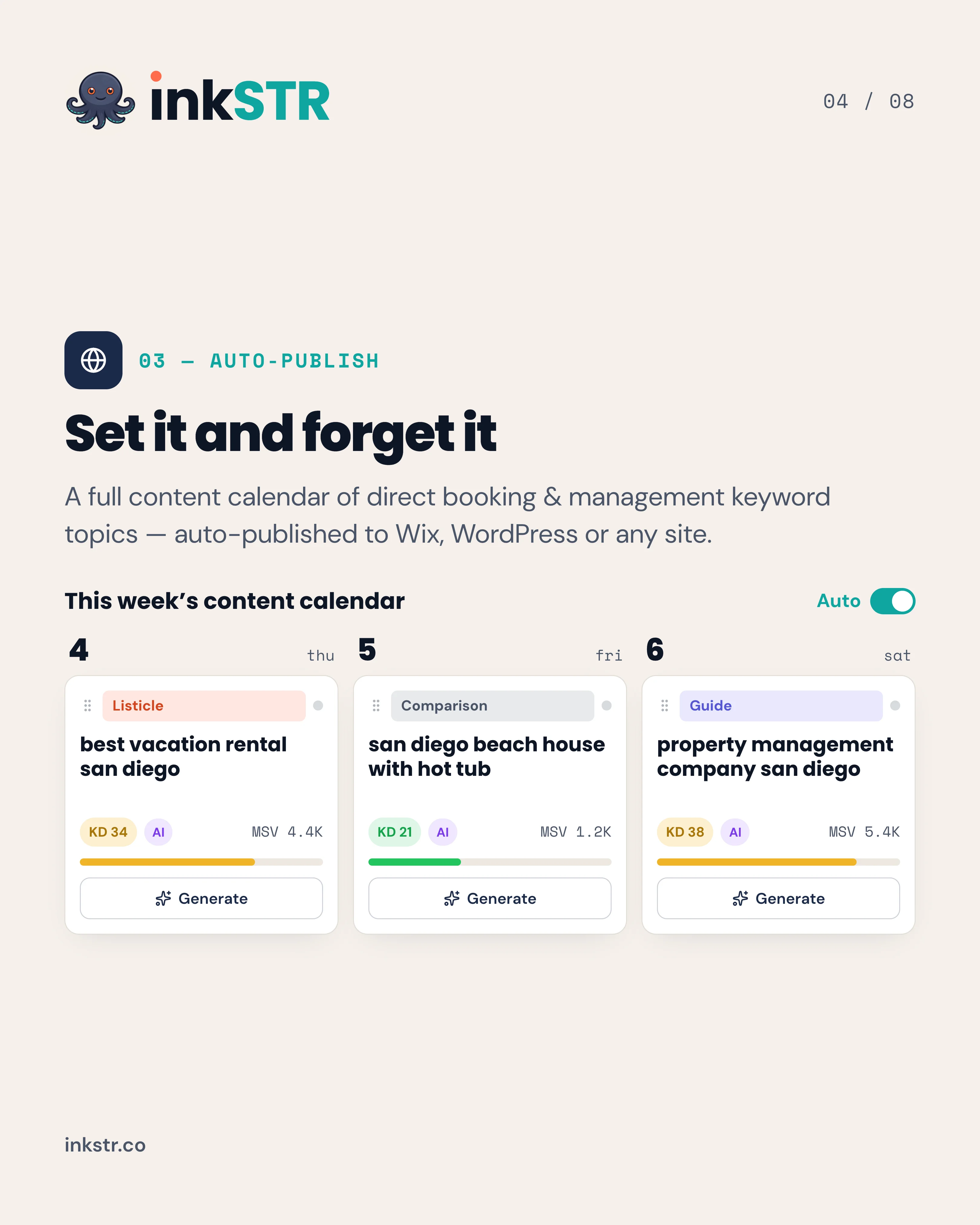
Most STR operators we work with are stuck at the content bottleneck, not the technical one. Their site loads fine and Google can crawl it, but there's no ongoing stream of location-specific, search-intent-matched articles that actually rank. That's the exact gap our Content Calendar was designed for: it schedules and manages blog publishing on autopilot so content goes out consistently instead of in bursts followed by months of silence.
A five-market luxury mountain rental brand we work with, covering Breckenridge, Whitefish, the Poconos, Fairplay, and Driggs, published 114 articles across four months using this exact pipeline. Monthly Google search visits went from 26 to 1,924 in that window, and distinct search queries ranking climbed to 5,939. That's not a technical SEO fix. That's consistent, targeted content execution.
| Automation Category | What It Handles | Best For |
|---|---|---|
| Content creation and publishing | Keyword research, drafting, scheduling, CMS publishing | Operators with thin or stale blog content |
| Technical audits | Crawl errors, schema, site speed, broken links | Sites with existing traffic but crawl issues |
| Rank tracking and reporting | Keyword position monitoring, dashboards, alerts | Teams that already have a content and technical strategy |
| On-page optimization | Meta tags, header structure, internal linking suggestions | Sites with content but weak on-page structure |
| Local SEO | Google Business Profile management, local citations | Single-market operators competing on local search |
Can ChatGPT Do SEO?
ChatGPT can assist with SEO tasks like keyword brainstorming, outline generation, and drafting rough copy, but it cannot research live search volume, publish content to your website, or track ranking changes over time. It's a starting point, not an execution engine.
Plenty of operators try to use ChatGPT as their entire content strategy: ask it for blog topic ideas, paste in a rough outline request, copy the output into WordPress. This works occasionally for a single post. It falls apart at scale because ChatGPT has no memory of your site's existing content, no access to your Google Search Console data, and no way to schedule publishing across a content calendar.
Specifically, ChatGPT doesn't know that your Gatlinburg cabin site already has three articles about hiking trails and needs new topics instead of duplicates. It doesn't know your actual keyword rankings. And it definitely doesn't publish directly to your site. For a property manager running content across 10 or more listings, manually copying ChatGPT output into a CMS every week becomes its own full-time task.
This is exactly the gap between a general-purpose AI assistant and a purpose-built platform. inkSTR's Auto-Publishing feature connects directly to Wix and WordPress, so drafted articles go live on a set schedule without anyone copying and pasting text between tools. The research chat inside inkSTR also tracks what's already been published on your site, so new articles fill genuine content gaps instead of duplicating existing topics.
How Do You Tell If an SEO Tool Actually Automates Execution?
A true execution-level automated SEO tool applies changes, publishes content, or fixes issues without requiring a human to manually implement every recommendation. Ask one question before subscribing: does this tool DO the work, or does it just tell you what work needs to be done?
This distinction matters more than any feature list. A rank tracker that emails you "your Nashville listing dropped three positions" is monitoring. A tool that drafts a new article targeting the keyword you lost ranking on, and publishes it, is execution. Most vendors blur this line in their marketing copy, so you have to look past the homepage language.
Run this checklist against any automated SEO tool before paying for it:
- Does it generate full draft content, or only outlines and suggestions you still have to write yourself?
- Does it publish directly to your CMS, or export a file you have to manually upload?
- Does it integrate with Google Search Console so it knows what's already ranking and what needs new coverage?
- Is it built for your specific industry's search intent, or is it a horizontal tool repurposed for every business type?
- Does the pricing make sense compared to hiring a freelance writer at $300 to $700 per post?
If a tool fails more than one of these, you're likely paying for a glorified dashboard. Our How inkSTR Works page walks through the exact workflow from keyword to published post, precisely because we think operators deserve to see the full pipeline before signing up, not just a features list.

What Does an Automated SEO Tool Cost Compared to Hiring a Writer?
Automated SEO tools built for content execution typically run $99 to a few hundred dollars per month depending on volume, compared to $300 to $700 per individual blog post from a freelance travel writer. For an operator publishing four articles a month, freelance costs alone could exceed $1,200 to $2,800 monthly before any tool subscription.
The math gets more lopsided the bigger your portfolio gets. A property management company running content across 15 properties, publishing even one article per property per month, would spend well over $4,500 monthly on freelance writers alone at the low end of that range. That doesn't include the time spent briefing writers, editing drafts, sourcing images, and manually publishing to each site.
Industry pricing for execution-focused automated content platforms commonly lands around $99 per month for a defined volume of articles, a figure that shows up repeatedly across the automated content tool space. inkSTR's Pricing starts at $99 per month, structured specifically for STR operators who need consistent output without the per-post freelance math working against them.
A single direct booking is typically worth $1,000 to $4,000 in revenue. A ranking blog article can drive organic traffic for 2 to 5 years once it's established. Compare that lifespan against a one-time freelance invoice, and the return calculation shifts heavily toward tools that keep publishing on a schedule rather than a single commissioned post.
Ready to automate your content marketing?
inkSTR handles keyword research, content strategy, article writing, and publishing, all on autopilot.
How Do You Integrate an Automated SEO Tool Into Your Existing Content Workflow?
Integrating an automated SEO tool works best when it runs on a defined content calendar alongside any existing human-written content, rather than replacing your entire workflow overnight. Start by identifying which content types you want automated and which you want to keep writing yourself.
Most operators worry that automation means losing their brand voice entirely. In practice, the tools that integrate well let you maintain editorial control over tone and property-specific details while the platform handles the repetitive parts: keyword research, drafting structure, scheduling, and publishing mechanics. If you want a deeper look at keeping brand voice intact through automation, we've covered this specifically in our guide on article automation without losing your brand voice.
A common mistake we see: operators turn on full automation, then never review a single published article for months. Automated doesn't mean unattended. Check published articles against your Google Search Console data periodically to confirm new content is targeting genuine gaps, not duplicating existing pages.
inkSTR's multi-project support lets a manager overseeing 15 properties run 15 parallel content calendars without duplicating effort, each pulling from property-specific data rather than a single generic template. That structure is exactly why our Whitefish and Breckenridge portfolio client could scale to 114 articles across five distinct markets in four months without content bleeding together between locations.
What Should You Prioritize First When Choosing an Automated SEO Tool?
Prioritize integration with your existing analytics and CMS platform first, then evaluate whether the tool handles your industry's specific search intent, before comparing price. A tool that's cheap but doesn't publish to your website, or doesn't understand vacation rental search terms, wastes money regardless of the monthly rate.
Marketer research suggests evaluating automated SEO tools against a consistent checklist: integration with Google Search Console and Google Analytics, LLM support for AI search visibility, data accuracy, pricing lower than hiring, and responsive customer service. That checklist holds up well, but it misses one variable specific to hospitality: does the tool understand the difference between "pet friendly cabin rental" and "pet friendly apartment," or between a beach town's seasonal search patterns and a mountain retreat's?
Common mistakes operators make when choosing a tool:
- Picking a horizontal, industry-agnostic tool because it's cheaper, then discovering the content reads generic and doesn't rank for hospitality-specific searches.
- Skipping the CMS integration check, then manually copying content between platforms anyway.
- Ignoring whether the tool tracks AI search citations, a growing share of how travelers now discover properties through ChatGPT and Perplexity.
As of August 2026, inkSTR has published more than 3,100 articles across active customer sites, generating over 2.3 million Google Search impressions and 17,000-plus clicks in the trailing 90 days. Those figures come from a platform built specifically for the search behavior of vacation rental guests, not repurposed from a generic e-commerce SEO tool.

What Metrics Should You Track After Automating Your SEO?
Track Google Search Console clicks and impressions, keyword ranking movement, and direct booking inquiries attributed to organic search after implementing an automated SEO tool. These three metrics together show whether automation is actually converting traffic into revenue, not just adding page views.
Impressions and clicks tell you whether your content is getting found. Ranking movement tells you whether specific articles are climbing for target keywords. But the metric operators care about most, direct booking revenue attributed to organic search, requires connecting your analytics to your booking system or at least tagging inquiry sources consistently.
In our Hemlock Hills case, a Smoky Mountains cabin rental management company, monthly Google Search clicks moved from 788 to 5,195 over 11 months, while monthly impressions grew from 130,000 to 450,000 in the same window. Keywords ranking climbed to over 26,000, and direct booking revenue attributed to that organic traffic reached $309,775 in the first 14 months. Every figure there was measured directly in Google Search Console and Google Analytics, not estimated by a third-party tool.
If you're not seeing movement in at least impressions within the first 60 to 90 days of running an automated content pipeline, something in your setup needs attention, either your keyword targeting is too competitive for a new site, or your publishing cadence isn't consistent enough for Google to recognize a pattern. Our piece on why your vacation rental website is not ranking on Google covers the most common causes in more depth.
Frequently Asked Questions
How long does it take to see results from an automated SEO tool?
Most operators start seeing measurable movement in Google Search impressions within 60 to 90 days of consistent publishing, though ranking gains for competitive keywords can take longer. In our Peak Properties case, monthly Google search visits grew from 26 to 1,924 within four months of publishing 114 articles across five markets.
Is an automated SEO tool worth it for a single-property vacation rental?
Yes, if you're spending 3 to 5 hours per post writing manually or paying a freelancer $300 to $700 per article, a single-property operator can still benefit significantly, since one ranking article can drive organic traffic for 2 to 5 years. The math simplifies further for single properties since there's no multi-market complexity to manage.
Can an automated SEO tool replace a human content strategist?
An automated SEO tool handles execution, research, drafting, and publishing, but strategic decisions about market positioning and brand voice still benefit from human oversight. inkSTR is built to handle the repetitive execution work while leaving property-specific judgment calls to the operator.
Does automated content actually get cited by ChatGPT and Google AI Overviews?
Yes, content structured with clear answer-first paragraphs, defined headings, and factual specificity gets cited by AI search tools. inkSTR has secured over 735 verified AI-search citations for customer content as of August 2026, and our guide on ranking in AI search covers the structural patterns that make this possible.
What's the difference between an automated SEO tool and just using ChatGPT?
ChatGPT can draft rough copy but has no memory of your existing published content, no access to your Search Console data, and no ability to publish directly to your website. An automated SEO tool built for execution handles the full pipeline: research, drafting, scheduling, and publishing without manual copy-pasting.
Can I use an automated SEO tool if I manage multiple vacation rental properties?
Yes, tools built for multi-property management, like inkSTR's multi-project support, let you run separate content calendars for each property or market without duplicating templates or content across sites. This matters because each market has different search intent, whether it's a beach town, mountain retreat, or urban apartment.
How much does inkSTR cost compared to other automated SEO tools?
inkSTR's Pricing starts at $99 per month, in line with typical execution-focused content automation pricing across the industry. Compared to hiring a freelance writer at $300 to $700 per post, the monthly cost covers a full pipeline of research, drafting, and publishing rather than a single article.
Conclusion
An automated SEO tool worth paying for in 2026 executes work, drafting content, publishing to your CMS, tracking real ranking data, rather than just monitoring and reporting problems back to you. For short-term rental operators specifically, the tool also needs to understand hospitality search intent: the difference between a lake house search and an urban loft search.
We built inkSTR around that exact distinction. Every feature, from keyword research to auto-publishing, is designed around vacation rental terminology and traveler search behavior, not repurposed from a generic e-commerce template. As of 2026, that focus has produced measurable results across multiple property portfolios, from a five-market mountain rental brand to a Charlotte-area management company generating owner leads directly from AI search.
If manual blogging, keyword research, and publishing feel like a second job stacked on top of running your properties, that's the exact gap this platform was built to close.
If you're tired of choosing between paying freelance rates per post or letting your content calendar sit empty for months, Get started with inkSTR and see your first automated article draft built around your property's actual keyword data this week.
Content powered by inkSTR.co
Enjoyed this article? Share it:
Get more of inkSTR in Google Search
Add inkstr.co as a preferred source and our articles show up more in Top Stories, AI Overviews, and AI Mode — with a “Preferred” badge.
Get more guides like this
New SEO and AI-search guides, straight to your inbox. No spam, unsubscribe anytime.