SEO Writer AI: What It Is and Whether It Works for STRs

An SEO writer AI is software that researches a keyword, drafts a search-optimized article around it, and often schedules or publishes that article without a human writing it from scratch. For short-term rental hosts, that means blog content built around what travelers actually search for, generated and published on a schedule instead of sitting on a to-do list for months.
Key Takeaways
- An SEO writer AI combines keyword research, drafting, and (in more complete platforms) scheduling and publishing into one workflow, replacing what used to take a human writer 3-5 hours per article.
- A freelance travel writer typically charges $300-$700 per quality blog post, while a dedicated STR-focused AI writing platform like inkSTR runs $99/month for ongoing, unlimited-cadence content.
- Generic AI writing tools like ChatGPT can draft a paragraph, but they cannot do live keyword research, competitor gap analysis, scheduled publishing, or STR-specific search intent matching without significant manual setup.
- Every booking that comes through direct traffic instead of Airbnb or VRBO saves hosts the 17-19% combined host and guest fees those platforms charge, and a single direct booking is typically worth $1,000 to $4,000 in revenue.
- A well-built, ranking blog article can drive organic search traffic for 2-5 years after publication, making it one of the few marketing investments with a long compounding payoff.
- inkSTR is a purpose-built SEO writer AI for short-term rental operators that generates, schedules, and publishes articles automatically, closing the gap between knowing you need content and actually getting it live.
If you manage a vacation rental, you've probably typed some version of "seo writer ai" into Google while wondering whether AI-generated content is a shortcut or a shortcut that backfires. As of 2026, the honest answer is: it depends entirely on which tool you use and how narrowly it's built for your niche.
Generic, industry-agnostic AI writers can produce grammatically correct paragraphs about almost anything, but they don't understand that a "lake house" listing has different search intent than an "urban loft," or that a guest searching "pet friendly cabin near Gatlinburg" wants something different from a guest searching "luxury cabin rental Smoky Mountains." That gap between generic AI output and content that actually converts browsers into direct bookings is the whole reason niche-specific SEO writer AI platforms exist.
This guide walks through what an SEO writer AI actually does, what it costs, whether tools like ChatGPT can replace one, and how to evaluate whether automating your content pipeline makes sense for your property or portfolio in 2026.
What Is an SEO Writer AI?
An SEO writer AI is a software platform that uses machine learning models to research target keywords, generate structured blog content around those keywords, and format the result with the headings, meta tags, and internal links search engines expect. Unlike a general-purpose chatbot, a true SEO writer AI is built around a repeatable content pipeline, not a single prompt-and-response exchange.
Most platforms in this category follow a similar sequence: you provide a topic or keyword, the tool researches search intent and competing pages, drafts an outline built from that research, writes the full article, and in more advanced platforms, schedules it for publishing. Industry reviews of tools in this space describe workflows that move from topic input to keyword research, outline creation, and drafting section by section before finishing with title tag and meta description generation.
Where these platforms differ most is specificity. A horizontal AI writing tool built for e-commerce, SaaS, and local service businesses treats every industry the same way. That's a real limitation for short-term rental content, where terms like "check-in instructions," "host reviews," and "cleaning fee" carry specific meaning that a generic tool won't naturally weave into search-friendly phrasing. We built inkSTR specifically because horizontal tools kept producing content that read like it was written for any business, not a vacation rental. Our AI Content Writer is trained on STR terminology, traveler search behavior, and location-based SEO patterns that matter for beach towns, mountain retreats, and urban rental markets specifically.
How Much Do SEO Writers Charge?
Freelance travel and hospitality writers typically charge $300 to $700 per quality blog post, depending on length, research depth, and revision rounds. For a property manager who needs consistent output, say two or three posts a month across a growing portfolio, that adds up to $600 to $2,100 monthly before you've published a single article about your competitor's local guides.
That per-post pricing model punishes exactly the operators who need content most. A new STR business owner launching their first listing can't justify $500 for one blog post with no proven ROI yet. A property management company running 15 or more properties faces a worse math problem: writing unique, location-specific content for every property at freelance rates quickly becomes a five-figure annual line item.
Here's what that manual alternative actually looks like day to day. You research keywords yourself, or pay separately for that. You brief a freelancer, wait days for a draft, send it back with revisions, then handle formatting, image sourcing, and publishing yourself. Writing one quality blog post manually takes 3-5 hours of research and writing even when you do it yourself, and that's before you've touched scheduling or SEO formatting.
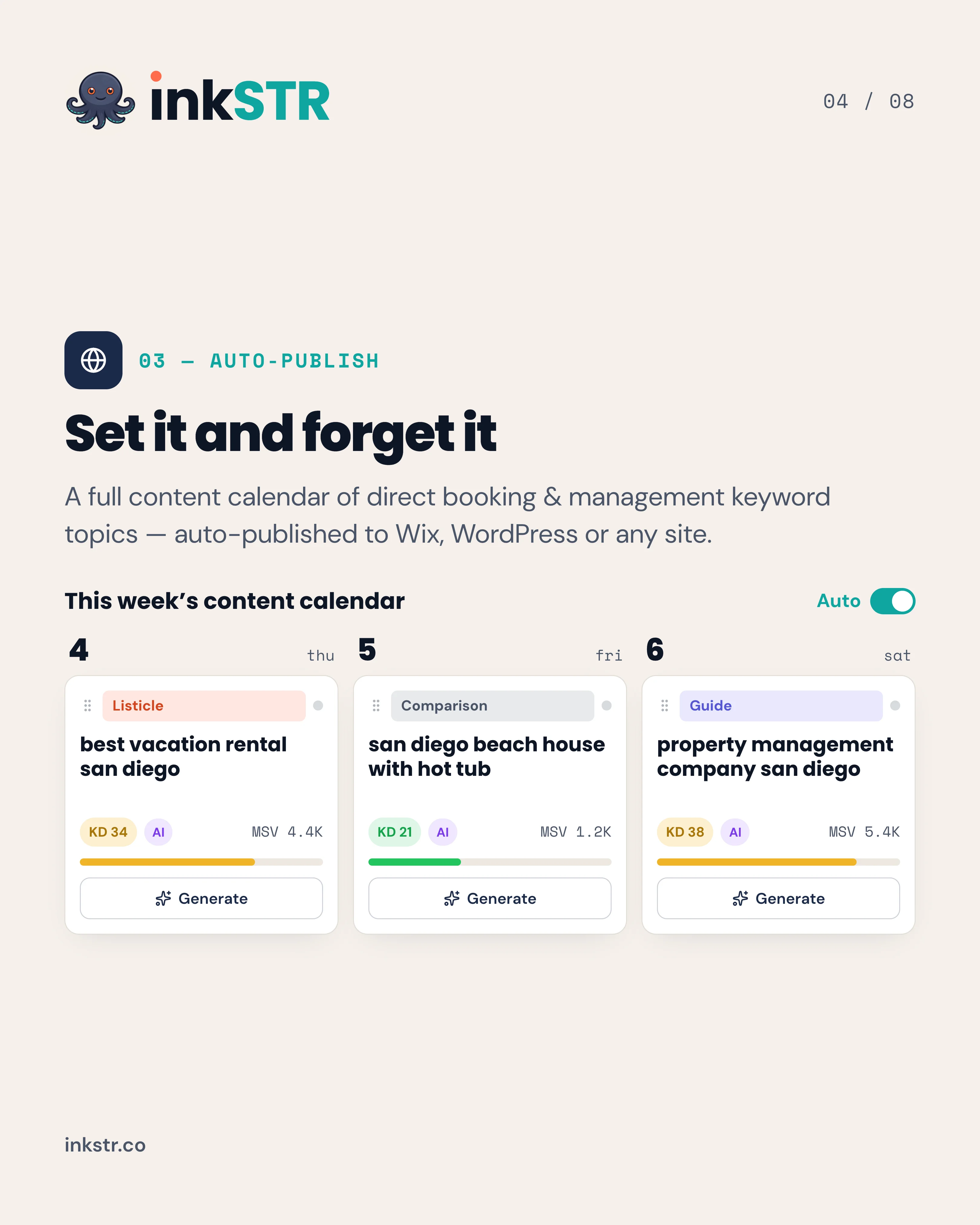
inkSTR removes the per-post pricing model entirely. Plans start at $99 per month for unlimited article generation on a recurring schedule, not a per-piece invoice. For a property manager running multiple listings, that means the tenth article costs the same incremental amount as the first: nothing extra. We designed our Content Calendar feature around this exact problem, letting you run independent content pipelines for each property or brand without paying a freelancer rate per property, per month.
| Approach | Typical Cost | Time Per Article | Scales to Multiple Properties |
|---|---|---|---|
| Freelance travel writer | $300-$700 per post | Days to weeks turnaround | Cost multiplies per property |
| Writing it yourself | Your time only | 3-5 hours per post | Time multiplies per property |
| inkSTR (STR-specific SEO writer AI) | from $99/month | Generated and scheduled automatically | Multi-project pipelines per property |
What Is an SEO Writer?
An SEO writer is someone or something that produces content specifically structured to rank in search engines, meaning it targets a keyword, matches searcher intent, and follows formatting conventions like clear headings, internal links, and scannable paragraphs. The term applies equally to a human freelancer and a software platform, but the underlying goal is identical: get found by people actively searching for what you offer.
For short-term rental operators, that means an SEO writer isn't producing generic travel inspiration. It's writing content that answers a specific traveler's search, "best dog-friendly cabins near Asheville" or "things to do near downtown Charleston rentals," in a way Google and increasingly AI search tools like ChatGPT and Perplexity can extract and recommend directly.
The problem most hosts run into is that hiring a human SEO writer requires either deep hospitality knowledge or a lengthy briefing process every time. A generalist freelancer writing about your mountain cabin one week and a client's SaaS product the next rarely develops the pattern recognition needed to write content that genuinely reflects how a traveler searches. We've reviewed hundreds of STR content calendars at inkSTR, and the pattern is consistent: generic writers produce generic pages, and generic pages rank for nothing specific.
An SEO writer AI purpose-built for hospitality solves this differently. It doesn't need re-briefing every time because the model itself is trained around traveler search intent, seasonal booking patterns, and location-based SEO. Our Keyword Research feature identifies the exact phrases your target guests type into Google before they ever reach a booking page, so every article starts from real search demand instead of guesswork about what "sounds good."
Can ChatGPT Do SEO?
ChatGPT can help with pieces of SEO work, drafting headline ideas, generating an outline, or summarizing a topic, but it cannot independently perform live keyword research, analyze current SERP competition, schedule publishing, or track ranking performance without being manually connected to other tools. As of 2026, ChatGPT remains a capable assistant for ideation, not a complete SEO content pipeline.
This distinction matters because a lot of hosts assume "I'll just use ChatGPT" solves their content problem. It solves part of it. You can ask ChatGPT to write a blog post about your beach house rental, and it will produce readable paragraphs. What it won't do on its own is tell you which keywords are actually searched by your target guests this month, check what's currently ranking for those terms, generate schema markup, place internal links strategically, or push the finished piece live to your WordPress or Wix site on a recurring schedule.
That gap is where most DIY content efforts stall. A host writes three posts using ChatGPT, realizes there's no system tracking whether those posts are ranking or driving traffic, and the content calendar quietly dies by month two. Meanwhile, competitors who publish consistently keep climbing.
This is exactly the workflow gap inkSTR was built to close. Rather than treating content generation as one isolated step, our platform connects keyword research, drafting, and publishing into a single pipeline, then integrates with Google Search Console so you can see which keywords are actually moving. Our Auto-Publishing feature pushes finished articles directly to Wix or WordPress without you copying and pasting a single paragraph, which is the step ChatGPT alone simply doesn't handle.

How Much Does AI SEO Cost?
AI SEO tools in 2026 typically cluster into three pricing tiers: entry plans around $8-$12 per month for basic drafting features, mid-tier plans in the $39-$59 range for more complete workflows, and enterprise plans starting near $199-$200 per month or custom pricing for agency-scale needs. Where a specific platform lands depends heavily on whether it's a generic writing assistant or a full content pipeline with research, scheduling, and publishing built in.
The catch with entry-tier generic tools is that $8-$12 per month usually buys you drafting help only. You're still doing your own keyword research, still manually publishing, still guessing at internal linking strategy. It's cheap because it does less. For an STR operator, the real cost isn't the subscription fee, it's the hours you spend stitching together research, drafting, formatting, and publishing into something that actually functions as a content strategy.
Multi-property managers face a compounding version of this cost problem. If you're running content for 15 properties and every property needs its own local angle, generic tools with no STR-specific training force you to manually correct location details, amenity mentions, and traveler search intent on every single draft. That editing time is invisible in the subscription price, but it's real.
inkSTR prices at a flat $99 per month, positioned specifically for what a full pipeline, research, drafting, scheduling, and publishing, actually costs to run for a hospitality-specific use case. Given that a single direct booking is typically worth $1,000 to $4,000 in revenue, one converted guest from organic search content can cover months of the subscription. That's the ROI math we walk new users through before they ever publish their first article: the question isn't whether $99 a month is affordable, it's how many direct bookings one ranking article needs to produce before it pays for itself many times over.
Why Is My Vacation Rental Not Getting Bookings From Google?
If your vacation rental website isn't appearing in Google search results for the terms your ideal guests search, the most common cause is thin or outdated content that doesn't match specific traveler search intent, not a technical SEO problem. Google, and increasingly AI search tools, reward pages that answer a specific question thoroughly, and penalize generic, one-time-written pages that never get refreshed.
We see this constantly across mid-size property management portfolios: the website has a homepage, a booking page, and maybe an "About" page, but nothing that answers "what to do near [property location]" or "is [property type] good for families." Those are exactly the searches travelers run before they ever type a listing name into Airbnb. Without content answering them, you're invisible at the exact moment a guest is deciding where to book.
The agitating part is that every month without that content is a month competitors with active blogs keep climbing past you. According to search platform trends, AI-generated overviews now surface in roughly a quarter of Google searches, meaning your competitors' content can get cited directly in an AI answer box before a searcher even clicks through to a website. If you have nothing published, you have zero chance of that citation.
Our guide to why your vacation rental website isn't ranking on Google breaks this down in more depth, but the short version is: inkSTR's content strategy wizard builds pillar and cluster content around your specific property type and location, then our platform keeps publishing on a schedule so your site never goes quiet for months at a time the way most DIY content calendars do.
What Should I Blog About for My Vacation Rental Website?
The strongest vacation rental blog content answers specific traveler questions tied to your property's location and type, not generic travel inspiration. Local area guides, seasonal activity roundups, and practical stay-planning content (what to pack, how check-in works, what's within walking distance) consistently outperform broad "top destinations" posts because they match exactly what a guest searches before booking.
A common mistake we see, especially among independent cabin and cottage owners, is trying to compete with big destination sites by writing about the whole region instead of writing hyper-specifically about what makes their exact property and street worth booking. A luxury cabin competitor with ten times your marketing budget will always outrank you on broad terms like "best mountain cabins." You win on specific, local, first-person content they haven't bothered to write.
Our guide to local area guides that sell and our roundup of vacation rental blog topics that actually drive bookings both dig into topic selection in more detail. The pattern that works: write about the specific trailhead five minutes from your door, the specific coffee shop your guests always ask about, the specific rules for your building's parking.
This is precisely why inkSTR's keyword research doesn't just hand you generic "vacation rental" terms. It surfaces location-specific, intent-matched keywords for your exact market, whether that's a beach town, a lake house destination, or an urban apartment, so every article topic is chosen because real travelers are searching for it, not because it sounded like a good idea.
Ready to automate your content marketing?
inkSTR handles keyword research, content strategy, article writing, and publishing, all on autopilot.
How Do I Get Direct Bookings Without Paying Platform Fees?
Getting direct bookings means building organic search traffic to your own website so guests find and book with you before ever opening Airbnb or VRBO, avoiding the combined 17-19% host and guest fees those platforms charge on every reservation. The mechanism for that traffic is almost always content: blog articles, local guides, and landing pages that rank for the searches your ideal guest runs before they've picked a platform.
The painful reality most hosts face is that relying solely on Airbnb or VRBO search visibility caps how much of your revenue you actually keep. Every booking through those channels quietly hands over nearly a fifth of the transaction. Across a busy season, that's real money that never touches your account, and it happens regardless of how good your listing photos are.
Content built with strategic internal linking changes that math. A well-written local guide that ranks for "things to do near [your city]" can route a reader toward your booking page instead of an OTA search result, capturing a guest who might otherwise never have found your specific property at all. For more on the psychology behind why guests convert on some booking pages and not others, our piece on vacation rental booking strategies is worth reading alongside this one.
inkSTR's internal link management automatically routes readers from educational blog content toward your primary booking page, related posts, and relevant external context, building a self-reinforcing traffic funnel instead of a collection of disconnected articles. That's the exact gap between publishing content and publishing content that converts.

How Do I Compete With Big Property Management Companies in Search?
Competing with larger, better-funded property management companies in search results comes down to publishing consistent, hyper-local content those companies rarely bother writing at the individual-property level. Big operators optimize for scale across dozens of markets; they don't write the granular, single-neighborhood content that ranks for very specific searches.
A boutique operator or independent host who publishes weekly local guides, seasonal updates, and property-specific FAQs consistently outranks large competitors for long-tail searches, even though the big company has far more domain authority overall. This is a documented pattern in SEO more broadly: specificity often beats scale for narrow, intent-matched queries.
The obstacle is consistency, not ideas. Most independent operators know they should blog regularly but can't sustain it once bookings, cleaning schedules, and guest messages pile up. Content calendars stall by month two, and that inconsistency is exactly what search engines penalize, alongside AI search systems that favor freshly updated, regularly published sources.
Our guide to ranking on Google for STR-specific factors covers the technical side of this competition in more depth. On the content side, inkSTR's scheduled publishing keeps your site active even during your busiest operational weeks, because the articles are generated and queued in advance rather than depending on you finding a free afternoon to write.
Data and Evidence: What the Market Tells Us About AI Content in 2026
Industry research shows AI-assisted content production has moved from experimental to mainstream faster than most SEO trends in recent memory. Content marketers using AI tools typically report saving several hours per week, with meaningful reductions in average blog-post production time compared to fully manual workflows. That shift is reshaping what "keeping up" with content actually requires.
Ahrefs' analysis of newly created web pages in 2026 found that a large majority contained AI-generated content in some form, which tells you the competitive floor has already moved. If most new pages in your space have some AI involvement, publishing nothing puts you further behind than it would have three years ago.
At the same time, adoption alone isn't the differentiator anymore, specificity is. A horizontal AI writer producing generic paragraphs about "vacation rentals" competes against thousands of other generic pages doing the same thing. The advantage now sits with tools trained specifically on a niche's search intent and terminology, which is the entire premise behind why inkSTR exists as an STR-specific alternative rather than a general-purpose writing assistant.
| Factor | Generic AI Writing Tool | STR-Specific SEO Writer AI (inkSTR) |
|---|---|---|
| Keyword focus | Broad, industry-agnostic | Traveler search intent, location-based |
| Publishing | Manual copy/paste typical | Scheduled auto-publishing to Wix/WordPress |
| Multi-property support | One project at a time | Independent content pipeline per property |
| Pricing model | Varies by plan tier | from $99/month |
What Mistakes Cause AI-Generated Content to Fail to Rank?
The most common reason AI-generated content fails to rank is publishing it without any human review for accuracy, brand voice, or added value beyond what's already ranking, which is exactly the pattern Google's helpful content guidance targets. Content that reads as generic, repetitive, or thin on specific detail struggles regardless of whether a human or an AI drafted it.
A second frequent mistake is inconsistent publishing. One burst of five articles followed by three months of silence sends a weaker signal than steady, predictable output, even if the total word count ends up similar. Search engines and AI citation systems both seem to favor sources that update regularly over sources that go quiet.
The third mistake, particularly relevant for portfolio operators, is publishing identical or near-identical content across multiple property sites. If every property in a 20-unit portfolio gets the same generic "top 10 things to do" article with only the city name swapped, search engines recognize the duplication pattern and neither page benefits.
inkSTR's quality scoring and pre-publish validation catch thin or generic drafts before they go live, and our multi-project support means every property gets its own distinct content pipeline rather than a template with find-and-replace city names. That structural difference is the difference between content that ranks and content that just exists.
Practical Guidance: How to Choose an SEO Writer AI for Your Portfolio
Choosing the right SEO writer AI for a short-term rental business depends on matching the tool's specialization to your specific operational reality, not just picking the platform with the most features listed on a pricing page. A single-property host and a 40-unit portfolio manager need different things from the same category of tool.
Here's the checklist we walk new users through:
- Confirm the tool understands hospitality-specific search intent, not just general SEO best practices. Ask for a sample article about a property type similar to yours before committing.
- Check whether keyword research is built in or requires a separate subscription to another tool entirely.
- Verify the platform supports scheduled, automatic publishing to your actual website platform, whether that's Wix, WordPress, or something custom.
- If you manage multiple properties, confirm the tool supports independent content pipelines per property rather than one shared project.
- Look for built-in quality checks or validation steps before publishing, not just raw AI output pushed live automatically.
- Compare the pricing model against your actual publishing cadence. A per-article fee punishes consistent publishers; a flat monthly fee rewards them.
Trade-offs to understand going in: no AI writer, however specialized, replaces the value of your own firsthand property knowledge entirely. The strongest results we see come from operators who let inkSTR handle research, drafting, and publishing, then spend a few minutes reviewing drafts for anything uniquely true about their property that only they would know. That combination, automated pipeline plus a light human touch, consistently outperforms either fully manual or fully hands-off approaches. Our piece on article automation without losing your brand voice covers exactly how to strike that balance.
Frequently Asked Questions
Is AI-generated SEO content actually penalized by Google?
Google has stated it does not penalize content simply for being AI-generated; it penalizes low-quality, unhelpful content regardless of how it was produced. The distinction that matters is whether the content demonstrates real expertise and answers a specific search intent thoroughly, not whether a human or AI wrote the first draft.
Can I use inkSTR if I manage more than one property or brand?
Yes. inkSTR's multi-project support gives each property or brand its own independent content pipeline, so a manager overseeing 15 properties can run 15 parallel content calendars without duplicating effort or manually swapping city names in a template.
How long does it take to see SEO results from vacation rental blog content?
Most operators start seeing initial ranking movement within a few months of consistent publishing, though a fully mature content strategy typically compounds over a longer horizon. A single ranking article can continue driving organic traffic for 2-5 years, which is why consistency matters more than speed in the early months.
Does blog content actually reduce dependence on Airbnb and VRBO?
Blog content that ranks for traveler searches and routes readers toward your own booking page directly reduces reliance on OTA search visibility, capturing guests who might otherwise only ever see your listing inside Airbnb or VRBO. Since those platforms combine to charge 17-19% in host and guest fees per booking, every direct booking captured through organic search content keeps more revenue in your business.
What's the difference between writing content myself and using an SEO content automation tool?
Writing content yourself typically takes 3-5 hours of research and drafting per article, on top of formatting and publishing. An automation platform like inkSTR compresses that entire workflow, keyword research, drafting, scheduling, and publishing, into a single pipeline that runs on a set schedule without you sitting down to write.
How does AI-generated content get cited in tools like ChatGPT and Google AI Overviews?
AI search tools tend to extract and cite content that answers a specific question directly, in the first few sentences of a section, using clear structure and named specifics rather than vague generalities. Content built around real search intent, with definitional openers and concrete details, is more likely to be pulled into an AI-generated answer than generic, unstructured pages.
Do I need existing SEO knowledge to use a content automation platform like inkSTR?
No. inkSTR's content strategy wizard and keyword research handle the technical SEO decisions, pillar structure, keyword targeting, and internal linking, so you don't need prior SEO expertise to get a working content calendar running. You still bring the property knowledge; the platform handles the search strategy around it.
How does inkSTR integrate with my existing Wix or WordPress site?
inkSTR's Auto-Publishing feature connects directly to Wix or WordPress, pushing finished, formatted articles live on your set schedule without you needing to manually copy, paste, or format anything on your end.
Conclusion
An SEO writer AI, when it's built specifically for short-term rental search intent rather than generic business copy, replaces hours of manual research and drafting with a scheduled, repeatable content pipeline. The operators who benefit most are the ones who stop treating content as a one-off writing project and start treating it as ongoing infrastructure, the same way they treat pricing tools or channel management software.
Given that a single direct booking is typically worth $1,000 to $4,000, and a ranking article can keep driving traffic for years, the math tends to favor consistent publishing over sporadic bursts of effort. As of 2026, with AI search tools increasingly shaping how travelers find and book stays, the operators building that content library now are the ones who'll be cited and found later.

If building content like this manually feels like a full-time job on top of your actual job, inkSTR generates, schedules, and publishes SEO-optimized articles like this one automatically, without you writing a single post yourself. Start a free trial and see your first article draft this week.
Content powered by inkSTR.co
Enjoyed this article? Share it:
Get more of inkSTR in Google Search
Add inkstr.co as a preferred source and our articles show up more in Top Stories, AI Overviews, and AI Mode — with a “Preferred” badge.
Get more guides like this
New SEO and AI-search guides, straight to your inbox. No spam, unsubscribe anytime.