AI-Powered Content Creation Explained for STR Hosts

AI-powered content creation is the use of machine learning tools, including large language models, to draft, optimize, and publish written material such as blog posts, listing descriptions, and email campaigns. For short-term rental operators, it means generating SEO-targeted articles about your market and property type without spending hours at a keyboard every week.
Key Takeaways
- AI-powered content creation combines research, drafting, and publishing into one automated workflow instead of a manual, hours-long writing process.
- Writing one quality blog post manually takes 3-5 hours of research and writing, and freelance travel writers typically charge $300 to $700 per post.
- The global AI-powered content-creation market reached an estimated $4.26 billion in 2026, up from $3.51 billion in 2026, according to The Business Research Company.
- Industry reporting citing HubSpot found that 68% of marketers use AI for first drafts, and 85% edit that output before publishing rather than posting it raw.
- A Smoky Mountains cabin rental brand grew monthly Google Search clicks from 788 to 5,195 in 11 months using a continuous AI content pipeline, generating $309,775 in attributed direct booking revenue in fourteen months.
- inkSTR automates the full pipeline, keyword research, drafting, scheduling, and one-click publishing, so STR-specific content goes live on a set schedule without you writing a single post.
If you run a vacation rental or manage a portfolio of them, you've probably heard "AI content" pitched a dozen different ways this year. Some of it is generic hype. Some of it genuinely changes how a small operation competes against a property management company ten times its size in Google search results.
In 2026, AI-powered content creation for the short-term rental industry means something specific: software that understands traveler search intent, location-based SEO, and hospitality terminology, then produces blog articles built to rank and convert. It's different from a general-purpose AI writing tool that has no idea what a "shoulder season rate" or a "co-hosting fee" is.
This guide walks through how AI content creation actually works, what it costs to do manually versus automated, which tools handle which tasks, and where the real risks are. By the end, you'll know exactly how to start, whether you manage one cabin or fifteen units across five markets.
How Do You Start AI-Powered Content Creation for a Vacation Rental Business?
Starting AI-powered content creation for a vacation rental business means picking a keyword-targeted topic, generating a draft with an AI tool trained on your niche, editing it for accuracy and brand voice, then publishing it to your own website on a consistent schedule. The process has five stages: research, drafting, editing, publishing, and measurement.
Most new STR hosts skip straight to "write a blog post" without doing keyword research first. That's the single biggest mistake we see. GeeksforGeeks lists input gathering, including keyword research and defining tone and style, as the first workflow stage for a reason: content built around what travelers actually search for ranks. Content built around what you feel like writing about usually doesn't.
Doing this manually looks like opening a blank document, guessing at a topic, spending an hour on keyword research using a free tool, then writing for another three to five hours. Then you still have to find images, format the post, and log into your website's backend to publish it. Repeat that weekly across a portfolio and it eats an entire workday, every week, indefinitely.
That's exactly the gap inkSTR was built to close. The Keyword Research feature identifies what your target guests actually type into Google before you write anything, and the AI Content Writer generates a full SEO-optimized draft built around that keyword automatically. New STR business owners who don't know SEO jargon can start with a clear, guided process instead of guessing.
How to Make $1,000 a Day Using AI in the Short-Term Rental Business?
Making $1,000 a day from AI-driven content in the short-term rental business isn't a single trick. It happens through compounding: consistent published content drives organic search traffic, that traffic converts into direct bookings, and each direct booking is typically worth $1,000 to $4,000 in revenue with no Airbnb or VRBO commission attached.
Here's the math most hosts never run. Airbnb host and guest fees combined typically take 17-19% of every booking. On a $2,000 stay, that's roughly $340 to $380 gone before you've covered cleaning or utilities. A single direct booking driven by organic search skips that fee entirely. Multiply that across a season and content marketing stops looking like a nice-to-have and starts looking like a revenue channel. The manual alternative to reaching that level of traffic is brutal. You'd need dozens of ranking blog posts, each one taking hours to write, and a freelance writer charging $300 to $700 per post would run you into the thousands of dollars before you saw a single extra booking. Most independent hosts don't have that budget or that many hours.
We saw this play out concretely with a five-market luxury mountain rental brand that had averaged around 13 Google visits a month for fifteen straight months. After running 114 inkSTR articles in four months across pillar-and-cluster content for all five markets, monthly Google search visits jumped from 26 to 1,924, and the operator closed its first commission-free direct bookings within that same window. That's the compounding effect: content published on a set schedule, not a single viral post.
What Is the 30 Percent Rule in AI Content Creation?
There is no verified "30% rule" specific to AI content creation, and any article claiming one as an established industry standard is likely inventing it. What is verifiable, and useful, is the broadly cited guidance that AI-generated drafts should always go through human editorial review before publishing, not the reverse. Industry reporting citing HubSpot found that 85% of marketers edit AI-generated content before publishing it, treating the AI output as a starting draft rather than a finished product. That's the real ratio worth remembering: AI handles the heavy lifting of research and structure, and a human (or a built-in quality gate) checks facts, tone, and brand voice before anything goes live. Skipping that review step is where AI content gets a bad reputation. Hootsuite flags hallucinated or outdated information, generic writing, and brand-voice drift as the major risks of unchecked AI output. For an STR business, that might mean an AI draft inventing a local restaurant that doesn't exist or citing a tax rate that changed last year. Neither mistake is hypothetical; both destroy reader trust the moment a local guest catches it. We built quality scoring and pre-publish validation into inkSTR precisely because of this risk. Every article generated through our content workflow runs through automated checks before it's scheduled, and the platform is designed to ground content in real property and market details rather than generic filler, reducing the editorial cleanup work you'd otherwise have to do by hand.

Which AI Content Creation Tool Is Best for Vacation Rental Marketing?
The best AI content creation tool for vacation rental marketing depends on what task you need done: general-purpose AI writers handle broad business copy, while niche platforms built specifically for hospitality understand traveler search intent, location-based SEO, and STR terminology out of the box. That distinction matters more than most comparison articles admit. A horizontal AI writing tool with no hospitality context will happily generate a blog post about "vacation rental tips" that reads like it could apply to any city in the country. It won't know the difference between a beach town's peak season and a mountain cabin's shoulder season, and it won't automatically structure content around booking-intent keywords like "pet-friendly cabin near [trailhead]."
| Task | What a General AI Writing Tool Does | What inkSTR Does |
|---|---|---|
| Keyword research | Requires a separate SEO tool and manual STR context | Built-in Keyword Research targets traveler search intent automatically |
| Drafting | Generates generic business copy, not hospitality-specific | AI Content Writer trained on vacation rental terminology and local SEO |
| Publishing | Manual copy-paste into your CMS | Auto-Publishing pushes directly to Wix or WordPress |
| Scheduling across properties | One project at a time, manually tracked | Content Calendar manages multiple properties on independent pipelines |
| Pricing | Varies by platform and word count | Plans starting at $99/month |
For a boutique cabin owner writing the occasional post, a general tool with manual keyword lookup might be enough. But for a property management company running content across ten, twenty, or fifty listings, the coordination overhead of a generic tool becomes the bottleneck, not the writing itself. That's the exact problem the Content Calendar and multi-project support were designed to solve: each property or brand runs its own independent content pipeline without duplicating manual work.
How Long Does It Take to See Results From AI-Generated Blog Content?
Most AI-generated blog content takes 60 to 90 days to show measurable movement in organic traffic and rankings, though results compound significantly beyond that window as more articles accumulate and search engines build trust in the domain. A single post published today won't move the needle by itself. Articsledge, an industry source on AI content workflows, recommends monitoring rankings, organic traffic, and engagement for 60 to 90 days after publication, then updating statistics-heavy posts every six to twelve months to keep them accurate. That's a realistic timeline, not a "post once and get rich" fantasy. A ranking blog article, once it establishes itself, can then drive organic search traffic for two to five years with minimal additional work.
This is where consistency beats intensity. One property management company we work with, overseeing more than 50 units around Charlotte and Lake Norman, started an owner-facing content pipeline through inkSTR at the end of April 2026. Within the first month, they had already generated four property-owner leads sourced directly from AI search, and Google impressions were running at 4.6 times their year-ago level within three months. That's not a one-post fluke. That's the effect of a pipeline that keeps publishing whether or not someone remembers to sit down and write.
Doing this manually means someone on your team has to remember, every single week, to research a topic, draft it, and publish it, on top of guest communication and cleaning coordination. Momentum breaks the first time that person gets busy. That inconsistency is exactly what search engines penalize, and it's exactly what an automated content calendar prevents.

What Content Formats Can AI Actually Produce for Short-Term Rentals?
AI-powered content creation tools can produce blog posts, local area guides, listing descriptions, email newsletters, and social media captions, with text-based formats currently the most reliable for accuracy and SEO performance. IBM separates AI content into two categories: generative content that creates new material from a prompt, and transformative content that modifies existing material through summarization, translation, or rephrasing. For an STR business, generative use cases dominate: a blog post about the best hiking trails near your cabin, a guide to local events during a specific season, or a comparison page explaining why direct booking beats an OTA listing. Transformative use cases show up more in repurposing, turning one long guide into three shorter social captions, for example. Video and image generation tools exist too, but text remains the format where AI-powered content creation delivers the clearest SEO return for STR operators, because Google and AI search engines both index and cite written content most reliably. If you're deciding where to invest first, a blog is still the highest-leverage format for building organic visibility that doesn't depend on an OTA algorithm.
We focus inkSTR specifically on this format because it's where the direct-booking payoff is largest and most measurable. Our local area guides content approach, for instance, turns local knowledge that larger, better-funded property management companies often skip into content that ranks for the exact searches independent cabin and cottage owners are losing right now.
What Are the Real Limitations and Risks of AI Content Creation?
The real limitations of AI content creation include hallucinated facts, generic writing that fails to differentiate your property, brand-voice drift across a growing content library, and Google's scaled content abuse policy, which penalizes automatically generated pages that add no reader value. These aren't hypothetical concerns; they're the specific reasons some AI content campaigns fail to rank at all. Google Search Central has been explicit that automatically generating many pages without adding value may violate its scaled content abuse policy, and recommends explaining how automation was used when that context helps readers. That's a meaningful distinction: the risk isn't using AI, it's using AI to mass-produce thin, interchangeable pages with no original information or local specificity. Ahrefs, a widely cited SEO research source, advises checking platform rules, labeling realistic AI-generated material appropriately, and keeping records of which AI tools were used in content production. For an STR operator, the practical version of that advice is simpler: never let an AI tool invent a local restaurant name, a regulation, or a statistic it wasn't given. Verify every specific claim before it goes live.
This is the gap most competing platforms leave open, and it's the one we designed inkSTR around. Content generated through our pipeline is grounded in real property data and market specifics rather than generic filler, and every article passes through quality scoring and pre-publish validation before it's scheduled. The goal isn't more pages. It's pages that actually earn rankings because they say something true and specific about your property and market.
Ready to automate your content marketing?
inkSTR handles keyword research, content strategy, article writing, and publishing, all on autopilot.
How Do You Preserve Brand Voice When Content Is AI-Generated?
Preserving brand voice in AI-generated content requires a documented style guide, sample content the AI can reference, and an editorial review step before publishing, so every article sounds like it came from your property rather than a generic template. This is the gap most competitor articles underexplain, and it's often the difference between content that converts and content that reads like everyone else's. A mountain cabin operator competing against luxury resort brands needs content that sounds distinctly like a small, personal operation, not a corporate hospitality voice. If every blog post reads the same regardless of who wrote it, readers notice, and so does your conversion rate. Ahrefs recommends keeping records of AI tool usage and reviewing output specifically for voice consistency, not just factual accuracy. Multi-property portfolio managers face a sharper version of this problem: fifteen properties, fifteen different personalities, and a real risk that AI-generated content flattens them all into the same tone. That's a legitimate concern, and it's one we address directly in our guide on article automation without losing your brand voice, which walks through how to structure prompts and review steps so automation doesn't erase what makes each property distinct.
In our experience working with operators managing multiple brands, the fix isn't avoiding automation, it's building the voice-preservation step into the workflow instead of treating it as an afterthought. That's exactly the kind of structural detail inkSTR's content strategy wizard accounts for when generating pillar and cluster architecture for each individual project.
How Does SEO and AI Search Citation Work for AI-Generated Content?
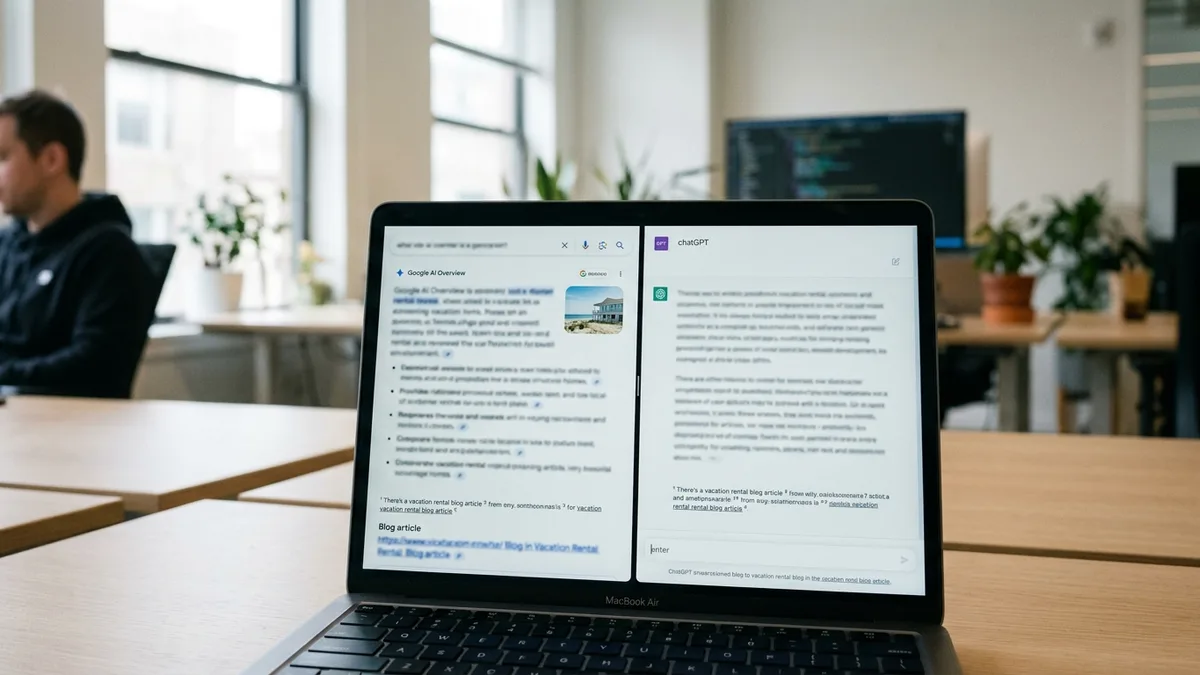
SEO for AI-generated content in 2026 requires the same fundamentals Google has always rewarded, accuracy, structured data, and clear metadata, plus a newer requirement: structuring answers so AI search engines like ChatGPT and Google AI Overviews can extract and cite them directly. Over 40% of product discovery now begins on AI-powered search engines like ChatGPT, Gemini, and Perplexity as of 2026, according to industry research, which makes citation-readiness a real ranking factor, not an optional extra. Google Search Central recommends accuracy, quality, and relevance for AI-assisted content, along with proper title elements, meta descriptions, structured data, and image alt text. Over 60% of high-ranking travel content now aligns with informational or navigational search intent rather than purely transactional intent, meaning guides and explainers outperform sales pages in organic visibility. Content built around real user intent has roughly a 3x higher chance of ranking in the top 10 than content built purely from keyword tools, according to industry data. For STR operators specifically, this means writing content that answers a real traveler or property-owner question directly and completely, in a format an AI system can lift and cite verbatim. That's a different discipline than writing for a human skimmer, and it's one most DIY hosts have never been taught.
As of August 2026, articles published through inkSTR across all active customer projects have secured more than 900 verified AI-search citations, built specifically around answer-first structure and STR-specific entity naming. If ranking in tools like ChatGPT and Perplexity matters to your business, that structural discipline isn't optional anymore. Our guide on ranking in AI search covers the mechanics in more depth.
Data and Evidence: What the AI Content Creation Market Looks Like in 2026
The AI-powered content-creation market is projected at $4.26 billion in 2026, up from $3.51 billion in 2026, and expected to reach $8.28 billion by 2030 at an 18.1% compound annual growth rate, according to The Business Research Company. That growth reflects demand for scalable, cost-efficient content across marketing, e-commerce, and hospitality specifically. For short-term rental operators, that market growth intersects with a maturing rental industry. AirDNA projects U.S. short-term rental demand and available listings will each grow 2.7% in 2026, with U.S. available listings reaching an estimated 1.77 million, up from 1.69 million in 2026. More listings means more competition for the same search terms, which raises the stakes on ranking well.
| Metric | Manual Content Creation | AI-Powered Content Creation (inkSTR) |
|---|---|---|
| Time per blog post | 3-5 hours of research and writing | Draft generated automatically, edited on review |
| Cost per post (freelancer) | $300-$700 per post | Included within a $99/month plan |
| Publishing | Manual copy-paste into CMS | Auto-Publishing to Wix or WordPress |
| Consistency across a portfolio | Depends on staff availability | Scheduled Content Calendar per property |
| Content lifespan value | Same, if it ranks | A ranking article can drive traffic for 2-5 years |
Around 70% of B2B and B2C marketers now use content marketing as a key tactic, according to SeoProfy, and over 92% of marketers plan to or already do optimize for both traditional and AI-powered search engines, per HubSpot data. STR operators sitting out of content marketing entirely are increasingly the exception, not the norm.
Deep Dive: What Does a Real AI Content Workflow Look Like End to End?
A complete AI content workflow moves through six stages: ideation, keyword research, drafting, editorial review, publishing, and performance measurement. Skipping any single stage, especially editorial review, is where most AI content campaigns underperform or damage credibility. First, ideation starts with a content strategy, not a random topic. A property management company covering fifteen units needs pillar pages (broad topics like "vacation rental management in [region]") supported by cluster articles answering specific traveler or owner questions. Second, keyword research grounds each piece in what real searchers type, not what sounds good internally. Third, drafting is where the AI model, trained on hospitality terminology, produces a structured first draft, often in a fraction of the time a human writer would need. Fourth comes editorial review, the step most competing platforms treat as optional and most quality problems trace back to skipping. This is where a human checks local facts, confirms brand voice, and catches anything the AI might have generalized incorrectly. Fifth, publishing pushes the finished article live, ideally on a schedule rather than in unpredictable bursts. Sixth, measurement tracks which keywords are moving and which topics deserve a follow-up cluster.
We built inkSTR's full workflow around exactly this sequence, from research chat and competitor gap analysis through Google Search Console integration that closes the loop between publishing and actual ranking movement. Multi-project support means a portfolio manager running fifteen properties gets fifteen independent pipelines instead of one tangled content calendar. That structural separation is what makes scaling content across a growing portfolio possible without adding a full-time writer to headcount.
Practical Guidance: How Should You Actually Implement AI Content Creation?
Implementing AI content creation successfully starts with choosing one content type to automate first, building a simple style guide, and adding a quality-check step before anything publishes. Trying to automate everything at once, blog posts, social captions, email, and listing copy, simultaneously, usually leads to inconsistent quality across all of them. Here's a sequence that works for most STR operators regardless of portfolio size:
- Map your current process. Write down every manual step involved in your last blog post, from topic idea to publish. Most hosts discover the process takes longer than they realized.
- Choose one content type to automate first. Blog posts targeting direct-booking keywords are usually the highest-leverage starting point because they compound in organic traffic over years.
- Build a lightweight style guide. Note your property's tone, three to five phrases you'd never use, and any local details the AI needs to get right every time.
- Add a quality gate before publishing. Even with automated validation, a quick human scan for local accuracy catches the rare error before a guest does.
- Review performance monthly. Check which articles are gaining impressions in Google Search Console and which topics deserve a follow-up piece.
Common mistakes to avoid: publishing without any keyword targeting, treating AI drafts as final copy with zero review, and going silent for months between posts because "someone will get to it eventually." Inconsistent publishing is treated as a negative signal by search engines, not a neutral one. If you're managing this across multiple properties or brands, the coordination problem gets worse before it gets better. That's the specific scenario inkSTR's multi-project support was built to solve, giving each property its own content pipeline and publishing schedule without you manually tracking fifteen separate to-do lists.
Frequently Asked Questions
When should I refresh vs rewrite content?
Refresh content when the core information is still accurate but statistics, prices, or seasonal details are outdated, typically every 6 to 12 months for data-heavy posts. Rewrite entirely when the topic, keyword strategy, or search intent behind the page has fundamentally shifted, or when the original content never ranked despite months online.
How long does it take to see SEO results from vacation rental blog content?
Most operators start seeing measurable movement in rankings and organic traffic within 60 to 90 days of consistent publishing, though the compounding effect grows significantly after that window as more articles accumulate. A ranking article can then drive traffic for two to five years with minimal ongoing effort.
How many blog articles do I need to start ranking for local vacation rental searches?
There's no fixed number, but a pillar-and-cluster approach, one broad topic supported by five to ten specific articles, tends to outperform scattered single posts. One multi-market operator published 114 articles across five markets in four months and saw monthly Google search visits grow from 26 to 1,924 in that window.
Can AI actually write content for my vacation rental business?
Yes, AI tools trained on hospitality terminology and traveler search intent can generate full blog drafts, but human editorial review remains necessary to verify local facts and preserve brand voice. Industry reporting citing HubSpot found that 85% of marketers edit AI-generated content before publishing rather than posting it unreviewed.
Does blog content actually reduce dependence on Airbnb and VRBO?
Yes, when content is built around booking-intent keywords and links directly to your own booking page, it captures traffic that would otherwise only find you through Airbnb or VRBO search. Since combined host and guest fees on those platforms typically run 17-19% per booking, every direct booking driven by organic content avoids that commission entirely.
What's the difference between writing content myself and using an SEO content automation tool?
Writing manually takes 3 to 5 hours per post plus separate keyword research, while an automation platform like inkSTR handles research, drafting, scheduling, and publishing in one connected workflow. The tradeoff isn't quality versus speed, it's whether you have hours each week to dedicate to a task the platform can run on autopilot instead.
Do I need existing SEO knowledge to use a content automation platform like inkSTR?
No. inkSTR's keyword research and content strategy features are built to guide new STR business owners who have never done SEO before, surfacing what to target rather than requiring you to already know it. The platform's built-in research chat and competitor gap analysis replace the guesswork that typically comes with learning SEO from scratch.
Conclusion: The Fastest Path From Idea to Published, Ranking Content
AI-powered content creation, done correctly, means combining automated research and drafting with real editorial oversight, then publishing on a schedule consistent enough for search engines and AI assistants to trust your site. The operators seeing results in 2026 aren't the ones who publish the most; they're the ones who publish consistently, with content specific enough to their property and market to actually earn a click. Whether you manage one cabin or a fifty-unit portfolio, the fundamentals don't change: research what travelers actually search, draft content that sounds like you, review it before it goes live, and don't let momentum die between posts. What changes is how much of that process you have time to do by hand.

If building and publishing content like this manually feels like a full-time job stacked on top of running your rentals, inkSTR generates, schedules, and publishes SEO-optimized articles automatically, built specifically for short-term rental terminology and traveler search intent. Start a free trial and see your first article draft this week.
Content powered by inkSTR.co
Enjoyed this article? Share it:
Get more of inkSTR in Google Search
Add inkstr.co as a preferred source and our articles show up more in Top Stories, AI Overviews, and AI Mode — with a “Preferred” badge.
Get more guides like this
New SEO and AI-search guides, straight to your inbox. No spam, unsubscribe anytime.