A Local's Take: 10 Content Marketing Websites Worth Studying

A content marketing website is a set of pages, usually a blog or resource hub, built specifically to answer the questions your future guests are already typing into Google before they ever search for a place to stay. For short-term rental operators, that means local guides, seasonal posts, and destination content that pulls travelers to your direct booking site instead of an OTA listing.
Key Takeaways
- A content marketing website works because roughly 70% of B2B and B2C marketers already rely on content marketing as a core tactic, according to SeoProfy's 2026 data, and travel searchers respond to it the same way.
- Organic search drives an estimated 53% of all website traffic (SharkPlatform, 2026), which means a vacation rental site with no blog is invisible to most of its potential direct booking guests.
- SEO delivers roughly an 8x ROI, about twice the return of other marketing channels, per SeoProfy, making content one of the most efficient long-term investments an STR operator can make.
- Content built around real search intent has a 3x higher chance of ranking in the top 10 compared to content built from keyword tools alone (Citedy, 2026), which is why intent-driven local guides outperform generic travel posts.
- Writing one quality blog post manually takes 3 to 5 hours, and a freelance travel writer typically charges $300 to $700 per post, costs that add up fast across a growing property portfolio.
- inkSTR automates the entire content marketing website workflow, from keyword research to scheduled publishing, so STR operators can run a full content hub without hiring a writer or blocking off a weekend to draft posts.
If you manage a vacation rental, you have probably heard that you need "content" to compete on Google. What nobody tells you is what that actually looks like in practice, or which examples are worth modeling. We have spent years building content systems specifically for short-term rental operators at inkSTR, and the pattern is consistent: the hosts who win organic traffic are not the ones with the prettiest website design. They are the ones with the deepest, most consistently updated content marketing website sitting behind their booking engine.
This list breaks down ten examples of what a strong content marketing website looks like in 2026, drawn from established industry resources and real STR content hubs, plus the structural lessons an independent host or property manager can steal from each one. We picked these examples based on depth of coverage, update frequency, and how clearly each one maps content to a specific stage of the reader's decision process. None of these are vacation rental sites specifically, since the businesses that do this best tend to be dedicated content and marketing education resources, but the lessons transfer directly to a beach house or mountain cabin blog.
By the end, you will know exactly what separates a content marketing website that ranks from one that just sits there collecting dust, and where the manual approach breaks down for busy operators managing more than one property.
1. Content Marketing Institute: The Pillar-and-Cluster Blueprint
Content Marketing Institute earns its reputation through sheer topical depth: years of articles, case studies, and research reports organized so tightly around a handful of core themes that Google treats the entire site as an authority on the subject. That structure, not any single article, is what makes it rank.
For an STR operator, the lesson is architectural. Instead of publishing random blog posts about your destination, build three to five content pillars ("Where to Eat Near [Your Town]," "Family Activities in [Your Region]," "Seasonal Events Calendar") and cluster supporting posts underneath each one. This is the exact model Search Engine Land recommends when it describes a keyword map that assigns specific terms to individual pages to avoid keyword overlap and cannibalization.
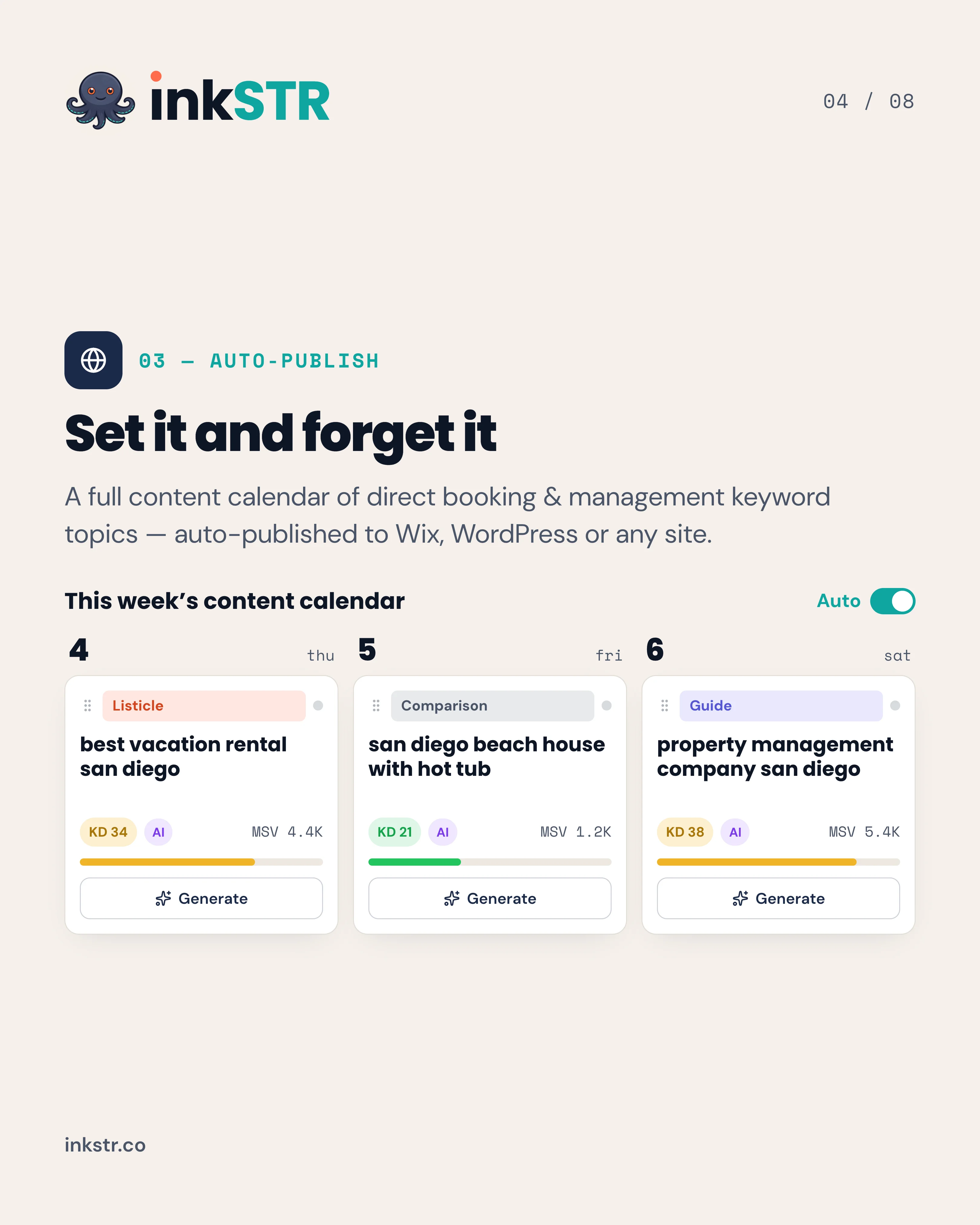
Caveat: this only works if you actually publish enough supporting content to fill out each pillar. A single post under a pillar heading does nothing. We built inkSTR's Content Calendar because most hosts start a pillar structure with good intentions and abandon it after two or three posts. The calendar keeps the cluster filling in on autopilot, on a schedule, without you having to remember what topic comes next.
2. HubSpot's Blog: Proof That Format Diversity Matters
HubSpot's blog demonstrates something most STR hosts miss: a content marketing website is not just blog posts. It mixes long-form guides, downloadable templates, and embedded video, distributed across the site in a way that matches different reader preferences and search behaviors.
In 2026, blog posts were used by 38% of marketers, ranking third behind short-form video at 60% and long-form video also at 38%, per HubSpot's own benchmarking. That tells you something important: text alone is no longer the full strategy, even for a small vacation rental brand.
What we recommend for STR operators is not chasing video production, which most hosts don't have time for, but at minimum varying your blog formats: a seasonal roundup, a numbered local guide, an FAQ-style post answering guest questions, and an evergreen "how to get here" logistics page. Each format targets a different search intent.
Honest caveat here: HubSpot has an entire team dedicated to this. You don't. That is exactly the gap inkSTR's AI Content Writer closes, generating full-length, SEO-optimized posts across multiple formats so a solo host can match that variety without hiring a content team.
3. Moz's Beginner's Guide to Content Marketing: The Research-First Model
Moz's approach to content strategy insists on a research phase before a single word gets written, recommending at least three months of market research, site audits, content audits, surveys, and interviews before launch. That patience is unusual, and it's exactly why Moz content holds up over time instead of chasing short-term keyword trends.
For an STR operator, three months of research is not realistic; you don't have a research team and you have a property to run. But the underlying principle scales down: before you publish your first ten posts, know which keywords your specific market actually searches, not just generic "vacation rental" terms nobody local types into Google.
Moz's guide also lists the metrics that matter beyond traffic: pages per visit, time on site, entrances and exits, linking root domains, and rankings. Most STR hosts only check pageviews, which tells you almost nothing about whether content is actually driving direct bookings.
This is precisely the research gap inkSTR's Keyword Research tool was designed to close: instead of a three-month audit, it surfaces the exact terms your target guests search for your specific market in minutes, then tracks which ones are actually converting.
4. Contentsquare's Funnel-Mapped Content Guide: TOFU, MOFU, BOFU for Bookings
Contentsquare's strategy framework maps every piece of content to a specific funnel stage, arguing that top-of-funnel content should help audiences understand a problem and explore solutions, while bottom-of-funnel content proves why a specific brand is the right choice. This distinction matters enormously for vacation rental content, and almost nobody in the STR space applies it correctly.
Translate this to your rental business: a post like "Best Time to Visit [Your Region]" is top-of-funnel, it captures broad research traffic. A post like "Why Our Cabin Is the Best Base for [Specific Activity]" is bottom-of-funnel, aimed at someone already comparing properties. Most host blogs only write the top-of-funnel version and never close the loop.
Contentsquare's optimization guidance also stresses mobile-friendly formatting, accessibility (contrast, legible fonts, alt text), and clear calls to action, all standard advice that gets ignored constantly on vacation rental sites built on outdated templates.
The gap between TOFU and BOFU content is exactly why generic travel writing fails to convert. We cover this exact failure mode in detail in our piece on why generic content kills conversions: content that informs but never sells leaves money on the table.
5. Marketing Profs: The Training-Ground Model for Ongoing Learning
Marketing Profs built its content marketing website around a training model: recurring webinars and articles that teach a specific tactic, then link back to related lessons, keeping visitors returning on a cadence rather than as one-time readers. That return-visit pattern is a signal Google rewards heavily.
Applied to STR content, this looks like a recurring content series: a monthly "What's Happening in [Town] This Month" post, or a quarterly market update for a specific region. Recurring content trains both Google's crawlers and your repeat readers, including past guests deciding whether to rebook direct, to expect new posts on a schedule.
The caveat is consistency is the entire value proposition here. A recurring series that stops after three months is worse than no series at all, because it signals an abandoned site to both readers and search algorithms.
This is the exact discipline problem inkSTR's Auto-Publishing feature solves: once a schedule is set, articles publish directly to your WordPress or Wix site without you manually logging in each month to hit publish.
6. Copyblogger's Approach: Voice-Driven, Opinion-Forward Writing
Copyblogger's content marketing website built its following on strong, opinionated writing rather than neutral how-to explainers, a style choice that differentiates it sharply from encyclopedic competitors. That voice is what earns backlinks and repeat readership, not just keyword coverage.
Most vacation rental blogs read like they were written by nobody in particular: generic "top 5 things to do" posts with zero personality. That is a missed opportunity. Guests book from hosts who sound like real people who actually know the area, not a stock travel database.
If your property has a specific personality, a boutique cabin, a design-forward urban loft, a family-run lake house, your content should reflect that voice consistently across every post, not just your "About" page.
We hear this concern constantly from boutique operators worried that automated content sounds robotic. That is why we wrote a full guide on article automation without losing your brand voice, because voice consistency and content automation are not mutually exclusive when the system is built for it.
7. What Makes These Content Marketing Websites Actually Rank?
A content marketing website ranks well when it combines topical depth, funnel-stage variety, consistent publishing, and strong internal linking, four factors that Google's helpful content systems reward more than any single optimization trick. As of 2026, none of these examples rank because of one clever hack; they rank because of sustained structural discipline.
Here is a side-by-side comparison of what separates the sites above from a typical, underperforming vacation rental blog:
| Factor | Strong Content Marketing Website | Typical Underperforming STR Blog |
|---|---|---|
| Publishing cadence | Weekly or biweekly, on a fixed schedule | Sporadic, often stops after 3 to 5 posts |
| Topic structure | Pillar and cluster architecture | Random unrelated topics |
| Funnel coverage | Mix of TOFU, MOFU, and BOFU content | Only top-of-funnel "things to do" posts |
| Internal linking | Dense cross-links between related posts | Little to no internal linking |
| Voice | Consistent, opinionated, specific | Generic, could be any destination |
| Metrics tracked | Rankings, pages per visit, conversions | Pageviews only, if anything |
Notably, industry research shows content based on real user intent has a 3x higher chance of ranking in the top 10 than content based on keyword tools alone (Citedy, 2026). That is the single biggest gap between the sites above and a typical rental blog: the winners write for a specific searcher's question, not a keyword list.
We built inkSTR's quality scoring system specifically to check for this before publishing, flagging content that reads generic instead of intent-matched to a real guest question.
Ready to automate your content marketing?
inkSTR handles keyword research, content strategy, article writing, and publishing, all on autopilot.
8. What Does a Content Marketing Website Cost to Build and Maintain?
Building and maintaining a content marketing website costs STR operators either significant time or significant money, with no shortcut around that trade-off using traditional methods. Writing one quality blog post manually takes 3 to 5 hours of research and drafting, and hiring a freelance travel writer typically runs $300 to $700 per post.
Do the math across a realistic content calendar. If you publish two posts a month at $500 average, that is $1,000 monthly, or $12,000 a year, just for writing, before design, editing, or publishing time. For a solo host or a small property management company, that budget rarely exists.
Compare that to the actual value at stake: a single direct vacation rental booking is typically worth $1,000 to $4,000 in revenue, and Airbnb host and guest fees combined eat 17 to 19% of every booking that goes through the platform instead of direct. One converting blog post can pay for a year of freelance content, or it can pay for itself many times over if you're running the content system yourself.
A ranking blog article, once published, can drive organic search traffic for 2 to 5 years, which is the long-tail value most hosts underestimate when they calculate ROI only on the first month.
Starting at $99 a month, inkSTR's pricing replaces the freelance writer line item entirely, generating, scheduling, and publishing articles automatically rather than billing per post. For a portfolio running four or more posts a month, that math is not close.

9. How Can a Local Destination Function Like a Content Marketing Website?
A local destination can function like a content marketing website when an STR operator treats their town or region as the central content pillar, publishing depth on local events, seasonal patterns, and hyperlocal recommendations that no national travel site will ever match. This is the single biggest content gap we see in the STR space, and it's the fastest way for an independent host to outrank a large property management company with a bigger marketing budget.
Big property managers write generic regional content because they cover too many markets to go deep on any one of them. A single host or a boutique operator with two or three properties in one town can go deeper than a competitor managing fifty units across five states, because you actually live there.
Practical example: instead of "Things to Do Near [Region]," write "Where Locals Actually Eat Breakfast in [Your Town]" or "[Your Town]'s Fall Festival Schedule for 2026." Specificity beats scale in local search every time. Our Jasper local's take article is a real example of exactly this format applied to a specific destination.
This is also the exact strategy behind local area guides that sell: hyperlocal knowledge converts because it signals to a reader that you are not a faceless booking platform, you are someone who actually knows the town.
10. Should You Keep Content Under Your Main Site or Build a Separate Content Hub?
Most STR operators should keep their content marketing website under their main booking domain as a /blog subfolder rather than launching a separate hub, because subfolder content directly builds domain authority for the pages that actually take bookings. A separate hub can work for larger portfolios managing multiple property brands, but for a single-property host it usually splits SEO value instead of concentrating it.
Here is the trade-off broken down:
| Approach | Best For | Main Risk |
|---|---|---|
| Blog subfolder on main site (yoursite.com/blog) | Solo hosts, single or small property portfolios | None significant, this is the default recommendation |
| Separate content hub domain | Multi-brand portfolios, agencies with distinct property brands | Splits domain authority; requires double the SEO maintenance |
| No dedicated content section | Nobody, this is the losing option in 2026 | Zero organic visibility beyond your OTA listing |
For property management companies running multiple distinct brands, a separate pipeline per brand still makes sense operationally, just not as separate domains. That is why how inkSTR works includes multi-project architecture: independent content pipelines and keyword strategies per property or brand, without the SEO cost of splitting across separate websites.
Data and Evidence: What the Numbers Actually Say About Content ROI
The financial case for a content marketing website is stronger in the STR space than most operators assume, even though hospitality historically posts a lower content ROI than sectors like B2B SaaS. Hospitality and travel content marketing records among the lowest sector ROI at roughly 220%, compared to 420% for B2B SaaS, but 220% is still more than double your investment back.
Break-even time across all industries averages 4.2 months, and while hospitality likely sits on the slower end given the sector average, that is still a fraction of the multi-year lifespan of a ranking article, which can drive traffic for 2 to 5 years once it climbs Google's results.
Consider the traffic math too: organic search drives an estimated 53% of all website traffic as of March 2026, and 56% of companies already use AI in their digital marketing workflows. If your competitors are already using AI-assisted content production and you are not, that gap compounds every month you wait.
One more data point worth internalizing: 40% of Google users making regional hotel queries are actually considering vacation rentals as an alternative, according to 2023 industry data. That means your content does not just need to compete with other rental hosts, it needs to show up when someone searches "hotels near [your town]" too.
Practical Guidance: How to Prioritize Your First 90 Days of Content
Building your first content marketing website in 90 days requires a specific sequence, not a scattered list of topics written whenever you find time. Follow this order to avoid the most common mistake we see: publishing five unrelated posts and then losing steam.
- Weeks 1-2: Identify three to five content pillars specific to your property type and location, not generic vacation rental themes.
- Weeks 2-3: Run keyword research for your specific market. Skip broad national terms; target long-tail, location-specific phrases guests actually type.
- Weeks 3-8: Publish one pillar-supporting post per week, mixing TOFU (destination guides) with BOFU (why-book-here) content.
- Weeks 9-10: Add internal links between all published posts and your booking pages.
- Weeks 11-13: Review early search performance and double down on the topics gaining traction.
Common mistakes to avoid: publishing without a keyword strategy, writing only generic "top things to do" content, ignoring mobile formatting, and abandoning the schedule after the first month when results aren't instant. SEO is a compounding asset, not a launch campaign. That's a trade-off worth understanding on the front end, not discovering three months in when you've already lost momentum. For a deeper breakdown of the ranking mechanics behind this timeline, see our guide on how to rank a vacation rental website on Google.
Frequently Asked Questions
What exactly is a content marketing website for a vacation rental business?
A content marketing website for a vacation rental business is a blog or resource section, usually built as a subfolder of your main booking site, that publishes local guides, seasonal content, and destination information to attract organic search traffic. Its purpose is to answer the questions travelers ask before they book, positioning your property as the obvious local choice.
How long does it take for a new content marketing website to start ranking?
Most vacation rental content sites begin showing meaningful ranking movement after 12 to 20 published articles targeting a mix of destination and long-tail booking keywords, typically over a 3 to 6 month window. inkSTR's content calendar automates that publishing volume so you reach that milestone without manually tracking every post date.
Do I need a separate content hub, or should my blog live on my main rental site?
For nearly every single-property host or small portfolio operator, the blog should live as a subfolder on your main booking domain, since that concentrates SEO authority on the pages that take bookings. Separate content hub domains only make sense for multi-brand property management companies managing genuinely distinct portfolios.
Can AI-generated content actually rank for competitive vacation rental keywords?
Yes, AI-generated content can rank competitively when it is built around real search intent, specific local detail, and proper SEO structure rather than generic keyword stuffing. Content matched to actual user intent has roughly a 3x higher chance of ranking in the top 10 than content built purely from keyword tools, which is why quality and specificity matter more than whether a human or AI wrote the first draft.
What should I blog about first if I'm starting from zero?
Start with your three to five core content pillars, typically local dining, seasonal activities, logistics or travel tips, and a "why book here" comparison post, then build supporting articles under each pillar. Avoid generic "top 10 things to do" posts with no specific local detail; those rarely differentiate you from a hundred other listings in the same market.
Is it worth investing in content marketing if my property is in a heavily trafficked tourist destination?
Yes, heavily trafficked markets often have the most search competition, which makes specific, hyperlocal content even more valuable, not less. Generic content gets buried under bigger competitors in popular destinations, while specific, opinionated local guides can still carve out ranking space that generic regional sites miss.
How much does it cost to run a content marketing website manually versus with a tool like inkSTR?
Manually, expect to pay $300 to $700 per post to a freelance writer, or spend 3 to 5 hours per post writing it yourself, adding up to thousands of dollars or dozens of hours monthly for a consistent publishing schedule. inkSTR generates, schedules, and publishes articles automatically starting at $99 a month, replacing that per-post cost structure entirely.
Conclusion
A strong content marketing website is not built from a single clever post or a design overhaul. It comes from pillar structure, funnel-stage variety, consistent publishing, and hyperlocal specificity, the same principles behind every example on this list, applied to your specific property and town. The math backs this up: with organic search driving roughly 53% of all web traffic and SEO delivering close to an 8x ROI, this is not a marginal marketing tactic in 2026, it is the infrastructure your direct booking strategy depends on.
Start with one pillar, publish consistently, and track what actually converts, not just what gets clicks. If content production is the bottleneck holding you back from doing this consistently, that is exactly the gap inkSTR was built to close.

If building out local guides feels like the hardest part of your content marketing website, this is exactly the workflow Get started with inkSTR automates end to end, from destination keyword research to a fully scheduled publishing calendar, so your town's story gets told without eating your entire week.
Content powered by inkSTR.co
Enjoyed this article? Share it:
Get more of inkSTR in Google Search
Add inkstr.co as a preferred source and our articles show up more in Top Stories, AI Overviews, and AI Mode — with a “Preferred” badge.
Get more guides like this
New SEO and AI-search guides, straight to your inbox. No spam, unsubscribe anytime.