How to Do Keyword Research for Vacation Rental Sites

How to do keyword research for vacation rental sites comes down to one habit: finding the exact words travelers type before they book, then building pages around those exact words. Start with four buckets (property type, location, amenities, guest type), verify demand with tools like Google Search Console and Ubersuggest, then match each keyword to a specific page on your site.
- Most travelers search in four keyword buckets: property type, location, amenities, and guest type, and the strongest listings combine at least two of these in every title and headline.
- Around 67% of clicks go to the top 5 search results for vacation rental keywords (LiveRez, 2026), so ranking on page one is not optional, it's the whole game.
- Content built around real user intent has a 3x higher chance of ranking in the top 10 than content built from keyword tools alone (Citedy, 2026).
- 38% of vacation rental traffic comes from organic search, more than direct or paid channels combined (CUFinder, 2026), making keyword research the highest-leverage marketing task most operators ignore.
- Google Search Console is the single most useful free tool for this work because it shows which queries are already sending clicks to your site.
- inkSTR's Keyword Research tool automates the entire process, from seed keyword generation to intent grouping, so operators skip weeks of manual spreadsheet work.
If you manage a vacation rental and you're not sure what travelers actually type into Google before they find a property like yours, you're not alone. Most hosts guess at keywords based on what sounds good, "cozy mountain retreat," "luxury lakefront escape," instead of what real search data shows people are typing.
That gap matters more in 2026 than it did five years ago. Online booking platforms captured about 96% of vacation rental booking value in 2026, which means almost every guest who finds your property does it through a search box, whether that's Google, Airbnb's internal search, or an AI assistant summarizing results. If your keyword strategy doesn't match the language travelers actually use, you're invisible in all three places at once.
At inkSTR, we've reviewed the content strategies of hundreds of short-term rental operators, and the pattern is consistent: hosts who rank well aren't necessarily better writers. They just chose the right words first. This guide walks through the exact process, seed keyword generation, intent buckets, tool selection, and page mapping, so you can do this yourself or hand it off entirely.
What Is the 80/20 Rule for Airbnb Keywords?
The 80/20 rule for Airbnb, applied to keyword strategy, means roughly 80% of your booking traffic will come from 20% of your keyword targets, typically the handful of high-intent, long-tail phrases that combine location and a specific traveler need. Most hosts waste effort chasing broad, low-converting terms instead.
In practice, this means a term like "vacation rental" is nearly worthless to target directly. It's too broad, too competitive, and doesn't signal what the searcher actually wants. A phrase like "pet-friendly cottage near Lake Tahoe" is narrower, but it converts at a much higher rate because the searcher has already decided on their must-haves.
Here's the practical application: identify the 3 to 5 keyword phrases that most precisely describe your property's unique combination of location, amenities, and guest type. Then build your homepage, your top listing description, and your first blog posts around those specific phrases rather than spreading thin across 40 generic terms.
We see this mistake constantly in our work with property management companies managing 10 to 50-plus units. They try to rank for "vacation rentals in [city]" across every property page, competing against themselves and diluting relevance signals. That's exactly the problem our Keyword Research feature solves: it identifies the specific 20% of keyword phrases with the highest booking-intent signal for each property, so you stop spreading effort across terms that will never convert.
What Is the Best Search Engine for Vacation Rentals?
Google remains the best search engine for vacation rental keyword research because it captures the largest share of informational and location-based travel queries, and 42% of US leisure travelers say Google Search impacted their travel provider decision on their last trip (ShortTermRentalz, 2023). But "best search engine" now includes AI assistants like ChatGPT and Perplexity, which pull answers from the same ranking content.
Notably, 40% of Google users who make regional hotel queries are also considering vacation rentals (ShortTermRentalz, 2023). That statistic alone should change how you think about keyword targeting: you're not just competing with other Airbnb hosts, you're competing with hotels for the same search real estate.
Beyond Google, Airbnb and VRBO function as search engines in their own right. Guests type filters and search terms directly into these platforms, which behave more like product search than open web search. Your keyword strategy needs to account for both environments: Google for your direct booking website, and platform-native search for your listing itself.
The manual alternative here is exhausting. Checking rankings across Google, Airbnb search, and now AI Overviews means juggling three or four separate tools, none of which talk to each other. That's why inkSTR's Keyword Research tool tracks opportunities across the channels that actually drive bookings, and why our content is built with ranking in AI search as a first-class goal, not an afterthought.
What Are the 4 Types of Keywords for Vacation Rental Search?
The four types of keywords relevant to vacation rentals are property type, location, amenities, and guest type, and the strongest-performing pages combine at least two of these categories into a single specific phrase. Understanding this framework is the foundation of everything else in keyword research.
| Keyword Type | Example | Best Used For |
|---|---|---|
| Property Type | cabin, condo, villa, cottage, beach house | Homepage and listing titles |
| Location | Myrtle Beach, near Disney World, Smoky Mountains | Local area guides and landing pages |
| Amenities | hot tub, pool, pet-friendly, ski-in/ski-out, oceanfront | Filter-matching listing descriptions |
| Guest Type | family-friendly, romantic getaway, digital nomad | Blog content and email segments |
A single high-converting phrase usually stacks two or three of these categories: "family-friendly beach house in Myrtle Beach" combines guest type, property type, and location in six words. That's the level of specificity Google rewards and travelers respond to.
Here's the content gap most guides skip entirely: mapping the exact language travelers use inside Airbnb and VRBO's own search filters back to your website copy. If a traveler filters by "pet-friendly" and "hot tub" on Airbnb, your direct booking site description should use those exact words, not synonyms like "animal-welcome" or "spa feature." Search engines and AI assistants both reward literal phrase matching over clever rewording.
Manually cross-referencing platform filter language with website copy takes hours per property, and most hosts never do it. This is precisely why we built inkSTR's Keyword Research tool to surface amenity and guest-type phrasing that matches both search engine queries and OTA filter language in one pass, instead of guessing at synonyms that sound nice but don't match real search behavior.
How to Search Keywords in Airbnb?
Searching keywords in Airbnb means using the platform's own search bar, filter menu, and autocomplete suggestions to surface the exact phrases travelers use when looking for a property like yours. Airbnb's autocomplete reveals real-time popular search terms, functioning similarly to Google's autocomplete feature but filtered specifically for lodging intent.
Start by typing your destination into Airbnb's search bar and noting every autocomplete suggestion that appears. These are not random, they reflect actual aggregate search volume from real travelers in that market. Do this for your specific neighborhood, nearby landmarks, and common amenity combinations.
Next, open the filter panel and study every category Airbnb offers: property type, amenities, accessibility features, and host language. Every filter option is, by definition, a keyword travelers actively use to narrow results. If "hot tub" and "mountain view" are both filter options, both need to appear explicitly in your listing title or first paragraph of your description.
Here's a gap almost no guide addresses directly: run the same search from a traveler's perspective using two or three different personas. Search "family-friendly cabin near Lake Tahoe" and separately search "quiet mountain cabin for couples." Compare which listings rank for each phrase. You'll often find the same property optimized for only one persona, missing bookings from the other entirely.
Doing this manually across every property in a portfolio, and repeating it seasonally as filter trends shift, is not realistic for a host managing five-plus units. That's the exact workflow inkSTR's Keyword Research tool automates: it identifies platform-native search language and matches it to your website's blog and landing page content, so your direct booking site speaks the same language your OTA listing needs to rank.
How Do I Find Keywords My Competitors Are Ranking For?
Finding competitor keywords means analyzing which vacation rental listings and websites appear on page one for your target destination, then reverse-engineering the specific phrases in their titles, headers, and descriptions. This tells you what Google and Airbnb already consider relevant for your market.
Start by searching your primary destination term ("cabin rental Gatlinburg") and noting the exact phrasing used by every top-10 result. Pay attention to headline structure, not just individual words. Notably, VRBO ranks on the first page of Google for 94% of vacation rental markets analyzed, and lands in the top 3 results 64% of the time (BuildUp Bookings, 2019), which tells you platform authority alone carries significant weight you'll need to out-specify with better content.
For deeper analysis, tools like Ubersuggest show location-based keyword ideas, estimated monthly volume, and difficulty scores. Paid platforms like SEMRush go further, revealing exactly which keywords a competing website ranks for and how much organic traffic each page receives.
The manual version of this process, checking rankings, exporting competitor keyword lists, cross-referencing volume and difficulty, easily eats 3 to 5 hours per market. Multiply that across a portfolio of properties in different destinations and it becomes a full-time job nobody has time for. This is exactly the problem inkSTR was designed to solve: our Keyword Research tool includes built-in competitor gap analysis, so you see which phrases are winning in your market without manually rebuilding that spreadsheet every quarter.
How Do I Group Keywords by Search Intent?
Grouping keywords by search intent means sorting every phrase into informational, navigational, or transactional categories, then mapping each group to a matching page type on your site. Informational keywords need blog content, transactional keywords need booking or listing pages.
Informational keywords look like "best time to visit Smoky Mountains" or "things to do near Lake Tahoe." These belong on blog posts and local area guides, not your booking page, because the searcher isn't ready to book yet. Transactional keywords look like "book cabin rental Gatlinburg for 4th of July" or "pet-friendly condo Destin available in July." These belong directly on listing and landing pages.
Content based on real user intent has a 3x higher chance of ranking in the top 10 compared to content built purely from keyword-volume tools without intent context (Citedy, 2026). That's a significant gap, and it's the reason keyword volume alone is a poor targeting metric. A high-volume keyword with the wrong intent will drive traffic that never converts.
Build a simple spreadsheet with columns for keyword, intent type, target page, monthly volume, and difficulty score. Sort by relevance first, then volume and difficulty. This structure, more than any single tool, is what separates hosts who rank from hosts who publish content nobody finds.
We built inkSTR's Content Strategy Wizard around exactly this intent-mapping logic, automatically classifying each keyword by intent and recommending whether it belongs on a local area guide, a listing page, or a conversion-focused landing page. That mapping step is where most manual keyword research efforts stall out entirely.

What Tools Should I Use for Vacation Rental Keyword Research?
The right vacation rental keyword research tools combine free platform-native data with paid SEO software: Ubersuggest for volume estimates, Google Search Console for existing performance data, and Google's own autocomplete for real-time traveler phrasing. Each tool answers a different question, and no single tool covers the full picture.
Google Search Console is free and arguably the most valuable tool available, because it shows the exact queries already sending clicks to your existing site. If you're getting impressions for "oceanfront condo with pool Destin" but low click-through, that's a signal to rewrite your title tag, not chase new keywords.
Ubersuggest is a solid hybrid free-paid option for location-based keyword ideas, monthly volume, and difficulty scores within a limited number of daily searches. For deeper competitive analysis, SEMRush and similar paid platforms reveal exactly which pages are driving organic traffic for your competitors. Google Trends is worth checking for seasonal or event-based terms, like "film festival stay Park City," where demand spikes at predictable times of year.
| Tool | Cost | Best For |
|---|---|---|
| Google Search Console | Free | Existing site performance data |
| Ubersuggest | Free/Paid tiers | Location-based volume estimates |
| SEMRush | Paid | Competitor keyword and traffic analysis |
| Google Trends | Free | Seasonal and event-based demand |
| inkSTR Keyword Research | Included in inkSTR plans | STR-specific intent grouping and content mapping |
The problem with stitching together four or five separate tools is that none of them speak the language of short-term rentals specifically. General SEO tools treat "cabin" the same way they'd treat any generic noun, without understanding that cabin rentals cluster around seasonal demand, hyper-local landmark searches, and amenity-based filtering that's unique to hospitality. That's the gap inkSTR's Keyword Research feature fills. It was built specifically to understand vacation rental terminology and traveler search intent, so you're not translating generic SEO software output into STR-specific strategy yourself.
How Do I Use Long-Tail and Hyper-Local Keywords?
Long-tail and hyper-local keywords are specific, multi-word phrases that name exact neighborhoods, landmarks, or nearby attractions rather than generic city names, and they consistently convert better because they match a traveler who has already narrowed down their exact needs. A phrase like "parking near Staples Center" or "hiking near Yosemite" signals precise intent.
Generic keywords like "vacation rental" attract broad, low-intent traffic and face brutal competition from major booking platforms with far more domain authority than any individual host site. Long-tail phrases like "quiet mountain cabin for couples near Gatlinburg" face a fraction of that competition while attracting travelers who are much closer to booking.
Naming specific landmarks, restaurants, hiking trails, or event venues near your property is one of the highest-leverage tactics available, and it's also one of the easiest for AI-generated content to get wrong if it isn't grounded in real local knowledge. Every local reference needs to be accurate: the actual distance, the actual trail name, the actual venue.
Here's where most hosts get stuck: knowing you need hyper-local keywords is easy, actually researching every trail, restaurant, and event within a 20-minute radius of your property is not. That's manual research across tourism board sites, Google Maps, and local event calendars, easily 3 to 5 hours per property before you've written a single sentence.
Our AI Content Writer is built with STR-specific location intelligence, so hyper-local keyword phrases translate directly into accurate local area guides without you doing the landmark research manually every time.
Ready to automate your content marketing?
inkSTR handles keyword research, content strategy, article writing, and publishing, all on autopilot.
How Do I Map Keywords to Pages on My Website?
Mapping keywords to pages means assigning one primary keyword phrase and 2 to 3 closely related secondary keywords to each individual page on your website, rather than trying to rank one page for dozens of unrelated terms. This is the step that turns keyword research from a spreadsheet exercise into actual traffic.
Each property listing page should target one primary keyword combining property type, location, and one standout amenity, for example "pet-friendly cottage near Asheville." Blog posts and local guides should target informational long-tail phrases. Your homepage should target your broadest, highest-volume term, usually property type plus city name.
The content gap almost nobody addresses well: structuring content within a single page to separate "what travelers search for" from "what your listing actually says." Most listings bury their best keyword phrases in paragraph three when they should appear in the first sentence. A simple audit, reading your own listing description as if you were a first-time searcher, often reveals mismatches between filter language and copy that's costing you visibility.
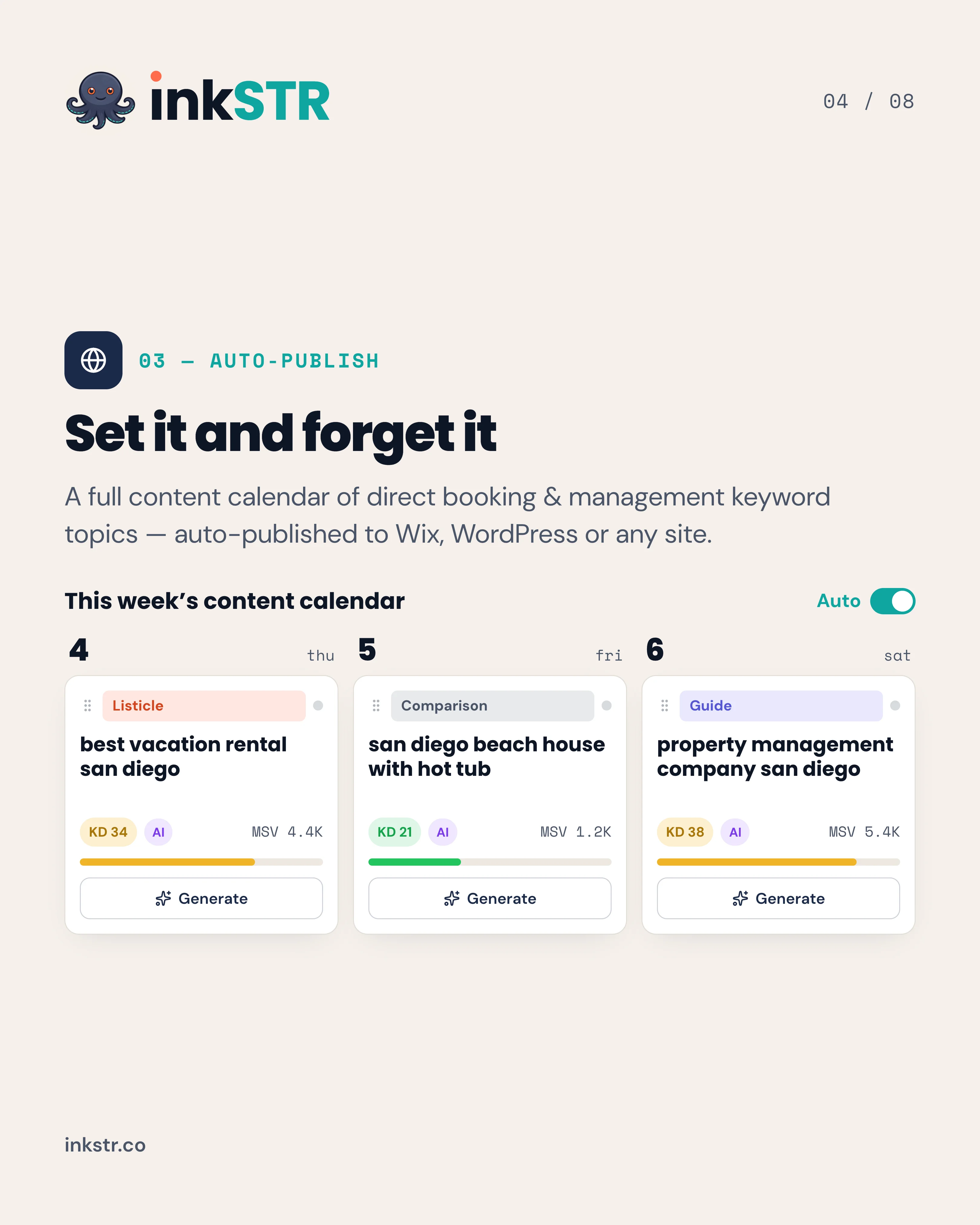
Doing this consistently across 10, 20, or 50 properties, keeping each page's primary and secondary keywords distinct so pages don't compete against each other, is a coordination problem most property management companies don't have staff time to solve. This is exactly why inkSTR's Content Calendar exists: it maintains separate content pipelines per property so keyword targeting stays distinct across your entire portfolio instead of overlapping and diluting each page's relevance.
Can AI Tools Like ChatGPT Help With Keyword Research?
AI tools like ChatGPT can help generate keyword variations and content ideas from a small seed list, functioning as a brainstorming assistant rather than a data source. Because these tools don't have access to real search volume or ranking data, they should supplement, not replace, tools like Google Search Console and Ubersuggest.
Ask an AI assistant to generate 20 variations of a seed phrase like "mountain cabin rental" and you'll get useful long-tail combinations you might not have considered, mixing guest type, amenity, and seasonal language. But without verifying those phrases against actual search volume data, you're guessing at which ones matter.
This is also where AI search itself changes the equation. As of 2026, a meaningful share of travel research now happens inside AI assistants directly, not just traditional Google search. That means your content needs to be structured for both search engine ranking and AI citation simultaneously, a dual requirement that most keyword research guides from even a year or two ago don't address at all.
We built inkSTR to handle both sides of this from day one. Our Keyword Research tool combines AI-assisted brainstorming with real search volume verification, and our AI Content Writer structures every article for citation by AI Overviews and assistants like ChatGPT and Perplexity, not just traditional blue-link rankings.
What Mistakes Should I Avoid in Vacation Rental Keyword Research?
The most common vacation rental keyword research mistakes are targeting keywords that are too broad, ignoring OTA-native search filter language, and never revisiting keyword targets as seasons and travel trends shift. Each of these mistakes is fixable, but only if you know to look for it.
- Chasing generic, high-competition terms. "Vacation rental [city]" sounds appealing but you're competing against major platforms with far more domain authority. Prioritize long-tail phrases instead.
- Ignoring your own Google Search Console data. Many hosts never check which queries are already sending impressions to their site, missing free signal about what's almost working.
- Mismatching OTA filter language and website copy. If Airbnb travelers filter by "pet-friendly," your website description needs that exact phrase, not a rephrased version.
- Treating keyword research as a one-time task. Seasonal demand shifts, new amenities get added, and nearby attractions change. Revisit your keyword map at least quarterly.
- Publishing content without mapping it to a specific page and intent. A blog post with no clear keyword target rarely ranks for anything specific.
Most of these mistakes come down to time, not knowledge. Hosts know they should revisit keywords quarterly; they just don't have four spare hours every quarter to do it manually. Our How inkSTR Works page walks through exactly how the platform keeps keyword targeting current automatically, using ongoing Google Search Console integration to surface new opportunities as search behavior shifts.
Data and Evidence: What the Numbers Say About Keyword-Driven Content
The data consistently supports investing in keyword-specific content over generic property descriptions. Around 67% of clicks go to the top 5 search results for vacation rental keywords (LiveRez, 2026), meaning ranking outside page one is close to invisible for most search terms.
| Metric | Data Point | Source |
|---|---|---|
| Top 5 result click share | 67% of clicks | LiveRez, 2026 |
| Intent-based content ranking advantage | 3x higher chance top 10 | Citedy, 2026 |
| Organic search share of STR traffic | 38% | CUFinder, 2026 |
| Google's influence on travel decisions | 42% of US leisure travelers | ShortTermRentalz, 2023 |
| VRBO first-page presence | 94% of markets analyzed | BuildUp Bookings, 2019 |
This data tells a clear story: organic search isn't a side channel, it's the largest single traffic source for vacation rentals when measured against direct and paid combined. That makes keyword accuracy, not keyword volume, the deciding factor between a listing that ranks and one that doesn't.
A freelance travel writer typically charges $300 to $700 per quality blog post, and writing one manually takes 3 to 5 hours of research and writing. If a single direct booking is worth $1,000 to $4,000 in revenue, and Airbnb host and guest fees combined run 17 to 19% of every booking, the math on ranking blog content that drives even a handful of direct bookings a year becomes hard to ignore.
Practical Guidance: A Step-By-Step Keyword Research Checklist
Here's the exact sequence we recommend, whether you're doing this manually or using inkSTR to automate it:
- Brainstorm seed keywords across the four buckets: property type, location, amenities, guest type.
- Check Google autocomplete and Airbnb autocomplete for your destination to surface real traveler phrasing.
- Verify volume and difficulty using Ubersuggest, SEMRush, or your Google Search Console data.
- Group every keyword by intent: informational, navigational, or transactional.
- Map each keyword to a specific page, one primary keyword plus 2 to 3 secondary phrases per page.
- Audit competitor listings in your exact market for phrasing you're missing.
- Revisit quarterly as seasonal demand and OTA filter trends shift.
Trade-offs worth understanding: doing this manually gives you full control but costs real hours every single month. Hiring a freelance SEO consultant solves the time problem but adds recurring cost without STR-specific expertise built in. Using a purpose-built tool like inkSTR's Keyword Research feature combines the speed of automation with hospitality-specific intelligence, at a fraction of what a freelancer or agency would charge for the same output.
Conclusion: Turning Keyword Research Into Direct Bookings
Knowing how to do keyword research for vacation rental sites isn't about finding more keywords, it's about finding the right ones and mapping them precisely to the pages travelers actually land on. Start with the four buckets, verify demand with real data, group by intent, and revisit the map every quarter.
The operators who win organic search in 2026 aren't the ones with the biggest keyword lists. They're the ones whose content matches exactly what a traveler typed, whether that traveler is scrolling Google, filtering Airbnb, or asking ChatGPT for a recommendation. Start with your top three properties this week: run the autocomplete test, check your Search Console data, and rewrite one listing description around what you find.
If you want that system running without doing every piece manually, inkSTR handles keyword research, content mapping, and publishing so you can focus on the properties that actually earn the revenue.

If keyword research is the part of your content strategy you keep putting off, inkSTR generates a full keyword plan and matching content calendar for your market in minutes. Start your free trial at inkSTR.co and see your first keyword map before your next property turnover.
Frequently Asked Questions
How long does it take for vacation rental keyword-targeted content to rank on Google?
Most vacation rental websites begin showing meaningful ranking movement after publishing a consistent volume of keyword-mapped content over several months, typically 3 to 6 months for competitive markets. Long-tail, hyper-local keywords tend to rank faster than broad, generic terms because there's less competition. inkSTR's content calendar automates a consistent publishing cadence so you're not manually tracking every publish date.
Do I need separate keywords for each property I manage, or can I share keywords across a portfolio?
Each property needs its own primary keyword combining its specific location, amenities, and guest type, even within the same portfolio. Sharing identical keywords across multiple property pages causes them to compete against each other in search results instead of each ranking independently. inkSTR's multi-project architecture keeps keyword targeting distinct per property automatically.
What is the difference between keyword research for a direct booking website and optimizing an Airbnb listing?
Keyword research for a direct booking website targets Google's ranking algorithm and focuses on blog content, local guides, and landing pages built around search intent. Optimizing an Airbnb listing targets the platform's internal search and filter system, which rewards exact phrase matches to filter categories like "pet-friendly" or "hot tub." Both require the same underlying research, applied differently.
Can AI-generated content actually rank for competitive vacation rental keywords?
Yes, when the content is built around verified search intent and specific, accurate local detail rather than generic filler. AI-generated content that lacks real keyword mapping or hyper-local accuracy underperforms, but content structured around genuine traveler search behavior performs comparably to manually written content. inkSTR's quality scoring validates each article before publishing to catch generic or unfocused content.
How many keywords should I target per property page?
One primary keyword combining property type, location, and a standout amenity, supported by 2 to 3 closely related secondary keywords, is the recommended structure per page. Targeting more than that dilutes relevance signals and confuses which phrase the page should rank for.
How do I find out which keywords my vacation rental competitors are ranking for?
Search your target destination terms directly and study the exact phrasing used in top-10 results' titles and headers. Tools like Ubersuggest and SEMRush reveal which specific keywords are driving organic traffic to competing pages, letting you identify gaps in your own targeting.
Is it worth targeting hyper-local keywords if my property is in a heavily trafficked tourist market?
Yes, arguably more so. In saturated markets, broad terms face the most competition from major platforms and hotels, so hyper-local phrases naming specific neighborhoods, trails, or venues near your property become your best path to visibility. These narrower phrases also tend to attract travelers further along in their decision, closer to actually booking.
What's the fastest way to start keyword research if I've never done it before?
Begin with Google Search Console if your site already has some traffic, since it shows queries already sending clicks. If you're starting from zero, brainstorm the four keyword buckets, property type, location, amenities, guest type, then check Google and Airbnb autocomplete for your destination to verify real traveler phrasing before writing a single page.
Content powered by inkSTR.co
Enjoyed this article? Share it:
Get more of inkSTR in Google Search
Add inkstr.co as a preferred source and our articles show up more in Top Stories, AI Overviews, and AI Mode — with a “Preferred” badge.
Get more guides like this
New SEO and AI-search guides, straight to your inbox. No spam, unsubscribe anytime.