How to Write a Vacation Rental Listing Description
A vacation rental listing description that converts follows a specific structure: a benefit-driven headline under 50 characters, an experience-led opening hook, a complete room-by-room specifics section, a location paragraph, and a direct call to action, all within 250 to 400 words.
Key Takeaways
- Escapia recommends 250 to 400 words or four to six short paragraphs as the ideal length for a vacation rental listing description in 2026.
- Most OTA channels cap headlines around 50 characters, and Guesty cites average attention spans hovering around eight seconds, so your first line has to work immediately.
- Properties with a 100% complete listing page receive up to 18% more bookings than incomplete ones, according to Booking.com Partner Hub data cited by Maverick Strategies in 2026.
- Roughly half of all vacation rental bookings now happen on mobile devices, according to Rentals United, which means your first two sentences must render fully above the fold on a phone screen.
- Vrbo's own best practice guidance recommends listing 30 to 60 amenities plus at least one location type to optimize for conversion.
- inkSTR's AI Content Writer applies this same structure automatically to blog and website copy, so your listing description and your direct booking site tell a consistent, search-optimized story.
Most hosts write their listing description once, on the day they publish, and never touch it again. Guesty's internal customer survey found 58% of hosts don't regularly update their listing descriptions, which means the majority of active listings on Airbnb and Vrbo today are running on stale, first-draft copy written before the host understood what actually converts.
That's a problem in 2026 because guest expectations have shifted. Escapia's Unpack '26 travel trend research found 91% of travelers are now interested in trips centered on reading, relaxation, and quality time, and mentions of reading in guest reviews climbed 285% year over year. Farm stays are up too, with 84% of travelers expressing interest and farm mentions in reviews up 300% year over year, led by Gen Z travelers. A description written in 2021 doesn't speak to any of that.
We work with hosts and property management companies across every market archetype, from beach condos to mountain cabins to urban lofts, and the pattern is consistent: the listings that convert aren't the ones with the most amenities. They're the ones that answer a specific guest's specific question in the first sentence. This guide walks through exactly how to do that, with a full template you can adapt today.
How to Write a Rental Description?
Writing a rental description means structuring five elements in a fixed order: a benefit-led headline, an experience-first opening hook, complete room-by-room specifics, a location and nearby-attractions paragraph, and a closing call to action. Skipping any one of these five weakens conversion, regardless of how good the individual sentences read.
Start with the headline, since most OTA channels give hosts around 50 characters and Airbnb caps listing names at exactly that length. Avoid generic phrasing like "Cozy Cabin Getaway." Instead, name the specific benefit: "Ski-In Cabin, Wood Stove, Sleeps 8" tells a guest more in the same character count.
Next comes the hook, which should describe the feeling of staying there before you describe the square footage. Then move into specifics: exact bed and bathroom counts, a room-by-room breakdown, and your full amenity list. Vrbo's own guidance recommends 30 to 60 amenities plus at least one location type tagged for search visibility.
Without this structure, hosts default to a wall of adjectives that says nothing concrete. We see this constantly in listings we review: "beautiful," "stunning," "perfect for families," with zero specifics backing any of it. Guests skim past it because it could describe any property in any market. This is precisely the gap inkSTR's AI Content Writer was built to close for your broader web content: it pulls the same structural discipline (specific hook, concrete detail, clear CTA) into every blog post and landing page you publish, so the quality of your Airbnb description doesn't stop at the OTA border.
How to Write a Good Listing Description?
A good listing description answers the guest's unspoken question, "why this property, for me, right now," within the first two sentences, then backs that answer with specific, verifiable details rather than generic superlatives. Specificity is what separates a good description from a merely adequate one.
For example, compare "Beautiful home near the beach" to "Two-minute walk to Crescent Beach, private deck faces sunset side." The second version gives a guest something they can picture and verify. It also gives search engines and AI assistants a concrete detail to extract and cite, which matters more every year as guests research trips through AI search tools before they ever land on an OTA.
Good descriptions also match tone to guest type. A property marketed to business travelers should lead with reliable Wi-Fi, a dedicated desk, and proximity to transit. The same property marketed to a family should lead with the pack-and-play, the fenced yard, and the walk to the splash pad. Here's how that tonal shift looks in practice:
| Guest Type | Lead With | Tone | Avoid |
|---|---|---|---|
| Couples | Privacy, views, romantic amenities like a hot tub or fireplace | Warm, intimate | Group capacity language |
| Families | Safety features, kid-friendly amenities, proximity to attractions | Reassuring, practical | Overly formal or luxury-only framing |
| Business travelers | Wi-Fi speed, workspace, transit access, quiet hours | Efficient, direct | Vacation-only imagery |
| Groups | Sleeping capacity, communal spaces, house rules on noise/parking | Energetic, clear | Romantic or solitude-focused language |
Notably, this same guest-type calibration applies to the blog content on your direct booking website, not just your OTA listing. That's where inkSTR's Keyword Research feature comes in: it identifies which guest segment is actually searching in your market, so your website content and your listing description reinforce the same positioning instead of contradicting each other.
How to Write an Airbnb Listing Description?
Writing an Airbnb listing description requires working within Airbnb's specific format constraints: a 50-character title, a summary field, and an expandable "the space" section where most of your persuasive copy lives. Airbnb's search algorithm and its guest-facing display behave differently from Vrbo or a direct booking website, so the same words need different formatting to perform well on each.
Airbnb's own documentation on search ranking factors confirms that completeness and guest engagement signals influence visibility, not just keyword presence in the description. That means an accurate, detailed description that reduces guest questions (and therefore reduces cancellations and negative reviews) carries real weight beyond the words themselves.
Structurally, front-load your strongest detail in the summary field since that's what displays in search results before a guest taps through. Then use the expandable body to go deeper: room-by-room layout, full amenity list, and house rules. Booking.com's own Property Page Score guidance makes a similar point: listing completeness directly correlates with guest-facing performance, a pattern that holds across platforms, not just one.
One mistake we see constantly among independent hosts and small property management companies alike: copying the exact same Airbnb description onto Vrbo and their own website, formatting and all. Each channel has different character limits and different guest expectations. This is exactly why inkSTR's Content Calendar exists for your broader content strategy: it schedules channel-appropriate content across your website so you're never manually reformatting the same copy five different ways.
How to Write a Marketing Description for a Rental Property?
A marketing description for a rental property, as opposed to an OTA listing description, needs to work as standalone SEO content on your own website, meaning it should be built around the search terms real guests type into Google, not just the internal search filters of Airbnb or Vrbo. This distinction matters because your website competes for organic visibility, not internal marketplace ranking.
Industry research shows that 38% of vacation rental traffic comes from organic search, 32% from direct traffic, and 16% from paid search, according to CUFinder's 2026 analysis. That organic share is exactly the traffic your website description needs to capture, and it will not happen with the same 250-word blurb you use on Airbnb. Your website description has room to add local context, a personal welcome note, and internal links to your area guide or amenities page.
Separately, ShortTermRentalz reports that 42% of US leisure travelers say Google Search directly impacted their travel provider decision on their last trip, and 40% of Google users making regional hotel queries are actually considering vacation rentals. Your website's rental description is competing for exactly that search intent, whether or not you've optimized for it.
We consistently see property management companies treat their website description as an afterthought, copy-pasted from the OTA listing with zero SEO consideration. That's a missed opportunity given how much organic traffic is available. inkSTR's Keyword Research tool identifies the exact phrases guests in your market are searching for, and the AI Content Writer builds a website description and supporting blog content around those terms automatically, something a copy-pasted OTA blurb can never do on its own.
What Length and Format Actually Convert?
The ideal vacation rental listing description length is 250 to 400 words, structured into four to six short paragraphs, according to Escapia's 2026 hosting guidance. Shorter descriptions under 150 words tend to omit critical guest questions, while descriptions over 500 words lose readers before they reach the amenities.
Meta descriptions for your website's rental pages should run 150 to 160 total characters for best SEO results, per BuildUp Bookings' 2026 recommendations. That's a separate field from your listing body copy but equally important since it's what shows in Google's search results before a click.
Formatting matters as much as length. Roughly half of all vacation rental bookings now happen on mobile, according to Rentals United, so long unbroken paragraphs get abandoned fast on a phone screen. Break your description into short paragraphs, use bullet points for amenities, and put your strongest sentence first in every paragraph, since mobile readers skim rather than read linearly.
| Element | Recommended Length | Where It Lives |
|---|---|---|
| Headline/Title | Under 50 characters | Airbnb title field, Vrbo headline |
| Full listing description | 250 to 400 words | OTA body copy, website property page |
| Meta description | 150 to 160 characters | Website SEO field only |
| Amenity list | 30 to 60 items | Vrbo, Airbnb amenity checkboxes |
If you're managing more than one property, hitting these length and format benchmarks consistently across every listing and every website page becomes a real time cost. That's the exact gap inkSTR's Auto-Publishing feature addresses for your website content: it publishes formatted, mobile-ready property pages directly to Wix or WordPress without you manually checking character counts on each one.
How Do You Format Descriptions Differently Across Channels?
Channel-specific formatting means adjusting the same core information to fit each platform's structural rules, since Airbnb, Vrbo, Booking.com, and your own direct booking website each display and rank descriptions differently. This is one of the most overlooked parts of writing rental copy, and it's rarely addressed in depth anywhere else.
Airbnb splits your description into a short summary plus an expandable "the space" section, so your strongest hook needs to survive in the truncated preview. Vrbo displays more of the description upfront and rewards a complete amenity checklist, per Vrbo's own search positioning guidance. Your direct booking website has no character limit at all, which means it's the one place you can add the local color, the personal host note, and the internal links that OTAs strip out.
For international guests, consider basic translation quality if you host in a market with meaningful non-English-speaking demand. A description that reads naturally in English but was machine-translated poorly into a second language actively damages trust rather than building it. Reviewing translated copy for tone, not just accuracy, is worth the extra step if a meaningful share of your bookings come from international guests.
Multi-property managers feel this formatting burden most acutely. Reformatting the same base description five different ways across five channels, for fifteen properties, is a full afternoon of copy-paste work every time a property updates. inkSTR's Content Calendar was built with multi-project support specifically for this: each property runs its own independent content pipeline, so channel-specific formatting happens without you manually rewriting the same paragraph five times.

Ready to automate your content marketing?
inkSTR handles keyword research, content strategy, article writing, and publishing, all on autopilot.
How Do You Improve a Description After It's Published?
Improving a published listing description means treating it as a living document you test and revise based on booking data, not a one-time task you complete at launch. Most hosts never return to their description once it's live, which is exactly why Guesty's internal survey found 58% of hosts don't regularly update their copy.
Start by tracking your view-to-inquiry ratio before and after any edit. If your listing gets strong traffic but weak conversion, the description likely isn't answering a specific guest objection, parking, pet policy, or exact walk time to the nearest attraction. Revise one variable at a time so you can attribute any change in booking rate to the specific edit you made.
Seasonal refreshes matter too. A mountain cabin description written for ski season should shift language toward hiking and lake access by early summer. Booking window data from Expedia Group's Q1 2026 first-party search shows 91-to-180-day advance searches up 35% year over year, meaning many guests are researching and booking your listing months before their trip, so seasonal copy needs to be live before demand peaks, not after.
Few resources address this iterative, data-driven approach to description writing, which is a real gap. If you're not tracking conversion changes after edits, you're guessing. This ongoing refinement is exactly the kind of recurring content work that becomes unsustainable manually across a growing portfolio, and it's part of why inkSTR's full content workflow includes ongoing publishing on a set schedule rather than a single one-time draft.
What Does a Complete Description Template Look Like?
A complete listing description template combines five components in sequence: headline, hook, specifics, location, and call to action, each serving a distinct job in moving a browser toward booking. Below is the exact structure to copy and adapt for your own property.
- Headline (under 50 characters): Name one concrete benefit. Example: "Lakefront A-Frame, Private Dock, Sleeps 6."
- Hook (1 to 2 sentences): Describe the feeling, not the features. Example: "Wake up to fog lifting off the water and coffee on your own private dock, no neighbors in sight."
- Specifics (room-by-room, 2 to 3 paragraphs): Exact bed and bathroom counts, kitchen equipment, unique features like a wood stove or hot tub, and your full amenity list.
- Location (1 paragraph): Distance to the nearest town, grocery store, or landmark attraction, plus drive time to the nearest airport if relevant.
- Call to action (1 to 2 sentences): A direct, low-pressure close. Example: "Check our calendar for open dates, this cabin books out fast during leaf season."
For reference, a real listing example from Lavrion, Greece describes itself as located 20 meters from the sea, about 35 minutes from Athens airport, and a 5-minute drive to a center with tavernas, coffee shops, and supermarkets. That level of specific, verifiable distance detail is what separates a template that converts from one that reads like filler.
Accessibility deserves a place in this template too, and it's routinely skipped. If your property has step-free entry, a roll-in shower, or wide doorways, state it plainly in the specifics section. This isn't just a selling point for guests who need it; it's increasingly a legal and reputational expectation, so confirm your specific compliance obligations with a qualified professional rather than guessing.
Running this exact template across every property in a growing portfolio, and keeping it updated seasonally, is precisely the repetitive workflow inkSTR's AI Content Writer automates for your website content, applying the same structural discipline at scale instead of requiring a fresh manual draft for every property and every season.
Why Does a Strong Description Matter Beyond the Listing Itself?
A strong listing description matters beyond the individual listing because it directly influences your booking conversion rate, and conversion rate compounds across every guest who ever sees your property in search results. Booking.com's Partner Hub data, cited by Maverick Strategies in 2026, found properties with a 100% complete listing page receive up to 18% more bookings than incomplete ones. That 18% gap isn't a rounding error. Across a full year of bookings, it's the difference between a strong season and a mediocre one, for the exact same property in the exact same market. Beyond individual bookings, your listing description quality also feeds into your broader direct booking strategy. A well-written OTA description builds trust that carries guests toward your own website for their next stay, avoiding the 17-19% combined host and guest fees that come with every Airbnb booking. If you want to go deeper on capturing that repeat-guest value, our guide on how to increase direct bookings covers the follow-on strategy once a guest has already stayed with you once.
We've also seen operators underestimate how much their description quality affects their Google ranking for their own website, since search engines reward complete, specific, keyword-relevant page content over thin copy. A generic, half-finished description hurts you twice: once on the OTA conversion rate, and again on organic search visibility. This dual impact is exactly why we built inkSTR to handle both the OTA-adjacent content strategy and the on-site SEO content from a single workflow.
Frequently Asked Questions
How long should a vacation rental listing description be?
Most industry guidance recommends 250 to 400 words, or four to six short paragraphs, as the ideal length for a vacation rental listing description in 2026. Shorter descriptions tend to skip critical guest questions like parking and pet policy, while descriptions over 500 words lose readers before they reach the amenities section.
What should the headline of a rental listing say?
Your headline should name one concrete, specific benefit rather than a generic adjective, and it needs to fit within roughly 50 characters since that's the cap most OTA platforms including Airbnb enforce. "Ski-In Cabin, Wood Stove, Sleeps 8" outperforms "Cozy Mountain Getaway" because it gives a guest something specific to picture.
Should I write a different description for Airbnb versus Vrbo?
Yes, because Airbnb truncates your description into an expandable summary field while Vrbo displays more content upfront and rewards a complete amenity checklist of 30 to 60 items. Using the identical copy on both platforms means one of them is seeing a version that isn't optimized for its specific display format.
How often should I update my listing description?
You should review and refresh your description at least seasonally, since guest interests shift throughout the year and Guesty's internal survey found 58% of hosts never update their copy after publishing. A description written for ski season should shift toward hiking or lake access language by early summer to stay relevant to what guests are actually searching for.
Does my listing description affect my Google ranking?
Yes, a complete and specific listing description on your own website contributes to organic search visibility, since search engines reward detailed, keyword-relevant page content over thin or generic copy. This is separate from OTA internal ranking, which is why your website property page needs its own SEO-focused version of the description, not a copy-paste of your Airbnb listing.
Can AI write my vacation rental listing description for me?
AI tools can generate a strong first draft quickly, particularly when given specific details about your property's layout, amenities, and location, but the best results come from reviewing and adding your own local knowledge afterward. inkSTR's AI Content Writer is built specifically for short-term rental terminology and traveler search intent, which general-purpose AI writing tools aren't trained on.
What's the biggest mistake hosts make in their listing description?
The most common mistake is relying on generic adjectives like "beautiful" or "stunning" instead of specific, verifiable details a guest can picture and act on. A description that could apply to any property in any market fails to differentiate a listing, and it gives search engines nothing concrete to index either.
Conclusion
Writing a vacation rental listing description that converts comes down to structure: a specific headline under 50 characters, an experience-led hook, complete room-by-room specifics, a location paragraph, and a direct call to action, all within 250 to 400 words. Properties with complete, specific descriptions see measurably higher booking rates, up to 18% more according to Booking.com Partner Hub data, and that gap only widens as more guest research moves through Google and AI search tools in 2026.
Getting this right once for your OTA listings is a good start. Getting it right consistently across every channel, every season, and every property in a growing portfolio is a different challenge entirely, and it's the one most hosts eventually outsource or automate. inkSTR handles that consistency end to end, from keyword research to the finished, published page, so your listing quality and your website content move together instead of drifting apart.
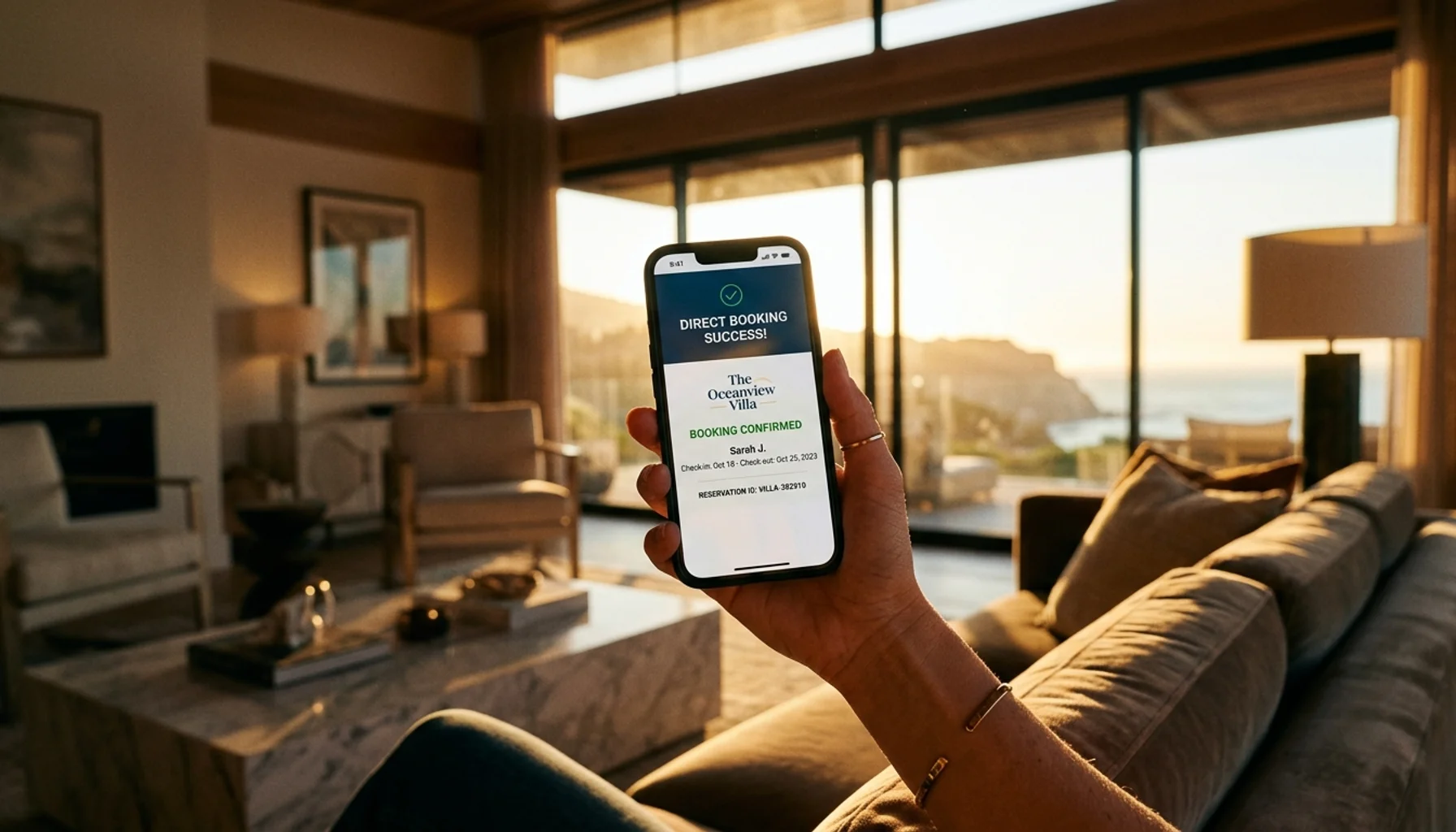
If writing and maintaining strong property descriptions across your website feels like a full content job on top of running your rentals, Get started with inkSTR and see how the AI Content Writer builds SEO-optimized property and blog content around the exact search terms your future guests are typing in 2026.
Content powered by inkSTR.co
Enjoyed this article? Share it:
Get more of inkSTR in Google Search
Add inkstr.co as a preferred source and our articles show up more in Top Stories, AI Overviews, and AI Mode, with a “Preferred” badge.
Get more guides like this
New SEO and AI-search guides, straight to your inbox. No spam, unsubscribe anytime.