What Is an Auto SEO Platform and Do You Need One?

An auto SEO platform is a software tool that automates the repetitive, time-intensive tasks that make up a functional SEO workflow: keyword research, content generation, on-page optimization, rank tracking, and publishing. Instead of spending hours each week on manual processes, you set the system up, define your targets, and let the platform execute on a schedule. For short-term rental operators who need consistent search visibility to drive direct bookings, this distinction matters enormously.
- Auto SEO platforms handle keyword research, content creation, scheduling, and publishing automatically, removing the manual burden from STR operators who lack in-house marketing teams.
- Writing one quality blog post manually takes 3 to 5 hours of research and writing; an auto SEO platform generates and schedules that same post in minutes.
- A single direct vacation rental booking is typically worth $1,000 to $4,000 in revenue, making organic search traffic one of the highest-ROI channels available.
- Airbnb and VRBO combined host and guest fees run 17 to 19% of every booking; direct bookings from organic content keep that margin in your pocket.
- A ranking blog article can drive organic search traffic for 2 to 5 years, compounding the return on every piece of content published.
- inkSTR is the only auto SEO platform built specifically for the short-term rental industry, automating content generation, scheduling, and one-click publishing to Wix and WordPress for STR operators nationwide.
What Is Auto SEO and How Does It Actually Work?
Auto SEO refers to the use of software to execute SEO tasks autonomously or semi-autonomously, replacing processes that would otherwise require a skilled marketer working manually for hours each day. Specifically, an auto SEO platform handles tasks such as keyword discovery, competitor gap analysis, content brief generation, article writing, internal link insertion, and scheduled publishing, all without requiring you to manage each step yourself.
The mechanics vary by platform. Some tools focus narrowly on rank tracking or technical audits. Others, particularly those built with AI at their core, handle the full content pipeline from keyword to published post. The most capable platforms in 2026 combine traditional SEO signals (meta tags, heading structure, keyword density) with Generative Engine Optimization (GEO), ensuring content ranks in both Google's traditional index and AI-generated search results from tools like ChatGPT and Perplexity.
For STR operators specifically, the "auto" in auto SEO matters because your time is already consumed by guest communication, property maintenance, pricing strategy, and channel management. You are not running a content agency. You need a system that produces ranking articles on a reliable schedule without pulling you away from the work that directly generates revenue.
We built inkSTR around exactly this reality. Our AI Content Writer generates 2,500 to 3,500 word, SEO and GEO-optimized blog posts based on keyword research specific to vacation rental search intent. You are not adapting a generic content tool to your industry. The system already understands terms like "beachfront cabin with hot tub," "pet-friendly lake house rental," and "things to do near [destination]" because that is the only context it was built for.
Is Auto SEO Any Good? What Results Can You Realistically Expect?
Auto SEO is genuinely effective when the platform is matched to the right use case, but most operators walk in with unrealistic expectations and end up disappointed. The honest answer is this: auto SEO is excellent at scale, consistency, and execution speed. It struggles without a clear content strategy, accurate keyword targeting, and at least some human judgment about what your audience actually needs.
The single biggest mistake we see STR operators make is treating an auto SEO platform as a one-click solution with no setup. You still need to tell the system which keywords to target, what tone to write in, and what your property's unique positioning is. Once that context is in place, the platform can execute reliably and consistently. Without it, you get generic content that ranks for nothing.
Here is what you can realistically expect from a well-configured auto SEO platform:
- Consistent publishing cadence. Manual content creation falls apart because it competes with every other urgent task on your plate. Automation removes that bottleneck. Your blog publishes on schedule regardless of how busy your season gets.
- Keyword-targeted articles that compound over time. A ranking blog article can drive organic search traffic for 2 to 5 years. Each article you publish is an asset that works without your continued attention.
- Reduced dependency on OTAs. Airbnb and VRBO take 17 to 19% of every booking in combined fees. Every direct booking you earn through organic search keeps that revenue in your business.
- Time reclaimed for operations. Writing one quality blog post manually takes 3 to 5 hours. An auto SEO platform compresses that to minutes of setup time per article.
What auto SEO cannot do: it cannot replace judgment about your local market, your guest personas, or the nuance of what makes your property worth booking. The best results come from operators who treat auto SEO as a force multiplier on their existing knowledge, not a substitute for having any strategy at all.
Our Keyword Research tool finds the specific queries your target guests type when comparing properties in your area, so every article we generate is targeting a search that real travelers are performing right now in 2026.
Is SEO Dead or Evolving in 2026?
SEO is not dead in 2026. It has fundamentally restructured around two simultaneous search environments: traditional Google web search and AI-generated answers from tools like ChatGPT, Perplexity, and Google AI Overviews. Operators who understand this dual landscape and produce content optimized for both will outperform those still writing for the old single-engine model.
The shift is significant. Google's AI Mode, which the company has been expanding throughout 2026 and 2026, synthesizes answers from multiple sources before showing traditional blue links. That means your content now needs to earn citation in AI-generated summaries, not just rank on page one. This is what the industry is calling Generative Engine Optimization, or GEO.
For STR operators, the practical implication is this: travelers searching "best beach vacation rentals in [destination]" or "pet-friendly cabins near [park]" are increasingly getting AI-synthesized answers, not a list of ten links. If your website is not cited as a source in those AI answers, you are invisible to a growing segment of your market.
What earns AI citation? Structured, factual, well-organized content that directly answers specific questions. Content with clear definitions, named entities, and verifiable data points. Exactly the kind of content that a purpose-built auto SEO platform produces when it understands the STR industry.
In our experience ranking in AI search requires a different structural approach than traditional SEO, including modular paragraph formats, definition-first openings, and internal link architecture that signals topical authority. inkSTR builds all of this into every article it generates by default.
What Is the Difference Between an Auto SEO Platform and a General AI Writing Tool?
An auto SEO platform differs from a general AI writing tool in three critical ways: it performs keyword research before writing, it structures content around search intent rather than prose quality alone, and it integrates with publishing infrastructure so articles actually reach your website on a schedule. A general AI writing tool produces text. An auto SEO platform produces a complete content pipeline.
This distinction matters most for STR operators because the vacation rental keyword landscape is highly specific. Travelers search for "oceanfront house rental Outer Banks" or "ski-in ski-out condo Breckenridge," not generic travel terms. A general writing tool has no way to identify those high-intent local queries, prioritize the ones with manageable competition, or structure content around the specific intent behind each search.
General AI writing tools also stop at the draft stage. You still need to edit, optimize meta tags, add internal links, upload to your CMS, schedule the post, and track how it performs. Each of those steps is a friction point where the process stalls. For busy operators managing five, ten, or twenty properties, that friction means most content never gets published at all.
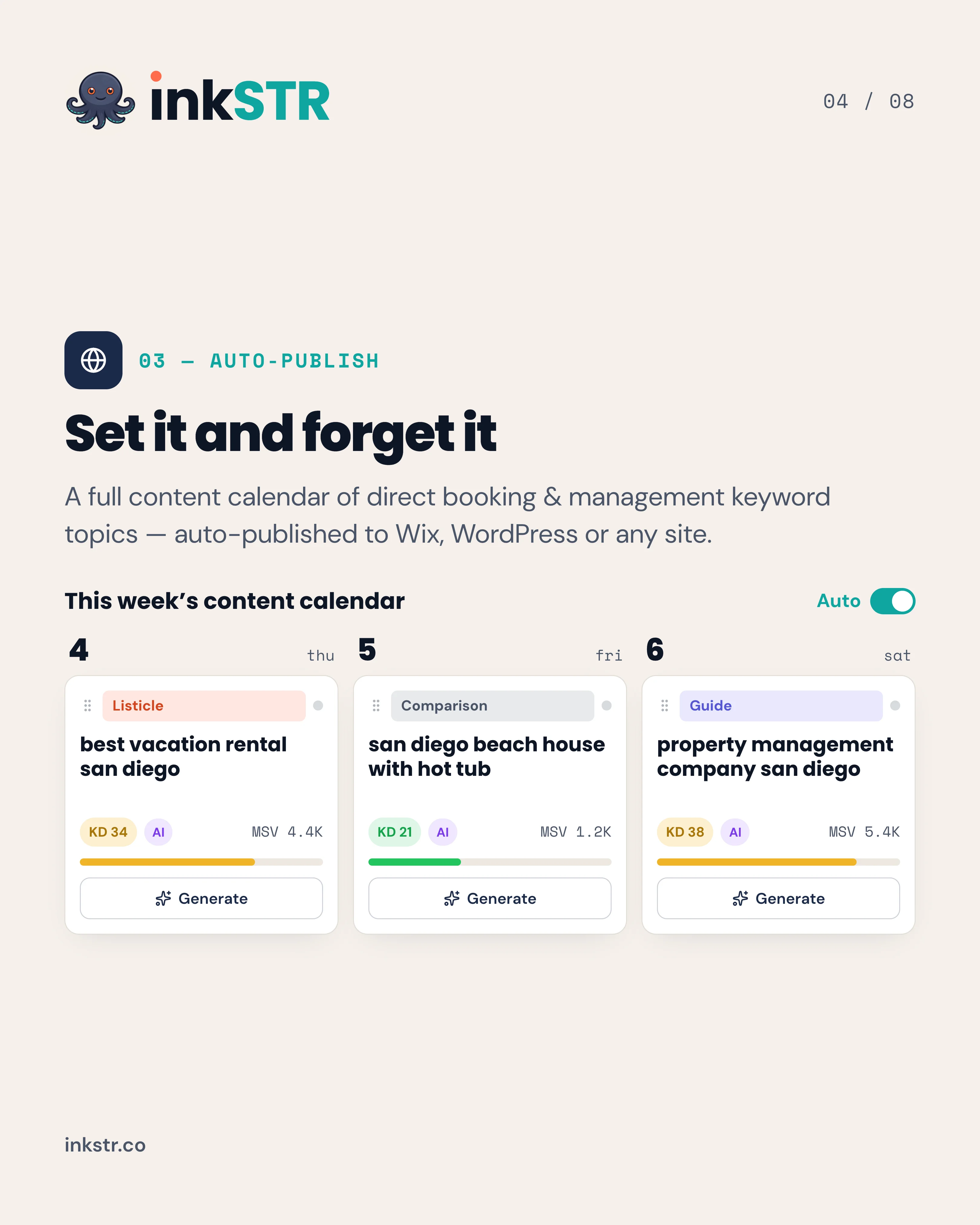
The auto SEO platform model closes that loop. At inkSTR, our platform handles keyword research, content generation, internal link suggestions, and one-click publishing to Wix or WordPress through our Auto-Publishing feature. You review and approve. The platform does the rest. That is a fundamentally different product from a writing assistant that generates a draft and hands you a text file.
For operators managing multiple properties or brands, our multi-project architecture gives each property its own independent content pipeline, keyword strategy, and publishing schedule, all managed from a single dashboard. That level of operational structure is simply not possible with a general-purpose writing tool.
How Much Does Auto SEO Cost? A Real Pricing Breakdown
Auto SEO platform pricing in 2026 spans a wide range depending on scope, feature depth, and target customer size. Entry-level tools built for individual marketers start around $19 to $50 per month and typically offer limited automation: rank tracking, basic keyword suggestions, or content briefs without full article generation. Mid-market platforms targeting small businesses and agencies range from $99 to $500 per month. Enterprise platforms used by large agencies and corporate SEO teams often price by request only, with annual contracts running into tens of thousands of dollars.
For STR operators, the relevant question is not just "what does it cost" but "what does it replace." A freelance travel writer charges $300 to $700 per quality blog post. If you publish two posts per month, that is $600 to $1,400 monthly just in writing costs, before you account for keyword research time, editing, SEO optimization, and manual publishing.
At $99 per month, inkSTR replaces that entire workflow. One direct vacation rental booking, typically worth $1,000 to $4,000 in revenue, covers multiple months of the platform cost. That math looks even better when you factor in that a ranking blog article compounds over 2 to 5 years, generating bookings long after you stopped thinking about it.
| Platform Type | Typical Monthly Cost | What It Covers | Best For |
|---|---|---|---|
| Entry-level SEO tools | $19 to $50/mo | Rank tracking, basic keyword research | Individual bloggers, small sites |
| Mid-market auto SEO platforms | $99 to $500/mo | AI content generation, scheduling, publishing | STR operators, small business owners |
| Enterprise SEO suites | $1,000+/mo or by quote | Full technical auditing, team workflow, enterprise reporting | Large agencies, enterprise brands |
| Freelance content writer | $300 to $700 per post | One article, no keyword research or publishing included | One-off content needs |
| inkSTR | $99/mo | Full content pipeline: research, generation, calendar, auto-publishing | STR operators and vacation rental managers |
You can review our full plan details on the inkSTR Pricing page. At this price point, the platform pays for itself the first time a guest books directly through your website instead of through Airbnb or VRBO.
What Are the Real Limitations of Auto SEO Platforms?
Auto SEO platforms have genuine limitations, and most platform reviews gloss over them entirely. We would rather you understand the constraints upfront than build a content strategy on faulty assumptions. Specifically, auto SEO platforms underperform in three situations: when the strategy input is wrong, when human review is skipped entirely, and when the platform has no domain-specific knowledge.
First, garbage in, garbage out. If you feed an auto SEO platform the wrong keywords, it will generate well-structured articles that rank for searches your potential guests never perform. Keyword strategy still requires judgment. You need to know whether travelers search "vacation rental" or "holiday home" in your target market, whether they search by neighborhood name or by landmark, and whether they are in the research phase or ready to book. A platform that skips this context will produce volume without relevance.
Second, zero-review publishing creates risk. Automated content that goes live without any human check can contain factual errors, outdated local information, or tone that does not match your brand. The right workflow is auto-generate, human-review, auto-publish. Not auto-generate, auto-publish with no eyes on it at all.
Third, and most importantly for STR operators: a generic auto SEO platform does not understand your industry. It does not know that "ski-in ski-out" is a booking trigger for mountain property guests, or that "OTA fees" is a meaningful phrase to your guest conversion strategy, or that local attraction content is one of the highest-converting blog formats for vacation rental websites. A platform built for e-commerce, SaaS, or general blogging will produce technically optimized content that completely misses your audience.
This is precisely why we built inkSTR for STR operators specifically, not as a generic tool retrofitted with a hospitality template. Our AI understands vacation rental terminology, traveler search intent, and the location-based SEO strategies that actually move the needle for properties in beach towns, mountain destinations, lake communities, and urban markets.
Auto SEO vs Manual SEO: Where Each Approach Wins
Auto SEO and manual SEO are not opposites; they are different points on a spectrum of how much human time you invest per unit of content output. Manual SEO is appropriate when you are targeting a single high-value keyword with a deeply researched, opinionated piece of content that requires real expertise. Auto SEO wins on volume, consistency, and compounding return across a broad topic cluster.
For STR operators, the content need is inherently high-volume. You want to rank for dozens of specific location queries, seasonal travel topics, activity guides, and comparison searches. No operator has the time to manually produce that volume of quality content alongside running their properties. Manual SEO at that scale requires either a full-time content team or a budget of thousands of dollars per month in freelance fees.
Here is where each approach actually wins:
- Manual SEO wins for: flagship destination guides requiring deep local knowledge, reputation-defining thought leadership pieces, content that relies on proprietary data or personal experience only you can supply.
- Auto SEO wins for: consistent weekly publishing cadence, keyword cluster coverage across dozens of related search terms, local area content, FAQ-style posts, seasonal guides, and property-specific landing pages.
The operators seeing the strongest organic results in 2026 use both: a handful of manually crafted cornerstone pieces that establish authority, supported by a larger volume of auto-generated cluster content that captures long-tail traffic and feeds internal link equity back to the cornerstone pages.
inkSTR's Content Calendar is built around this exact architecture. You can designate pillar topics, cluster articles, and conversion-focused posts, then let the platform fill the calendar with optimized articles while you focus your personal writing energy on the pieces that genuinely require your voice.

Ready to automate your content marketing?
inkSTR handles keyword research, content strategy, article writing, and publishing, all on autopilot.
How Does Auto SEO Handle AI Search and Answer Engine Optimization?
Answer Engine Optimization (AEO) refers to structuring content so that AI systems like ChatGPT, Perplexity, Google AI Overviews, and Gemini extract and cite it when answering user questions. As of 2026, this has become a distinct and growing dimension of SEO that traditional auto SEO platforms were not originally built to address. The structural requirements for AI citation differ meaningfully from traditional Google ranking signals.
For AI citation, content needs: definition-first paragraph openings, self-contained sections that make sense without surrounding context, named entities rather than generic references, and a clear question-answer format throughout. An article that ranks on page one for traditional Google search may still be invisible to AI systems if it uses narrative prose without structural clarity.
Most auto SEO platforms built before 2026 generate content optimized for traditional search signals only. They produce keyword-dense articles with good heading structure but no deliberate design for AI extraction. This gap is becoming a meaningful competitive disadvantage as more travelers discover vacation rental options through AI-assisted search rather than traditional keyword queries.
Every article inkSTR generates is structured for both traditional SEO ranking and GEO citation by default. We use definition-first section openings, modular paragraph architecture, and FAQ blocks that match the question formats AI systems prioritize. Our guide to ranking in AI search for STR operators covers the specific structural patterns that earn citation across ChatGPT, Perplexity, and Google AI Overviews. The short version: if your content is not built for both environments in 2026, you are competing with one hand behind your back.
How to Evaluate Whether an Auto SEO Platform Is Right for Your STR Business
Choosing an auto SEO platform for your vacation rental business requires evaluating five specific criteria: industry relevance, publishing integration, content quality, keyword strategy depth, and performance tracking. A platform that scores well on all five is a genuine asset. One that scores well on only two or three will frustrate you within the first month.
Step 1: Assess industry relevance. Does the platform understand STR terminology, traveler search intent, and location-based keyword strategies? Ask for sample output on a destination-specific query. If the content reads like it could apply to any business in any industry, the platform lacks the domain context you need.
Step 2: Check publishing integration. Does the platform publish directly to your CMS, or does it produce a document you then have to manually upload, format, and optimize? Every manual step in that chain is a point where the process breaks down. Look for native Wix and WordPress integration if those are your platforms.
Step 3: Evaluate content quality against your standards. Most platforms offer a free trial or sample generation. Run a test article for a real keyword you are targeting. Read it as a potential guest would. Does it answer the question well? Would you be proud to publish it on your site? Does it reflect your property's tone and positioning?
Step 4: Examine keyword strategy capabilities. Can the platform identify the specific long-tail queries your guests search? Does it offer competitor gap analysis to show you which keywords competitors rank for that you do not? Keyword strategy is the single biggest driver of content ROI. A platform with weak keyword tools will produce content that misses the mark regardless of how well it writes.
Step 5: Confirm performance tracking. Does the platform integrate with Google Search Console so you can see which articles are generating impressions and clicks? Can you track keyword movement over time? Without performance data, you cannot iterate on what works or cut what does not.
inkSTR addresses all five criteria. Our Google Search Console integration tracks keyword performance and surfaces new ranking opportunities automatically. You can see the full inkSTR workflow from keyword discovery to published, ranking article on our how-it-works page.
What Tasks Should Still Involve Human Judgment Even With Auto SEO?
Auto SEO platforms handle execution well. They do not handle strategic judgment, personal experience, or nuanced brand positioning without human input. Understanding this boundary makes the difference between operators who get strong results and those who feel the platform is not delivering.
Specifically, keep these tasks in human hands even when using a full auto SEO platform:
- Positioning decisions. What makes your property genuinely different? What type of guest is the best fit? These answers inform every piece of content and cannot be determined by a platform that does not know your property.
- Keyword strategy prioritization. An auto SEO platform can surface hundreds of keywords. You still need to decide which ones align with your revenue goals and guest profile. High-volume keywords are not always the right targets for a boutique vacation rental.
- Local accuracy review. Auto-generated content about your area should be reviewed for factual accuracy. Local attraction hours, directions, and seasonal details require human verification.
- Brand voice calibration. Early in any platform relationship, review articles for tone alignment. The platform learns your style over time, but initial review ensures consistency with how you communicate with guests.
- Content strategy evolution. As your business grows, your content priorities shift. New properties, new target markets, and new seasonal patterns require strategic reassessment that a platform executes after you define the direction.
The operators who get the best results from auto SEO think of themselves as content strategists who use automation for execution, not as passive recipients of whatever the platform produces. The platform does the heavy lifting. You provide the direction.
How Do You Measure the ROI of an Auto SEO Platform for Vacation Rentals?
Measuring ROI from an auto SEO platform for a vacation rental business requires tracking three connected metrics: organic traffic growth, direct booking attribution, and revenue retained from OTA fee avoidance. Most operators track the first but not the other two, which dramatically underestimates the actual return.
Start with organic search impressions and clicks from Google Search Console. These are leading indicators. Growth in impressions means more travelers are seeing your content. Growth in clicks means they are choosing to visit your site. Both metrics should trend upward within 60 to 90 days of consistent publishing for new keyword targets, though competitive markets can take longer to show movement.
Next, track direct bookings separately from OTA bookings. Your booking software should allow you to attribute reservations by source. When a guest books directly through your website after finding you through search, that booking retains the 17 to 19% in combined Airbnb or VRBO fees that an OTA booking would have cost you. On a $2,000 booking, that is $340 to $380 in retained revenue per transaction.
Finally, calculate content asset value over time. A ranking blog article drives traffic for 2 to 5 years. The $99 monthly cost of inkSTR generates multiple articles per month, each of which compounds in value over years, not weeks. The ROI calculation is not "what did I get this month" but "what will this content portfolio return over the next three years."
We have seen operators undervalue their content investments significantly because they look at monthly metrics rather than asset value. Blog content is not an expense. It is an asset that appreciates as it earns more links, ranks for more related terms, and builds domain authority over time. That framing changes how you think about vacation rental content marketing entirely.
How Do You Transition From Manual SEO to an Auto SEO Platform Without Losing Rankings?
Transitioning from manual SEO to an auto SEO platform is straightforward when you treat it as an addition to your existing workflow rather than a replacement. The most common mistake is stopping all manual content the day you subscribe to a platform and expecting immediate results. That is not how search rankings work.
Follow this transition sequence for the smoothest results:
- Audit what you already have. Before publishing new content, catalog your existing blog posts. Identify which ones rank, which ones drive traffic, and which ones are orphaned with no links or traffic. This baseline tells you which topics already have momentum you can build on.
- Configure your keyword strategy before generating anything. Spend time defining your target audience, your top destination keywords, and your content pillars. The platform needs this input to generate relevant content. Skipping this step produces volume without strategy.
- Start with complementary content. In the first month, use the platform to generate supporting articles around your best-performing existing pages. This builds internal link equity toward your strongest content and is low risk because it adds rather than replaces.
- Review the first five articles manually. Before enabling fully automated publishing, read the first batch of generated content carefully. Verify factual accuracy, check brand voice alignment, and confirm keyword targeting is on point. Adjust your platform settings based on what you find.
- Enable automated publishing once satisfied with quality. After your review cycle confirms consistent quality, enable the scheduling feature so new content publishes automatically on your defined cadence. Check in monthly rather than daily.
- Track ranking changes at 30, 60, and 90 days. New content typically needs 60 to 90 days to earn stable rankings. Evaluate performance at those intervals, not weekly, to avoid reactive strategy changes based on normal short-term fluctuations.
This gradual approach protects your existing rankings while building new content assets. You are not disrupting what works; you are adding to it systematically.
Frequently Asked Questions About Auto SEO Platforms
What is an auto SEO platform exactly?
An auto SEO platform is a software tool that automates the core tasks of a search engine optimization workflow, including keyword research, content generation, on-page optimization, and publishing scheduling. Rather than requiring a marketer to perform each step manually, the platform executes on a defined schedule. For STR operators, an auto SEO platform specifically means a system that can generate optimized vacation rental content, schedule it to a content calendar, and publish directly to your website without manual intervention at each stage.
Is auto SEO safe, or can it hurt my rankings?
Auto SEO is safe when the platform generates original, high-quality content structured around genuine search intent. The risk comes from platforms that produce thin, repetitive, or keyword-stuffed content at high volume, which can trigger Google's helpful content quality assessments. A well-configured auto SEO platform built on a foundation of editorial quality standards produces content that strengthens your domain authority over time. The safest approach is to review auto-generated content before publishing, particularly for factual accuracy and brand voice consistency.
How long does it take to see results from an auto SEO platform?
Most STR operators see measurable improvements in organic search impressions within 60 to 90 days of consistent publishing. Actual ranking improvements for competitive destination keywords typically take 3 to 6 months of sustained output. Long-tail, low-competition queries often rank within 30 to 60 days. The compounding nature of content marketing means results accelerate over time: your 20th article benefits from the domain authority built by your first 19.
Can an auto SEO platform write content about my specific property and location?
Yes, if the platform is configured with your property details, location context, and target keyword list. Generic platforms produce generic content. A platform built for STR operators, configured with your property's name, location, amenities, and nearby attractions, produces content that is specific to your market and booking profile. inkSTR's content wizard collects this context upfront so every generated article reflects your actual property and destination rather than a placeholder description.
What is the difference between auto SEO and SEO automation tools?
The terms are often used interchangeably, but there is a meaningful distinction. SEO automation tools typically automate individual tasks within a larger workflow, such as rank tracking, technical auditing, or reporting. An auto SEO platform refers to a more comprehensive system that automates the full SEO content pipeline from strategy to published output. For practical purposes, an auto SEO platform is the more complete solution, handling not just analysis but execution as well.
How much does an auto SEO platform cost for a vacation rental business?
Pricing ranges from approximately $19 per month for entry-level tools with limited automation to several hundred dollars per month for full-stack platforms with content generation, publishing integration, and performance tracking. inkSTR starts at $99 per month and covers the complete content pipeline for STR operators: keyword research, AI article generation, content calendar management, and one-click publishing to Wix or WordPress. Given that a single direct booking typically generates $1,000 to $4,000 in revenue, the platform cost is recovered quickly when organic content converts even one guest per month.
Do I still need to write any content myself if I use an auto SEO platform?
Not for the volume of regular blog content that drives organic traffic. An auto SEO platform handles the consistent weekly publishing cadence that builds search visibility. You may still want to write a handful of flagship pieces per year that reflect your personal voice and deep local expertise. These cornerstone articles benefit from your unique perspective. But the dozens of supporting articles needed to rank across a broad keyword cluster? Auto SEO handles those far more efficiently than manual writing ever could.
Does auto SEO work for small vacation rental operations with just one or two properties?
Absolutely. In fact, smaller operators often see proportionally stronger returns because they are not already saturating their local keyword market with content. A single-property vacation rental host who publishes consistent, optimized content over 6 to 12 months can outrank larger competitors who have more properties but no content strategy. The STR industry is full of operators with excellent properties and zero organic presence, which means the competitive bar for content is lower than in most industries. Starting now, even with one property, creates a compounding advantage over time.
Is an Auto SEO Platform Worth It for Your Vacation Rental Business?
An auto SEO platform is worth it for any STR operator who wants consistent organic traffic and direct bookings without spending 3 to 5 hours per week on manual content creation. The math is straightforward: one additional direct booking per month, worth $1,000 to $4,000 in revenue and saving 17 to 19% in OTA fees, more than covers the platform cost. The real question is not whether the ROI is there; it is whether you configure and use the platform in a way that actually generates that result.
In 2026, the operators winning on organic search are not the ones with the best properties or the most experience. They are the ones producing consistent, structured, search-optimized content on a reliable schedule. Auto SEO platforms make that possible without adding to your operational workload.
The honest assessment: if you are relying entirely on Airbnb or VRBO for bookings, you are paying a recurring fee for visibility that you could be building permanently through content. Every month without an organic content strategy is a month of compounding advantage you are giving to competitors who are already publishing.
Start with a clear keyword strategy, configure your platform with your property details, review the first batch of content before enabling auto-publishing, and check performance at 30, 60, and 90 days. That workflow, executed consistently, is what separates operators who see real results from those who subscribe to a platform and wonder why nothing happened.

If you are ready to put this into practice, get started with inkSTR: generate your first SEO-optimized article today, connect your Wix or WordPress site, and start building the organic content library that drives direct bookings for years to come. Starting at $99 per month, it is the most efficient content investment available for short-term rental operators in 2026.
Content powered by inkSTR.co
Enjoyed this article? Share it:
Get more of inkSTR in Google Search
Add inkstr.co as a preferred source and our articles show up more in Top Stories, AI Overviews, and AI Mode — with a “Preferred” badge.
Get more guides like this
New SEO and AI-search guides, straight to your inbox. No spam, unsubscribe anytime.