Best STR Blog Writer Tools: 10 Picks for Rental Hosts

The best STR blog writer is a tool built specifically for short-term rental content, one that understands guest search intent, destination SEO, and direct booking conversion, not a generic AI writer repurposed from other industries. This matters because vacation rental content has different keyword patterns, different seasonal cycles, and different conversion goals than a typical business blog.
- An STR blog writer is any tool, custom-built script, or SaaS platform used to generate blog content for vacation rental and property management websites.
- Manual blog writing takes 3-5 hours of research and drafting per post, and freelance travel writers typically charge $300-$700 per article.
- Airbnb and VRBO combined host and guest fees run 17-19% of every booking, a cost direct bookings avoid entirely.
- A single direct booking is often worth $1,000 to $4,000 in revenue, and one ranking blog article can drive organic traffic for 2-5 years.
- Some operators build custom Python-based writers using open-source LLMs, while others use hosted SaaS tools; both approaches have real trade-offs covered below.
- inkSTR is purpose-built for STR operators, generating, scheduling, and auto-publishing keyword-targeted articles for $99/month, removing the manual bottleneck entirely.
If you manage even one vacation rental in 2026, you've probably heard that blogging drives direct bookings and reduces your dependence on OTAs. What nobody tells you is how many different ways there are to actually produce that content, from hand-coding a Python script that calls an LLM API, to hiring a freelancer, to using a hosted AI writing platform built for general marketing.
We've spent years watching STR operators try nearly every version of this. Some built their own BlogWriter-style scripts using open-source models. Others paid per-article freelance rates that added up fast. Most eventually realized that generic AI writing tools don't understand vacation rental terminology, seasonal booking windows, or how to structure content that converts a reader into a guest instead of just a page view.
This list ranks the ten approaches to STR blog writing worth knowing about in 2026, starting with the purpose-built option and moving through DIY, freelance, and general-purpose alternatives. Each entry includes what it actually does, what it costs, and who it's realistically right for.
1. inkSTR: The Purpose-Built STR Blog Writer
You're trying to publish consistent blog content for your vacation rental, but every tool you've tried treats your property like it's selling insurance or software. That's the core problem with general-purpose AI writers: they don't know what a "shoulder season" is, they don't understand OTA fee structures, and they have no idea that "cabin near Gatlinburg" and "pet-friendly lake house" are different search intents entirely.
Without STR-specific tooling, you're left manually explaining vacation rental context to a generic AI every time you want an article, then rewriting half of what it gives you because it reads like it was written for a SaaS company. That process alone can eat an hour before you've written a single sentence of usable copy. Multiply that by the 12-20 articles most sites need before search rankings start moving, and you've lost weeks.
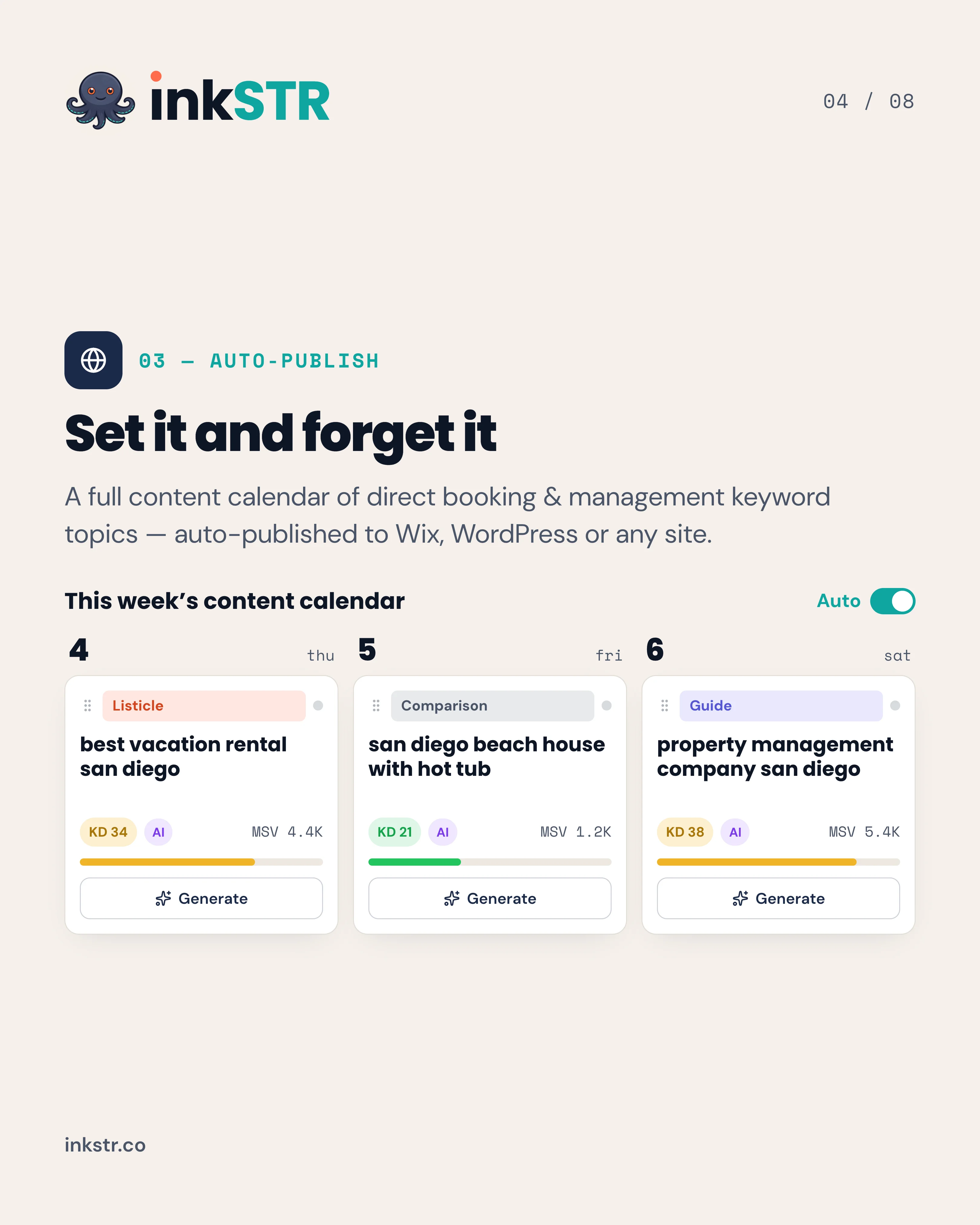
inkSTR was built specifically for short-term rental operators and property managers. The AI Content Writer generates full-length, SEO-optimized blog posts already fluent in guest search intent, whether you manage a beachfront condo in Gulf Shores or a mountain cabin outside Asheville. The Keyword Research tool finds the exact terms your target guests search, and the Content Calendar schedules everything on autopilot so you're not manually publishing week after week.
Best for: hosts and property managers who want a hands-off pipeline. Price: plans start at $99/month through inkSTR's pricing page. Caveat: it's not built for non-STR content, so if you also run an unrelated blog, you'll need a separate tool for that.
2. Custom Python-Based BlogWriter Scripts
A custom BlogWriter script is a self-built Python class that calls a large language model API and returns generated text, typically structured with a method like write(self, text) that passes a prompt string and returns a completion string. Developers building these often use libraries like LiteLLM to route requests to the completion endpoint and extract the response content.
Building this route gives you full control, but it also means you're maintaining infrastructure. You write the prompt engineering yourself, you handle API errors, and you have zero built-in understanding of STR search intent unless you code that logic manually. Every keyword decision, every content structure choice, every SEO consideration rests entirely on you.
For a developer-operator managing a single property, this can work as a weekend project. For a property management company managing 15-plus listings, it becomes a second job. There's no scheduling layer, no publishing automation, and no built-in quality scoring, all of which inkSTR handles natively.
Best for: technically fluent hosts who enjoy building tools. Cost: API usage fees plus your development time. Caveat: no STR-specific logic exists unless you write it yourself from scratch.
3. Local LLM Setups With Ollama and FastAPI
A local LLM blog writer setup runs an open-source model, commonly llama3, on your own machine through a tool like Ollama, then wraps it in a lightweight FastAPI web app with routes like /generate that accept topic and style parameters. This approach avoids per-call API fees since the model runs locally rather than through a paid cloud endpoint.
The appeal is cost: once you've downloaded the model (often several gigabytes), generation is essentially free. But local models require decent hardware, the output quality varies significantly compared to hosted commercial models, and you're still responsible for every piece of SEO logic, keyword targeting, and publishing.
This route also has zero built-in understanding of vacation rental content structure. You'll spend real time tuning prompts to get output that doesn't read like a generic AI wrote it. For an operator juggling guest messages and turnovers, that time investment rarely pencils out compared to a platform that already understands the niche.
Best for: hobbyist developers experimenting with local AI. Cost: free after setup, but requires capable hardware. Caveat: steep learning curve with no STR context built in.
4. Freelance Travel Writers
Hiring a freelance travel writer means paying a human, typically $300 to $700 per article, to research and write blog content for your vacation rental site. This was the standard approach for years before AI tools matured, and it still produces genuinely good writing when you find the right person.
But the math gets brutal at scale. If your site needs 12-20 articles to start seeing meaningful ranking movement, you're looking at $3,600 to $14,000 before you know if the strategy works. And that's a one-time batch, not an ongoing content engine. Most freelancers also don't specialize in STR SEO specifically, they write general travel content that reads well but doesn't target the exact booking-intent keywords your ideal guest is searching.
Writing one quality post manually or coordinating with a freelancer also takes 3-5 hours of back-and-forth between research, drafts, and revisions. That's real time you're not spending managing your property or guests.
Best for: operators with budget for a handful of cornerstone articles. Cost: $300-$700 per post. Caveat: expensive at the volume needed to actually rank, and rarely STR-specialized.
5. General-Purpose Hosted AI Writing Platforms
General-purpose AI writing platforms let you enter a topic, generate a draft, and edit the output, typically following a three-step flow: enter an idea, tweak the results, publish the post. These tools are built to serve every industry from software to fashion, which means the AI has no default understanding of RevPAR, ADR, or seasonal booking windows unless you spell it out in every prompt.
The consequence is that you end up doing the STR-specific thinking yourself, then hoping the AI executes it well. You'll still need to research your own keywords, structure your own content calendar, and manually publish every article since these platforms rarely integrate with property management systems like Hospitable or OwnerRez.
They're a reasonable stopgap if you already have SEO experience and just need drafting help. But for STR operators without a marketing background, the lack of niche fluency shows up in generic phrasing, missed seasonal opportunities, and content that doesn't speak to actual guest search behavior.
Best for: marketers with existing SEO skills who just need drafting speed. Cost: varies by platform and plan tier. Caveat: zero STR-specific keyword intelligence out of the box.

6. In-House Marketing Coordinator
An in-house marketing coordinator is a part-time or full-time hire responsible for writing and publishing blog content alongside other marketing duties like social media and email. Property management companies with 10-50-plus properties often try this route when freelance costs get too high.
The problem is bandwidth. A coordinator juggling content, social posts, and owner communications for a growing portfolio rarely has 3-5 hours per article to spare consistently. Content becomes the first task that slips when a guest issue or owner call takes priority, and consistency is exactly what search rankings reward over time.
This is the audience we hear from most at inkSTR. Property managers tell us their coordinator wants to write more but simply can't sustain a publishing schedule across 15-plus properties without a system doing the heavy lifting. That's a direct fit for automated scheduling paired with AI drafting.
Best for: companies with existing marketing staff who need a force multiplier. Cost: salary plus time trade-offs. Caveat: content is the first task to slip under operational pressure.
7. Django or WordPress Custom Blog CMS Integration
A custom CMS integration means connecting a self-built blog writer, such as a Django-based application using Django Rest Framework for CRUD operations, directly into your existing website backend. This lets developers build custom REST endpoints for blog data and content management.
This approach appeals to STR operators who already run a custom-built booking site and want content generation wired directly into their existing stack. But integrating a custom BlogWriter class into a live WordPress or Django CMS requires ongoing maintenance: API key rotation, error handling when the model returns malformed output, and manual quality checks before anything publishes live.
There's also no built-in SEO scoring or keyword gap analysis in a raw CMS integration. You're building the entire content strategy layer yourself, on top of the technical integration work. inkSTR's Auto-Publishing feature solves the same underlying problem, one-click publishing to Wix or WordPress, without requiring you to write or maintain any custom code.
Best for: developers with an existing custom site who want tight technical control. Cost: developer time plus API fees. Caveat: significant ongoing maintenance burden with no SEO intelligence layer.
8. Ethical Disclosure and AI Content Review Workflows
An AI content review workflow is the internal process an STR operator uses to check AI-generated blog drafts for accuracy, brand voice, and factual claims before publishing. This step matters more than most operators realize, and it's one of the biggest gaps we see in how people talk about STR blog writers.
Publishing AI-generated content without any review risks factual errors about local attractions, outdated regulation references, or claims that don't match your actual property. Best practice as of 2026 is straightforward: always fact-check location-specific details, never publish pricing or regulatory claims without verifying them against current sources, and maintain a consistent editorial voice even when a tool generates the first draft.
Disclosure isn't usually a legal requirement for blog content the way it is for advertising, but transparency builds trust with readers and with search engines evaluating your site's overall quality signals. That's why inkSTR includes quality scoring and pre-publish validation before articles go live, so you're reviewing a polished draft, not raw, unchecked output.
Best for: every operator, regardless of which writing method you use. Cost: your time to review, typically 10-15 minutes per article with a quality-scored draft. Caveat: skipping this step is the single most common mistake we see.
9. Hybrid Approach: AI Draft Plus Manual Brand Voice Pass
A hybrid workflow uses an AI tool to generate the first draft, then applies a manual editing pass to inject specific brand voice, property details, and local knowledge before publishing. This method balances speed against the risk of content sounding generic or interchangeable with any other rental listing.
Operators managing boutique properties, glamping sites, or cabin clusters often need this extra step because their guests expect editorial-quality writing that matches a curated brand experience, not commodity vacation rental copy. A fully automated draft without a voice pass can feel flat for this audience.
The trade-off is time: a manual voice pass adds back some of the hours you saved by using AI in the first place, though far less than writing from scratch. We built our approach to brand voice preservation specifically around this tension, letting operators keep their distinct tone while still automating the bulk of the drafting and research work.
Best for: boutique and design-forward properties with a distinct brand identity. Cost: AI tool cost plus your editing time. Caveat: requires more hands-on involvement than fully automated publishing.
Ready to automate your content marketing?
inkSTR handles keyword research, content strategy, article writing, and publishing, all on autopilot.
10. No Blog Strategy at All (The Default Most Operators Fall Into)
No blog strategy means relying entirely on your Airbnb or VRBO listing for visibility, with no owned content driving traffic to a direct booking website. This is where most solo hosts and even some small property management companies default to, usually not by choice but by exhaustion.
The cost of this default isn't obvious month to month, but it compounds. Every booking that comes through Airbnb instead of your own site costs you 17-19% in combined host and guest fees. If your average booking is worth $1,000 to $4,000, that's $170 to $760 lost per reservation, indefinitely, with no path to change that math without owned content driving direct traffic.
Meanwhile, competitors who do publish consistently build a compounding asset: a ranking blog article can drive organic search traffic for 2-5 years. Every month without a content strategy is a month your competitor's content gets a head start you can't easily claw back. This is exactly the gap inkSTR was built to close, turning "no strategy" into a scheduled, automated pipeline without requiring you to become a content marketer.
Best for: nobody, honestly. This is the option to avoid. Cost: ongoing OTA fees with no offset. Caveat: the longer this continues, the harder it becomes to catch up in search rankings.
How Do These STR Blog Writer Options Compare on Cost and Time?
The clearest way to evaluate an STR blog writer option is by comparing upfront cost against ongoing time investment, since both determine whether a strategy is sustainable past the first few articles. Here's how the ten approaches stack up.
| Approach | Typical Cost | Time Per Article | STR-Specific SEO | Best For |
|---|---|---|---|---|
| inkSTR | $99/month | Minutes to review | Built-in | Hosts and property managers wanting hands-off publishing |
| Custom Python BlogWriter script | API fees + dev time | Hours of setup, then variable | None (manual) | Developer-hosts who enjoy building tools |
| Local LLM with Ollama/FastAPI | Free after setup | Significant setup + tuning | None (manual) | Hobbyists with capable hardware |
| Freelance travel writer | $300-$700/post | 3-5 hours coordination | Rarely specialized | Budget for a few cornerstone posts |
| General AI writing platform | Varies by plan | 1-3 hours with editing | None (manual prompting) | Marketers with existing SEO skills |
| In-house coordinator | Salary/time cost | 3-5 hours, often deprioritized | Depends on hire | Companies with existing marketing staff |
| No strategy | 17-19% OTA fees ongoing | Zero (and zero traffic) | None | Nobody |
Notice the pattern: options with no built-in STR-specific SEO logic push all the strategic work back onto you. That's fine if you have SEO experience and time to spare. Most operators we work with have neither, which is precisely why a purpose-built system changes the equation.
What Should You Actually Blog About as a Vacation Rental Host?
Vacation rental hosts should blog about location-specific guides, seasonal booking content, amenity deep-dives, and comparison content that targets guests actively deciding where to stay, not generic travel tips. The goal is matching content to booking-intent search queries, not just filling a content calendar.
Strong topics include local area guides that highlight nearby attractions relevant to your specific property type, seasonal content tied to demand drivers (fall foliage near mountain cabins, summer lake activities near lakefront rentals), and amenity-focused posts that answer specific guest questions like "pet-friendly cabins near [destination]." Our guide on vacation rental blog topics that actually drive bookings breaks this down further by property type.
Avoid generic travel blogging that could apply to any destination. A post titled "Top 10 Things to Do in [City]" competes against established tourism sites and travel bloggers with far more domain authority than a single-property website will ever have. Narrower, booking-intent content performs better because it matches what someone actively planning a stay actually searches.
Can AI Actually Write Content That Ranks for Vacation Rental Keywords?
Yes, AI-generated content can rank for vacation rental keywords when it's built on solid keyword research, structured for search intent, and reviewed for accuracy before publishing. Ranking has never depended on whether a human or an AI typed the first draft, it depends on whether the content answers the searcher's question better than what's already ranking.
The failure mode isn't AI itself, it's AI without STR-specific context. Generic AI output that doesn't understand destination search intent, seasonal booking windows, or guest decision-making tends to read as thin and interchangeable, exactly the kind of content Google's helpful content systems are designed to deprioritize. That's the gap most competitors in this space miss entirely.
What actually works is AI content paired with niche-specific keyword targeting and quality review before publishing. inkSTR was built around that exact requirement: every article passes through quality scoring before it publishes, and the underlying AI is trained specifically on STR terminology and traveler search patterns, not generic marketing copy. For more on how ranking actually works for this niche, see our piece on how to rank your vacation rental website on Google.
Practical Guidance: How to Choose the Right STR Blog Writer Approach
Choosing the right approach depends on three factors: your available time, your technical skill level, and how many properties or content pipelines you're managing. Here's how to think through the decision.
- Assess your time budget first. If you have zero spare hours per week for content, cross off any option requiring manual drafting or freelance coordination.
- Be honest about technical skill. Custom Python scripts and local LLM setups sound appealing but require real development capability to maintain long-term.
- Calculate the true cost of freelance at scale. Multiply $300-$700 by the 12-20 articles you'll likely need, then compare that one-time cost to an ongoing monthly platform fee.
- Check whether the tool understands your niche. Ask any AI writing tool to draft an article about "cabin rental amenities near a national park" and see if it produces STR-specific language or generic travel filler.
- Confirm publishing integration exists. A tool that generates drafts but doesn't schedule or publish them still leaves you doing manual work every single week.
- Review before you publish, always. Regardless of method, never publish AI-generated content without checking location details, regulatory claims, and factual accuracy.
Common mistakes we see: publishing inconsistently (a burst of five articles then nothing for three months kills momentum), targeting keywords with no realistic ranking chance against established travel sites, and skipping the quality review step entirely. Consistency and STR-specific targeting matter more than raw volume.
What Is the Real ROI of Using an STR Blog Writer?
The ROI of an STR blog writer comes from converting organic search traffic into direct bookings that avoid OTA commission fees, compounding over the multi-year lifespan of a ranking article. A single direct booking is typically worth $1,000 to $4,000 in revenue, and unlike a paid ad, a ranking blog post keeps working long after you've stopped paying for the click that found it.
Run the math on a $99/month platform cost against even one additional direct booking per year at the low end of that range, and the tool pays for itself more than eight times over. Compare that to freelance costs of $300-$700 per article, where you're paying per piece with no guarantee any single article ranks, versus a flat monthly cost covering unlimited scheduled publishing.
The compounding piece matters most. A blog article published today can keep driving organic search traffic for 2-5 years, meaning the ROI calculation improves every month the content stays live and indexed. This is the exact argument we make in our deeper breakdown of revenue maximization strategies for hosts, and it's why we built inkSTR around volume and consistency rather than one-off article sales.
Frequently Asked Questions
How long does it take for vacation rental blog content to rank on Google?
Most vacation rental websites start seeing meaningful ranking movement after 12 to 20 published articles targeting a mix of destination keywords and long-tail booking intent queries, typically over four to six months of consistent publishing. inkSTR's content calendar automates that publishing schedule so you reach that volume without manually tracking every deadline.
Do I need a separate blog for each property I manage, or can I publish everything on one site?
It depends on your portfolio structure. Single-property hosts should keep everything on one site, while property management companies handling multiple distinct brands often benefit from separate content pipelines per property to avoid mixing keyword strategies. inkSTR's multi-project architecture supports either approach with independent pipelines per property or brand.
What's the difference between SEO content for a direct booking website and optimizing an Airbnb listing?
Airbnb listing optimization works within Airbnb's internal search algorithm and only reaches guests already browsing that platform. Blog content targets Google and AI search engines directly, capturing guests before they ever land on an OTA, which is the entire point of building a direct booking strategy.
How many blog posts do I need before I see organic traffic to my vacation rental site?
Most sites need a baseline of 12-20 well-targeted articles before search engines have enough signal to rank the site meaningfully for competitive local terms. Fewer articles can still drive traffic for very specific long-tail keywords with less competition, but broader visibility takes sustained volume.
Can AI-generated blog content actually rank on Google for competitive vacation rental keywords?
Yes, provided the content is built on real keyword research, structured around actual search intent, and reviewed for accuracy before publishing. AI-generated content that lacks STR-specific context tends to read as generic and underperforms, which is why niche-specific tools outperform general-purpose AI writers for this use case.
What types of blog posts drive the most direct booking conversions for short-term rental operators?
Local area guides tied to a property's specific nearby attractions, seasonal content matched to demand drivers, and amenity-specific comparison posts tend to convert best because they match booking-intent search queries rather than general travel curiosity. Generic "things to do" content competes against tourism boards and rarely converts as well.
How do I find out which keywords my vacation rental competitors are ranking for?
Keyword gap analysis tools compare your site's ranking keywords against competitor domains to surface terms they rank for that you don't yet target. inkSTR includes built-in keyword research and competitor analysis specifically calibrated for STR search terms, rather than generic business keywords.
Is it worth publishing local area guides if my property is in a heavily trafficked tourist market?
Yes, but the angle matters. A generic "top 10 things to do" guide won't outrank established tourism sites, but a guide framed specifically around what's walkable or drivable from your exact property, paired with your amenities, targets a narrower and more convertible search intent that big tourism sites don't address directly.
The Bottom Line on Choosing an STR Blog Writer
The best STR blog writer for most operators in 2026 is one built specifically for vacation rental search intent, not a repurposed general-marketing tool or a DIY script that requires ongoing maintenance. Custom Python builds and freelance writers both have a place, but neither scales affordably once you're managing the 12-20 articles most sites need to start ranking.
What we've seen consistently across hosts and property management companies is that consistency beats cleverness. A tool that reliably publishes STR-specific, quality-reviewed content every week outperforms an occasional burst of expensive freelance work or an ambitious custom build that stalls after month two. The math is simple: at $99/month, inkSTR pays for itself with a fraction of one direct booking, while the content keeps compounding for years after it's published.
As search behavior keeps shifting toward AI-powered answers in 2026, the operators who build a real content library now, rather than waiting, will have the ranking head start when guest search habits fully catch up. That's not a prediction, it's already happening in the data we track across our own users.

If you're ready to stop piecing together freelancers, custom scripts, and generic AI tools, get started with inkSTR and see your first keyword-mapped content calendar built in minutes, not weeks.
Content powered by inkSTR.co
Enjoyed this article? Share it:
Get more of inkSTR in Google Search
Add inkstr.co as a preferred source and our articles show up more in Top Stories, AI Overviews, and AI Mode — with a “Preferred” badge.
Get more guides like this
New SEO and AI-search guides, straight to your inbox. No spam, unsubscribe anytime.