Automatic Blog for Vacation Rentals: How It Works in 2026
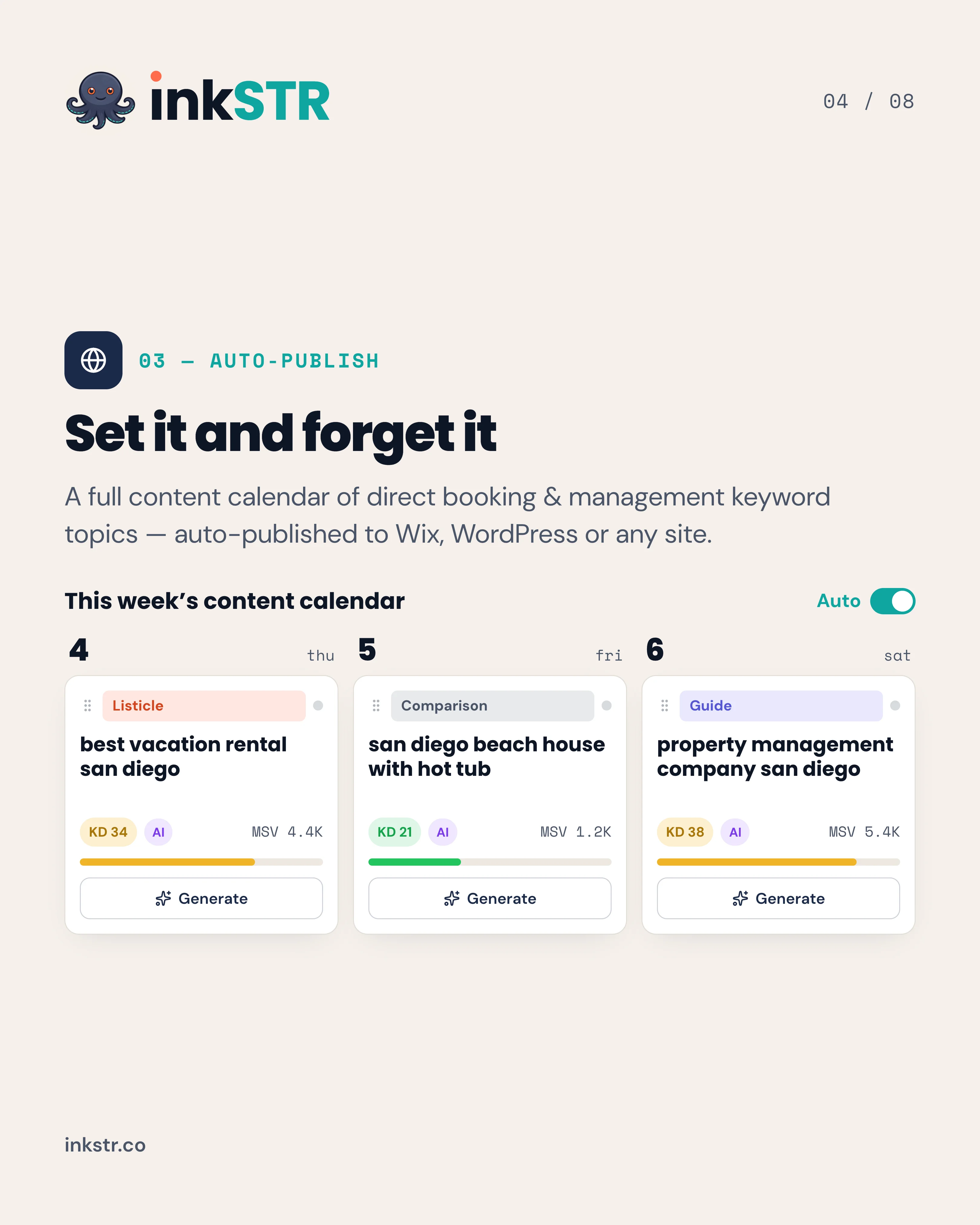
An automatic blog is a content system that uses AI to research keywords, draft SEO-optimized articles, and publish them to your website on a set schedule, without you writing, formatting, or uploading a single post yourself. For short-term rental operators, it means your direct booking site keeps gaining Google visibility while you're handling guest turnovers and check-ins.
- An automatic blog combines keyword research, AI drafting, and scheduled publishing into one workflow instead of three separate manual tasks.
- Writing one quality blog post manually takes 3 to 5 hours of research and writing, and freelance travel writers typically charge $300 to $700 per post.
- A single direct booking is worth $1,000 to $4,000 in revenue, while Airbnb host and guest fees combined eat up 17 to 19 percent of every OTA booking.
- A ranking blog article can drive organic search traffic for 2 to 5 years after publication, making it one of the few STR marketing assets that compounds instead of depreciating.
- As of 2026, over 55 percent of vacation rental properties are managed by professional companies, according to Coherent Market Insights, meaning solo hosts increasingly compete against operators with real marketing budgets.
- inkSTR generates, schedules, and publishes STR-specific blog articles automatically, so you get a working content engine without hiring a writer or learning SEO from scratch.
If you manage a vacation rental in 2026, you've probably heard that blogging drives direct bookings. What nobody tells you is how much time that actually takes, or how fast a freelancer's invoice adds up once you're publishing consistently. An automatic blog solves the production problem, not by replacing good content strategy, but by removing the manual bottleneck that stops most operators from ever getting past post number three.
At inkSTR, we've watched hundreds of STR operators start a blog with good intentions and abandon it within two months. The pattern is almost always the same: no time, no writer, no system. This article breaks down exactly what an automatic blog does, how the workflow functions from keyword to published post, what it costs compared to hiring out the work, and where the real risks are if you automate the wrong way.
What Is an Automatic Blog?
An automatic blog is a website content system where AI handles keyword research, article drafting, SEO formatting, and publishing on a recurring schedule, with minimal manual input from the operator. Instead of you opening a blank document every week, the system identifies what your target guests are searching for and produces a finished, optimized article ready to go live.
For vacation rental operators specifically, this means content built around real traveler search intent: things like "pet-friendly cabin near Gatlinburg" or "beach house with private pool Destin." Generic auto-blogging tools built for any industry don't understand this terminology. An automatic blog built for short-term rentals does, because it's trained on hospitality search patterns rather than generic business copy.
The distinction matters more in 2026 than it did a few years ago. Search behavior has shifted toward AI-driven answers in Google's AI Mode, ChatGPT, and Perplexity, and generic content rarely gets cited in those results. Specificity, not volume, is what earns visibility now. That's exactly the gap AI automation tools built for a specific niche are designed to close, and it's the entire premise behind how inkSTR structures every article it generates for STR clients.

How Does an Automatic Blog Actually Work?
An automatic blog works through four connected stages: keyword research, AI drafting, SEO optimization, and scheduled publishing. Each stage used to require a separate tool or a separate person. Modern platforms chain them together so the output is one finished article, not four disconnected steps you have to stitch together yourself.
First, the system identifies which keywords your target guests are searching, based on your market and property type. Specifically, this means terms like "lake house rental with dock Lake Tahoe" rather than generic phrases like "vacation rentals." That's the exact function of inkSTR's Keyword Research tool: it surfaces the search terms your actual future guests type into Google, not the vanity keywords everyone else already targets.
Second, the AI drafts a full article, typically 2,500 to 3,500 words, structured around that keyword and formatted for both search engines and AI citation systems. This is where inkSTR's AI Content Writer does the heavy lifting, producing STR-specific copy instead of generic travel filler.
Third, the article is scheduled into a content calendar. Fourth, it publishes automatically to your site. As a result, you get a consistent publishing cadence without manually tracking a single deadline.
Why Isn't My Vacation Rental Getting Direct Bookings From My Website?
Your vacation rental isn't getting direct bookings because your website has no content that ranks for the searches your future guests actually run. A polished homepage and a nice property description aren't enough. Google needs to see ongoing, keyword-targeted content before it will rank your site above Airbnb's own listing pages.
Here's what that looks like without a system in place. You build a direct booking site, write your best property description, and wait. Nothing happens, because you've published zero blog content and Google has no reason to consider you an authority on your destination market. Meanwhile, every booking still routes through Airbnb, where host and guest fees combined take 17 to 19 percent off the top of revenue you could have kept.
The manual fix is publishing consistently, but that's exactly where operators stall. Writing one solid post takes 3 to 5 hours, and hiring it out runs $300 to $700 per article. Publish twice a month and you're looking at a real ongoing cost, in either your time or your budget, before you've even started ranking.
This is exactly the problem inkSTR was designed to solve. The platform's content that converts visitors into guests is built around your specific market and property type, so the articles going live are targeting the search terms your future direct booking guests are actually typing, not generic travel content that never ranks.
How Do I Rank Higher on Google Than Big Property Management Companies?
You rank higher than larger competitors by publishing more specific, more consistent content than they do, not by outspending them. Big property management companies often have more properties but weaker content strategy, because their marketing coordinator is spread across 15-plus listings with no dedicated writer.
Notably, domain authority isn't fixed. It builds through consistent publishing over months, and a boutique operator publishing twice weekly can out-rank a larger company publishing sporadically. Specifically, Google rewards topical depth: a cluster of articles around "Smoky Mountains cabin rentals" beats one generic "About Us" page every time.
Without a system, competing here means either you personally become a content strategist on top of running your property, or you pay an agency retainer most solo hosts can't justify. Neither is sustainable long-term.
We built inkSTR's Content Calendar specifically because consistency, not raw budget, is what beats larger competitors in search. Automating your publishing cadence means a two-property host can maintain the same output frequency as a 50-property management company, without hiring a full marketing team. For a deeper look at the mechanics behind this, see our guide on how to rank your vacation rental website on Google.
How Do I Get Direct Bookings Without Paying Platform Fees?
You get direct bookings without OTA fees by building organic search traffic to your own booking site, so guests find and book you directly instead of routing through Airbnb or VRBO. This requires ranking for destination and property-type keywords that match how guests actually search, not just having a website that exists.
The math here is worth sitting with. A single direct booking is typically worth $1,000 to $4,000 in revenue. Airbnb and VRBO fees take 17 to 19 percent of every booking that goes through their platforms instead. Over a season, that gap adds up to real money left on the table, and it compounds every year you don't have a direct traffic source.
The painful alternative is what most operators actually do: nothing, because building that traffic source manually feels overwhelming. They keep paying platform fees indefinitely because the alternative, consistent content production, never gets prioritized against guest communication and turnover logistics.
In our experience working with operators across beach towns, mountain retreats, and urban markets, the ones who actually reduce OTA dependence are publishing content month after month, without exception. inkSTR's Auto-Publishing feature pushes finished articles directly to Wix or WordPress, removing the last manual step between a written article and a live, indexable page. For more on the strategy layer behind this, our piece on increasing direct bookings covers the conversion side once traffic starts arriving.
What Should I Blog About for My Vacation Rental Website?
Your vacation rental blog should cover local area guides, seasonal travel content, property-specific FAQs, and comparison content that answers questions guests ask before booking. The goal is matching content to what a traveler searches at each stage, from "things to do near [destination]" to "is [your property] pet friendly."
Local area guides consistently perform best because they target high-intent, location-based searches. For example, an article on the best hiking trails near your cabin captures travelers already planning a trip to that region. Additionally, seasonal content, like fall foliage guides or ski season packing lists, captures recurring annual search volume.
Without a strategy, most operators default to generic "why book with us" content that nobody searches for. That's a wasted post. The painful part is realizing this only after paying $300 to $700 for an article that never gets a single visitor.
inkSTR's content strategy wizard maps pillar and cluster topics specific to your market before a single article gets written, so every post targets a real search query instead of guessing. For a broader list of formats that convert, check our guide on vacation rental blog topics that actually drive bookings, and our companion piece on local area guides that sell.
How Long Does It Take to Write a Blog Post for a Vacation Rental?
Writing one quality vacation rental blog post manually takes 3 to 5 hours of research and writing, according to standard content production benchmarks. That estimate covers keyword research, drafting, editing, formatting for SEO, and uploading, not counting time spent sourcing images or building internal links.
For an operator managing a single property solo, that's most of a workday for one article. Multiply that across a portfolio of five or more properties, each needing its own market-specific content, and the math stops working entirely. This is precisely why so many STR blogs die after three or four posts: the time cost never gets easier, it just gets deferred.
Hiring it out shifts the time cost to a dollar cost. Freelance travel writers typically charge $300 to $700 per quality post, and that's before you factor in editing rounds or briefing time to explain your property and market.
inkSTR compresses that multi-hour workflow into minutes by automating the research, drafting, and formatting stages simultaneously. What used to consume an afternoon now happens while you're handling a guest check-in. We cover the mechanics of this shift in our guide to article automation without losing your brand voice.
Is It Worth Paying a Content Writer for My Short-Term Rental?
Paying a freelance content writer is worth it if you need occasional, highly specific pieces, like a branded property story, but it's rarely sustainable for the consistent monthly publishing volume that actually moves rankings. At $300 to $700 per post, publishing twice monthly runs into thousands of dollars annually, with no guarantee any individual post ranks.
The trade-off most operators miss: SEO rewards consistency over polish. A slightly less refined article published every week outperforms a beautifully written article published twice a year, because Google's algorithm favors sites with ongoing, fresh content signals.
This creates a real dilemma. Quality writers are expensive at scale, but inconsistent publishing wastes whatever budget you do spend. Most solo hosts and small property managers end up paying for a handful of posts, seeing no traffic change, and quitting content marketing altogether.
inkSTR exists precisely in this gap, at $99/month for the full platform, a fraction of what even two or three freelance posts cost, while producing the publishing volume freelancers can't sustain at that price point. If you're weighing tools against hiring out, our guide on must-have tools for STR managers scaling up breaks down where content automation fits into your broader tech stack.
Can AI Write Content for My Vacation Rental Business?
AI can write vacation rental content that ranks on Google, provided the AI is trained on hospitality-specific terminology, structured for SEO, and quality-checked before publishing. Generic AI tools built for any industry frequently produce thin, repetitive content that Google's helpful content system flags. Niche-specific AI trained on STR search patterns performs differently.
The gap most competitors in this space don't address well is what happens between "AI wrote it" and "it's actually good enough to publish." Fully automated content with zero quality control risks duplicate phrasing, generic claims, and thin coverage, exactly the signals Google's ranking systems are built to catch. Notably, industry research shows AI plugins can generate and schedule posts on autopilot, but autopilot without review is a real risk, not a feature to brag about.
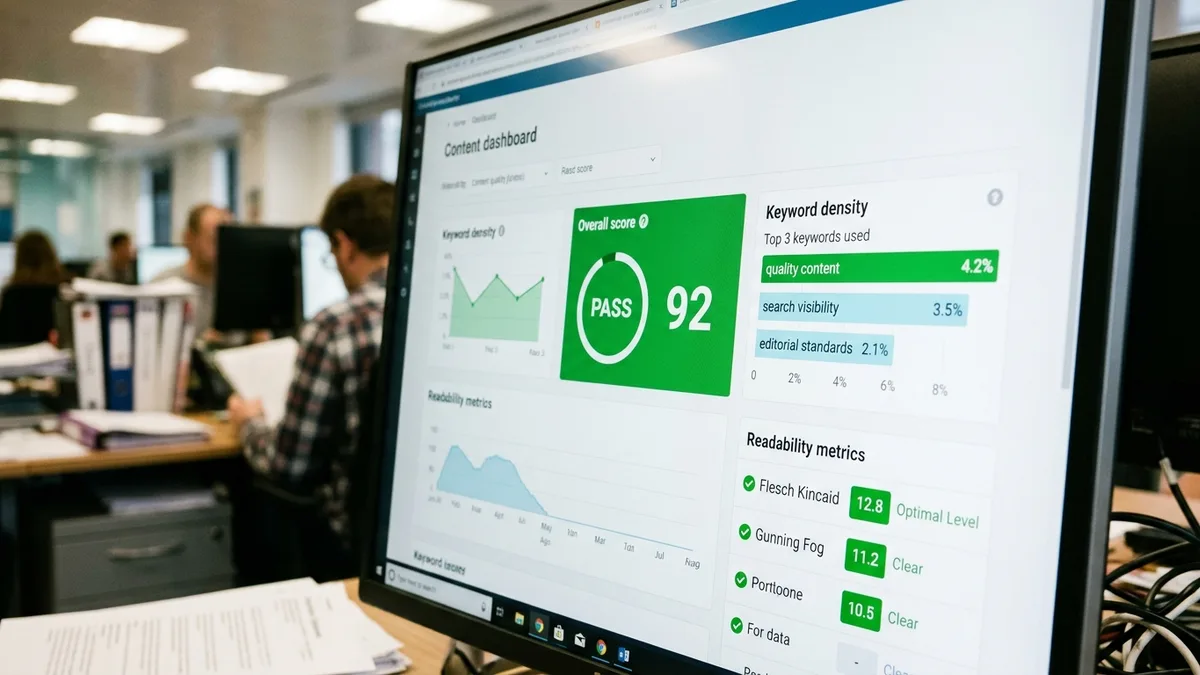
The honest answer is that AI content quality depends entirely on the system behind it. A tool that scores content before publishing, checks for keyword relevance, and structures articles for both traditional SEO and AI citation will consistently outperform one that just generates text and pushes it live.
inkSTR runs every article through quality scoring and pre-publish validation before it goes live, which is the safeguard most competing automatic blog tools skip entirely. As of 2026, this kind of built-in governance is becoming the differentiator between tools that get penalized and tools that actually build rankings.
Ready to automate your content marketing?
inkSTR handles keyword research, content strategy, article writing, and publishing, all on autopilot.
What Keywords Should I Target for My Vacation Rental Website?
You should target keywords that combine your location with specific property features and traveler intent, such as "beachfront condo Gulf Shores pet friendly" rather than broad terms like "vacation rentals." Broad keywords are dominated by Airbnb, VRBO, and large aggregator sites that no individual operator can outrank.
Instead, long-tail, specific searches convert better and face less competition. For example, "cabin with hot tub near Asheville sleeps 8" has far lower competition than "cabin rentals," and it matches almost exactly what a traveler booking that specific trip is searching.
The manual research process for finding these terms takes real time: checking search volume, evaluating competition, and mapping keywords to content topics. Most operators either skip this step entirely and guess, or spend hours in spreadsheet-based keyword tools that weren't built for STR search patterns.
inkSTR's keyword research function identifies these location-and-feature combinations automatically, mapped specifically to vacation rental search behavior. For technical SEO validation alongside your content strategy, tools like Screaming Frog can help audit your site structure, while platforms like SEMRush offer broader competitive keyword data if you want to cross-reference findings.
Why Do My Competitors Rank First for Vacation Rental Keywords in My Market?
Your competitors rank first because they've published more consistent, more specific content over a longer period, building the domain authority Google rewards over time. Ranking position isn't decided by property quality. It's decided by which site Google trusts most to answer a given search query, and trust accumulates through sustained publishing.
In contrast, a newer site with excellent content published only twice will rarely outrank an established site with mediocre content published fifty times. This frustrates operators who assume a beautiful website should automatically win. It doesn't. Google's ranking on Google factors depend heavily on freshness and volume signals, something covered in more depth in our piece on ranking on Google for STR operators.
The painful reality is that closing this gap manually, matching a competitor's years of publishing history, would take years of consistent output at 3 to 5 hours per article. Few operators have that runway before they need bookings now.
inkSTR's content calendar automates the publishing cadence needed to compete on volume and consistency, the two factors that actually move rankings, without requiring years of manual grinding to catch up.
What Is the ROI of Content Marketing for Short-Term Rentals?
The ROI of content marketing for short-term rentals comes from the compounding value of ranking articles, which can drive organic traffic for 2 to 5 years after publication, compared to the one-time cost of writing them. Unlike paid ads, which stop generating traffic the moment you stop paying, a well-ranked blog post keeps working long after it's published.
Here's the comparison worth running for your own numbers. A direct booking is worth $1,000 to $4,000. A freelance-written post costs $300 to $700 upfront. If one ranking article drives even a single direct booking over its multi-year lifespan, it has already paid for itself several times over, before accounting for every booking after that.
| Approach | Cost | Time Investment | Traffic Lifespan |
|---|---|---|---|
| Manual writing (self) | Your time only | 3 to 5 hours per post | 2 to 5 years if it ranks |
| Freelance writer | $300 to $700 per post | Briefing and editing time | 2 to 5 years if it ranks |
| inkSTR automatic blog | $99/month total | Minutes to review and schedule | 2 to 5 years if it ranks |
| OTA-only (no blog) | 17 to 19% of every booking | None, but ongoing fee drain | No compounding asset built |
The table above is the calculation we walk operators through constantly. inkSTR's $99/month plan produces a publishing volume that would cost thousands per month if hired out post by post, while building the same compounding traffic asset. Details on plans are on the Pricing page.
How Do I Build an Email List for My Vacation Rental?
You build an email list for your vacation rental by capturing visitor emails through your blog content, typically via a downloadable guide, seasonal packing list, or booking discount offer embedded in high-traffic articles. Blog traffic without an email capture mechanism is a missed opportunity, since most first-time visitors won't book on their first visit.
Specifically, area guide articles convert well as email capture points because readers researching a trip are actively planning, not just browsing casually. A "free printable packing list for your Smoky Mountains trip" offer embedded in a relevant blog post captures intent-driven visitors at exactly the right moment.
Without consistent blog traffic, though, there's no volume to build a list from in the first place. This is the compounding problem: no content means no traffic, no traffic means no list, no list means no repeat direct bookings from past guests.
Once inkSTR's automatic blog is generating consistent organic traffic to your site, that traffic becomes the raw material for list-building efforts layered on top. The content engine is the foundation; email capture tools build on it from there.
Data and Evidence: What the Vacation Rental Market Looks Like in 2026
The vacation rental market context in 2026 explains why content marketing matters more now than it did five years ago. According to Mordor Intelligence, the global vacation rental market is projected at USD 109.4 billion in 2026, growing at a 4.57% CAGR through 2031. StayFi projects U.S. short-term rental revenue reaching USD 76.46 billion in 2026 alone.
That growth means more competition, not less. Coherent Market Insights reports that over 55 percent of vacation rental properties were managed by professional companies as of 2026, up from 42 percent in 2022, a clear signal that the market is professionalizing fast. As a result, solo hosts competing on search visibility face better-resourced competitors than they did just a few years back.
Additionally, nearly 40 percent of property managers now use AI-powered tools for pricing, messaging, or maintenance, per Coherent Market Insights, meaning AI adoption in this industry is already mainstream, not experimental. Content automation is simply the next logical extension of that trend.
North America is projected to hold 36.2 percent of global vacation rental market revenue share in 2026, per Coherent Market Insights, meaning U.S. and Canadian operators are competing in the single largest regional market globally. Standing out in that volume requires more than a nice listing photo; it requires a genuine search presence.
Deep Dive: Avoiding the Risks of Automating Your Blog
The biggest risk of an automatic blog is publishing thin, generic, or duplicate content at high volume, which Google's helpful content system is specifically built to detect and penalize. Volume without quality control doesn't build authority. It erodes it, sometimes taking an entire domain's rankings down with it.
Specifically, three failure patterns show up repeatedly with poorly governed automation: articles with no unique local detail (interchangeable with any market), articles that repeat the same claims across a dozen posts, and articles published faster than the site's existing authority can support. Notably, publishing 30 posts a month on a brand-new domain with no backlink profile is a red flag to search engines, not an achievement.
The content gap most competing tools don't address well is governance: how do you audit an automatic blog over time to catch quality drift before it damages rankings? A practical checklist looks like this:
- Review published articles monthly for factual accuracy specific to your property and market.
- Check for keyword cannibalization, multiple posts unintentionally targeting the same search term.
- Confirm internal links point to current, live pages, not outdated property listings.
- Verify each article includes at least one detail unique to your specific property or region.
- Track Google Search Console for sudden ranking drops after any publishing surge.
inkSTR's pre-publish quality scoring exists specifically to catch these issues before an article goes live, rather than after it's already indexed and potentially damaging your domain. This governance layer is what separates a sustainable automatic blog from a volume-first tool that trades short-term output for long-term ranking risk. For more on avoiding thin content while scaling, see our guide on why generic content kills conversions.
Practical Guidance: How to Choose an Automatic Blog Platform
Choosing an automatic blog platform for your vacation rental means prioritizing niche specificity, quality control, and publishing integration over raw article volume. The wrong choice produces content fast that never ranks. The right choice produces fewer, more targeted articles that actually convert.
Here's what to prioritize, in order:
- Niche relevance. Does the tool understand STR terminology and traveler search intent, or does it produce generic business copy?
- Quality control. Does the platform score or review content before publishing, or does it push everything live automatically with no check?
- Publishing integration. Can it publish directly to your existing site (Wix, WordPress) without manual export and upload steps?
- Multi-property support. If you manage more than one property, can the tool keep separate content pipelines and brand voices per property?
- Tracking and iteration. Does it connect to Google Search Console or similar to show what's actually working?
Common mistakes to avoid: choosing a tool based purely on posts-per-month volume, ignoring whether the content is actually keyword-targeted, and publishing without ever checking Google Search Console for what's ranking. A tool that produces seven posts a week with no quality check is not a win, it's a liability waiting to surface.
inkSTR was built around exactly this priority order: niche-specific AI, built-in quality scoring, direct publishing integration, and multi-project support for portfolio operators managing more than one property or brand.

Frequently Asked Questions
How long does it take for vacation rental blog content to rank on Google?
Most vacation rental websites see meaningful ranking movement after 12 to 20 published articles targeting a mix of destination and long-tail booking keywords, typically over several months of consistent publishing. inkSTR's content calendar automates that publishing cadence so you reach that volume without manually tracking every deadline.
Do I need a separate blog for each property I manage?
If your properties serve different markets or brand identities, separate content pipelines usually perform better than one combined blog, since search intent differs by location. inkSTR's multi-project architecture supports independent pipelines per property, keeping keywords and brand voice from blending across listings.
What is the difference between SEO content for a booking website and optimizing an Airbnb listing?
Airbnb listing optimization works within Airbnb's internal search algorithm and only affects visibility on that platform. Blog content, by contrast, targets Google's broader search index and can attract guests who never open Airbnb at all, driving them straight to your direct booking site instead.
How many blog posts do I need before I see organic traffic?
Most operators need a baseline of 12 to 20 well-targeted articles before organic traffic becomes meaningful, though timing depends on domain age and competition in your specific market. Consistency matters more than any single post, which is why an automatic blog focused on steady output tends to outperform sporadic manual publishing.
Can AI-generated blog content actually rank on Google for competitive vacation rental keywords?
AI-generated content can rank when it's specific, well-structured, and quality-checked before publishing, but generic AI content without those safeguards frequently gets flagged as thin by Google's helpful content system. inkSTR runs every article through quality scoring specifically to avoid that outcome before anything goes live.
What types of blog posts drive the most direct booking conversions?
Local area guides, seasonal travel content, and property-specific FAQ articles consistently convert better than generic "about us" content, because they match high-intent searches from travelers already planning a trip. These formats also tend to earn organic traffic for years after publishing.
How do I find out which keywords my vacation rental competitors are ranking for?
You can research competitor rankings using SEO tools like SEMRush or Ubersuggest, or through a platform's built-in keyword research feature that maps gaps specific to your market. inkSTR's Keyword Research tool identifies these opportunities automatically, mapped to STR search behavior rather than generic business terms.
Is it worth publishing local area guides if my property is in a heavily trafficked tourist market?
Yes, because even in high-traffic tourist markets, most competing content is generic and repetitive, leaving room for specific, well-structured local guides to rank. Being in a popular destination increases search volume, which makes the opportunity larger, not smaller.
Conclusion: Is an Automatic Blog Worth It in 2026?
An automatic blog is worth it for any short-term rental operator who wants consistent Google visibility without spending hours writing every week or thousands of dollars hiring it out. The core math is simple: writing manually costs 3 to 5 hours per post, hiring it out costs $300 to $700 per post, and every direct booking you win instead of losing to OTA fees is worth $1,000 to $4,000.
The operators who succeed at reducing OTA dependence aren't the ones with the prettiest website. They're the ones publishing consistently, month after month, with content specific enough to actually rank. Building that system yourself is possible. Building it without a dedicated tool is what stops most operators before they see results.
If you want that system running without doing every piece manually, Get started with inkSTR, which handles keyword research, drafting, quality scoring, and publishing as one automated pipeline built specifically for vacation rental operators. See the full process on our How inkSTR Works page.

If you're ready to stop guessing at your publishing schedule, inkSTR's content calendar lays out every scheduled article for your market in one view, so you always know what's going live next. Check plans and get started here.
Content powered by inkSTR.co
Enjoyed this article? Share it:
Get more of inkSTR in Google Search
Add inkstr.co as a preferred source and our articles show up more in Top Stories, AI Overviews, and AI Mode — with a “Preferred” badge.
Get more guides like this
New SEO and AI-search guides, straight to your inbox. No spam, unsubscribe anytime.