How to Do SEO Yourself: A Vacation Rental Host Guide

Yes, you can do SEO yourself for a vacation rental website, and most independent hosts already have everything they need except time. Doing it yourself means handling keyword research, on-page optimization, and content publishing without an agency, which is realistic for a single property but gets harder to sustain once you own a portfolio.
Key Takeaways
- Learning how to do SEO yourself for a vacation rental site typically requires four core skills: keyword research, on-page optimization, content creation, and basic technical setup through Screaming Frog or Google Search Console.
- Writing one quality blog post manually takes 3 to 5 hours of research and writing, according to time-investment data widely cited in blogging industry research.
- Hiring a freelance travel writer instead runs $300 to $700 per post, a cost that adds up fast across a content calendar aimed at 20 or more posts a year.
- Airbnb and VRBO combined host and guest fees run 17 to 19% per booking, which is the exact dependency that direct-booking SEO content is built to reduce.
- A single direct booking is typically worth $1,000 to $4,000 in revenue, and a ranking blog article can keep generating that traffic for 2 to 5 years after publishing.
- Platforms like inkSTR automate the research-to-publish pipeline specifically for short-term rental terminology and traveler search intent, which is the part of DIY SEO that burns out most solo hosts.
If you manage your own listing and website, you've probably searched some version of "how to do SEO yourself" at 11 p.m. after realizing your booking page gets almost no organic traffic. You're not wrong to think it's learnable. SEO for a single vacation rental property is genuinely more approachable than SEO for a national ecommerce brand, because your keyword universe is smaller and more specific: a city name, a property type, a handful of nearby attractions.
At inkSTR, we've reviewed hundreds of independent host websites and property management sites, and the pattern is consistent. Hosts who understand the fundamentals but stop after two or three blog posts see almost nothing. Hosts who treat SEO as an ongoing publishing habit, even a modest one, start climbing rankings within months. This guide walks through exactly what DIY SEO involves in 2026, where the time actually goes, and where automation makes more sense than grinding it out solo.
We'll also cover the questions we hear most from hosts trying to figure this out on their own: whether it's realistic to skip an agency entirely, what a beginner should tackle first, whether ChatGPT can actually do the work for you, and how to apply all of this to your own site rather than a hypothetical example.
Is It Possible to Do SEO Yourself?
Yes, doing SEO yourself is possible for a vacation rental website, and for a single property or small portfolio it's often the more practical starting point than hiring an agency. The core requirements are keyword research, on-page optimization, consistent content publishing, and basic technical hygiene through tools like Google Search Console, none of which require a marketing degree.
What DIY SEO does require is time, and that's where most hosts underestimate the job. Writing one solid blog post, the kind that actually targets a keyword and answers a traveler's question completely, takes 3 to 5 hours of research and writing for someone without a content background. Multiply that by the 20 to 40 posts most sites need in a first year to build topical authority, and you're looking at 60 to 200 hours of work before you see meaningful traffic.
For a host running one cabin or a single beach condo, that math can work if you treat content as a weekly habit instead of a burst project. For a property manager overseeing 15 units across three markets, it doesn't scale. That's the honest answer: DIY SEO is possible, but "possible" and "sustainable" are different questions, and the gap between them is exactly where inkSTR's AI Content Writer was built to sit, generating SEO-optimized drafts so the research-to-publish cycle doesn't eat your whole week.
Without any content system, the alternative looks like this: you write when you remember to, competitors with dedicated marketing staff publish weekly, and your site sits on page three for every keyword that would actually bring you a direct booking. Every month that goes by without new content is a month a competitor's property management company fills that gap instead.

How to Do SEO as a Beginner?
SEO for a beginner starts with four sequential steps: find the keywords your guests actually search, optimize your existing pages around them, publish new content targeting gaps, and connect your site to Google Search Console to track what's working. Skipping the order, especially jumping straight to content before keyword research, is the most common beginner mistake.
Step 1: Keyword Research Before Anything Else
Start with free tools like Ubersuggest to see search volume for phrases like "pet-friendly cabin near Gatlinburg" or "beachfront condo weekly rental." A beginner should aim for 15 to 20 target keywords covering your property type, location, and traveler intent (family trips, pet-friendly, group getaways) before writing a single post.
Step 2: Fix On-Page Basics First
Before adding new pages, audit your existing ones. Check that every page has a unique title tag, a meta description under 155 characters, and one clear H1. Tools like Google SERP Simulator let you preview exactly how your titles and descriptions will render in search results, which catches truncation issues before they cost you clicks.
Step 3: Publish Consistently, Not in Bursts
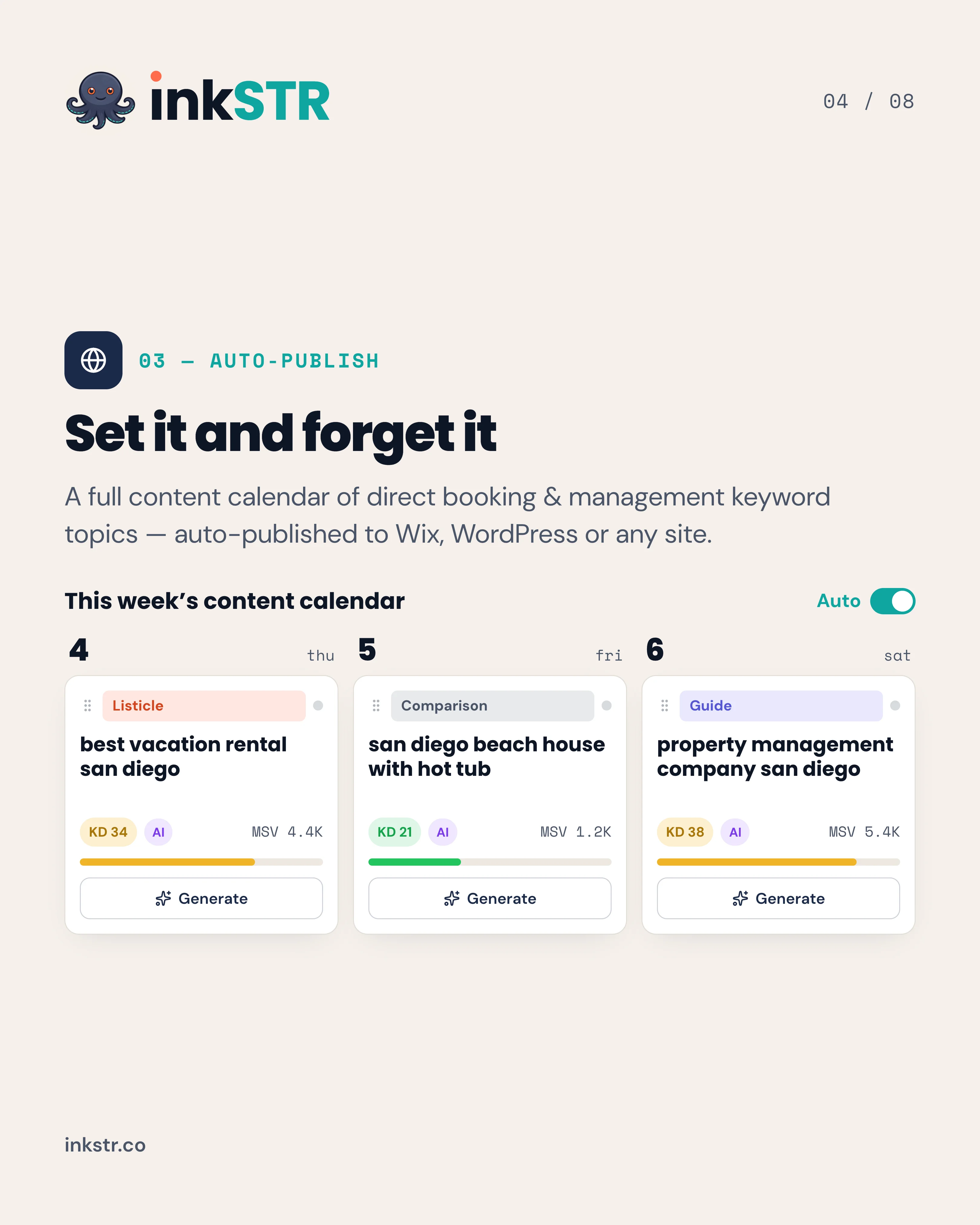
Google rewards publishing consistency more than volume. One post every two weeks, sustained for a year, outperforms ten posts in a month followed by silence. This is precisely the habit inkSTR's Content Calendar was designed to enforce, scheduling and managing publishing on autopilot so the calendar doesn't go quiet the moment a busy guest season hits.
Step 4: Track and Iterate
Connect Google Search Console early. It's free, and it shows you exactly which queries are already bringing impressions to your site, often revealing keyword opportunities you hadn't considered.
The agitating part of this beginner path is that most hosts do steps one and two, get distracted, and never build the consistent publishing habit in step three. As of 2026, that inconsistency is the single biggest reason DIY sites plateau at page two.
Can ChatGPT Do SEO?
ChatGPT can help with parts of SEO, specifically keyword brainstorming, outline generation, and drafting rough copy, but it cannot independently research current search volume, verify factual accuracy, publish content, or track ranking performance. Treating ChatGPT as a full SEO solution rather than one input in a larger workflow is where most hosts get burned.
Here's where ChatGPT genuinely helps: generating a list of blog topic ideas around your location, drafting an H2 outline for a post about local attractions, or rewriting a clunky paragraph. Here's where it consistently falls short for vacation rental content specifically: it doesn't know your property's actual amenities, it can invent restaurant names or attractions that don't exist near you, and it has no mechanism to check whether a keyword actually has search demand before you spend an evening writing about it. We've seen hosts publish ChatGPT-drafted posts recommending restaurants that closed years ago, or citing regulations that were never real, because the model filled gaps with plausible-sounding text instead of verified facts. That's a trust problem, not just an SEO problem, and it's specifically why inkSTR pairs its Keyword Research tool with hospitality-specific content generation, so the keywords behind every article are verified search terms guests actually type, not guesses.
The other gap: ChatGPT doesn't publish anything. You still copy, format, add images, insert internal links, and hit publish manually, every single time. That manual step is exactly what Auto-Publishing removes, pushing finished articles straight to Wix, WordPress, or a custom site without you touching a CMS dashboard.
How Do I Do SEO for My Own Website?
Doing SEO for your own vacation rental website means applying keyword research, on-page optimization, and content publishing specifically to your property's pages, not a generic template. That means your homepage, your amenities page, your local area guide, and every blog post should target a distinct keyword tied to how travelers actually search for a stay like yours.
Start by mapping your site structure: one page per core topic (property overview, amenities, location, booking policy), then a blog section for ongoing content. Each blog post should target one primary keyword and answer it completely, rather than skimming five topics shallowly. For a mountain cabin, that might mean a post on "best trails near [town] for a weekend cabin trip." For an urban apartment host, it might mean "where to stay in [neighborhood] for a work trip."
Internal linking matters more than most DIY guides mention. Every blog post should link back to your booking page, and posts should link to each other where topically relevant. This is where understanding what a backlink actually is becomes useful too, since internal links and external backlinks serve different but complementary purposes in your rankings.
If your site still isn't gaining traction after fixing on-page basics and publishing consistently, the issue is often deeper than content quality. We cover the common technical and structural culprits in our breakdown of why vacation rental websites don't rank, and the step-by-step fix in how to actually rank a vacation rental site on Google.
What Does DIY SEO Actually Cost You in Time and Money?
DIY SEO costs time instead of cash upfront, but the time cost is substantial: writing one quality blog post manually takes 3 to 5 hours, and a realistic content calendar needs 20 to 40 posts in year one. The alternative, hiring a freelance travel writer, runs $300 to $700 per post, which turns a year of content into a $6,000 to $28,000 line item.
| Approach | Time Cost | Cash Cost | Best For |
|---|---|---|---|
| Fully DIY (write it yourself) | 3 to 5 hrs/post | $0 direct cost | Single property, host with spare evenings |
| Freelance writer per post | Minimal (editing only) | $300 to $700/post | Hosts with budget but no time |
| inkSTR automated pipeline | Minutes to review | Starting at $99/month | Solo hosts and multi-property managers alike |
Here's the number that changes the calculation: a single direct booking is typically worth $1,000 to $4,000 in revenue, and Airbnb and VRBO combined host and guest fees run 17 to 19% of every booking made through those platforms. A ranking blog article, once it climbs, can keep driving that direct traffic for 2 to 5 years. Content is one of the few marketing investments with a compounding return instead of a one-time spend.
This is the exact math we walk through with hosts considering inkSTR's pricing, which starts at $99 a month, a fraction of even a single freelance blog post, for a system that generates, schedules, and publishes articles automatically on an ongoing basis.
What's the Real Difference Between Manual SEO and an Automated Content System?
The real difference is not quality, it's consistency and scale. A skilled DIY host can write a genuinely excellent post. What breaks down is doing that 30 times a year, every year, while also cleaning turnovers, answering guest messages, and managing pricing.
We've watched this pattern repeat across property management companies specifically. A manager overseeing 15 properties starts strong with a content push, writes eight posts in month one, then the calendar goes silent for four months when a busy season hits. Google's ranking systems reward exactly the consistency that gets abandoned first when a host gets busy.
Common DIY SEO Mistakes That Quietly Kill Rankings
- Duplicate meta descriptions across multiple pages, which tells Google your pages aren't distinct enough to rank separately.
- Redirect chains left over from old page restructures, which slow crawl speed and dilute link equity.
- Thin content, posts under 500 words that don't fully answer a search query, which rank briefly then fall off.
- Keyword stuffing in an attempt to rank faster, which reads as spam to both readers and search algorithms.
- Publishing bursts followed by months of silence, breaking the consistency signal search engines track over time.
A tool like Screaming Frog can crawl your site and surface duplicate metas and redirect chains in minutes, something worth running quarterly even if you're otherwise fully DIY. For deeper competitive research, tools like SEMRush and Moz show what's already ranking for your target keywords, so you're not guessing at difficulty.
Ready to automate your content marketing?
inkSTR handles keyword research, content strategy, article writing, and publishing, all on autopilot.
What Should a Beginner Blog About for a Vacation Rental Site?
A beginner should blog about the questions guests already ask before booking: what's nearby, what the property includes, what to pack, and how the local area compares to alternatives. Generic travel content about a city, written the way a tourism board would write it, rarely converts because it doesn't connect back to why someone should book your specific property.
Effective topics for a first content calendar include local area guides tied to your property's actual location, seasonal packing lists specific to your climate, comparisons between your property type and nearby alternatives, and posts answering logistics questions like parking or check-in. We go deeper on this exact question in our guide to vacation rental blog topics that actually drive bookings, and cover why generic content underperforms in why generic travel content kills conversions.
For inspiration on the depth level a strong local guide should hit, our own local's take on Jasper is a useful reference for how specific and experience-driven a location post should read compared to a generic tourism summary.
How Do You Handle Local SEO Beyond the Basics?
Local SEO for a vacation rental goes beyond claiming a Google Business Profile, it requires consistent name, location, and property-type information across every directory and platform where your listing appears, plus location-specific content that generic competitors haven't bothered to write.
Start with your Google Business Profile, keep it updated with current photos and accurate hours if you offer any in-person check-in. Beyond that, most beginner guides stop, but the details matter: make sure your address format is identical everywhere it appears, since inconsistent formatting confuses local ranking algorithms. Add location-specific schema markup where your CMS supports it. And build content around hyper-local questions, "best coffee shop walking distance from [property]" ranks far more easily than "things to do in [city]" because you're competing against fewer, weaker pages.
This is also where multi-property operators face a distinct challenge urban and boutique hosts don't: each property needs its own localized content, not one generic page repeated across a portfolio. We cover this in depth in ranking on Google: what STR operators need to know, which addresses the STR-specific ranking factors that generic SEO guides skip entirely.
Practical Guidance: How Do You Prioritize Your First 90 Days of DIY SEO?
The first 90 days of DIY SEO should prioritize technical fixes and keyword research before content volume, since publishing on top of a broken foundation wastes the writing effort. Follow this sequence rather than jumping straight to blogging.
- Week 1 to 2: Set up Google Search Console and Google Business Profile. Run a crawl with Screaming Frog to catch duplicate metas and broken redirects.
- Week 3 to 4: Complete keyword research using Ubersuggest or SEMRush, building a list of 20 to 30 target phrases split across location, property type, and traveler intent.
- Week 5 to 6: Rewrite existing page titles and meta descriptions around your top-priority keywords, checking rendered length with the Google SERP Simulator.
- Week 7 to 12: Begin publishing, aiming for one post per week targeting a distinct keyword from your research list, with internal links back to your booking page.
The mistake we see most often at this stage is skipping straight to week 7 without doing weeks 1 through 6 first. A beautifully written post targeting the wrong keyword, or published on a site with broken redirects, underperforms a mediocre post on a technically clean site every time.
If maintaining that weekly cadence for 12 straight weeks sounds unrealistic given everything else on your plate, that's the exact gap inkSTR was built to close. The how inkSTR works page walks through the full pipeline, from keyword identification to a published post, without you personally writing, formatting, or publishing a single article.
Frequently Asked Questions
How long does it take to see SEO results from vacation rental blog content?
Most vacation rental sites start seeing early ranking movement within 3 to 6 months of consistent publishing, with meaningful traffic gains typically appearing after 6 to 12 months. New sites with no existing authority generally take longer than established sites adding content to a page that already has some history.
How many blog articles do I need to start ranking for local vacation rental searches?
There's no fixed number, but most hosts see initial traction after 15 to 20 well-targeted posts, since Google needs enough content to recognize your site as an authority on your location and property type. Quality and keyword targeting matter more than hitting an exact count.
Can I use inkSTR if I manage more than one property or brand?
Yes, inkSTR supports multi-project setups so each property or brand runs its own independent content pipeline. A manager overseeing several listings can run parallel content calendars without duplicating research or writing effort across properties.
Does blog content actually reduce dependence on Airbnb and VRBO?
Yes, ranking blog content drives organic search traffic directly to your own booking page, bypassing the discovery step that ties guests to Airbnb or VRBO listings. Since combined host and guest fees on those platforms run 17 to 19% per booking, every direct booking driven by organic content is revenue that skips that fee entirely.
What's the difference between writing content myself and using an SEO content automation tool?
Writing content yourself costs time, roughly 3 to 5 hours per post, while an automated tool like inkSTR compresses that into an automated research-to-draft pipeline built specifically around short-term rental terminology and traveler search intent. The output difference is less about quality and more about whether you can sustain a weekly publishing habit indefinitely.
How does AI-generated content get cited in tools like ChatGPT and Google AI Overviews?
AI systems tend to extract and cite content with clear definitional openings, self-contained paragraphs, and specific named details, rather than vague marketing copy. Content built around real traveler questions, structured with direct answers up front, is far more likely to surface in an AI Overview or a ChatGPT response than generic filler text.
Do I need existing SEO knowledge to use a content automation platform like inkSTR?
No, inkSTR's keyword research and content strategy tools are built to guide the process for hosts without prior SEO background, surfacing keyword opportunities and generating drafts without requiring you to already understand technical SEO concepts. That said, understanding the fundamentals covered in this guide helps you evaluate whether the output is actually targeting the right terms.
How does inkSTR integrate with my existing Wix or WordPress site?
inkSTR's auto-publishing feature connects to Wix and WordPress directly, pushing finished, formatted articles live on a set schedule without manual copy-paste work. This removes the last manual step in the DIY SEO workflow, the part most hosts describe as the most tedious.
Conclusion
Doing SEO yourself for a vacation rental site is realistic, and the fundamentals, keyword research, on-page fixes, consistent publishing, and basic tracking, aren't complicated to learn. What's hard to sustain is the weekly time commitment once guest communication, cleaning coordination, and pricing already fill your schedule. The math is straightforward: 3 to 5 hours per post, $300 to $700 if you outsource it, against a direct booking worth $1,000 to $4,000 that keeps arriving for years after a post ranks.
As of 2026, the hosts pulling ahead aren't necessarily the ones with the best writing skills, they're the ones who never let their publishing calendar go quiet. That's the single variable that separates a site stuck on page two from one that owns page one for its market.
If keeping that calendar full every week feels like a second job on top of running your property, Get started with inkSTR to see how the research-to-publish pipeline handles it in the background, whether you manage one cabin or fifteen units across three markets.
Content powered by inkSTR.co
Enjoyed this article? Share it:
Get more of inkSTR in Google Search
Add inkstr.co as a preferred source and our articles show up more in Top Stories, AI Overviews, and AI Mode — with a “Preferred” badge.
Get more guides like this
New SEO and AI-search guides, straight to your inbox. No spam, unsubscribe anytime.