SEO How to Do It Yourself: A Real Step-by-Step Guide

Search engine optimization how to do-it-yourself comes down to five repeatable steps: install Google Search Console and Google Analytics, research the keywords your guests actually type, fix the technical basics that block crawling, publish content built around search intent, and build internal and external links. Every step is doable without hiring an agency, though the time cost is real.
Key Takeaways
- Yes, DIY SEO is possible for a short-term rental website, and it starts with free tools: Google Analytics and Google Search Console.
- Writing one quality blog post manually takes 3 to 5 hours of research and writing, and a freelance travel writer typically charges $300 to $700 per post.
- Top-ranking pages usually carry 3.8 times more backlinks than lower-ranked competitors, according to SeoProfy (2026).
- Organic search generates leads at roughly $31 each, compared to about $198 per lead from paid search, according to SeoProfy.
- A single direct vacation rental booking is typically worth $1,000 to $4,000 in revenue, making organic traffic one of the highest-leverage channels a host can build.
- inkSTR automates the keyword research, drafting, and publishing steps of this process, so operators who don't have 3 to 5 hours per post can still build a compounding content engine.
If you run a vacation rental and every booking still routes through Airbnb or VRBO, minus their 17 to 19 percent combined host and guest fees, DIY search engine optimization is the most direct lever you have to change that. You don't need an agency retainer to start. You need a system you'll actually follow through on.
This guide walks through the entire process a solo host or small property management company can run without outside help: what to set up first, how to research keywords that match how travelers actually search, which technical issues quietly kill your rankings, and how to build content that Google and AI search tools like ChatGPT and Perplexity will actually cite. We built inkSTR after watching operators try to do all of this manually, on top of running their properties, and burn out before month three.
As of 2026, the mechanics haven't changed much from prior years: Google still rewards helpful, people-first content and fast, crawlable sites. What's new is that a meaningful share of travel research now happens inside AI assistants before it ever hits a traditional search results page, which changes how you should structure what you publish.
Can I Do SEO Optimization Myself?
Yes, you can do SEO optimization yourself, and for a single vacation rental property or a small portfolio, it's often the right starting move before paying for outside help. The core tasks (measurement setup, keyword research, technical fixes, content, and link building) don't require a certification, just consistent time investment.
The catch is that "yourself" doesn't mean "free of cost." It means you're trading dollars for hours. A freelance travel writer typically charges $300 to $700 per quality blog post, and writing one well yourself, researching the topic, drafting, editing, formatting takes 3 to 5 hours. If you're publishing weekly, that's 12 to 20 hours a month just on writing, before technical audits or keyword research.
Here's where solo hosts and small property managers usually get stuck: they do SEO in bursts. A big push in January, nothing until summer, then a scramble before peak season. Google doesn't reward bursts. It rewards sites that publish consistently over months, because that's the signal that a site is actively maintained and genuinely useful, not a one-time project.
This is exactly the gap inkSTR was built to close. Instead of you personally writing, formatting, and scheduling every post, our AI Content Writer generates full SEO-optimized articles built around vacation rental search intent, and our Content Calendar keeps them publishing on a steady cadence automatically. You still own the strategy. You just stop being the bottleneck.

How Do You Do SEO as a Beginner?
Doing SEO as a beginner means following a sequence: verify your site in Google Search Console, install analytics, audit your technical basics, research keywords, then publish content that matches what travelers search. Skipping the order, jumping straight to writing without measurement in place, is the most common beginner mistake.
Step 1: Set Up Measurement Before You Write Anything
Google Search Console tells you which keywords already send you impressions and clicks, whether pages are indexed, and if there are crawl errors. Pair it with Google Analytics to see what visitors do once they land. Skipping this step means you're publishing blind. You won't know if a post is working for months.
Step 2: Audit the Technical Basics
More than 60 percent of searches happen on mobile devices, so a site that loads slowly or breaks on a phone is losing bookings before a guest reads a word. A common site-speed benchmark cited across the industry is under three seconds to load. Check for broken links, missing sitemaps, and pages blocked from crawling.
Step 3: Research Keywords That Match Guest Intent
A generic keyword tool built for massage therapists or law firms won't understand that "pet-friendly cabin near hiking trails" is a high-intent vacation rental search. This is where niche context matters, and it's a large part of why inkSTR's Keyword Research tool is built specifically around traveler search behavior rather than generic business terms.
Step 4: Publish Consistently, Not in Bursts
A ranking blog article can drive organic search traffic for 2 to 5 years once it earns its position, but only if you keep publishing long enough for Google to trust the site is actively maintained. One post in isolation rarely moves the needle. A steady publishing schedule does.
How Can I Make Search Engine Optimization Work for a Vacation Rental Site?
Making search engine optimization work for a vacation rental site means building content around the specific searches travelers run before booking, not generic "things to do" posts. Property-specific, intent-matched content (pet policies, parking details, proximity to trailheads) converts better than broad destination content because it answers the exact question a guest already has.
We've watched this play out directly. One inkSTR customer, a cabin rental brand in the Smoky Mountains, grew from 788 to 5,195 monthly Google Search clicks in 11 months, with monthly impressions climbing from 130,000 to 450,000 over the same period. That growth came from pillar-and-cluster content grounded in real property details, not generic filler. The brand attributed $309,775 in direct booking revenue to that content in its first 14 months.
A five-market luxury mountain rental brand had a similar pattern: 26 monthly Google search visits for fifteen straight months, then 1,924 monthly visits within four months of publishing 114 articles across all five markets. Those are the kind of results that come from matching content to search intent at scale, not from writing a handful of posts and hoping.
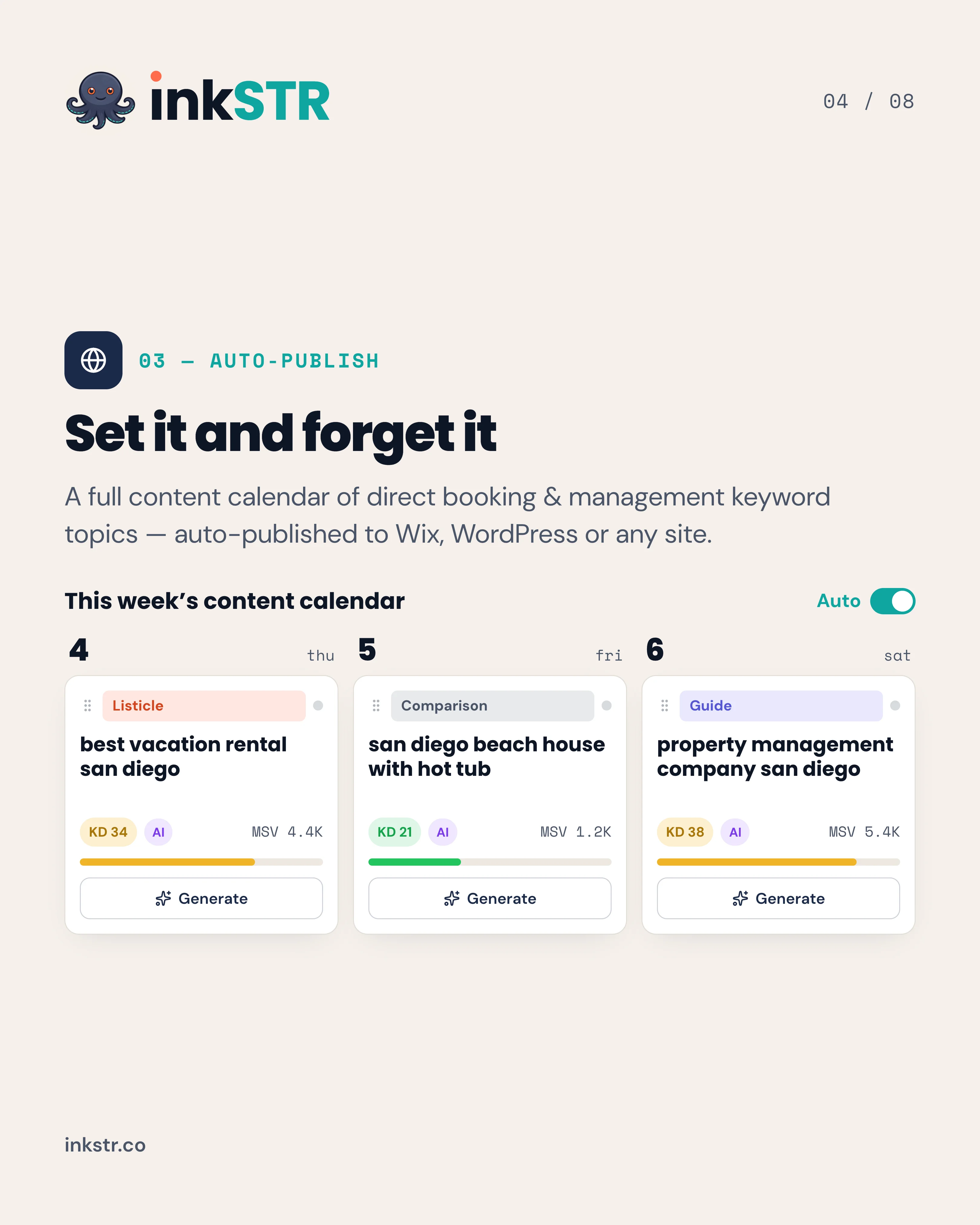
Manually replicating that output, 114 articles in four months, is not realistic for someone also managing guest communication, cleaning turnovers, and pricing. That volume is precisely what our Auto-Publishing feature exists for: it pushes generated articles directly to Wix or WordPress without you touching a publish button.
What Should Your Content Actually Cover?
Content that converts covers specific, bookable details: what the property includes, what's nearby, what makes it different from the listing three doors down. Avoid vague "unique atmosphere" language. Our piece on why generic travel content kills conversions goes deeper on this exact failure mode.
Can I Do SEO Myself for Free?
You can do a meaningful amount of SEO yourself for free using Google Search Console, Google Analytics, and free-tier tools like Ubersuggest for keyword ideas. What "free" doesn't cover is your time, and time is the real cost most operators underestimate when they decide to go the DIY route.
Free tools get you measurement and directional keyword data. They don't write your content, format it for search snippets, schedule it, or publish it. If you're a solo host with one property, free tools plus a few hours a week is a reasonable starting point. If you manage 10, 15, or 50 units, the free-tools-plus-elbow-grease model collapses fast, because the content workload multiplies with every property.
This is the wall a Charlotte and Lake Norman area management company hit before adopting our platform. They needed owner-acquisition leads, not just guest traffic, from their content investment. Within the first month of running an owner-facing inkSTR content pipeline structured for AI-search citability, they generated 4 property-owner leads directly from AI search, with Google impressions running 4.6 times their year-ago level within three months.
Free tools didn't get them there. A dedicated content pipeline, one that understood the difference between guest-facing and owner-facing search intent, did. That distinction is exactly what our Property Management content strategy is built around, and it's why generic AI writing tools, built for any industry, tend to miss it entirely.

What Does a Complete DIY SEO Workflow Actually Look Like?
A complete DIY SEO workflow follows eight sequential stages: measurement setup, technical audit, keyword research, on-page optimization, content creation, internal linking, off-page link building, and ongoing monitoring. Most beginner guides list these stages but rarely show how they connect end to end.
| Stage | What It Involves | Typical Time Cost (Manual) |
|---|---|---|
| Measurement setup | Verify Search Console, install Analytics | 1 to 2 hours, one-time |
| Technical audit | Site speed, mobile usability, broken links, sitemap | 3 to 6 hours, one-time plus periodic checks |
| Keyword research | Search volume, competition, guest intent matching | 2 to 4 hours per topic cluster |
| On-page optimization | Title tags, meta descriptions, headings, URLs | 30 to 60 minutes per page |
| Content creation | Research, writing, editing, formatting | 3 to 5 hours per article |
| Internal linking | Connecting related pages and posts | 15 to 30 minutes per article |
| Off-page link building | Outreach, guest posts, directory listings | Ongoing, highly variable |
| Monitoring | Tracking rankings, clicks, indexing issues | 1 to 2 hours weekly |
Add that up for a solo host publishing weekly and you're looking at well over 20 hours a month once you include monitoring and iteration. That's roughly half a work week, every month, indefinitely, since SEO isn't a project you finish, it's a channel you maintain.
inkSTR's How inkSTR Works page walks through how the platform compresses this entire workflow, from keyword to published post, into a system that runs on its own schedule instead of your calendar.
What Do You Need for Keyword Research Beyond Search Volume?
Keyword research for a vacation rental site needs more than search volume numbers. It requires matching keywords to guest intent, meaning the difference between someone researching a destination broadly and someone ready to book a specific property type in a specific area.
A common keyword-research pattern in general SEO guidance is to enter seed topics into a planner, export terms with volume and competition data, and target keywords with roughly 100 to 1,000 monthly searches and low-to-medium competition. That approach works fine for a generic business. It falls short for vacation rentals because the tools weren't built to distinguish "cabin with hot tub near ski resort" from a completely unrelated local service search.
Notably, a share of travel research now starts inside AI assistants rather than a traditional search bar. That shifts keyword strategy toward conversational, specific phrases, the kind of thing someone would actually type into ChatGPT or say to Perplexity, rather than short fragment keywords. Our guide on ranking in AI search covers this shift in more depth.
We built inkSTR's Keyword Research tool around this exact gap: it's trained on traveler search behavior and vacation rental terminology, so it surfaces opportunities like "dog friendly lake house with dock" instead of generic local-business phrases that don't match how guests actually search.
What Technical SEO Fixes Matter Most for a Vacation Rental Site?
Technical SEO for a vacation rental site means confirming the site is crawlable, mobile-friendly, and fast enough that a guest doesn't abandon the page before it loads. These fixes don't drive rankings on their own, but ignoring them caps how well even great content can perform.
Start with a crawl audit to find broken links and orphaned pages, submit an updated sitemap, and confirm HTTPS is active site-wide. Then check mobile rendering specifically, since the majority of travel searches happen on phones. A site that looks fine on a desktop monitor but breaks a booking form on mobile is losing reservations silently, with no error message to alert you.
Where beginner guides usually stop short is troubleshooting: what do you do when a page is indexed but gets impressions with almost no clicks? Usually that's a title tag or meta description problem, the snippet isn't compelling enough to earn the click. What if a page gets no impressions at all? That's often an indexing or internal linking issue, Google hasn't found a reason to prioritize crawling it. What if rankings that were climbing suddenly drop? Check for a recent site change, a broken redirect, or a competitor publishing something more comprehensive.
inkSTR's content is built with these outcomes in mind from the draft stage, structured with clear headings, concise titles, and internal links that give Google and AI systems a reason to surface the page. That's a meaningful part of why our ranking on Google guide for STR operators focuses on vacation-rental-specific ranking factors rather than generic SEO advice.
Ready to automate your content marketing?
inkSTR handles keyword research, content strategy, article writing, and publishing, all on autopilot.
How Do You Build Links Without an Agency Budget?
Building links without an agency budget means earning them through genuinely useful content, local partnerships, and directory listings, rather than buying placements. Top-ranking pages carry roughly 3.8 times more backlinks than lower-ranked pages, according to SeoProfy (2026), so this step matters even though it's the slowest to show results.
Realistic DIY tactics include: getting listed in local tourism directories, partnering with nearby businesses for reciprocal mentions, and publishing genuinely useful local guides that other sites want to reference naturally. What doesn't work, and what beginner guides rarely warn against clearly enough, is buying bulk link packages or spamming blog comments. Google's algorithms have gotten better at discounting both.
Our article on what a backlink actually is in SEO breaks down which link-building tactics hold up in 2026 and which ones waste your time. For operators managing several properties, our platform's backlink exchange marketplace also lets same-owner projects strengthen each other's SEO profile, which is a structural advantage a single independent site can't replicate on its own.
What Are the Most Common DIY SEO Mistakes?
The most common DIY SEO mistakes are publishing inconsistently, targeting keywords with no guest intent behind them, ignoring mobile site speed, and treating content as a one-time project instead of an ongoing channel. Any one of these can flatten months of otherwise solid work.
- Publishing in bursts, then going quiet. Google favors sites that show sustained activity. A flurry of posts followed by six months of silence signals a site that isn't actively maintained.
- Writing for search engines instead of guests. Keyword-stuffed titles read as robotic and convert poorly, even if they briefly rank.
- Ignoring page speed on mobile. With most travel searches happening on phones, a slow-loading page loses bookings before the content even matters.
- Skipping measurement setup. Publishing without Search Console and Analytics installed means you're guessing at what's working.
- Copying generic "10 things to do" content. This format is heavily used and rarely converts readers into bookings, because it doesn't answer a specific, bookable question.
- Underestimating the time cost. Writing one quality post takes 3 to 5 hours. Multiply that across a real publishing schedule and the math gets unsustainable fast for a solo operator.
Our piece on why your vacation rental website isn't ranking walks through diagnostic steps for each of these failure patterns specifically.

Is It Worth Paying a Content Writer Instead of Doing SEO Yourself?
Paying a content writer is worth it if you value your time at more than the freelance rate and can't sustain a consistent publishing schedule alone. A freelance travel writer typically charges $300 to $700 per quality post, which is often cheaper than the opportunity cost of your own hours once you factor in editing, formatting, and publishing.
The real comparison isn't "free DIY" versus "paid writer." It's DIY time cost versus freelance dollar cost versus a third option: automated, niche-specific content generation. A freelancer, even a good one, still needs briefing, revision rounds, and manual publishing. That adds coordination time on top of the invoice.
inkSTR's Pricing starts at $99 a month, which covers generating, scheduling, and auto-publishing articles without per-post invoices or revision cycles. For an operator publishing several posts monthly, that often works out to a fraction of what a single freelance article would cost, while still producing content built specifically around vacation rental search intent rather than generic travel writing.
Data Snapshot: DIY SEO Time and Cost Reality
The numbers below reflect verified figures from industry sources and inkSTR's own case study data, giving a concrete picture of what DIY SEO actually costs in time versus dollars.
| Metric | Figure | Source |
|---|---|---|
| Time to write one quality blog post manually | 3 to 5 hours | inkSTR business data |
| Freelance travel writer cost per post | $300 to $700 | inkSTR business data |
| Average value of a single direct booking | $1,000 to $4,000 | inkSTR business data |
| Airbnb host and guest fees combined | 17 to 19% of booking value | inkSTR business data |
| Backlink gap, top-ranked vs lower-ranked pages | 3.8x more backlinks | SeoProfy, 2026 |
| Organic vs paid lead cost | $31 organic vs $198 paid | SeoProfy, 2026 |
| inkSTR monthly platform cost | $99/month | inkSTR pricing |
As of September 2026, articles published across inkSTR customer sites have crossed 3,900, generating over 2.5 million Google Search impressions in the trailing 90 days alone. That volume simply isn't achievable through manual, one-post-at-a-time writing for most operators managing a full booking calendar alongside their content work.
Frequently Asked Questions
How long does it take for a vacation rental website to rank on Google?
Most sites see meaningful traffic gains within 3 to 6 months of consistent publishing, though competitive markets can take longer. A ranking blog article, once established, can continue driving organic traffic for 2 to 5 years, which is why consistency matters more than any single post.
Do I need a blog if I already have a direct booking website?
Yes, because a booking website alone rarely ranks for the research-stage searches travelers run before they're ready to book. Blog content built around guest intent is what captures that earlier search traffic and funnels it toward your booking page.
Can AI-generated content actually rank on Google and get cited in AI search results?
Yes, when it's built around genuine search intent, structured with clear answer-first sections, and specific rather than generic. inkSTR has secured over 1,164 verified AI-search citations for customer content as of September 2026, which shows this isn't theoretical.
How do I get more direct bookings without relying on Airbnb or VRBO traffic?
Build content around the specific searches travelers run before choosing a property, then link that content clearly to your booking page. Our guide on Direct Bookings covers the broader strategy behind this shift.
What should a vacation rental blog post actually include to convert readers into bookings?
It should answer a specific, bookable question, mention concrete property or area details, and link clearly toward the booking page. Vague "unique atmosphere" language rarely converts; specificity does.
Is content marketing worth it for a small, independent vacation rental host?
Yes, particularly because a single direct booking is typically worth $1,000 to $4,000, meaning even a handful of extra bookings a year can justify the time or cost of a content strategy. The math gets more favorable the longer a piece of content stays live and ranking.
What keywords should I target for my vacation rental website?
Target specific, intent-matched phrases travelers actually type, like "pet friendly cabin near hiking trails" rather than broad destination terms. Generic keyword tools built for other industries often miss this distinction, which is why niche-specific research matters.
How often should I publish new blog content for my vacation rental site?
Weekly or biweekly is a reasonable target for most operators, since Google rewards sites that show sustained, ongoing activity rather than sporadic bursts. Consistency over months matters more than volume in any single week.
Quick Reference: The DIY SEO Steps in Order
- Verify your site in Google Search Console and install Google Analytics.
- Audit technical basics: site speed, mobile usability, sitemap, broken links.
- Research keywords matched to guest search intent, not generic business terms.
- Optimize titles, meta descriptions, headings, and URLs on existing pages.
- Publish intent-matched content on a consistent schedule.
- Build internal links between related posts and your booking page.
- Earn backlinks through directories, partnerships, and genuinely useful content.
- Monitor rankings, clicks, and indexing weekly, and adjust based on what's working.
Conclusion
Search engine optimization how to do-it-yourself is absolutely achievable for a vacation rental host or property manager, and the steps above work whether you're running one cabin or a fifty-unit portfolio. The honest tradeoff is time: 3 to 5 hours per post, ongoing technical monitoring, and months of consistent publishing before rankings compound.
What changes in 2026 is how much of that workload can move off your plate without losing the niche specificity that makes vacation rental content actually convert. That's the balance we built inkSTR to strike, automated where it should be, specific where it needs to be.
If keeping up with keyword research and blog publishing across your properties feels impossible right now, Get started with inkSTR and see your first automated content plan today.
Content powered by inkSTR.co
Enjoyed this article? Share it:
Get more of inkSTR in Google Search
Add inkstr.co as a preferred source and our articles show up more in Top Stories, AI Overviews, and AI Mode — with a “Preferred” badge.
Get more guides like this
New SEO and AI-search guides, straight to your inbox. No spam, unsubscribe anytime.