SEO Do It Yourself: A Real Guide for STR Operators

SEO do-it-yourself is entirely possible for a short-term rental website, and it costs nothing but time. You can set up free tools, do your own keyword research, and write your own content. The catch is that writing one quality blog post manually takes 3-5 hours, and most operators underestimate how many posts it takes before rankings actually move.
Key Takeaways
- SEO do-it-yourself covers keyword research, on-page fixes, content writing, and basic link building, all doable without an agency using free tools like Google Search Console and Google Analytics 4.
- Writing one quality blog post manually takes 3-5 hours of research and writing, and a freelance travel writer typically charges $300-$700 per post.
- ChatGPT can draft outlines and brainstorm keyword angles but cannot publish content, track Search Console rankings, or maintain a schedule on its own.
- A ranking blog article can drive organic search traffic for 2-5 years, so consistent publishing compounds in a way a single post never will.
- In one case, a five-market vacation rental brand grew from 26 to 1,924 monthly Google search visits in four months after moving from sporadic manual posts to a structured content pipeline.
- inkSTR automates the research, drafting, scheduling, and publishing stages of DIY SEO, so you keep the control of doing it yourself without absorbing the full time cost.
If you run a vacation rental, cabin, or small property management company, you have probably already searched some version of "seo do-it-yourself" while staring at a website that gets almost no organic traffic. That search usually happens after realizing that agencies quote monthly retainers you cannot justify for one or two properties, and after noticing that competitors somehow rank first for the exact search terms your ideal guest is typing.
The good news: DIY SEO for a short-term rental site is not a mystery. It is a repeatable set of tasks, keyword research, on-page structure, content publishing, and basic technical maintenance, that any operator can learn. As of 2026, the tools required to start are free, and the fundamentals have not changed much even as AI search tools like Google AI Overviews reshape how answers get surfaced.
What has changed is the cost of doing nothing. Organic search still drives roughly 53% of all trackable website traffic, more than paid search, social, and email combined, according to industry traffic composition data. If your STR site is not showing up in that channel, you are leaning entirely on Airbnb and VRBO, and giving up 17-19% of every booking in combined host and guest fees to do it. This guide walks through exactly what you can do yourself, what free tools actually cover, where ChatGPT helps and where it does not, and the point at which most operators decide manual SEO stops making sense.
Is It Possible to Do SEO Yourself?
Yes, doing SEO yourself for a short-term rental website is entirely possible in 2026, and thousands of independent hosts do it. Seo do-it-yourself means handling keyword research, on-page optimization, content creation, and basic technical fixes without hiring an agency or a full-time SEO specialist. Nothing about the process legally or technically requires outside help.
The real constraint is not skill, it is time. A solo host running one or two properties can absolutely learn to use Google Search Console, structure title tags correctly, and write a location-specific blog post. Many guides recommend targeting 20-50 well-chosen keywords as a starting point, which is a manageable list for a single property.
Where DIY SEO gets harder is scale. Once you manage more than a few units, or you are trying to compete with property management companies that publish constantly, the same tasks multiply. A property manager running content across 15 properties is not doing "SEO yourself" anymore in any practical sense, they are running a small publishing operation with no staff assigned to it.
This is exactly the gap inkSTR was built to close. We built it for operators who want the results of doing SEO themselves, keyword targeting, consistent publishing, direct booking traffic, without personally writing every article at 11pm after a full day of guest turnovers. The AI Content Writer handles the drafting step specifically, so the "yourself" part of DIY SEO shifts from writing paragraphs to reviewing and approving them.

Can I Do SEO on My Own for Free?
Mostly, yes. Google Search Console, Google Analytics 4, and Google Business Profile are entirely free, and together they cover setup, measurement, and local visibility for your short-term rental site. What free tools do not solve is the actual work of writing and publishing content consistently.
Start with Google Search Console. It is the official tool for tracking which keywords your site ranks for, how many impressions and clicks you get, and whether Google can index your pages correctly. Pair it with Google Analytics 4 to see what visitors do once they land on your site, whether they browse your calendar page or bounce immediately.
For local visibility, Google Business Profile is non-negotiable and free. A complete, accurate profile with photos and updated availability information is one of the highest-leverage things a DIY operator can do, since local intent searches ("cabin rentals near me") convert at a meaningfully higher rate than generic browsing traffic.
The free technical basics matter too: a site that loads in under 3 seconds, mobile-friendly design (mobile now accounts for the majority of search traffic), a clean sitemap, and honest image alt text. None of that costs money. What it costs is hours, and that is where most solo hosts stall out. Writing one quality blog post manually still takes 3-5 hours of research and writing, and free tools do not shrink that number. That's where the Keyword Research feature inside inkSTR takes over, surfacing the actual terms your target guests search so you are not guessing which of those free-tool metrics to chase.
Can ChatGPT Do SEO for a Vacation Rental Site?
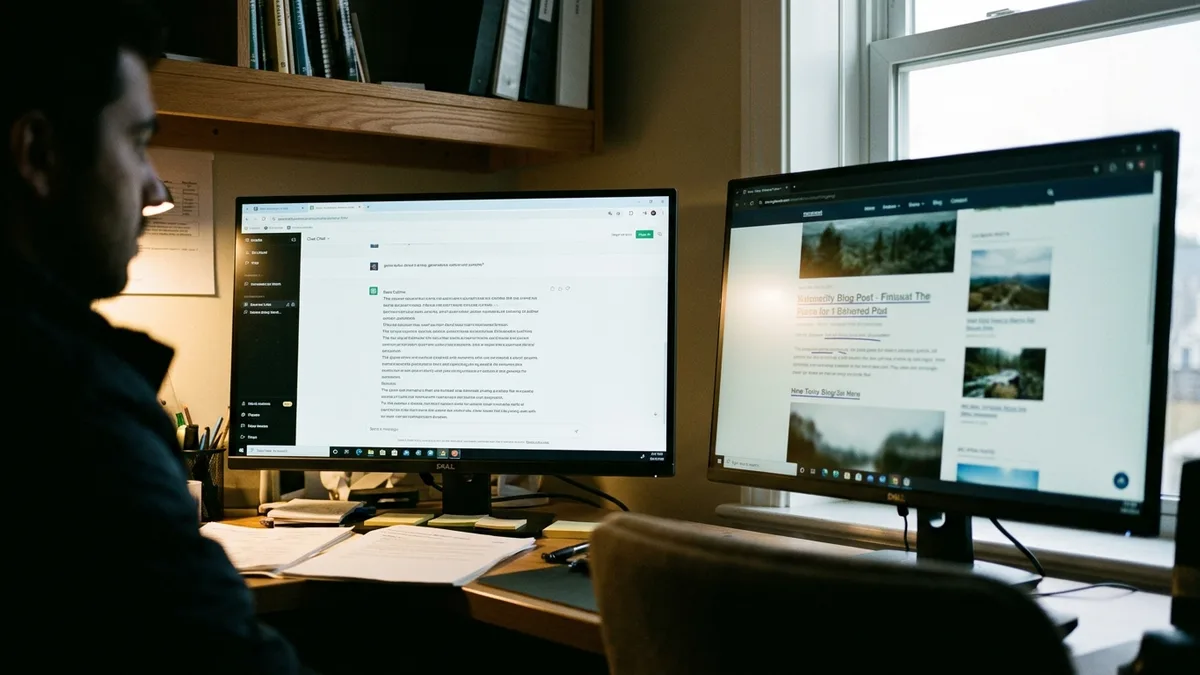
ChatGPT can help with parts of SEO, specifically keyword brainstorming, outline drafting, and first-pass copy, but it cannot execute the full SEO process for a vacation rental site on its own. It has no access to your Search Console data, cannot publish to your live website, and does not maintain a content calendar without a human running it manually.
Used well, ChatGPT is a decent starting point for idea generation. Ask it for blog topic ideas around your cabin's location, and you will get a reasonable list. Ask it to draft an outline for a "things to do near the property" post, and it will produce something workable. That is genuinely useful for operators with zero content experience.
Where it falls apart is everything downstream of drafting. ChatGPT does not know your actual search rankings, cannot tell you which keywords are gaining or losing position, and will not remind you that your last post was three months ago. It also has no concept of your internal linking structure, meaning content it drafts often lacks the deliberate links between your blog and your direct booking page that actually drive conversions.
There's also a growing wrinkle: AI-driven search experiences, including Google AI Overviews, now influence more than 60% of queries and appear in roughly 26% of US searches as of early 2026. Getting cited inside those AI answers requires structured, answer-first content and consistent publishing signals, not a one-off ChatGPT draft pasted into WordPress. inkSTR builds every article with that structure from the start and has secured more than 660 verified AI-search citations for customer content as of August 2026, which is the kind of outcome a single ChatGPT session was never designed to produce.
What Is the 80/20 Rule in SEO for STR Operators?
For a short-term rental site, the practical version of an 80/20 approach means a small share of your content, usually your best local guides and direct-comparison posts, drives most of your organic traffic and bookings. Instead of spreading equal effort across every possible topic, focus your limited DIY hours on the content types with the clearest link to a guest's actual search intent.
In practice, that means prioritizing location-specific guides over generic hospitality content. A post titled "best hiking trails near [your cabin]" tied directly to your booking page will usually outperform a vague "why choose our rental" post, because it matches what a real traveler types into Google. Long-tail keywords, the specific multi-word phrases travelers actually search, account for roughly 70% of all search queries, which means the biggest opportunity for a small operator is rarely the broad, competitive term.
The other 20% worth protecting is technical hygiene: title tags with your keyword near the front, one clear H1 per page, and internal links connecting your blog posts to your booking page so you are not leaving "stranded" content that ranks but never converts. Skip generic OTA-style marketing copy if your goal is organic traffic. It rarely ranks and rarely converts.
Our guide to vacation rental blog topics that actually drive bookings goes deeper on which content types earn that priority spot. Inside inkSTR, the content strategy step applies this same prioritization automatically, building a pillar-and-cluster structure so your highest-intent pages get built first instead of whatever topic happens to come to mind that week.
DIY SEO vs. Paying a Freelancer vs. Automating It: What Does the Data Say?
Comparing the three realistic paths for STR content, doing it yourself, hiring a freelance writer, or automating the pipeline, comes down to time cost, dollar cost, and consistency. Each has a real tradeoff, and the right choice depends mostly on how many properties you manage and how much of your week you can dedicate to writing.
| Approach | Time Cost per Article | Dollar Cost | Consistency Risk |
|---|---|---|---|
| Fully DIY (writing it yourself) | 3-5 hours of research and writing | $0 in cash, high opportunity cost | High. Posting stops during busy guest turnover weeks. |
| Freelance travel writer | Minimal time, but requires briefing and edits | $300-$700 per post | Medium. Depends on your budget staying consistent monthly. |
| Automated pipeline (inkSTR) | Minutes for review, not hours for drafting | Starting at $99/month | Low. Scheduled publishing runs on autopilot. |
The freelancer route solves the writing bottleneck but introduces a new one: cost per unit of content scales linearly. Ten posts a year at $500 average runs $5,000, before any keyword research or strategy layer is added. And a single direct vacation rental booking is typically worth $1,000 to $4,000 in revenue, so the freelancer cost only pays off if the content actually converts, which requires the keyword targeting most freelancers are not equipped to do.
The DIY-only route has no cash cost but the worst consistency risk. Most solo hosts write in bursts, three posts in a productive month, then nothing for the next four, which search engines penalize through inconsistent crawl signals and stalled authority building. A ranking blog article can drive organic search traffic for 2-5 years once established, but that timeline assumes the article gets built and published in the first place.
inkSTR sits in a different spot on this table entirely: it keeps the DIY spirit, you are not paying per-article freelancer rates, but removes the time bottleneck through the Content Calendar and Auto-Publishing features, which schedule and push content live to Wix or WordPress without you touching the copy-paste step. See the full breakdown on our Pricing page.
Ready to automate your content marketing?
inkSTR handles keyword research, content strategy, article writing, and publishing, all on autopilot.
How Do You Transition From DIY SEO to a Real Content System?
Transitioning from fully manual SEO to a structured content system means recognizing the specific signal that manual effort has hit its ceiling, then replacing the bottleneck task, usually writing and publishing, while keeping the parts of DIY SEO that still make sense to control yourself, like reviewing drafts and tracking Search Console.
The clearest signal is publishing gaps. If you notice three posts went up in January and nothing since, that is not a motivation problem, it is a bandwidth problem. Competitors publishing weekly will out-rank a site posting quarterly regardless of how good any individual post is, because consistency is itself a ranking signal search engines weight.
A second signal is portfolio growth. A single cabin owner can sustain DIY SEO for a while. A property manager who just added a fourth or fifth listing cannot realistically keep writing location-specific content for every property while also handling guest communication and turnovers. That is the exact moment we see operators start searching for automation.
In one case, a Smoky Mountains cabin rental brand had plateaued on organic search, dependent on OTAs and paid channels to fill gaps. After moving to a continuous content pipeline built around real property data and answer-first structure, monthly Google Search clicks grew from 788 to 5,195 in 11 months, with $309,775 in attributed direct booking revenue in the first 14 months. That kind of growth was not available through occasional manual posting, it required sustained, structured publishing that a solo operator's schedule could not realistically support.
The transition does not mean giving up control. It means keeping the strategic decisions, which markets to target, which properties to prioritize, while handing the repetitive execution to a system. Read our full breakdown on how to rank your vacation rental website on Google for the mechanics behind that shift.
What DIY SEO Mistakes Put Your Site at Risk?
The most damaging DIY SEO mistakes for short-term rental sites are inconsistent publishing, thin generic content copied across every listing page, and ignoring basic technical hygiene like page speed and mobile responsiveness. None of these cause a formal penalty, but all three quietly suppress rankings over time.
Thin content is the most common. A "why book with us" page that could describe any rental anywhere, without a single specific detail about your actual location, amenities, or nearby attractions, rarely ranks for anything. Search engines increasingly reward information gain, meaning content that adds something a searcher could not already find elsewhere. Generic copy fails that test immediately.
Inconsistent publishing is the second major risk. Posting five articles in a burst and then nothing for six months signals an abandoned site more than a strategic content plan. Top-ranking pages increasingly feature longer, more comprehensive content, averaging around 1,400-1,450 words per top-10 result, and that kind of depth is hard to sustain sporadically.
Third, many DIY operators skip mobile optimization and page speed entirely, assuming design polish matters more than technical performance. It does not. A site that loads slowly on a phone loses visitors before they see a single word of your carefully written content. Our post on why your vacation rental website is not ranking on Google covers the diagnostic steps for catching these issues early, before they compound into a ranking problem that takes months to reverse.
inkSTR's pre-publish validation and quality scoring catch several of these issues automatically before an article goes live, so the consistency and depth problems that sink most DIY efforts do not creep into your published content in the first place.
How Does DIY SEO Fit With Your Other Marketing Channels?
DIY SEO works best when it reinforces your other marketing channels, email, paid ads, social media, rather than operating in a silo. Blog content built around search intent should feed your email list, get repurposed for social captions, and complement rather than compete with any paid campaigns you run.
A common DIY mistake is treating SEO as an isolated project disconnected from everything else. A blog post about local hiking trails, for example, should include a clear path to your email signup, not just a link to your booking calendar. That single post then becomes a lead magnet for building the list you use for repeat-guest marketing, not just a standalone search asset.
Paid ads and organic SEO can also send mixed signals if managed separately. If your ads promote a discount rate but your organic landing pages show list price, that inconsistency undercuts guest trust right at the moment they are deciding whether to book direct. Coordinating the two, ideally from a shared content and offer calendar, avoids that friction.
Social media rarely drives direct SEO ranking benefit on its own, but it does distribute the content your SEO effort produces to a wider audience faster than organic search alone. Posting a blog link to social the day it publishes gives Google an early engagement signal while also reaching guests who already follow you. Read more on why your blog content isn't converting visitors into guests for the mechanics of tying these channels together with clear conversion paths.

Frequently Asked Questions
Is it possible to do SEO yourself for a vacation rental website?
Yes. You can set up Google Search Console, run keyword research, write blog content, and fix basic technical issues without hiring an agency. The tradeoff is time: most operators spend 3-5 hours per blog post and need dozens of posts before rankings move meaningfully.
Can I do SEO on my own for free?
Mostly, yes. Google Search Console, Google Analytics 4, and Google Business Profile are all free and cover setup, measurement, and local visibility. The gap is content creation and consistent publishing, which free tools do not automate for you.
Can ChatGPT do SEO for my short-term rental site?
ChatGPT can help brainstorm keyword ideas, draft outlines, and generate first-pass copy, but it cannot check Search Console data, publish to your website, schedule posts, or maintain a content calendar on its own. It is a drafting assistant, not a content pipeline.
What is the 80/20 rule in SEO?
For STR operators, the practical version is that a small share of your pages, typically your best-performing blog posts and location pages, drive most of your organic traffic. Focus your DIY SEO time on the content types proven to convert, like local guides and direct booking comparisons, rather than spreading effort evenly across every possible topic.
How long does it take to see results from DIY SEO?
Most operators see early keyword movement within a few months of consistent publishing, but meaningful traffic growth compounds over time. A ranking blog article can drive organic search traffic for 2-5 years once it establishes authority, which is why consistency matters more than any single post.
When should I stop doing SEO myself and hire help or automate it?
If you are managing more than a couple of properties, or you notice content updates only happen in bursts followed by months of silence, that inconsistency is the signal to automate. inkSTR was built for exactly that transition point, running a content pipeline that keeps publishing whether or not you have time to write.
Does DIY SEO actually reduce dependence on Airbnb and VRBO?
It can, but only if the content is built around search terms guests actually use and links clearly to your direct booking page. Content that just describes your property without targeting real search intent rarely moves the needle on direct bookings.
Do I need existing SEO knowledge before starting DIY SEO?
No. The core mechanics, keyword research, on-page basics, and consistent publishing, are learnable within a few weeks. The harder part is sustaining the workload once you understand what needs to happen, which is where most solo operators eventually hit a time ceiling.
Conclusion
SEO do-it-yourself is a legitimate strategy for short-term rental operators in 2026, and the free tools to start, Google Search Console, Google Analytics 4, Google Business Profile, cost nothing. What the free tools do not solve is the 3-5 hours per post it takes to write consistently, month after month, without burning out or letting your publishing schedule go quiet.
The operators who win with DIY SEO are the ones who treat it as a system, not a one-off project: consistent publishing, content built around real guest search intent, and a clear link between every blog post and the direct booking page it is meant to support. Where that system breaks down is scale, once you are managing more than a handful of properties, the manual version stops being sustainable no matter how disciplined you are.
inkSTR exists for exactly that gap, keeping the control and specificity of doing SEO yourself while removing the manual drafting and publishing load that eventually breaks every solo content calendar.

If building content like this manually feels like a full-time job on top of your actual job, Get started with inkSTR and see how the content calendar and keyword research tools turn DIY SEO into something you review instead of something you write from scratch every week.
Content powered by inkSTR.co
Enjoyed this article? Share it:
Get more of inkSTR in Google Search
Add inkstr.co as a preferred source and our articles show up more in Top Stories, AI Overviews, and AI Mode — with a “Preferred” badge.
Get more guides like this
New SEO and AI-search guides, straight to your inbox. No spam, unsubscribe anytime.