Will Google Penalize AI Written Blog Posts in 2026?
Google does not penalize blog posts simply because AI wrote them. Its spam policies target scaled content abuse: many pages made mainly to manipulate rankings, with little original value. So the question "will Google penalize AI written blog posts" comes down to quality, intent, and originality, not the tool that produced the draft.
Key Takeaways
- Google's spam policy defines scaled content abuse as generating many pages primarily to manipulate rankings rather than help users, regardless of how the content was created.
- Google's March 2026 announcement says the policy applies whether content is produced through automation, human effort, or a combination of the two.
- Policy violations can lead to lower rankings, removal from results, or a manual action, and Google publishes no numeric threshold for what counts as "many" pages.
- You can separate an algorithmic decline from a manual action by checking Search Console, then audit weak posts with a rewrite, consolidate, noindex, or delete decision.
- AI search now handles over 40 percent of web queries globally, according to Digital Strategy Force (March 2026), so original, citable content matters in two channels at once.
- inkSTR generates STR-specific drafts grounded in real property data, scores them before publishing, and schedules them, so volume never replaces substance.
Introduction
At inkSTR, we build AI content tools for short-term rental operators, and this is one of the first questions we hear from hosts who have never published a blog post: if a machine writes it, will Google punish my site?
The worry is reasonable. You have spent years building a direct booking site to escape the 17-19% Airbnb takes from every booking, and a ranking penalty would cost you more than a few weak posts. A single direct booking is typically worth $1,000 to $4,000 in revenue.
This guide quotes the policy logic plainly, shows how to tell whether Google is demoting your pages, and gives you a pre-publication checklist plus an audit workflow. It also covers AI-generated images and disclosure, because those questions come up right after the main one. Detectors get a section too.
Does Google Penalize AI-Generated Content?
Google does not penalize content for being AI-generated. Its guidance on generative AI says the concern is using AI to create many pages without adding value for users. The method of production is not the test. Purpose and originality are, along with usefulness.
Google's March 5, 2026 announcement says the scaled content policy applies whether content is produced through automation or human effort. A combination of the two counts as well. That wording closes the loophole in both directions. Hiring a cheap freelancer to spin out 200 near-identical pages is just as risky as prompting a model to do it.
The painful manual alternative looks like this: you write one quality post in 3-5 hours of research and drafting, or you pay a freelance travel writer $300-$700 for a single article. Neither scales, so many operators publish four posts and stall. Then they watch competitors take page one.
We built inkSTR's AI Content Writer around the policy's real test. It writes for short-term rental terminology and traveler search intent, then pulls in real property details so each article carries information a generic prompt cannot invent. That is the difference between AI-assisted content and filler.

What Counts as Scaled Content Abuse Under Google's Spam Policies?
Scaled content abuse is the practice of generating many pages primarily to manipulate search rankings rather than help users. Google's spam policy lists AI generation of many pages without added value as one example, alongside scraping feeds to build thin pages and stitching together other sites' content.
Other named examples include creating multiple sites to hide the scale of production and producing keyword-filled pages that make little sense. Notice what is missing: any numeric publishing limit. Google's official pages describe purpose and value, not a quota, so nobody can truthfully tell you that 10 posts a month is safe and 11 is not.
For an STR site, the risky pattern is easy to picture. A template that swaps "Gatlinburg" for "Destin" and "Breckenridge" across fifty city pages, changing nothing else, is the thing the policy describes. The safe pattern is a page that answers a distinct guest question with details only your property or market supplies.
Templating feels efficient to multi-market managers. It is also the fastest route to pages that Google crawls and then declines to index.
That is why inkSTR's content strategy wizard builds a pillar and cluster structure with a conversion layer, rather than duplicate city pages. Each article targets a different search intent, and quality scoring with pre-publish validation catches weak or risky drafts before they go live.
How Can You Tell If Google Is Demoting Your AI-Written Posts?
You can tell by checking Google Search Console for a manual action and then comparing impressions and indexing trends for your AI-assisted posts. A manual action appears as an explicit notice; an algorithmic demotion shows up as quiet decay in impressions, with no message at all.
Google says violations may be caught by automated systems, and by human review when needed. It adds that enforcement can result in a manual action. Sites that violate spam policies may rank lower or not appear at all. Those are three different problems with three different fixes.
A Search Console diagnostic you can run in 20 minutes
- Open the Manual Actions report. A notice there means a policy violation needs fixing and a reconsideration request.
- Open Pages indexing and filter for "Crawled, currently not indexed." A cluster of your newest posts sitting there signals Google sees little value in them.
- In Performance, compare impressions for AI-assisted posts against hand-written ones over the same weeks.
- Check whether declines line up with a core or spam update date.
- Flag any post with impressions but near-zero clicks for a title and intro rewrite before you suspect a penalty.
Doing this across a portfolio by spreadsheet takes an afternoon you do not have. inkSTR's Google Search Console integration tracks keyword rankings and flags opportunities, so underperforming posts surface without the export-and-pivot routine.
Is It Safe to Use ChatGPT to Write Blog Posts Without a Penalty?
Using a general chatbot to draft blog posts is not itself a penalty trigger, but publishing its raw output at volume is risky. Unedited output tends to be generic and lacks first-hand detail. It also resembles thousands of other pages. That combination is what the low-effort, low-originality guidance describes.
Google's Search Quality Rater Guidelines address this in sections 4.6.5 and 4.6.6, covering scaled content abuse and main content made with little effort, originality, or added value. Raters use the guidelines to evaluate ranking systems, and their ratings do not directly influence rankings. Treat the guidelines as a window into Google's thinking, not a rulebook that scores your page.
Here is the opinionated part. A blank chat window knows nothing about your cabin's hot tub or your pet policy. It does not know about the trailhead twelve minutes away either. You become the research department, pasting details in every time, which is exactly the 3-5 hour grind you were trying to avoid.
That is the gap inkSTR closes. With PMS integration for Hospitable and OwnerRez, drafts can draw on real reviews and photos. Guest data feeds in too, so the specifics that make content original come from your own records rather than from the model's imagination.
How Do You Edit AI Drafts So They Add Real Value?
Editing an AI draft for value means adding what the model cannot know: first-hand experience, verified facts, local specifics, and your own judgment. A useful test is whether a competitor could publish the same paragraph unchanged. If they could, it is not yet yours.
A before and after example
Illustrative example. A raw draft says: "Our lake house is perfect for families and offers many amenities." An edited version says: "The dock sits about forty steps from the back door, the kayaks live in the shed beside it, and the kitchen has a high chair because we got tired of guests asking." The second version carries detail no generic prompt would produce.
A pre-publication checklist
- Verify every factual claim, especially distances, hours, and policies.
- Add at least one detail only you know, such as a guest question you answer weekly.
- State downsides honestly: crowds, seasonal closures, overhyped stops.
- Remove sentences that could sit in any article on any destination.
- Link the post to your booking page so readers have a next step.
If your goal is to rank, our guide on how to rank your vacation rental website on Google covers the surrounding SEO work. And the inkSTR Keyword Research feature chooses topics real guests search, which means your editing time goes into posts worth editing.
How Does Google Evaluate Helpfulness, Originality, and E-E-A-T?
E-E-A-T stands for experience, expertise, authoritativeness, and trustworthiness, and Google uses it as a framework for judging whether content is people-first. For a vacation rental blog, experience is your strongest signal, because you have actually hosted guests in that specific place.
Practical signals include an author bio that explains who wrote the post and why they know the subject, plus photos from your own property. A post about a mountain cabin that mentions snow-tire requirements on the access road reads as written by someone who has driven it.
Our approach in the generic content kills conversions article applies here too: content that reads like every other travel page earns neither rankings nor bookings.
Credibility is slow to build and quick to lose. Fifty thin posts can dilute a site whose best five pages were genuinely good.
Proof that depth works exists in our own data. One Smoky Mountains cabin brand used a continuous inkSTR content pipeline of pillar-and-cluster articles grounded in real property data. Monthly Google Search clicks grew from 788 to 5,730 in 13 months. This was measured in Google Search Console and Google Analytics. Volume was part of it; grounding in real details was the other part.

Ready to automate your content marketing?
inkSTR handles keyword research, content strategy, article writing, and publishing, all on autopilot.
Can You Use AI-Generated Images in Your Blog?
You can use AI-generated images in a blog post, and Google does not treat them as a ranking violation by themselves. The risks are different: misleading guests, copyright uncertainty depending on the tool's terms, and weak accessibility if you skip alt text.
For a vacation rental, the line is trust. Never use an AI image to depict your actual property, because a guest who arrives to a different view will leave a review you cannot recover from. Use AI images for generic scenes such as a mountain landscape or a stylized illustration, and real photography for anything that represents what you rent.
Check the license terms of any image tool before commercial use, since terms vary by provider and change periodically. Confirm the current terms with the provider directly rather than relying on memory.
Photo handling is a time sink in itself. Renaming files and writing alt text take time, and so does matching images to sections. inkSTR's image library stores your property photos with AI-generated descriptions and SEO file naming, so real photos go where they belong and alt text describes what is visible.
Should You Disclose That You Used AI to Write Your Posts?
The official guidance we reviewed focuses on user trust and value, and does not establish a blanket requirement to label every AI-assisted blog post. Disclosure is a judgment call, and our view is that accountability matters more than a badge.
Put a named author on the post, keep an accurate bio, and take responsibility for what you publish. If you describe safety or legal information, review it with extra care. Health information deserves the same. Rules in other contexts, such as advertising or specific platforms, can differ, so confirm requirements with the relevant official source.
The risk of silence is not a Google penalty; it is a reader who trusts a claim you never verified. A host who publishes an unchecked statement about local rental permits can cause real harm to a guest or to their own business.
Our article automation and brand voice guide explains how to keep a consistent, accountable voice across automated posts. In inkSTR, writing style is customized per project, so each property sounds like itself. Each brand does too.
Should You Delete, Noindex, or Rewrite Old AI-Generated Posts?
Rewrite posts that target a good topic but read generically, consolidate posts that overlap, noindex pages that serve a purpose but should not appear in search, and delete pages with no value and no traffic. The decision depends on what each page is for, not on how it was written.
| Situation | Best action | Why |
|---|---|---|
| Good topic, generic writing | Rewrite with first-hand detail | Keeps the URL and any signals it has earned |
| Several posts answer the same question | Consolidate into one and redirect | Removes near-duplicate pages |
| Useful to guests, not meant for search | Noindex | Keeps it accessible without competing in results |
| No traffic, no purpose, no unique value | Delete | Reduces thin pages on the site |
Start with posts that show impressions but no clicks, since they are already visible and cheap to improve. Leave your best performers alone.
Auditing by hand across dozens of pages means opening each URL and checking indexing. Then you still have to decide. The inkSTR Content Calendar keeps every post's status and schedule visible in one place, which turns an audit from archaeology into a list. See also why a vacation rental website is not ranking for the broader diagnosis.
Do AI Content Detectors Affect Google Rankings?
AI content detectors are third-party tools that estimate whether text was machine-written, and Google has not said it ranks pages using their scores. The official policy language points to purpose, originality, and value instead, so a detector score is not the standard your page is judged by.
Detectors also produce uneven results, flagging polished human prose and missing lightly edited AI text. Spending an afternoon rewriting a good post until a detector approves it is time better spent adding a real detail or verifying a fact.
Use detectors, if at all, as a prompt to ask a different question: does this read as generic? That is an editing problem you can fix.
Across inkSTR customer sites, we have published more than 5,700 articles as of November 2026, and the lesson that holds is that consistent, grounded publishing beats trying to disguise origin. Our platform tracks quality through scoring before publishing, not through detector games.
Frequently Asked Questions
Will SEO help me rank higher than Airbnb and Booking.com?
SEO can help your own website appear alongside the platforms for informational and local searches, and that is where direct bookings begin. You will rarely outrank the big platforms for broad terms, so target specific queries like neighborhood guides and property-type searches. Our direct bookings page explains the approach.
Does Google allow AI-generated content on business websites?
Yes. Google's guidance says the issue is using AI to produce many pages without adding value, not using AI at all. Content that helps readers and meets Search Essentials and spam policy standards is acceptable however it was drafted.
What are the best AI writing tools for vacation rental blogs?
Look for a tool that understands STR terminology, grounds drafts in your real property data, and publishes to your site. inkSTR is built specifically for short-term rentals and starts at $99/month. See pricing for plan details.
How long can a ranking blog post keep working?
A ranking blog article can drive organic search traffic for 2 to 5 years. That long tail is why a few strong, original posts beat many thin ones.
Can AI-written blog content rank on Google if it is edited and optimized?
Yes. Google evaluates helpfulness and originality, not authorship method. Add first-hand detail and verify facts. Also make sure each post answers a distinct question.
How often should I publish if I want to stay safe?
Google gives no numeric limit, so cadence matters less than whether each page adds value. Publish at a pace you can quality-check, and use a scheduler such as the inkSTR content calendar to keep it steady.
Is AI content riskier for YMYL or affiliate sites?
Topics that affect health or money deserve heavier human review, as do those that affect safety. Thin affiliate pages are a classic low-value pattern. For vacation rentals, apply that extra care to legal and permit claims. Safety claims need it too.
So, Will Google Penalize AI Written Blog Posts?
Google does not penalize AI written blog posts for being AI-written. It acts against scaled, low-value, manipulative content, however produced, and in 2026 that standard matters more as AI search grows. Verify facts, add first-hand detail, audit with Search Console, and publish pages that answer distinct guest questions.
Your next step is small: pick your five most generic existing posts, add one detail only you know to each, and check indexing in Search Console. Quality compounds, and it protects the direct bookings you are building toward.
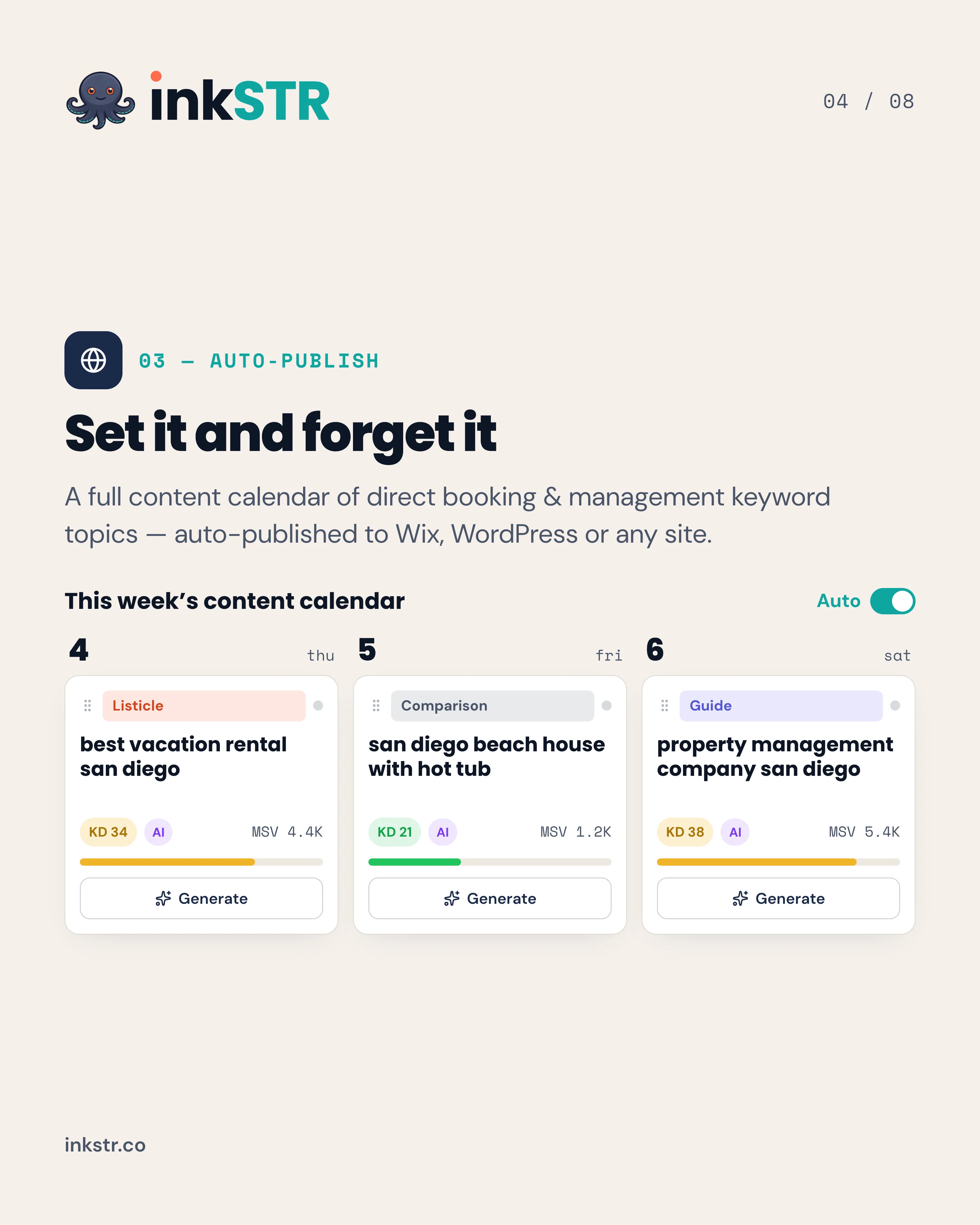
If you want to publish consistently without writing every post yourself, Start Free Trial with inkSTR. It drafts STR-specific articles grounded in your property data, scores them before they go live, and schedules them to publish to Wix or WordPress, so your blog grows while you focus on guests.
Content powered by inkSTR.co
Enjoyed this article? Share it:
Get more of inkSTR in Google Search
Add inkstr.co as a preferred source and our articles show up more in Top Stories, AI Overviews, and AI Mode, with a “Preferred” badge.
Get more guides like this
New SEO and AI-search guides, straight to your inbox. No spam, unsubscribe anytime.