AI Blog Writing Tool: What STR Operators Should Know

An AI blog writing tool is software that generates written content, typically blog posts, using large language models trained to produce structured, readable text from a topic or keyword prompt. For short-term rental operators, the useful version of this tool does more than draft paragraphs: it researches vacation rental search terms, structures posts around traveler intent, and gets the finished article published on schedule.
Key Takeaways
- An AI blog writing tool drafts articles from a keyword or topic prompt, but most standalone tools stop at the draft and leave research, SEO structuring, and publishing to you.
- Writing one quality blog post manually typically takes 3 to 5 hours of research and writing, and a freelance travel writer charges $300 to $700 per post.
- A single direct vacation rental booking is often worth $1,000 to $4,000 in revenue, which is the real ROI benchmark against any content tool's monthly cost.
- A Smoky Mountains cabin rental brand using inkSTR's full content pipeline grew monthly Google Search clicks from 788 to 5,195 in 11 months and attributed $309,775 in direct booking revenue in its first fourteen months.
- Airbnb host and guest fees combined run 17 to 19% of every booking, which is exactly the cost that direct-booking content is designed to reduce.
- inkSTR is built specifically for short-term rental operators, combining AI drafting with keyword research, a content calendar, and one-click publishing so the whole pipeline runs on autopilot, not just the writing step.
If you've searched for an AI blog writing tool, you're probably staring down a content calendar that's been empty since last spring, or a property management website that hasn't published anything new in months. That's a normal place to be. Most STR operators we talk to didn't start out planning to become content marketers. They started out managing guest turnovers, pricing calendars, and maintenance requests, and content got pushed to "someday."
In 2026, the market for generic AI writing software has gotten crowded, and most of it wasn't built with vacation rentals in mind. A tool trained on generic blog topics doesn't know the difference between a "ski-in ski-out cabin" search and a "pet-friendly beach condo" search, and it definitely doesn't know how to structure a post that gets an Airbnb host cited in an AI Overview instead of buried under three property management franchises.
This guide walks through what an AI blog writing tool actually does, where it falls short for short-term rental content specifically, and what a full content pipeline looks like when it's built for this industry instead of retrofitted from a generic template.
What Does an AI Blog Writing Tool Actually Do?
An AI blog writing tool is software that uses a language model to generate blog post drafts from a prompt, keyword, or outline, producing headlines, body paragraphs, and sometimes meta descriptions in a fraction of the time manual writing takes. For a vacation rental business, the practical question isn't whether the tool can write sentences. It's whether those sentences target the searches your future guests, or your future property-owner leads, are actually typing.
Most tools in this category handle drafting well. Fewer handle the steps around drafting: keyword selection, on-page SEO structure, image sourcing, internal linking, and getting the post live on your website. Industry benchmarks show that tools automating only the writing step save roughly 55 to 60% of total blog production time, while platforms that automate the full pipeline, research through publishing, save closer to 80 to 85%. That gap matters a lot if you're managing 20 units and can't spend your afternoon copy-pasting drafts into WordPress.
We built inkSTR around that second number. Drafting is one step in a nine-step process that also includes research, brand voice, SEO structuring, schema, internal links, image handling, and publishing. If your AI blog writing tool only covers the first step, you're still doing eight more manually, every single week.
How Much Time Does Writing a Vacation Rental Blog Post Really Take?
Writing one quality blog post manually typically takes 3 to 5 hours of research and writing, and that estimate assumes you already know your target keywords and have a rough outline in mind. For STR operators juggling guest messages and cleaning schedules, that's an entire evening or a lost Saturday morning, repeated weekly if you want to actually rank.
Multiply that by a portfolio. If you manage 15 cabins across two mountain markets, and each market needs its own local content, you're not looking at one post a week. You're looking at a content calendar that needs to run in parallel across multiple sites, with different keywords, different local landmarks, and different guest personas for each. Most independent hosts and small management companies simply stop trying after the third or fourth post, and the blog goes stale, which search engines notice.
This is precisely the workload we designed inkSTR's content calendar to absorb. Multi-project support means a manager overseeing 15 properties can run 15 parallel content pipelines without duplicating research or writing time for each market separately. Articles get generated, scheduled, and published automatically, so the calendar keeps moving even during your busiest turnover week.
Is It Worth Paying a Freelance Writer for STR Content Instead?
Paying a freelance writer for STR content is worth it only if that writer understands vacation rental search behavior specifically, and even then, freelance travel writers typically charge $300 to $700 per quality blog post, which adds up fast across a full content calendar. At four posts a month, that's $1,200 to $2,800 monthly, before you've published a single article about your actual property.
The math gets worse when you factor in onboarding time. Most freelancers need weeks to understand your brand voice, your local market, and your booking funnel before their content starts converting instead of just filling space. And if that writer moves on to another client, you start the ramp-up all over again with someone new.
We're not against human writers. We think the economics stop making sense at scale, especially compared against inkSTR's pricing starting at $99 per month for a fully automated pipeline that never needs onboarding and never takes a client sabbatical. For a management company running content across five markets, the freelance model simply doesn't scale the way an automated pipeline does.
Can AI Write Content That Actually Ranks for Vacation Rental Keywords?
Yes, AI-generated content can rank for vacation rental keywords, but only when the drafting process is paired with real keyword research and STR-specific search intent, not generic prompts. A 2026 study cited in industry research found that 74.2% of nearly 900,000 newly published web pages already contained AI-generated text, which means the competitive advantage isn't using AI. It's using AI with the right targeting underneath it.
The failure mode we see most often: an operator runs a generic prompt like "write a blog post about my cabin rental," gets back generic travel copy that could describe any cabin anywhere, and publishes it wondering why nothing ranks. Generic content ranks for nothing because it doesn't answer a specific search a specific traveler typed. A post titled "Best Hikes Near [Your Actual Town]" beats "Adventures Await in the Mountains" every time, because the first one matches what someone actually searches.
This is why inkSTR's keyword research feature runs before any drafting happens. The system identifies what your target guests, or in the case of a management company, what property owners considering a switch, are actually searching, then builds the article around that specific intent. For a real example of this working at scale: a five-market luxury mountain rental brand went from averaging 26 monthly Google search visits to 1,924 in four months after publishing 114 keyword-targeted inkSTR articles, with commission-free direct bookings already closing in that window.
What Should a Full AI Content Pipeline Include Beyond Drafting?
A full AI content pipeline for STR content should include keyword research, SEO structuring, image sourcing, internal linking, schema markup, and automated publishing, not just draft generation. Marketing research breaking blog production into nine discrete steps found that tools automating only the writing portion still leave roughly 70 to 75 minutes of manual work per post for the remaining steps: formatting, metadata, images, and getting the piece live on your CMS.
Here's what those remaining steps look like in practice if you're doing them yourself:
- Pulling relevant keywords from a research tool and mapping them to topics.
- Sourcing or generating images and writing SEO-friendly alt text for each.
- Structuring headings, adding internal links to other pages on your site, and checking for broken links.
- Formatting the post for your CMS, adding meta titles and descriptions, and scheduling the publish date.
- Publishing manually, then checking that formatting held up on the live page.
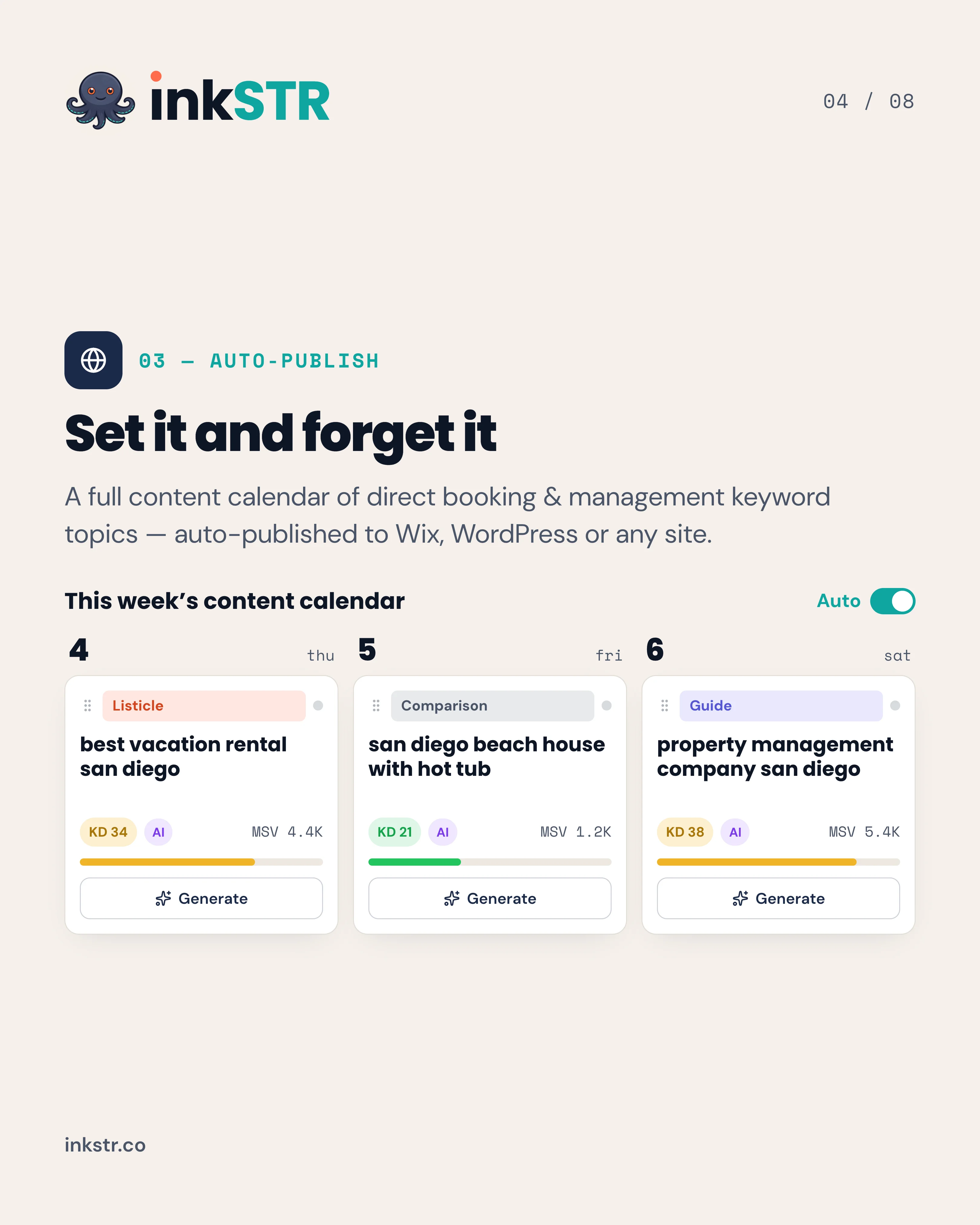
Each step is small on its own. Stacked together across a weekly publishing schedule, they consume most of an afternoon. inkSTR's auto-publishing feature collapses that entire list into one automated step, pushing finished, formatted articles directly to Wix or WordPress without you touching a single upload button. Combined with the built-in image library and internal link management, the draft that comes out the other end is publish-ready, not a starting point for two more hours of formatting work.
How Do You Compare Total Cost Per Published Article, Not Just Subscription Price?
Comparing total cost per published article means adding subscription price to the time cost of every manual step the subscription doesn't cover, and that total is almost always higher than the sticker price suggests. A tool priced at $49 a month that still requires 70 minutes of manual formatting, image sourcing, and publishing per post is not cheaper than a $99 tool that requires closer to 10 minutes of review before it goes live automatically.
Here's a framework for thinking about it honestly:
| Cost Component | Manual / Draft-Only Tool | Full Pipeline Platform |
|---|---|---|
| Subscription or writer fee | Varies by plan; freelancers run $300 to $700 per post | Flat monthly rate covering the full workflow |
| Keyword research time | Manual, often skipped entirely | Automated, built into the pipeline |
| Formatting, images, publishing | Roughly 70 to 75 minutes per post, based on industry benchmarks | Automated end-to-end publishing |
| Multi-property scaling | Time cost multiplies per property | Parallel pipelines per project, no added manual time |
| Revenue potential per ranking article | Same potential, if it ever gets properly optimized and published | A single direct booking is often worth $1,000 to $4,000 |
The bottom row is the one operators underweight. A ranking blog article can drive organic search traffic for 2 to 5 years once it's live and properly structured. That's a multi-year return sitting behind whichever tool actually gets the article published correctly the first time.
What Accuracy Safeguards Should an AI Blog Writing Tool Have?
Accuracy safeguards for an AI blog writing tool should include pre-publish quality scoring, fact verification against real data where possible, and a review step before content goes live, because AI drafts can produce confident-sounding but incorrect details if left unchecked. Industry survey data shows only 7% of marketers publish AI output unedited, while 56% significantly revise or rewrite it, which tells you review isn't optional even with a good tool.
For STR content specifically, the riskiest errors are property details: bedroom counts, amenity lists, distance to attractions, or local regulation claims that go stale. A tool with no verification layer will happily generate a confident paragraph about a hot tub your property doesn't have.
That's why inkSTR includes quality scoring and pre-publish validation as a built-in step, not an afterthought. And because the platform integrates with property management data through partners like Hospitable and OwnerRez, articles can be grounded in your actual property details instead of generic placeholders. Reviewing a draft that's already accurate takes minutes. Fact-checking one from scratch takes the better part of an hour.
Ready to automate your content marketing?
inkSTR handles keyword research, content strategy, article writing, and publishing, all on autopilot.
How Do You Choose Between Solo Blogging, Agency Help, and a Content Automation Platform?
Choosing between solo blogging, an agency, and a content automation platform depends mainly on your portfolio size and how much manual oversight you want in the loop. Solo bloggers with time to spare and one or two properties can manage a slower manual cadence. Agencies work for operators with budget to spend but no interest in touching content decisions at all. A content automation platform sits between those two, giving you speed without full detachment from strategy.
A rough decision framework:
- Single independent host, one to three properties: A content automation platform is usually the fastest path to consistent output, since manual writing eats into guest-facing time you don't have to spare.
- Growing management company, 10 to 50+ units: Manual writing doesn't scale across markets. A platform with multi-project pipelines lets each property or market run its own content calendar independently.
- New STR business, first property just listed: Budget matters most here. A platform with guided keyword research removes the need to learn SEO from scratch before publishing your first post.
- Multi-market real estate investor with STR portfolio: Cost per property, not just subscription price, is the deciding factor. A platform that runs parallel pipelines without added per-property labor wins here.
In every one of these scenarios, the deciding factor is whether the tool scales with you or requires layering on something else once you outgrow it. How inkSTR works is designed around that principle: the same platform runs one property or fifteen without changing your workflow.

How Does an AI Blog Writing Tool Help With Direct Bookings Specifically?
An AI blog writing tool helps with direct bookings by capturing search traffic before it ever reaches Airbnb or VRBO, routing readers instead toward your own booking page through targeted content and internal links. Airbnb host and guest fees combined run 17 to 19% of every booking, so every reservation that comes through your own site instead of a listing platform keeps that percentage in your pocket.
The mechanism matters more than the volume of posts. A blog post about local hiking trails that never links back to your booking page is a missed opportunity, not a marketing asset. Content built around direct booking intent needs to funnel readers deliberately, from an educational article toward your availability calendar.
We built inkSTR's internal link management specifically to automate that funnel. Every article routes readers toward primary direct booking CTAs, relevant secondary posts, and outward links that build topical authority, without you manually inserting links post by post. If you want the strategic thinking behind why this funnel structure converts better than generic travel content, our piece on vacation rental booking strategies goes deeper into the psychology behind it. And if you're a property management company evaluating this from a different angle, entirely focused on owner acquisition rather than guest bookings, our property management page covers that use case specifically.
How Does AI Content Get Cited in ChatGPT and Google AI Overviews?
AI content gets cited in tools like ChatGPT and Google AI Overviews when it answers a specific question directly, in a self-contained paragraph, with named entities and verifiable details that the AI system can extract without needing the rest of the page for context. Generic, vague copy rarely gets cited, because there's nothing quotable in it.
This is a newer battlefield than traditional SEO, and most horizontal AI writing tools weren't built with it in mind. AI search citation rewards answer-first structure: a definition or direct answer up top, followed by supporting specifics, rather than a slow narrative build-up. Our guide on ranking in AI search breaks down the specific structural patterns that get STR content cited versus ignored.
inkSTR builds every generated article around this answer-first structure from the draft stage, not as a retrofit. As of September 2026, inkSTR has secured over 1,000 verified AI-search citations for customer content across all live projects, and one management company in the Charlotte and Lake Norman market landed four property-owner leads sourced from AI search within its first month on the platform, with Google impressions running 4.6 times higher than the year prior after three months.
Data & Evidence: What the Numbers Say About AI Content and STR Marketing
The evidence on AI content adoption is no longer ambiguous: it's mainstream, and the differentiator now is targeting and pipeline completeness, not whether you use AI at all. Ahrefs survey data cited in recent research found that 87% of content marketers already use AI to create or assist with content, and HubSpot data found 55% of marketers name content creation as their top AI use case.
For STR specifically, the vacation rental market itself is large enough that content-driven differentiation matters. The global vacation rental market was valued at roughly $115.0 billion in 2026, according to Market Intelo, which means the operators capturing search visibility now are positioning against a genuinely growing pool of travel demand, not a shrinking one.
Across inkSTR's own customer base, we've published over 3,700 articles across all live projects as of September 2026, generating more than 2.4 million Google Search impressions and over 18,000 clicks across connected customer sites in the trailing 90 days alone. Those aren't projections. They're the current production numbers behind the case studies referenced throughout this article.
| Metric | Value | Source / Timeframe |
|---|---|---|
| Content marketers using AI to assist content creation | 87% | Ahrefs survey data |
| Marketers naming content creation as top AI use case | 55% | HubSpot data |
| Global vacation rental market size | $115.0 billion (2026) | Market Intelo |
| inkSTR articles published across all customer projects | 3,700+ | inkSTR platform data, September 2026 |
| inkSTR customer site clicks, trailing 90 days | 18,499 | inkSTR platform data, September 2026 |
What Mistakes Cause AI-Generated STR Content to Underperform?
AI-generated STR content underperforms mainly when it skips keyword research, ignores local specificity, or gets published without any internal linking strategy connecting it back to a booking page. These aren't AI limitations. They're workflow gaps that any drafting tool leaves for you to fill.
The most common mistakes we see repeated across STR portfolios:
- Publishing generic prompts without keyword targeting. A post about "why vacation rentals are great" ranks for nothing specific.
- Treating drafting as the finish line. A published draft without SEO structure, internal links, or schema markup rarely climbs rankings on its own.
- Inconsistent publishing cadence. A burst of five posts followed by three silent months signals inactivity to search engines, and rankings stall as a result.
- No local grounding. Content that could describe any cabin in any state loses to a competitor's post naming actual local trails, restaurants, and attractions.
- Skipping the internal link funnel. Traffic without a path to your booking page is traffic that converts nowhere.
Every one of these is a pipeline problem, not a writing problem, which is exactly why why your vacation rental website is not ranking so often comes down to structure rather than prose quality. If you want a walkthrough of fixing the ranking side specifically, our guide on how to rank your vacation rental website on Google covers it in more depth.
Frequently Asked Questions
What is the best vacation rental SEO tool?
The best vacation rental SEO tool is one built specifically for short-term rental search intent rather than generic business content, since STR searches rely heavily on location, amenities, and traveler-specific language. inkSTR is built specifically for this niche, combining keyword research, drafting, and publishing into one pipeline instead of requiring separate tools for each step.
Can AI write content for my vacation rental business?
Yes, AI can write vacation rental content, and it does so fastest when paired with real keyword research and STR-specific structuring rather than a generic prompt. Content generated without that targeting tends to read as vague travel copy that rarely ranks, while structured, keyword-driven AI content performs comparably to well-researched manual writing.
How long does it take to see SEO results from vacation rental blog content?
Results vary by market competitiveness and publishing consistency, but most operators see meaningful ranking movement within a few months of consistent publishing, not weeks. One five-market luxury rental brand saw monthly Google search visits jump from 26 to 1,924 within four months of consistent, keyword-targeted publishing.
How many blog articles do I need to start ranking for local vacation rental searches?
There's no fixed number, but consistency matters more than any single post count. Portfolios that publish steadily over months, covering a range of local, amenity-specific, and comparison keywords, consistently outrank sites that publish in short bursts and then go quiet for months.
Can I use an AI blog writing tool if I manage more than one property or brand?
Yes, and this is where most standalone AI writers fall short, since they aren't designed for parallel content calendars. inkSTR's multi-project support gives each property or market its own independent content pipeline, so a manager overseeing 15 properties can run 15 calendars simultaneously without duplicating research for each one.
Does AI-generated blog content actually reduce dependence on Airbnb and VRBO?
It can, when the content is structured to funnel readers toward your own booking page rather than simply existing as informational filler. Since Airbnb host and guest fees combined run 17 to 19% per booking, every direct booking a blog funnel generates keeps that percentage that would otherwise go to the platform.
What's the difference between writing content myself and using an AI content automation platform?
Writing manually gives you full creative control but costs 3 to 5 hours per post, which rarely scales past a couple of properties. An automation platform compresses research, drafting, SEO structuring, and publishing into one workflow, trading a small amount of creative control for consistency you can maintain across an entire portfolio.
Do I need existing SEO knowledge to use a content automation platform like inkSTR?
No. inkSTR's keyword research and content strategy features are built to guide the process for operators with no prior SEO background, identifying which terms to target and structuring articles accordingly. You don't need to know how to run a keyword gap analysis; the platform runs that analysis for you.
Conclusion
An AI blog writing tool solves one piece of a much larger content problem. Drafting is the easy part now; industry data shows AI-generated text already makes up the majority of new web content published in 2026. The advantage left on the table is everything around the draft: keyword targeting, publishing consistency, internal linking, and structure built for AI search citation, not just traditional rankings.
For short-term rental operators specifically, that gap is exactly where generic tools fail and niche platforms earn their keep. A tool that understands the difference between a "ski cabin near lifts" search and a "lakefront pet-friendly rental" search will outperform a horizontal writing tool every time, because it's solving the right problem from the start.
If drafting content is only the first of nine steps you're still doing manually, inkSTR handles the other eight too, from keyword research through auto-publishing on Wix or WordPress. Start a free trial with inkSTR and see your first fully-researched, publish-ready article this week.
Content powered by inkSTR.co
Enjoyed this article? Share it:
Get more of inkSTR in Google Search
Add inkstr.co as a preferred source and our articles show up more in Top Stories, AI Overviews, and AI Mode — with a “Preferred” badge.
Get more guides like this
New SEO and AI-search guides, straight to your inbox. No spam, unsubscribe anytime.